Skip to content
RobotWorld
Back to Papers

PAPER DEEP DIVE

灵巧手点云操作

DexPoint: Generalizable Point Cloud Policies for Dexterous Manipulation

DexPoint uses point cloud representations for generalizable dexterous manipulation without CAD models, showing strong sim-to-real transfer.

CMU, UC Berkeley1 min read
中文

DexPoint uses point cloud representations for generalizable dexterous manipulation without CAD models, showing strong sim-to-real transfer.

Related Papers

Pre-training Visual Dexterity in Simulation

Pre-training Visual Dexterity in Simulation

Large-scale pre-training has made robot policy fine-tuning increasingly data-efficient, but this progress has largely been driven by datasets and embodiments built around simple parallel-jaw grippers. Dexterous, multi-fingered hands remain comparatively data-starved because real teleoperation is costly to scale, while human hand video is off-embodiment and requires lossy pose estimation and retargeting. We introduce Simulation Pre-training for Dexterity (SPD), a pre-training framework for dexterous manipulation that uses data entirely collected in simulation. In SPD, humans manipulate virtual objects inside a VR headset, enabling on-embodiment trajectories and robot-free collection. With the help of five operators, we collect 75 hours of multi-task dexterous manipulation over one week, and use it to pre-train a causal transformer on a sequence modeling objective. We study the benefits of simulation pre-training on real-world tasks by fine-tuning on 1-2 hours of physical demonstrations on a 56-DoF bimanual dexterous setup. We find that our approach outperforms training behavior cloning policies from scratch, showing that simulation teleoperation is a viable pre-training source for real-world dexterous manipulation. We perform ablation studies, measuring the benefits of history conditioning and short action chunks for reactive control.

灵巧操作灵巧手预训练Aug 16, 2026
VTAP Gripper: Synergizing Fingertip Sensing and a Visuo-Tactile Active Palm for Dexterous In-Hand Manipulation

VTAP Gripper: Synergizing Fingertip Sensing and a Visuo-Tactile Active Palm for Dexterous In-Hand Manipulation

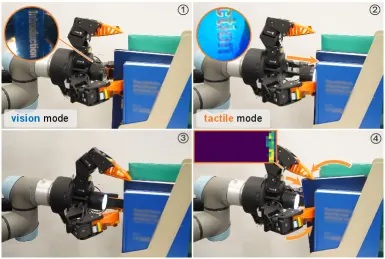
This paper presents a tactile-reactive gripper that integrates a Visuo-Tactile Active Palm (VTAP) and compliant, reconfigurable fingers equipped with tactile array sensors. The design exploits structured finger-palm synergy and multi-modal perception to achieve both robust grasping and fine manipulation. The actuated bi-modal palm seamlessly combines long-range visual localization with contact-rich tactile feedback, substantially extending the system's manipulation capability. To bridge the embodiment gap between human hand motion and the heterogeneous three-finger structure, we further propose a staged, gesture-conditioned retargeting framework for dexterous teleoperation. Extensive experiments validate the system across a range of challenging tasks: reactive grasping of YCB and fragile objects, in-hand syringe reorientation and plunger actuation, singulation of clustered objects down to 3 mm in diameter, and vision-tactile peg-in-hole insertion. Results demonstrate that high manipulation performance can be achieved through coordinated finger-palm interaction and multi-modal sensing, without resorting to high degrees of freedom anthropomorphic designs. The VTAP gripper and its retargeting framework offer a practical reference architecture for dexterous gripper design, manipulation, and contact-rich data collection in support of learning-based approaches. Project webpage: https://yuhochau.github.io/vtap/.

灵巧手触觉传感手内操作Jul 16, 2026
Handroid: Bridging Dexterous Hand and Humanoid

Handroid: Bridging Dexterous Hand and Humanoid

Dexterous hands and humanoid robots are typically developed as distinct embodiments: the former enable contact-rich manipulation at the object scale, whereas the latter provide mobility and whole-body interaction in human-centered environments. We introduce \textbf{Handroid}, a desktop-scale dual-embodiment robot that integrates both capabilities within a single reconfigurable platform. Handroid reuses one 27-DoF electromechanical body as either a dexterous hand or a desktop humanoid, measuring 0.33 m in height and 2.05 kg in weight. In the dexterous hand embodiment, 20 DoFs form an anthropomorphic hand closely matching the kinematic structure of the human hand. In the humanoid embodiment, the same articulated modules are reconfigured into a humanoid with a head, arms, and legs, including a 12-DoF lower-limb structure for locomotion and whole-body motion. Handroid further provides a unified control and learning framework supporting hand teleoperation, dexterous grasping, in-hand manipulation, humanoid locomotion, gait generation, and interactive motion authoring. We validate the platform through real-world dexterous manipulation, reinforcement-learning-based locomotion, keyframe motion deployment, and a long-horizon task involving embodiment reconfiguration, locomotion, docking, and dexterous pick-and-place. These results position Handroid as a compact and reproducible platform for advancing morphology-reconfigurable robotics and cross-embodiment robot learning.

灵巧手dexterous hand人形机器人Jul 17, 2026