PAPER DEEP DIVE
X2-N: A Transformable Wheel-legged Humanoid Robot with Dual-mode Locomotion and Manipulation
Wheel-legged robots combine the efficiency of wheeled locomotion with the versatility of legged systems, enabling rapid traversal over both continuous and discrete terrains. However, conventional designs typically employ fixed wheels as feet and limited degrees of freedom (DoFs) at the hips, resulting in reduced stability and mobility during legged locomotion compared to humanoids with flat feet. In addition, most existing platforms lack a full upper body with arms, which limits their ability to perform dexterous manipulation tasks. In this letter, we present X2-N, a high-DoF transformable robot with dual-mode locomotion and manipulation. X2-N can operate in both humanoid and wheel-legged forms and transform seamlessly between them through joint reconfiguration. We further propose a reinforcement learning (RL)-based whole-body control framework tailored to this morphology, enabling unified control across hybrid locomotion, transformation, and manipulation. We validate X2-N in a range of challenging locomotion and manipulation tasks, including dynamic skating-like motion, stair climbing and package delivery. Results demonstrate high locomotion efficiency, strong terrain adaptability, and stable loco-manipulation performance of X2-N, highlighting its potential for real-world deployment.
X2-N: A Transformable Wheel-legged Humanoid Robot with Dual-mode Locomotion and Manipulation
Paper: X2-N: A Transformable Wheel-legged Humanoid Robot with Dual-mode Locomotion and Manipulation
Authors: Yan Ning, Xingzhou Chen, Delong Li, Hao Zhang, Hanfu Gai, Tongyuan Li, Cheng Zhang, Zhihui Peng, Ling Shi
Institutions: HKUST Department of Electronic and Computer Engineering, Agibot Innovation Company X-lab
Links: arXiv:2604.21541
One-Sentence Summary
X2-N is a high-DoF transformable robot that seamlessly switches between humanoid foot-legged and wheel-legged modes through joint reuse — 13-DoF legs for anthropomorphic walking and stair climbing, 9-DoF for efficient wheeled locomotion — combined with an RL whole-body controller and model-based manipulation controller, achieving skating, stair climbing, and package delivery on a 21-DoF platform.
Background and Motivation
High-DoF agile legged robots have made significant progress in research and industry. Humanoid robots and wheel-legged robots represent two prominent platform directions. Humanoid robots achieve robust dynamic locomotion and dexterous manipulation through high-DoF full-body design. Their bipedal flat-foot structure provides stable standing with minimal ground occupancy, benefiting static manipulation. However, legged locomotion involves frequent body impacts compromising operational stability, and on continuous flat terrains typical of industrial/civil scenarios, legged locomotion is less energy-efficient, slower, and less stable than wheel-legged systems.
Wheel-legged robots integrate wheels into legged systems for improved locomotion efficiency and terrain adaptability, enabling stable operation during smooth wheeled locomotion. However, conventional designs have two key limitations: first, using fixed wheels as feet results in unsteady point-contact constraints during legged locomotion, less stable than humanoid flat feet; second, most systems feature limited-DoF legs and only lower bodies, lacking full upper bodies with arms, restricting manipulation capabilities compared to humanoids.
Existing platforms struggle to simultaneously achieve efficient agile locomotion and stable dexterous manipulation in a unified form. X2-N targets this gap by fusing humanoid flat-foot stability with wheel-legged efficiency on a single platform with a full upper body for dexterous manipulation. The core challenge is the kinematic structure mismatch between humanoid and wheel-legged configurations (different DoFs and contact constraints), with mode transformation typically requiring additional dedicated actuators.
X2-N addresses these challenges through three innovations: joint reuse (relocating the leg yaw joint to the end-effector wheel hub motor for steering, avoiding extra actuators), topology-level reconfiguration (foot-legged 13 DoF to wheel-legged 9 DoF via structural locking), and modular upper body (4-DoF base arm swappable to 7-DoF dexterous arm). The robot weighs ~28 kg, stands 1.1 m tall, with 21 DoFs in foot-legged mode and 17 in wheel-legged mode.
System Design
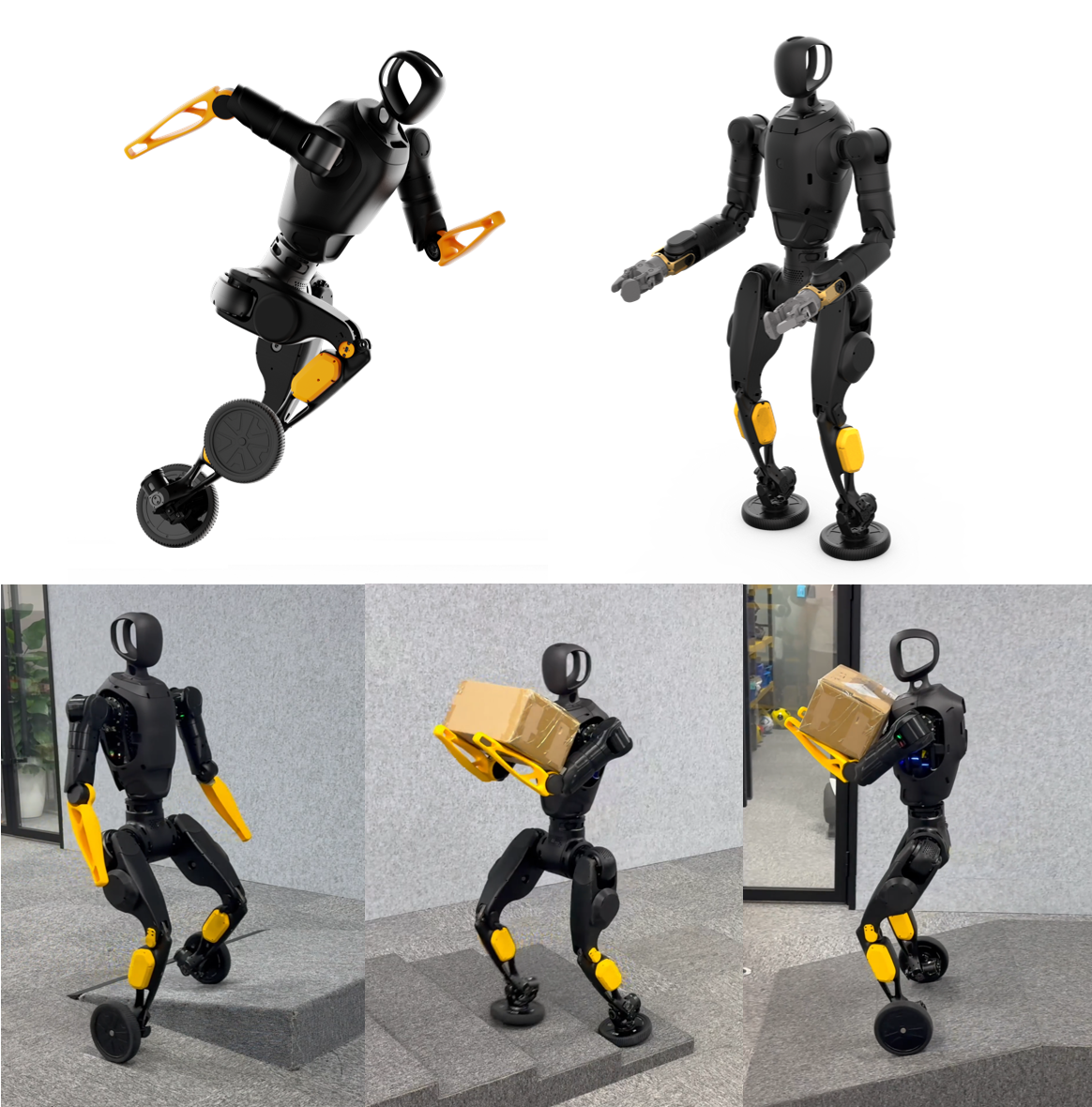
Figure 1: X2-N in dual locomotion modes with 4/7-DoF arms, operating on stairs and slopes.
Two-mode Transformable Leg Design. In foot-legged mode, the lower body has 13 DoFs: 1-DoF waist yaw and two 6-DoF legs. Each leg follows conventional humanoid topology: 3-DoF hip (pitch, roll, yaw), 1-DoF knee (pitch), 2-DoF ankle (pitch, roll). The key departure is relocating the yaw joint — the traditional flat foot is replaced by a wheel with direct-drive hub motor, which is reused as the leg yaw joint. By shifting leg yaw to the end-effector, X2-N integrates wheel-steering motors while preserving humanoid-compatible kinematics.
To improve dynamic performance, knee and ankle pitch actuators are relocated closer to CoM for reduced limb inertia, with four-bar linkage mechanisms for power transmission. In wheel-legged mode, yaw is achieved through wheel-velocity differentiation, eliminating the need for an explicit leg yaw joint. Each leg reconfigures to 4-DoF topology (including wheel steering), with a structural locking mechanism using ankle roll actuator position control to rigidly lock the wheel mount to the calf. Mode transformation is achieved by the ankle roll joint actively driving wheel motor orientation from horizontal foot-contact to vertical wheel-contact. The locking mechanism uses a retaining clip structure with multiple contact interfaces; a sliding slot guides the ankle to the calf during transformation.
Upper Body Design. The arms balance manipulation dexterity and dynamic agility through a modular interchangeable design: base configuration provides 4 DoFs per arm (shoulder 2 + upper arm yaw 1 + elbow 1) with rigid forearm links for efficient motion and load bearing; a swappable 3-DoF wrist module (yaw, roll, pitch) can be installed at the elbow, with linkage mechanisms aligning wrist axes to intersect in space for improved end-effector maneuverability. End-effectors include grippers or dexterous hands. The torso uses a metal-polymer hybrid structure, with front-facing camera, active cooling fans, and wiring through actuator hollow shafts.
| Actuator | Mass (g) | Gear Ratio | Peak Torque (Nm) | Peak Speed (rpm) |
|---|---|---|---|---|
| R90 | 990 | 16 | 120 | 105 |
| R57 | 370 | 40 | 30 | 110 |
| R52 | 360 | 36 | 20 | 130 |
| R52-U | 410 | 72 | 40 | 65 |
Four custom actuators use quasi-direct-drive designs with planetary gear reductions, providing high torque density, low rotor inertia, and near-linear current-torque mapping without dedicated torque sensors. High-load joints (elbow and ankle pitch) decouple motor and gearbox via belt transmission. Cross-roller bearings enable direct structural mounting. Onboard computation uses NanoPi (RK3588), with 10,000 mAh battery providing ~1 hour operation and CAN-fd communication at ~1 kHz.
Control Framework
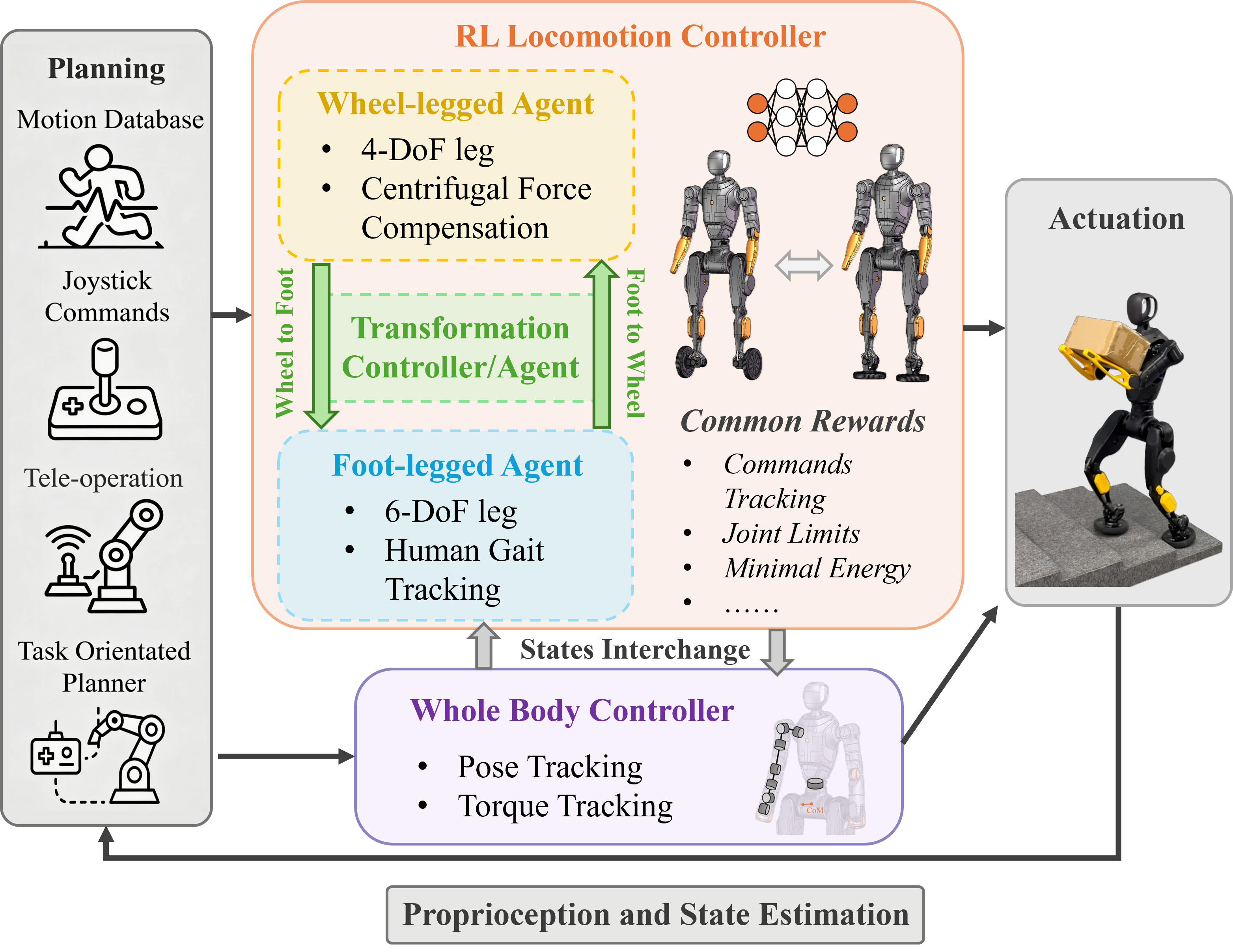
Figure 2: X2-N control architecture. RL locomotion controller (three independent agents) + model-based whole-body manipulation controller, coordinated via shared robot state.
Locomotion Controller. The PPO-based RL controller uses an actor-critic architecture with three independent agents: wheel-legged, foot-legged, and hybrid, switchable by scenario. Policies are trained in Isaac Gym, validated in MuJoCo, then deployed. Low-level actuation uses a torque-position-velocity hybrid controller (MIT policy), with 50 Hz policy inference and 1 kHz state estimation and actuator control.
Wheel-legged Agent with Centrifugal Compensation. X2-N's high-DoF legs, heavy upper body, and elevated CoM make wheel-legged locomotion challenging. To address centrifugal effects during steering, the desired roll angle is computed from forward velocity $v_x$ and yaw rate $\omega_{\text{yaw}}$:
$$\theta^{\text{des}}=\arctan\left(\frac{v_{x}\omega_{\text{yaw}}}{g}\right)$$
The centrifugal compensation reward penalizes deviation of observed lateral acceleration from the desired value:
$$R_{\text{cen}}=-(a_{y}^{\text{obs}}-\min(0.3,\sin\theta^{\text{des}}))^{2}$$
Foot-legged Agent with Human Gait Mimicry. Uses AMP (Adversarial Motion Priors) to learn humanoid gait priors from AMASS human motion capture data. The mimic reward is based on the distance between current and reference joint configurations:
$$R_{\text{mimic}}=\exp(-2\|\mathbf{q}-\mathbf{q}_{\text{ref}}\|)-0.2*\min(\|\mathbf{q}-\mathbf{q}_{\text{ref}}\|,0.5)$$
Hybrid Agent. Combines wheel-legged and foot-legged behaviors for dynamic "skating" (stepping forward with wheel boost) and "space-walking" (stepping forward while moving backward), fully exploiting X2-N's locomotion capabilities.
Transformation Controller. Foot-to-wheel transformation uses precomputed offline joint trajectories, with the ankle rotating in air to transition from foot-contact to wheel-contact. A balance reward stabilizes CoM and pose during transformation:
$$R_{\text{balance}}=k_{1}\exp\left(-\frac{\theta^{2}_{\text{roll}}}{\sigma_{\theta}^{2}}\right)+k_{2}\exp\left(-\frac{\theta^{2}_{\text{pitch}}}{\sigma_{\theta}^{2}}\right)+k_{3}\exp\left(-\frac{\omega^{2}_{\text{roll}}}{\sigma_{\omega}^{2}}\right)+k_{4}\exp\left(-\frac{\omega^{2}_{\text{pitch}}}{\sigma_{\omega}^{2}}\right)$$
flowchart TD
  A[Isaac Gym Training] --> B[PPO Actor-Critic]
  B --> C[Wheel-legged Agent]
  B --> D[Foot-legged Agent + AMP]
  B --> E[Hybrid Agent]
  C --> F[Centrifugal Compensation Reward]
  D --> G[Human Gait Mimicry Reward]
  E --> H[Skating / Space-walking]
  C --> I[Scenario Switching]
  D --> I
  E --> I
  I --> J[Low-level Hybrid Controller 1kHz]
  J --> K[X2-N Hardware]
  L[Task Commands] --> M[Whole-body Manipulation Controller]
  M --> N[Inverse Kinematics + Jacobian]
  N --> O[Newton-Euler Dynamics]
  O --> J
  K --> P[Shared State]
  P --> M
Whole-body Manipulation Controller. A model-based controller adapts to both arm configurations, coordinating with the locomotion controller via shared robot state. Task-driven target poses define position, velocity, and force vectors in Cartesian space. Desired joint positions and velocities are computed via inverse kinematics and the end-effector Jacobian $\mathbf{J_{\text{ee}}}$; joint torques are derived from external forces $\mathbf{F}_{\text{ext}}$ using Newton-Euler equations:
$$\mathbf{M(q)}\mathbf{\ddot{q}}+\mathbf{C(q,\dot{q})}+\mathbf{g(q)}=\mathbf{\tau}+\mathbf{J_{\text{ee}}}^{\top}\mathbf{F}_{\text{ext}}$$
where $\mathbf{M(q)}$ is the mass-inertia matrix, $\mathbf{C(q,\dot{q})}$ represents Coriolis and centrifugal terms, and $\mathbf{g(q)}$ is the gravity term. Derived joint positions, velocities, and torques are executed via a low-level PD controller.
Workspace Analysis
To evaluate the impact of joint reconfiguration in foot-legged mode, X2-N's leg is compared with a conventional humanoid leg (identical thigh and calf lengths). The reachable workspace is sampled using Monte Carlo methods, with volume evaluated via convex hull coverage and voxel grid occupancy. Yoshikawa's manipulability index is computed:
$$\bar{w}=\frac{1}{N}\sum_{k=1}^{N}\sqrt{\det\left(\mathbf{J_{\text{ee}}}(\mathbf{q}_{k})\mathbf{J_{\text{ee}}}^{\top}(\mathbf{q}_{k})\right)}$$
| Metric | X2-N Leg | Normal Leg | Ratio |
|---|---|---|---|
| Volume (voxel) | 0.603 | 0.743 | 81.16% |
| Volume (convex hull) | 1.440 | 1.640 | 87.80% |
| Mean manipulability | 0.0140 | 0.0154 | 90.91% |
| Max manipulability | 0.0302 | 0.0359 | 84.12% |
The reconfigured topology achieves workspace volume and manipulability comparable to a conventional humanoid leg (81-91%), with minimal impact on foot placement in typical locomotion scenarios. This validates that joint reconfiguration preserves high locomotion capability while enabling transformation and wheel integration.
Locomotion Performance and Energy Evaluation
In wheel-legged mode, X2-N traverses small ramps, performs in-place rotations on slopes, descends stairs, and recovers from external pushes, with legs acting as active suspension. The waist joint enables agile omnidirectional locomotion while maintaining upper body orientation. In foot-legged mode, X2-N performs anthropomorphic walking, stair and slope climbing, and push recovery. The hybrid mode achieves "skating" and "space-walking" behaviors.
Energy consumption is calculated by integrating joint power:
$$E_{\text{total}}=\sum_{k=0}^{N-1}\sum_{i=1}^{n}\eta^{-1}\tau_{i}(k)\dot{q}_{i}(k)\Delta t_{k}$$
where $\tau_{i}(k)$ and $\dot{q}_{i}(k)$ are torque and angular velocity of joint $i$ at time step $k$, and $\eta$ is transmission efficiency. Wheel-legged mode consumes significantly less energy than foot-legged mode on flat terrain, validating the dual-mode design's efficiency advantage.
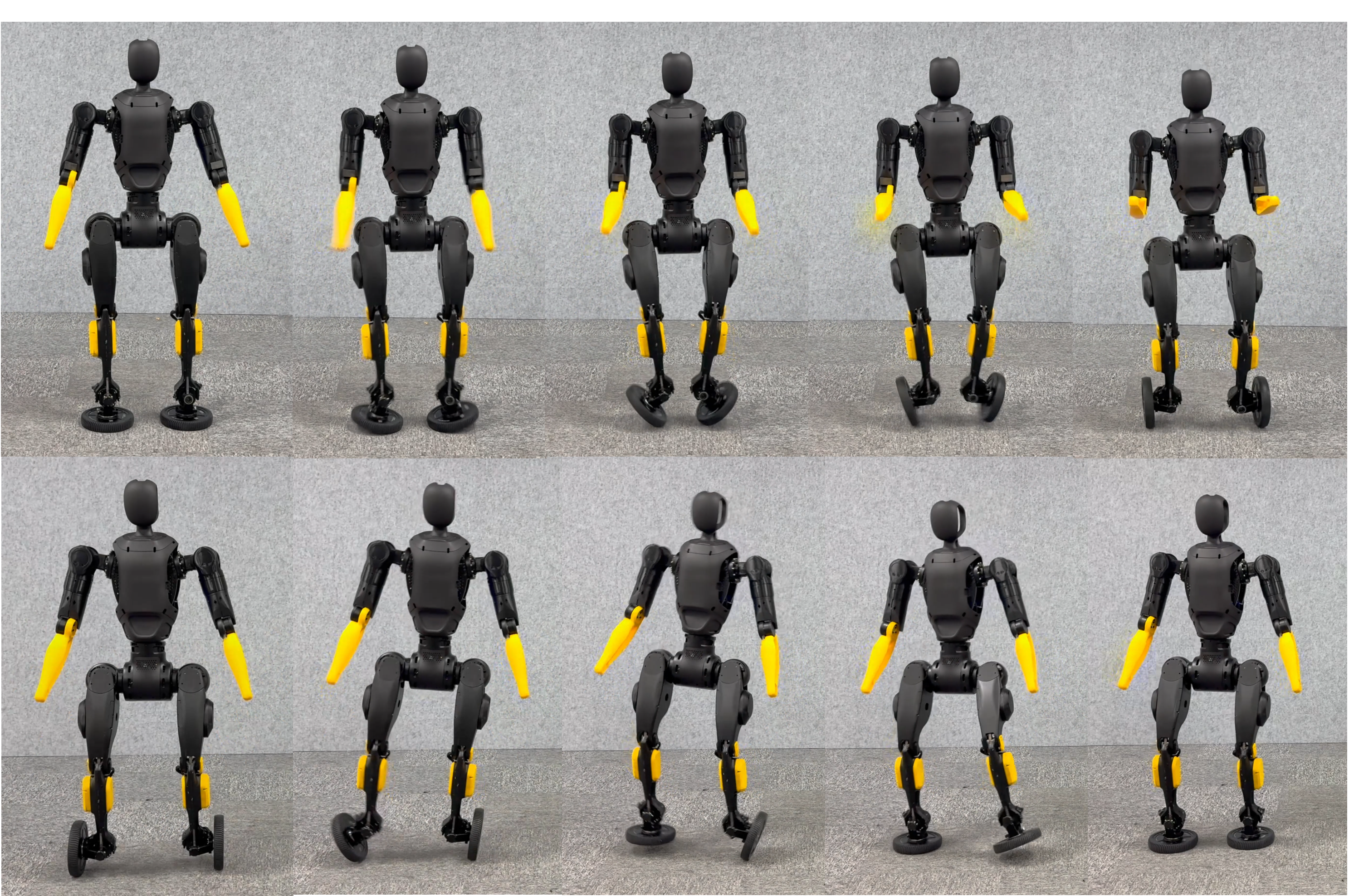
Figure 3: X2-N mode transformation processes. Top: foot-legged to wheel-legged; Bottom: wheel-legged to foot-legged. Achieved by ankle joint actively driving wheel motor orientation change.
Limitations
Workspace reduction. Joint reconfiguration preserves most locomotion capability but reduces workspace volume to 81-91% of a conventional leg, potentially limiting extreme motion range scenarios. Maximum manipulability drops to 84%, indicating reduced dexterity near configuration boundaries.
Transformation stability. The wheel-to-foot transformation involves inherently unstable single-point contact, requiring gradual refinement of transformation duration for smooth balance. The robot is in a transitional configuration during transformation, less robust to disturbances than in stable modes. The impact of upper body payload on transformation stability is not fully evaluated.
Conclusion
X2-N achieves dual-mode locomotion and manipulation on a single platform through three design principles — joint reuse, topology reconfiguration, and structural locking — without additional dedicated actuators. The RL locomotion controller (three agents with centrifugal compensation and gait mimicry) and model-based whole-body manipulation controller coordinate via shared state, achieving skating, stair climbing, and package delivery tasks. Workspace analysis validates the reconfigured topology's comparability to conventional humanoid legs (81-91%), and energy evaluation confirms the dual-mode design's efficiency advantage. The compact 28 kg, 1.1 m, 21-DoF design provides a promising platform for real-world deployment.
SOURCE LINKS