PAPER DEEP DIVE
Scalable Open-Source Visuotactile Sensor for 6-Axis Contact Wrench Estimation in Tensegrity Robots
This paper presents a scalable, open-source visuotactile sensing system for tensegrity robots that enables six-axis wrench estimation and contact detection. The proposed endcap sensor integrates an elastomeric shell, a 3D-printed thermoplastic polyurethane (TPU) interface, and a rigid base housing an embedded camera and LED illumination ring. A novel gyroid-infill bonding technique is introduced to form a durable elastomer-TPU interface without adhesives, yielding a lightweight and modular design compatible with large-scale tensegrity structures. A tactile-to-wrench neural network maps shear vector fields to six-dimensional force and torque measurements. Experimental results demonstrate accurate and stable wrench estimation with a mean squared error (MSE) of 0.1531 on static validation data and out-of-domain generalization under dynamic motion. Furthermore, full-system integration on a 12 kg tensegrity robot confirms the sensor's ability to reliably identify ground contacts. The system substantially improves the practicality of tactile feedback for tensegrity robots, offering a low-cost, reproducible, and physically interpretable pathway toward contact-aware proprioception and state estimation. Open source files are available at \href{https://github.com/Jonathan-Twz/tensegrity-gelfoot}{github.com/Jonathan-Twz/tensegrity-gelfoot}
Scalable Open-Source Visuotactile Sensor for 6-Axis Contact Wrench Estimation in Tensegrity Robots
Paper: Scalable Open-Source Visuotactile Sensor for 6-Axis Contact Wrench Estimation in Tensegrity Robots
Authors: Wenzhe Tong, Jonathan Mi, Xili Yi, Nima Fazeli, Xiaonan Huang (University of Michigan, Robotics Dept.)
Links: arXiv:2607.15633 · Code
One-Line Summary
This paper presents a scalable, open-source visuotactile sensing system for tensegrity robots, featuring an endcap sensor with elastomeric shell + TPU interface + embedded camera for 6-axis wrench estimation and contact detection. A novel gyroid-infill bonding technique eliminates adhesives, a neural network maps shear vector fields to 6D wrench with static validation MSE of 0.1531, and full-system integration on a 12kg tensegrity robot confirms reliable ground contact detection.
Background and Motivation
Tensegrity robots, composed of rigid struts and tensile cables, exhibit exceptional strength-to-weight ratios, impact resilience, and environmental navigation through shape morphing. However, their high DOF and nonlinear dynamics make state estimation challenging. Current proprioceptive methods rely on member-length measurements (resistive/capacitive strain sensors) or encoders+IMUs, while external sensing (ranging, motion capture) is impractical for field deployment.
Core gap: Lack of reliable direct ground contact measurement. Contact sensing provides explicit constraints for state estimators — knowing which endcap is anchored transforms a floating-base estimation problem into a more constrained formulation.
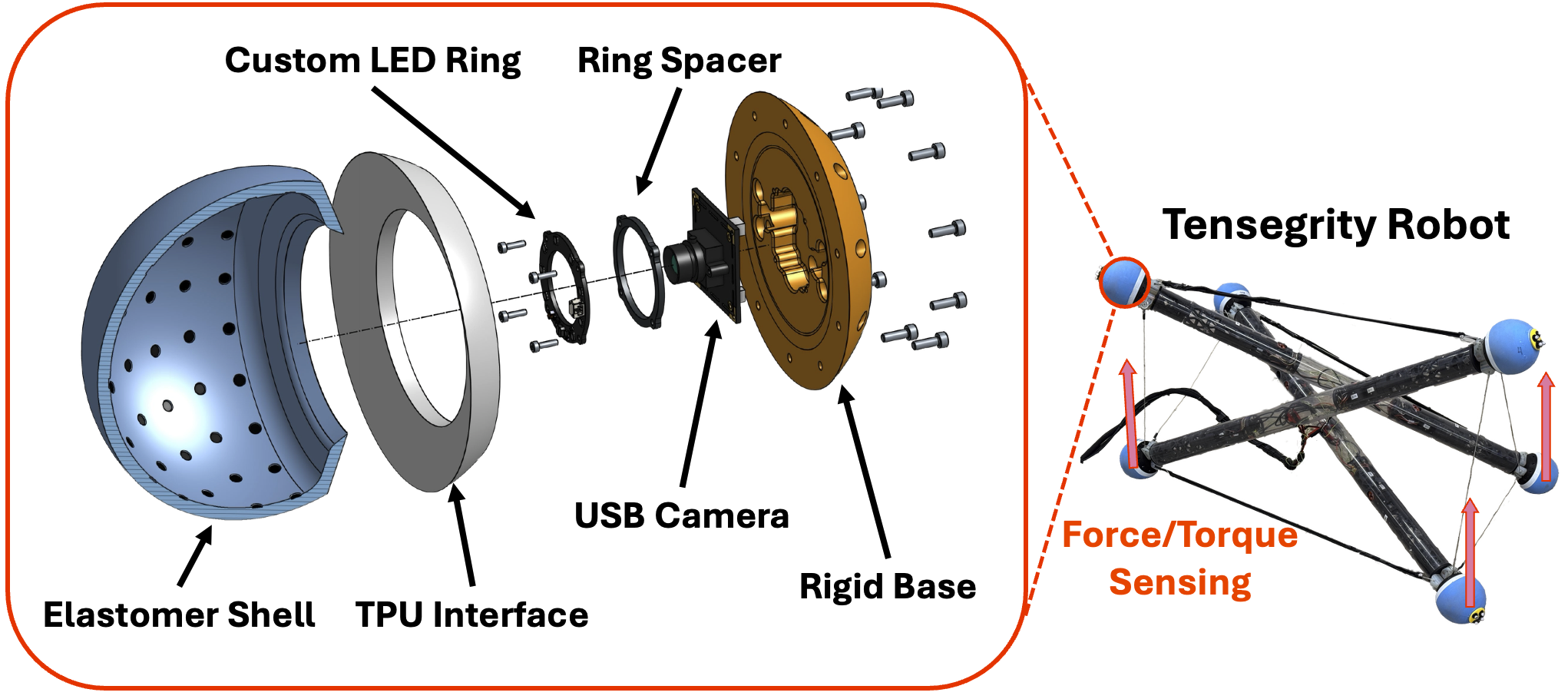
Figure 1: Exploded view of the visuotactile endcap sensor and its integration on a tensegrity robot.
Sensor Design
Mechanical Design
The sensor has a $130\,\mathrm{mm}$ diameter matching meter-scale tensegrity robot endcaps. Five core components: elastomer shell, TPU interface, rigid base, LED ring, and camera. The elastomer shell (Smooth-Sil™ 950, Shore 50A) has shallow dents on its inner surface painted with markers for deformation tracking.
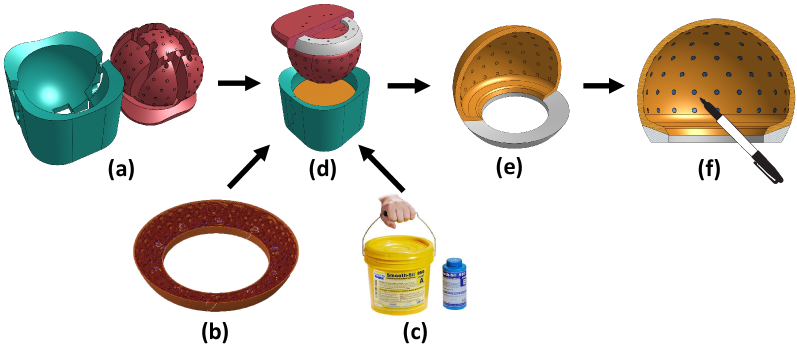
Figure 2: Manufacturing steps — 3D printing mold and TPU interface, elastomer casting, demolding, marker application.
Gyroid-Infill Bonding
A continuous-infill mechanical bonding technique joins the elastomer shell and TPU interface without adhesives. Liquid silicone flows into the open gyroid infill of 3D-printed TPU during casting, creating a mechanical interlock upon curing:
$$ \sigma_{\mathrm{bond}} = \min\left(\sigma_{\mathrm{elastomer}}, \sigma_{\mathrm{TPU}}, \sigma_{\mathrm{interlock}}\right) $$A $10\%$ gyroid infill balances bonding strength and flexibility. Tensile testing shows mechanical bonding provides $\sim 25\%$ higher tensile strength than Sil-Poxy adhesive, and $\sim 300\%$ higher peel strength.
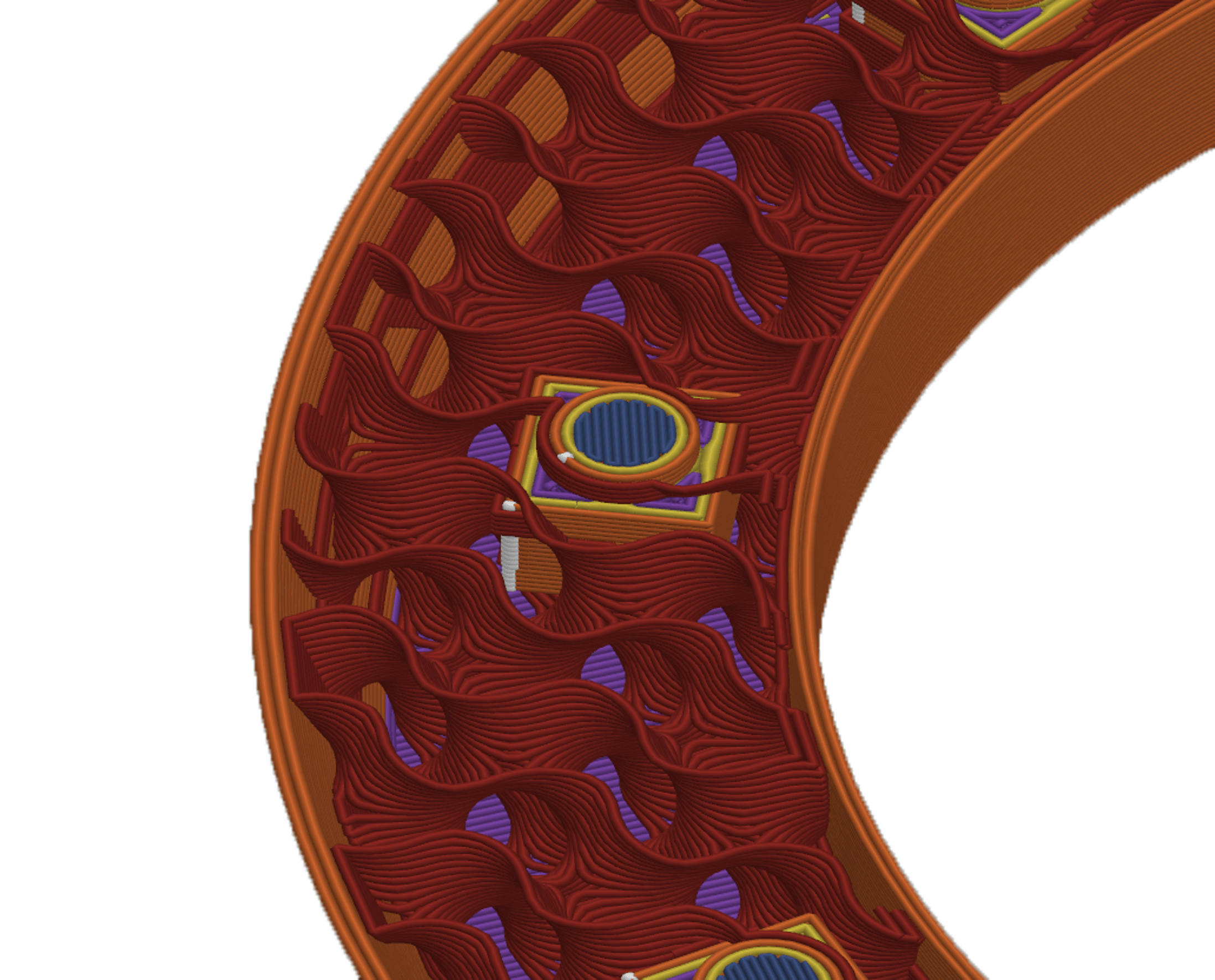
Figure 3: Gyroid infill cross-section — slicer software view and real elastomer-TPU bonded sample.
Electrical Design
The LED ring (PCBA) provides uniform illumination, powered via the camera's 5V output with a boost converter (TPS61165) raising to $25\,\mathrm{V}$, at $\sim 86\%$ efficiency, drawing under $130\,\mathrm{mA}$. The onboard camera (OV2710) has a $180°$ fisheye lens.
Contact Sensing Method
A tactile-to-wrench neural network maps a dense gel-foot vector field to 6D contact wrench. Input: two-channel shear vector field $\mathbf{V} \in \mathbb{R}^{2 \times H \times W}$; target: wrench $\mathbf{w} = [F_x, F_y, F_z, T_x, T_y, T_z]^\top \in \mathbb{R}^6$:
$$ \mathbf{w} = f_\theta(\mathbf{V}) + \mathbf{w}_{\mathrm{bias}} $$where $f_\theta$ is a residual MLP. Shear fields are computed via GelSlim 4.0 optical flow, sized $(2, 30, 30)$.
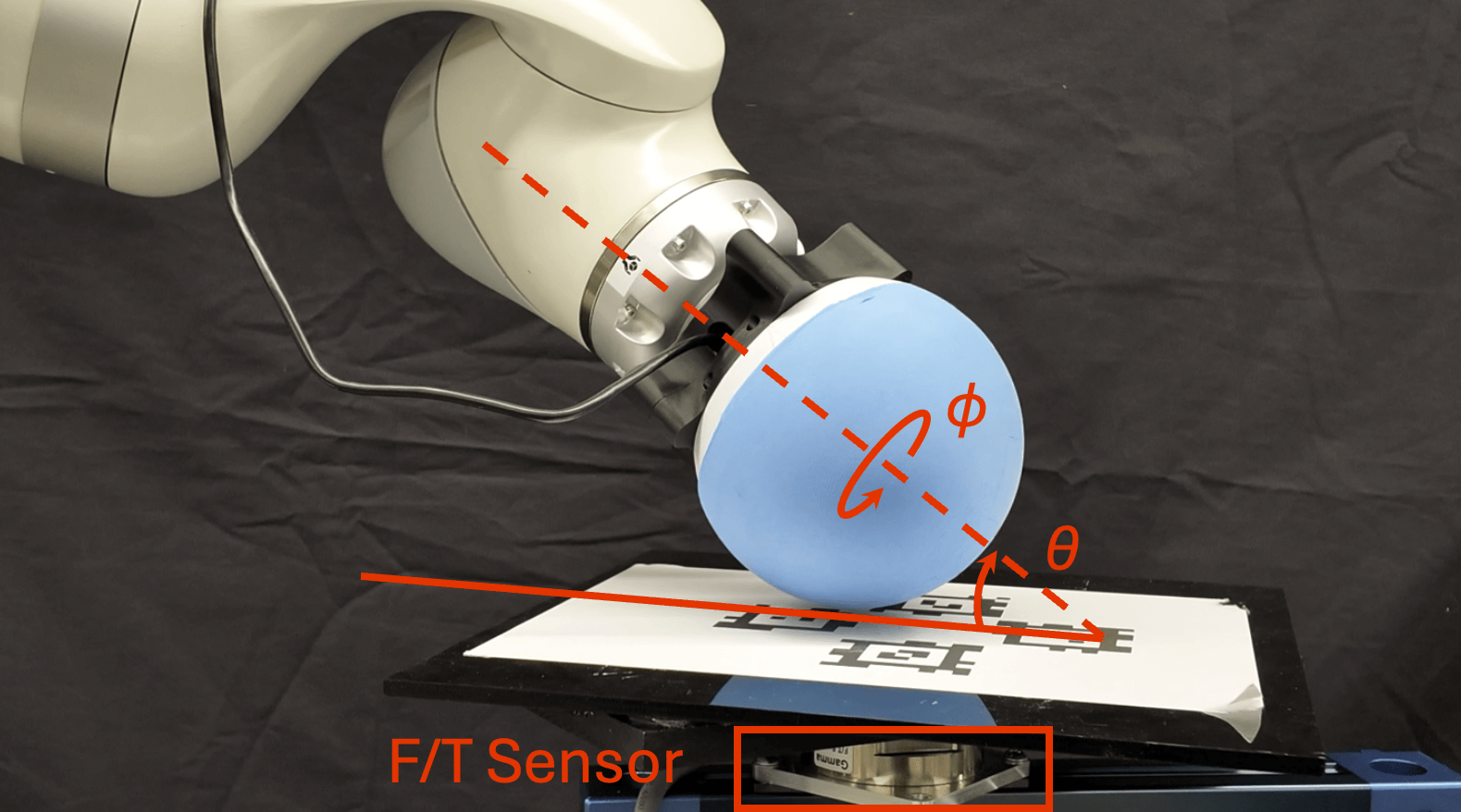
Figure 4: Endcap camera image and corresponding $18 \times 18$ shear field during contact near the lower edge.
Data collection uses a KUKA Med R820 with ATI Gamma 6-axis F/T sensor. Approach orientation parameterized by tilt $\theta$ and twist $\phi$:
$$ \theta \in \{10°, 20°, 30°, 40°, 50°\}, \quad \phi \in \{0°, 45°, 90°, \ldots, 315°\} $$At each $(\theta, \phi)$, normal force setpoints spanning $[5, 35]\,\mathrm{N}$ are applied, followed by circular motions. Final dataset: $34{,}368$ labeled samples.
Contact detection derives a binary indicator from predicted wrench:
$$ c_t = \mathbb{1}\left[\|\mathbf{F}_t\| > \tau\right], \quad \tau = 2\,\mathrm{N} $$
flowchart LR
    A["Endcap Camera
640×480 RGB"] --> B["Crop + Downsample
200×200"]
    B --> C["Optical Flow Shear Field
GelSlim 4.0"]
    C --> D["2-channel Shear Field V
2×30×30"]
    D --> E["Residual MLP f_θ"]
    E --> F["6D Wrench Prediction w
Fx,Fy,Fz,Tx,Ty,Tz"]
    F --> G["Contact Detection
||F|| > τ"]
    style E fill:#e1f5fe
    style G fill:#e8f5e9
Results
Static Wrench Validation
MSE on validation set:
$$ \mathrm{MSE} = \frac{1}{N}\sum_{i=1}^{N}\|\mathbf{w}_i - \hat{\mathbf{w}}_i\|^2 = 0.1531 $$Training MSE: $0.1314$, test: $0.1513$, validation: $0.1531$ — close to training loss, indicating no strong overfitting.
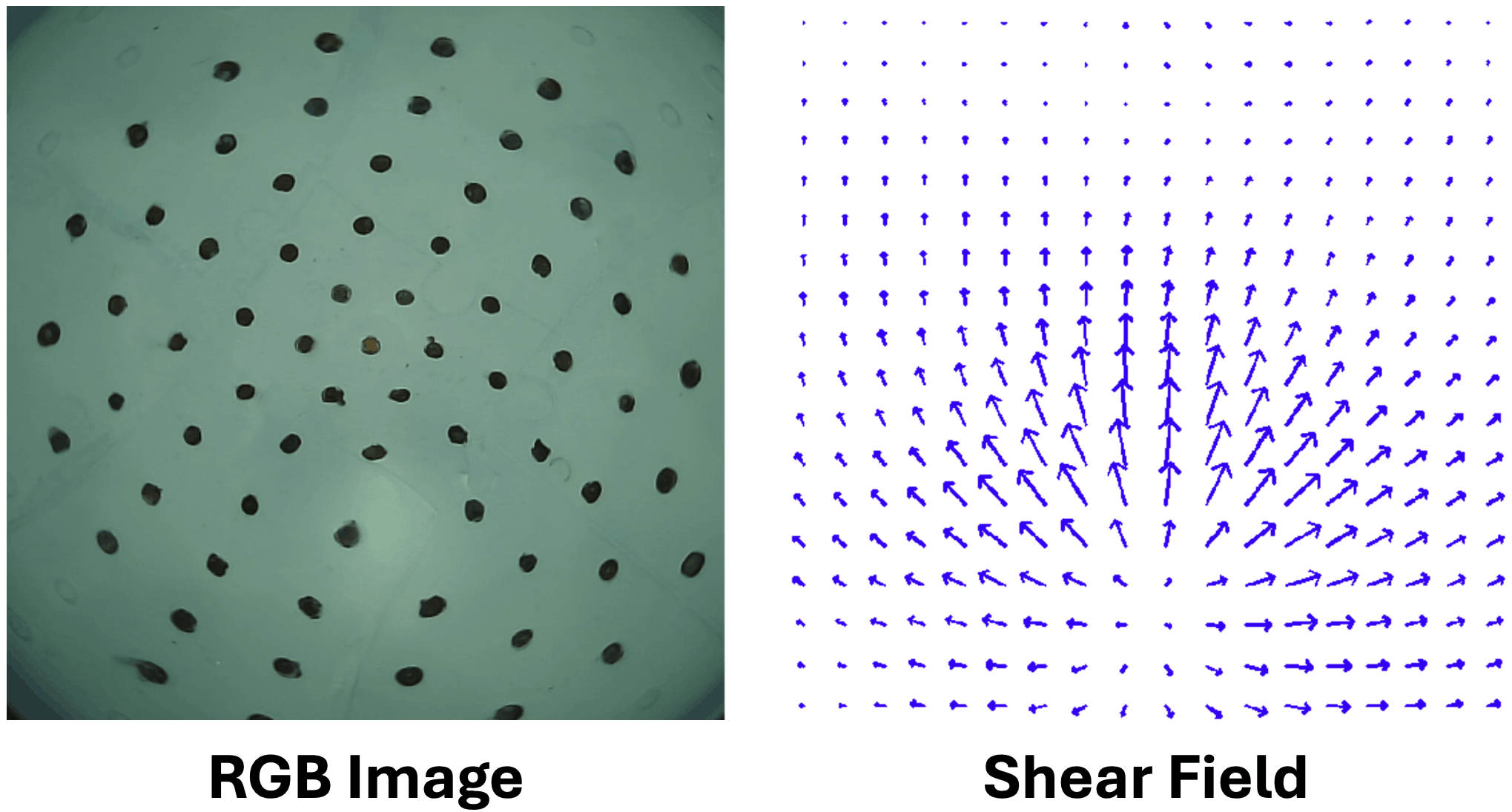
Figure 5: Sensor data — camera image and corresponding shear field.
| Dataset | MSE | Notes |
|---|---|---|
| Training | 0.1314 | Static contact training data |
| Test | 0.1513 | Static contact test data |
| Validation | 0.1531 | Static contact validation data |
| Dynamic (OOD) | 2.67 | Circular trajectory dynamic motion |
| Test Type | Mechanical Bond | Sil-Poxy | Improvement |
|---|---|---|---|
| Tensile Strength | Baseline | 25% lower | +25% |
| Peel Strength | Baseline | 300% lower | +300% |
Tensegrity Robot Testing
Six visuotactile endcaps were integrated onto a $12.0\,\mathrm{kg}$ three-bar tensegrity robot, evaluating real-time ground reaction force estimation and contact event detection across four configurations. The sensor reliably identified ground contacts.
Limitations
- Dynamic performance: Dynamic (out-of-domain) MSE is $2.67$, far higher than static $0.1531$, due to finite camera frame rate, shear-field processing latency, and lack of temporal history in the residual MLP. Torque estimation shows higher variability and phase lag during sliding contact.
- Torque precision: Torque prediction is more sensitive to small spatial errors in the shear field, especially near gel boundaries where optical distortion and illumination nonuniformity introduce local biases. Future versions should incorporate higher-frame-rate imaging, timestamp compensation, and temporal models.
Conclusion
This paper presents a scalable, open-source visuotactile sensing system for tensegrity robots. The gyroid-infill bonding technique achieves adhesive-free durable elastomer-TPU interfaces, and the neural network maps shear fields to 6D wrench with static MSE of $0.1531$. Full-system integration on a $12\,\mathrm{kg}$ tensegrity robot confirms reliable ground contact detection, providing a low-cost, reproducible, physically interpretable pathway toward contact-aware proprioception and state estimation.
Key insight: "Knowing which endcap is anchored to the ground can transform a floating-base estimation problem into a more constrained formulation" — contact sensing not only provides wrench measurements but fundamentally simplifies tensegrity robot state estimation through geometric constraints.