PAPER DEEP DIVE
EA-Nav: Learning Safe Visual Navigation Policies with Embodiment Awareness
Cross-embodiment navigation is a key challenge in embodied intelligence. Due to differences in embodiment, the same visual observation may imply different actions for different agents, making prediction ambiguous when relying solely on vision. Existing studies mainly rely on reinforcement learning, which requires large-scale interaction and careful reward design, making it difficult to support scalable pretraining and real-world adaptation. In contrast, imitation-learning-based approaches remain limited. To address these challenges, we propose an imitation-learning-based embodiment-aware navigation framework with a modular multi-stage design. In pretraining, we construct a cross-embodiment navigation dataset from Internet videos and introduce embodiment geometry as conditional tokens to reduce action ambiguity under the same observation. In fine-tuning, we design a multimodal information injection mechanism based on a decoupled architecture. Specifically, we design a trajectory augmentation strategy to generate high-risk samples, which are used to train spatial perception and risk-aware correction separately, thereby explicitly incorporating embodiment geometry for safe navigation. Experimental results show that the proposed method effectively improves navigation performance across different embodiment settings, demonstrating the effectiveness of incorporating embodiment geometry into embodied navigation.
EA-Nav: Learning Safe Visual Navigation Policies with Embodiment Awareness
Paper: EA-Nav: Learning Safe Visual Navigation Policies with Embodiment Awareness | Authors: Jialu Zhang, Yong Du, Xianda Guo et al. | Institutions: Zhejiang Univ. / Wuhan Univ. / Hunan Univ. / D-Robotics | Link: https://arxiv.org/abs/2607.19880 | Venue: ACM Multimedia 2026
One-Sentence Summary
EA-Nav proposes an IL-based cross-embodiment navigation framework that introduces embodiment geometry as conditional tokens in pretraining and designs decoupled spatial perception and risk-aware correction modules in fine-tuning, enabling the navigation model to predict safer trajectories conditioned on the robot's actual geometric properties.
Background and Motivation
Vision-based navigation is a core component of embodied intelligence, responsible for converting high-level goals into low-level executable trajectories. While significant progress has been made, most existing methods rely solely on visual observations, overlooking the importance of embodiment information—particularly geometry and physical morphology—as a critical modality. Different embodiments vary substantially in size and traversability: cats pass through narrow gaps while cars detour around them. Relying on a single visual modality prevents the model from predicting reliable trajectories conditioned on the robot's actual geometric characteristics.
A straightforward approach to incorporating embodiment information is reinforcement learning (RL), modeling the interaction between embodiment and environment through trial-and-error exploration. However, RL suffers from large exploration space and unstable convergence, requiring imitation learning (IL) to provide a well-initialized pretrained model. This work focuses on how to effectively inject embodiment geometry into the IL stage.
Existing IL-based cross-embodiment navigation methods face two major challenges. First, it is difficult to obtain sufficient training data reflecting how different embodiments interact with the environment. Second, expert demonstrations are typically discretized into waypoint sequences, breaking the mapping between continuous physical action space and the visual environment—when a trajectory changes, it is difficult to determine whether the modified trajectory remains safe.
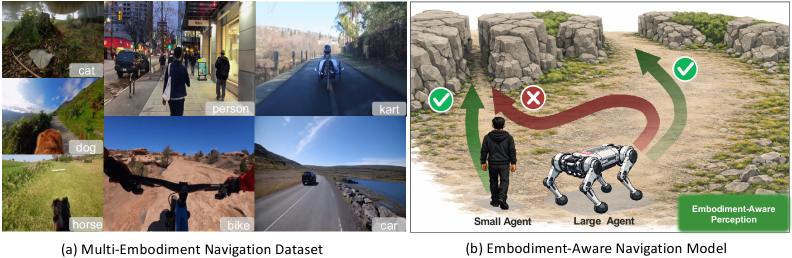
Figure 1: (a) Large-scale first-person videos collected from the Internet across diverse embodiments; (b) Embodiment geometry modality injection mechanism.
Method
Problem Definition and Embodiment Parameters
The embodiment geometry parameter $\mathbf{m} \in \mathbb{R}^4$ is defined as:
$$\mathbf{m} = [L_b, W_b, H_b, P_{\max}]^\top$$
where $L_b$, $W_b$, $H_b$ are the agent's length, width, and height, and $P_{\max}$ is the maximum traversable height. Given an ego-centric target $\mathbf{g} \in \mathbb{R}^2$ and embodiment parameter $\mathbf{m}$, the agent predicts an $H$-step action sequence based on image sequence $I_{t-k:t}$ and current depth $D_t$. Each action is $\mathbf{a}_t = [v_t, w_t]^\top$ with linear velocity $v_t$ and angular velocity $w_t$. The state is:
$$s_t = \{I_{t-k:t}, D_t, \mathbf{g}, \mathbf{m}\}$$
The policy $\pi_\theta(a_{t:t+H} \mid s_t)$ maps the current state to a future action sequence. The basic behavior cloning objective is:
$$\mathcal{L}_{\text{BC}}(\theta) = \mathbb{E}_{(s_t, a_{t:t+H}) \sim \mathcal{D}} \left\| \pi_\theta(s_t) - a_{t:t+H} \right\|_2$$
However, this standard framework is insufficient because the embodiment parameters in the dataset consist of limited discrete values, making it difficult for the model to learn a generalizable mapping from geometric features to action control.
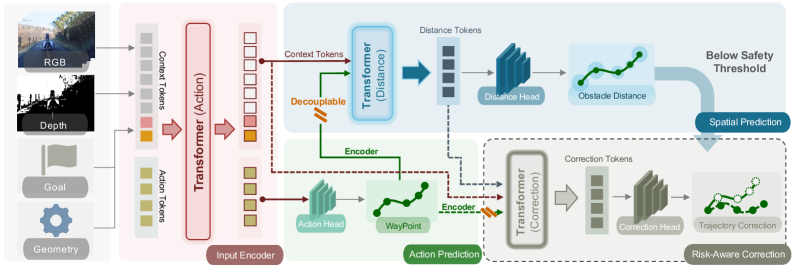
Figure 2: EA-Nav framework overview. Input Encoder, Action Prediction, Spatial Perception, and Risk-Aware Correction modules.
Input Encoder
The Input Encoder encodes multimodal inputs into a shared context feature. The multimodal context representation is:
$$z_{\text{context}} = [z_{\text{rgb}}, z_{\text{depth}}, z_g, z_m] \in \mathbb{R}^{N_c \times 384}$$
where $N_c = 130$ is the total number of context tokens. Unlike prior approaches compressing inputs into only 8-10 tokens, EA-Nav retains more tokens to preserve fine-grained spatial information. A unidirectional cross-attention design prevents the action prediction query from updating the context feature, keeping it focused on observation, goal, and embodiment information.
Spatial Perception Module
This module predicts the nearest-obstacle distance for each waypoint. The prediction process is formulated as:
$$z_{\text{dist}} = \text{Transformer}(z^*_{\text{context}}, \text{MLP}(z_{\text{traj}}))$$
$$\hat{\mathbf{d}} = \text{MLP}(z_{\text{dist}})$$
where $\hat{\mathbf{d}} = [\hat{d}_1, \hat{d}_2, \dots, \hat{d}_H]$ is the predicted nearest-obstacle distance. This module is decoupled from Action Prediction—using a sequential rather than parallel structure, allowing the predicted action sequence to be replaced with augmented high-risk trajectories during training.
Risk-Aware Correction Module
For trajectories identified as high-risk, the correction module predicts a low-dimensional global yaw offset. The correction space within $[-\theta_{\max}, \theta_{\max}]$ is discretized into angle bins ($\theta_{\max} = 45°$, interval $5°$). The module predicts feasibility for each bin:
$$z_{\text{corr}} = \text{Transformer}(z^*_{\text{context}}, z_{\text{dist}}, \text{MLP}(z_{\text{traj}}))$$
$$\mathbf{p}_{\text{corr}} = \sigma(\text{MLP}(z_{\text{corr}}))$$
where $\mathbf{p}_{\text{corr}} \in [0,1]^{\mathcal{B}}$ are feasibility probabilities. At inference, the feasible set $\hat{\mathcal{B}} = \{b \in \mathcal{B} \mid \mathbf{p}_{\text{corr}}(b) > \tau\}$ is obtained, and the bin with smallest deviation is selected: $\Delta\hat{\theta} = \arg\min_{b \in \hat{\mathcal{B}}} |b|$. Multi-hot supervision captures multiple valid recovery directions.
Risk Trajectory Augmentation
Since high-risk trajectories are scarce in real data, a risk trajectory augmentation pipeline is designed. Depth observations are fused into a robot-centric local point cloud map, RANSAC estimates the ground plane, and obstacle regions are inflated based on robot dimensions. The safety coefficient is:
$$s_d = \frac{d_{\min}}{\max(\|\mathbf{w}_H - \mathbf{w}_0\|_2, \epsilon)}$$
where $d_{\min}$ is the minimum obstacle clearance. Waypoints are uniformly scaled: $\tilde{\mathbf{w}}_i = \mathbf{w}_0 + \alpha(\mathbf{w}_i - \mathbf{w}_0)$, with $\alpha$ sampled around $s_d$. Rotations from $-45°$ to $45°$ form a trajectory pool; colliding candidates become risk trajectories, collision-free candidates define feasible correction bins.
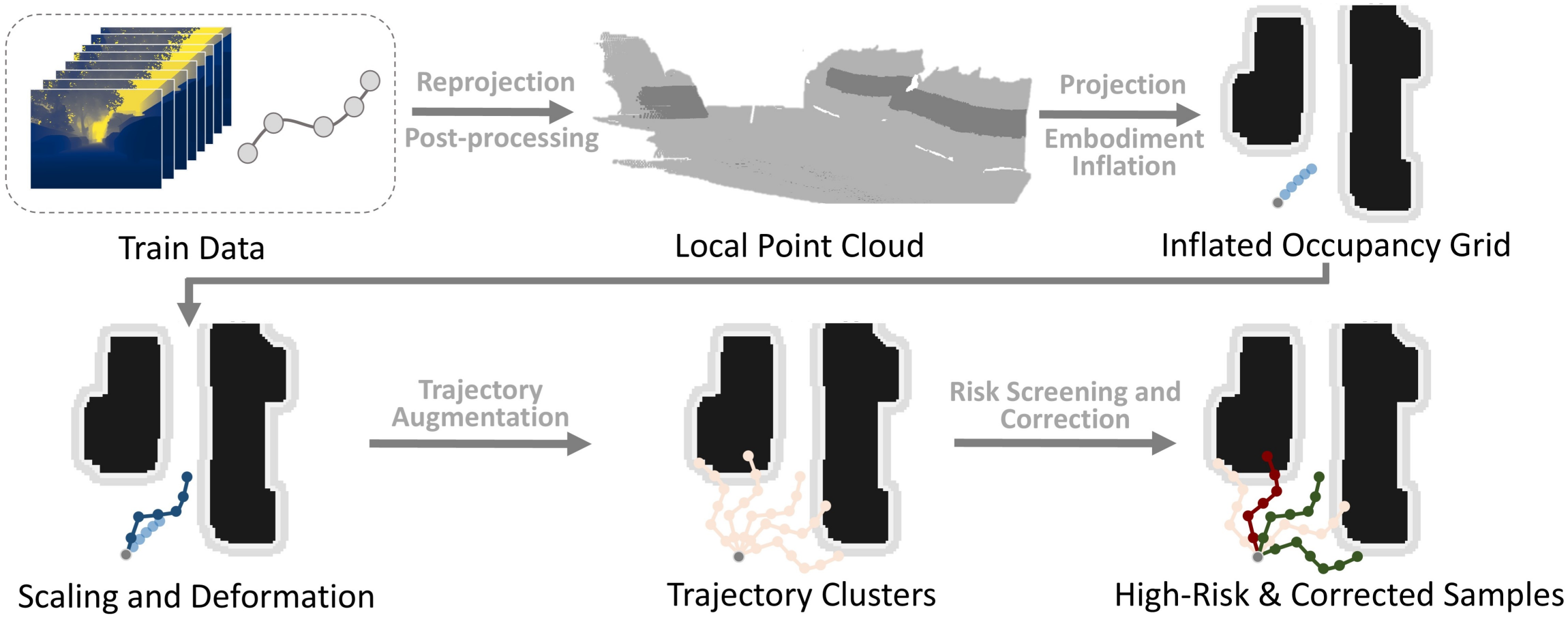
Figure 4: Augmentation pipeline. Light blue: original trajectory; pink: generated cluster; red: collision trajectory; green: traversable trajectory.
flowchart TB
    A["Image seq + Depth + Goal + Embodiment m"] --> B["Input Encoder
unidirectional cross-attention"]
    B --> C["Shared context z_context"]
    C --> D["Action Prediction
predict H-step sequence"]
    D --> E["Trajectory encoding z_traj"]
    C --> F["Spatial Perception
predict nearest obstacle distance"]
    E --> F
    F --> G{"Risk > threshold?"}
    G -->|No| H["Execute directly"]
    G -->|Yes| I["Risk-Aware Correction
predict yaw offset bins"]
    C --> I
    F --> I
    E --> I
    I --> J["Select min-deviation feasible bin"]
    J --> K["Corrected safe trajectory"]
Experimental Results
The pretraining dataset contains approximately 1,000 hours of real-world first-person videos across 8 embodiment categories, using Depth-Anything-3 for consistent observation and trajectory scales. Fine-tuning uses GND, SCAND-Spot, and SiT datasets. Evaluation is conducted on i2Nav and real-world robots (TurtleBot, Unitree Go2).
| Size | TPR↑ (aug) | TPR↑ (no aug) | MAE↓ (aug) | MAE↓ (no aug) |
|---|---|---|---|---|
| Body-S+ | 84.9 | 12.9 | 0.471 | 0.664 |
| Body-S+ | 79.7 | 8.8 | 0.511 | 0.715 |
| Body-M+ | 79.4 | 11.1 | 0.478 | 0.711 |
| Body-M+ | 70.6 | 21.6 | 0.532 | 0.712 |
| Body-L+ | 73.8 | 29.2 | 0.582 | 0.799 |
Table 1: Spatial Perception Performance. Risk augmentation improves high-risk recognition by ~5× with minimal false alarms.
Risk trajectory augmentation improves high-risk and collision sample recognition by approximately 5× with almost no additional false alarms. Different embodiment sizes produce different minimum obstacle distances along the same trajectory, indicating the model captures embodiment-conditioned spatial risk.
| Method | Scene1 SR↑ | Scene2 SR↑ | Scene3 SR↑ | Scene1 SPL↑ | Scene2 SPL↑ |
|---|---|---|---|---|---|
| iPlanner | 0.66 | 0.50 | 0.30 | 0.54 | 0.39 |
| NavDP | 0.73 | 0.60 | 0.56 | 0.63 | 0.52 |
| ExAug* | 0.61 | 0.46 | 0.38 | 0.42 | 0.33 |
| Ours (w/o corr) | 0.62 | 0.45 | 0.43 | 0.51 | 0.35 |
| Ours (w/ corr) | 0.70 | 0.62 | 0.60 | 0.59 | 0.51 |
Table 2: Navigation performance in simulation. Adding perception and correction modules improves average performance by ~31%.
The base model Ours(w/o corr) underperforms NavDP, mainly because training data from real environments is smaller and less diverse than NavDP's large-scale synthetic data, creating a sim-to-real distribution gap. Adding embodiment-aware Spatial Perception and Risk-Aware Correction improves average performance by approximately 31%, with larger gains in more cluttered scenes. In real-world experiments, robots of different sizes exhibit differentiated navigation behaviors—smaller robots tend to navigate through narrow spaces while larger robots prefer more open paths.
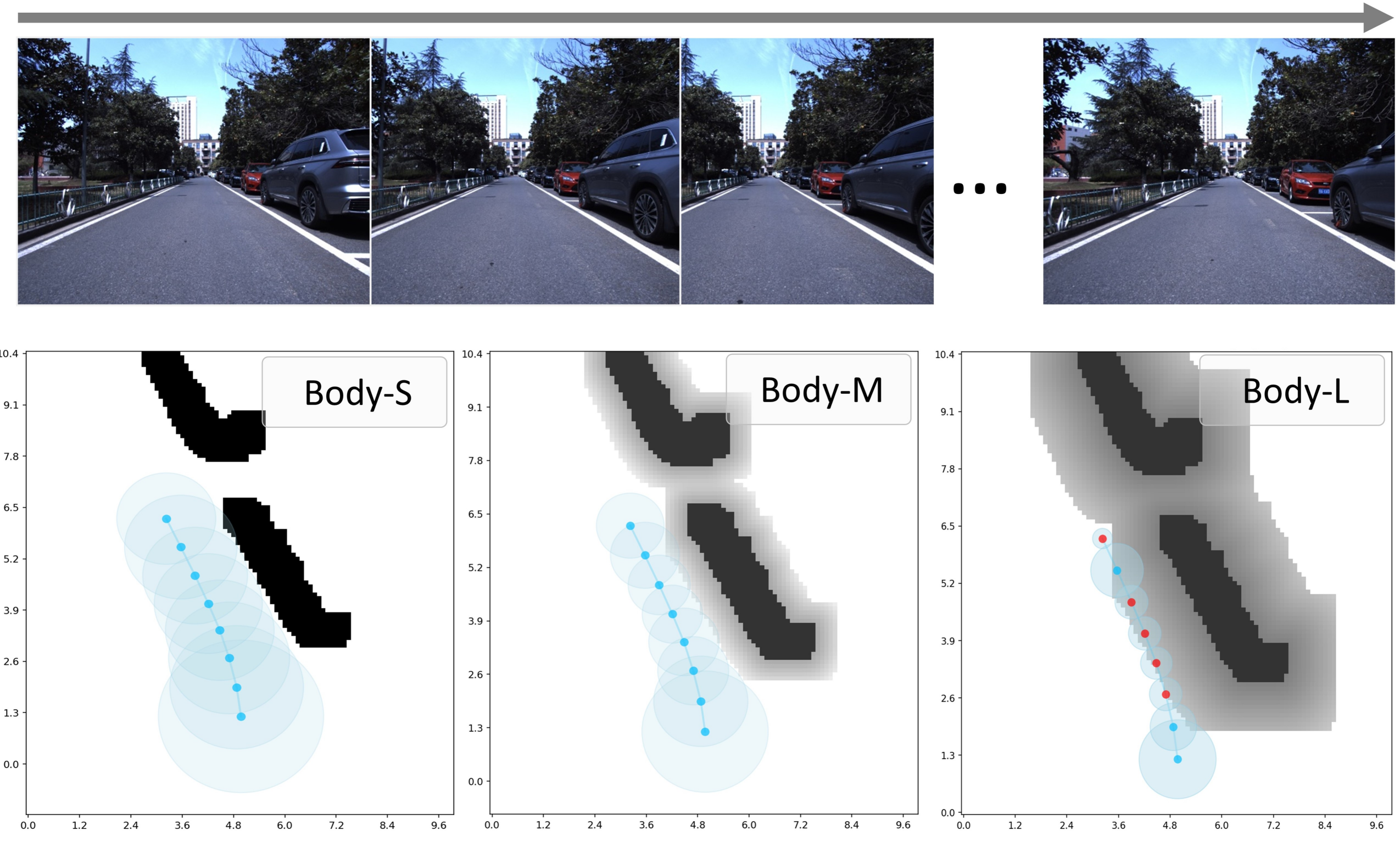
Figure 5: Analysis of embodiment geometry in pretraining. Introducing embodiment geometry consistently improves training loss, validation loss, and test SR.
Limitations
- Limited long-range correction capability: Under small-embodiment settings, obstacles are relatively farther away, making correction more dependent on long-range correction ability where the current model remains limited. The authors note "correction becomes more dependent on far-range correction ability, where the current model remains limited."
- Insufficient training data scale and diversity: The base model underperforms NavDP because training data from real environments is smaller and less diverse than large-scale synthetic data, creating a sim-to-real distribution gap.
- Discretized correction space precision: Risk-aware correction discretizes the correction space into 5° intervals, which may not capture fine-grained optimal correction angles, especially in high-risk scenarios with narrow feasible intervals.
Conclusion and Outlook
EA-Nav demonstrates the effectiveness of explicitly modeling embodiment geometry within the IL framework for cross-embodiment navigation. The two-stage injection strategy—conditional tokens in pretraining, explicit integration through decoupled architecture in fine-tuning—enables the model to make differentiated navigation decisions based on robot geometry. The risk trajectory augmentation strategy addresses the scarcity of high-risk samples, allowing spatial perception and risk correction modules to learn effectively from limited fine-tuning data. The 31% average performance improvement shows that embodiment conditions and task-specific inductive biases can effectively compensate for limited training data.
This work provides a scalable IL solution for cross-embodiment navigation, and the approach of constructing heterogeneous datasets from Internet videos offers a new avenue for large-scale pretraining. Future work can explore finer continuous correction space modeling and larger-scale cross-embodiment datasets.
Golden insight: The same corridor is a path for a cat and a dead end for a car—navigation safety depends not on what you see, but on who you are. EA-Nav lets the navigation model truly "know its own body size" for the first time.
SOURCE LINKS