PAPER DEEP DIVE
TRW: TRACE-RealWorld---An Auditable Consistency Contract for World Models as Materialized Views
TRACE-RealWorld addresses a core data-management problem: maintaining an actionable materialized view over a continuously changing physical world when reads of the base state are priced, delayed, heterogeneous, and fallible. Its data-management contributions are a commitment-level validity abstraction for materialized predictions; consequence-conditioned adaptive view maintenance; transaction-style, dependency-scoped compensation for commitments invalidated after authorization; and append-only provenance supporting exact replay. The work builds directly on materialized-view maintenance, adaptive stream synchronization, transaction recovery, sagas, data freshness, and provenance. The end-to-end Flood-SAR evaluation treats sensing as physical data acquisition and measures freshness, verification cost, stale reads, recovery scope, restoration failure, and replayability through six pre-registered questions with held-out seeds. The contribution is therefore not a new predictive model, but a consistency, recovery, and accountability contract for deploying learned world representations as operational data systems.
TRACE-RealWorld: An Auditable Consistency Contract for World Models as Materialized Views
Paper: TRW: TRACE-RealWorld—An Auditable Consistency Contract for World Models as Materialized Views
Author: Edward Y. Chang
Affiliation: Stanford University
Links: arXiv:2607.21910
One-Sentence Summary
TRACE-RealWorld treats world-model predicted state as a materialized view over the physical world, proposing the first commitment-level consistency contract — with typed calibrated claims specifying consequence-conditioned freshness and priced verification, adaptive refresh that consults the world when evidence could change a decision, and dependency-scoped Saga compensation repairing reversible commitments invalidated after authorization — proving that synchronization and compensation are each insufficient alone but their composition bounds expected violations under explicit assumptions, reducing stale execution to auditable levels in the Flood-SAR search-and-rescue simulation.
Background and Motivation
World models let agents plan against a predicted physical state, but that state drifts as the world changes; re-observation is costly and delayed, and repair can fail. The core data-management problem: maintaining an actionable materialized view over a continuously changing physical world when reads of the base state are priced, delayed, heterogeneous, and fallible.
Existing work divides into several lines: synchronizing numerical replicas (classical replication), event-triggered control (state-dependent communication), uncertainty propagation (ensemble epistemic uncertainty), and action verification (pre-execution checks). But no work binds these functions at the commitment level — where semantic freshness, consequence, channel choice, transactional repair, and replayable provenance form one consistency contract.
TRACE-RealWorld's core insight is to treat the world-model predicted state as a database materialized view: between observations it is incrementally maintained via a motion model (prediction), and partially refreshed upon observation (conditioning). A physical commitment is a "read" that authorizes a durable action over a time horizon, and its authorization can expire. This makes the freshness-safety problem of agentic world models a view-maintenance problem with two properties not jointly represented in classical caching: refreshes are priced physical acts with channel choice, and maintenance decisions must themselves be auditable.
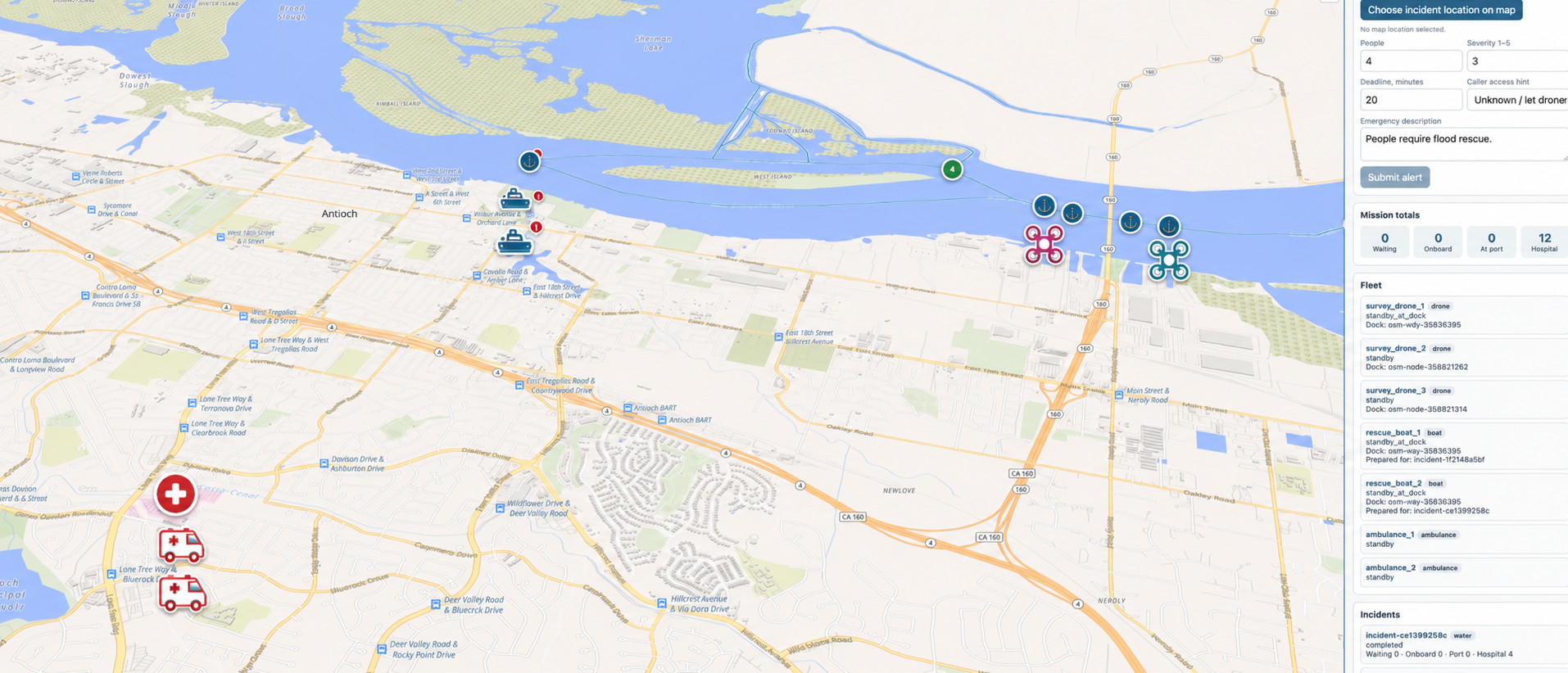 Figure 1: The six-layer Flood-SAR architecture. Every arrow crossing into or out of the world view is an auditable TRACE record.
TRACE-RealWorld Contract Definitions
1. World View and Commitment Read
Let $S_t$ be the physical world state at time $t$, observable only through priced channels $\mathcal{C}=\{1,\ldots,m\}$, where channel $j$ returns $y \sim p_j(\cdot|S_t)$ at cost $c_j$. A world view is a belief $b_t$ over $S_t$ maintained by a predictor: between observations $b_{t+1} = f(b_t, a_t)$ advances the view without reading the base; an observation $y_t$ through any channel conditions the view. A commitment is a read against the view that authorizes a durable action over horizon $[t, t+h]$.
2. Refresh Condition
A refresh condition is a triple $\rho = (\omega, \theta, \mathcal{C}_\rho)$: a declared observable $\omega$, a tolerance $\theta$, and a channel menu $\mathcal{C}_\rho \subseteq \mathcal{C}$. The condition fires when the declared discrepancy $d_\omega$ between predicted and observed evidence exceeds $\theta$:
$$ \rho = (\omega, \theta, \mathcal{C}_\rho),\quad \text{fires when } d_{\omega}(\hat{y}, y) > \theta $$The discrepancy is type-specific: for numerical observables $d_\omega(u,v) = |u-v|$ (absolute error); for categorical/semantic claims $d_\omega(u,v) = \mathbf{1}[u \neq v]$ (any $\theta < 1$ fires on disagreement).
3. Decision Margin
Refresh relevance is a property of the pending decision, not of signal variance alone. The decision margin is the expected-loss gap between the chosen action and its best alternative:
$$ m(b) = \min_{a' \neq a^*_b} \mathbb{E}_{s \sim b}[L(a', s)] - \mathbb{E}_{s \sim b}[L(a^*_b, s)] $$The set of beliefs where the margin vanishes is the boundary at which the optimal commitment switches. Polling the sensor is justified only when an observation could move the belief across this boundary — the quantity maintained is the justification of a commitment, and signal refresh is only its means.
4. Stale Event and Irreversible Commitments
An irreversible commitment's declared tolerance is boundary-anchored: the claim asserts the state lies on the safe side of the action's decision boundary at observed distance $d$. Its stale event is the one-sided terminal exceedance toward the boundary:
$$ p_\delta = \Phi\!\left(\frac{-d}{\sigma\sqrt{\delta}}\right) > 0 $$where $\delta$ is the minimum observation latency, $\sigma$ is the state drift standard deviation, and $\Phi$ is the standard normal CDF. This matches the gate's flip-risk semantics.
Theory: Digital-Physical Consistency
The paper proves that synchronization (refresh) and compensation (repair) are each insufficient, but their composition bounds expected violations under explicit measurable assumptions.
Theorem 1 (Insufficiency of synchronization): For a substate following $dx_t = \sigma\,dW_t$, with every observation channel having cost at least $c_{\min} > 0$ and latency at least $\delta > 0$, for a commitment with observed boundary distance $d > 0$, any refresh-only policy's conditional stale-execution probability is bounded below by:
$$ \Pr(\text{stale} \mid \mathcal{F}^{\text{obs}}_{t_e}) \geq \Phi\!\left(\frac{-d}{\sigma\sqrt{\delta}}\right) = p_\delta > 0 $$regardless of expenditure. In the zero-latency most favorable case, the minimum cost to reduce stale probability to $p$ is:
$$ C_{\min}(p) = \frac{c_{\min} \, H \, \sigma^{2} \, z_{p}^{2}}{d^{2}}, \quad z_p = \Phi^{-1}(1-p), \quad \lim_{p \to 0} C_{\min}(p) = +\infty $$where $H$ is the service time horizon. No refresh-only policy can drive stale-execution probability to zero at bounded observation cost.
Theorem 2 (Insufficiency of compensation): Post-hoc compensation cannot undo an already-executed irreversible action — repair is after the fact and cannot reverse physical consequences already caused.
Theorem 3 (Composition): Synchronization prevents detectable violations, compensation repairs violations that slip through synchronization, and their composition bounds expected violations under assumptions $A1$-$A6$.
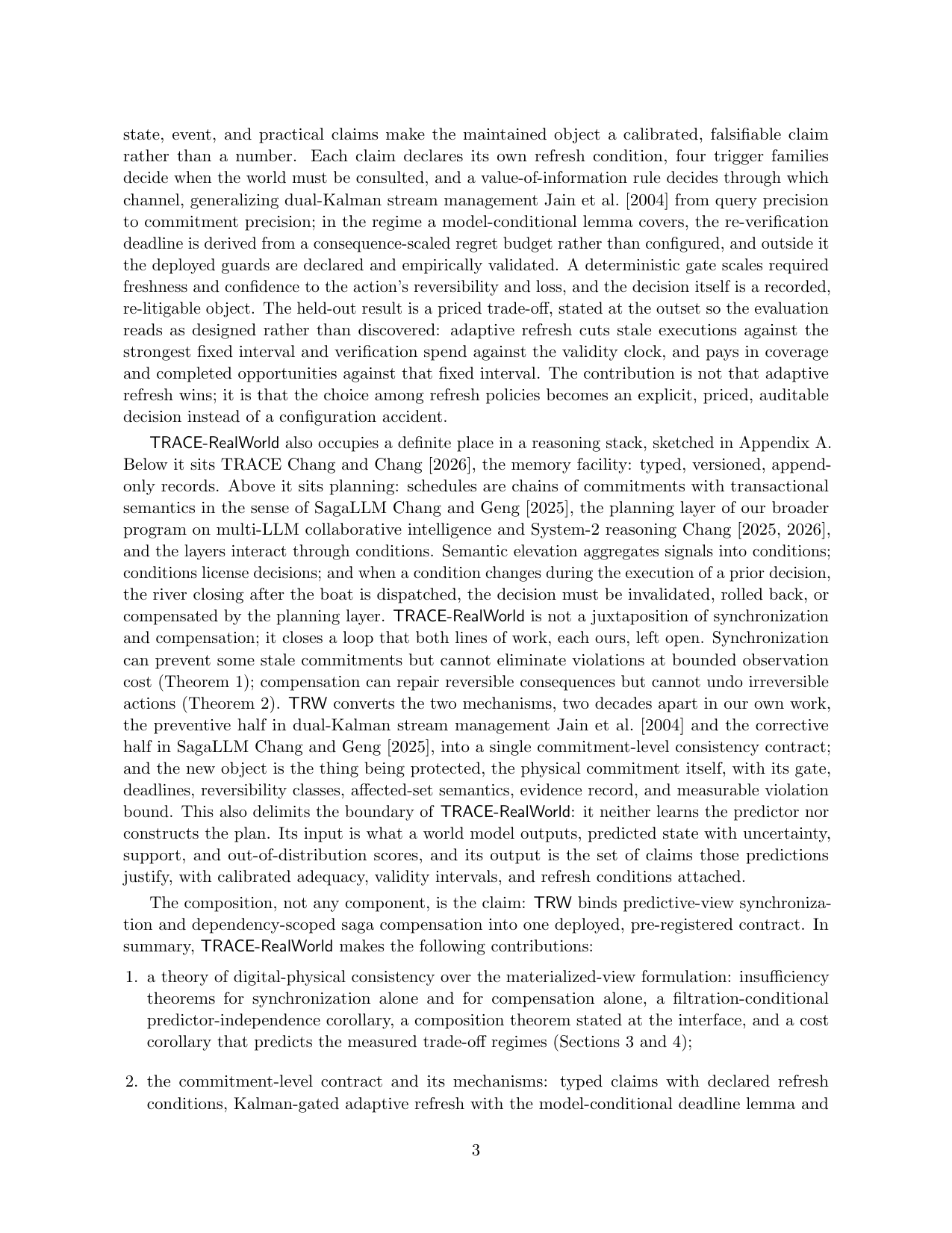 Figure 2: Theory framework page — insufficiency proofs for synchronization and compensation, and the composition theorem.
flowchart TD
    A["Physical world state S_t"] -->|"priced channels C"| B["World view b_t
materialized view"]
    B -->|"incremental b_{t+1}=f(b_t,a_t)"| B
    B --> C["Commitment read
authorizes durable action"]
    C --> D{"Refresh condition rho
d_omega > theta?"}
    D -->|"yes"| E["Adaptive refresh
consult the world"]
    D -->|"no"| F["Execute commitment"]
    E --> B
    F --> G{"Claim true
at execution?"}
    G -->|"true"| H["Successful execution"]
    G -->|"false (stale)"| I["Saga compensation
dependency-scoped repair"]
    I --> J{"Repair success?"}
    J -->|"yes"| H
    J -->|"no"| K["Escalate/HOLD
auditable record"]
    style E fill:#e1f5fe
    style I fill:#fff3e0
    style K fill:#e8f5e9
Experiments
Flood-SAR Evaluation Setup
Flood-SAR is a search-and-rescue simulation workbench over real geography. Evaluation is through six pre-registered questions (RQ1-RQ6) with frozen operating points and held-out seeds. The development grid contains 19 configurations: no refresh; fixed $k \in \{5,15,45,120,300,600\}$ seconds; validity clock $\alpha \in \{0.1,...,1.0\}$; adaptive refresh $\varepsilon_c \in \{0.25,...,7\}$. Development seeds 1-20 yield 380 missions; validation seeds 101-125 yield 475; test seeds 1001-1080 yield 240.
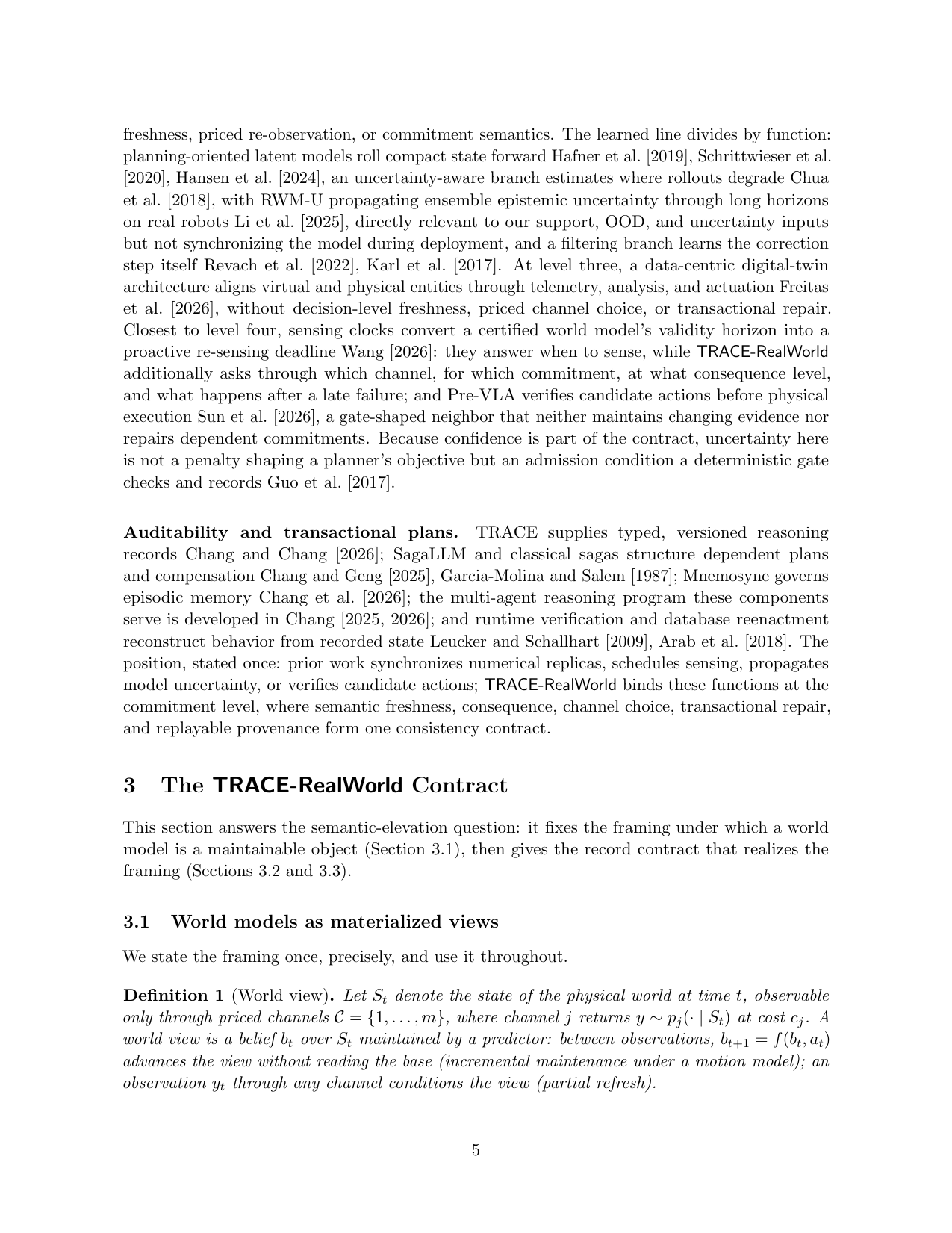 Figure 3: Evaluation methodology page — pre-registered questions and frozen operating points.
| Element | Checked By | Status |
|---|---|---|
| A1 cleared-stratum ECE | §7.2 | bounded (.131) |
| A2 latency ceiling $\delta_d$ | RQ6 (O2) | measured; cell unclassified |
| Thm 1 stale floor $p_\delta$ | RQ1 | held |
| Thm 2 post-hoc invariance | RQ6 (O1, O8) | 160/160 |
| Thm 3(i) oracle; deadlines | RQ5 | witnessed |
| Thm 3(ii,iii) repairs; debts | RQ6 (O3, O5) | (iii) unconditional in A2/A6 |
| Policy | Stale Exec↓ | Coverage↑ | Obs Cost↓ | Key Finding |
|---|---|---|---|---|
| No refresh | high | low | 0 | baseline, many stale executions |
| Fixed k=600s | medium | medium | fixed | periodic sampling doesn't track change |
| Validity clock α=0.4 | medium-low | medium | medium | no coverage certificate |
| Adaptive εc=4 | lowest | high | low | consults when evidence could change decision |
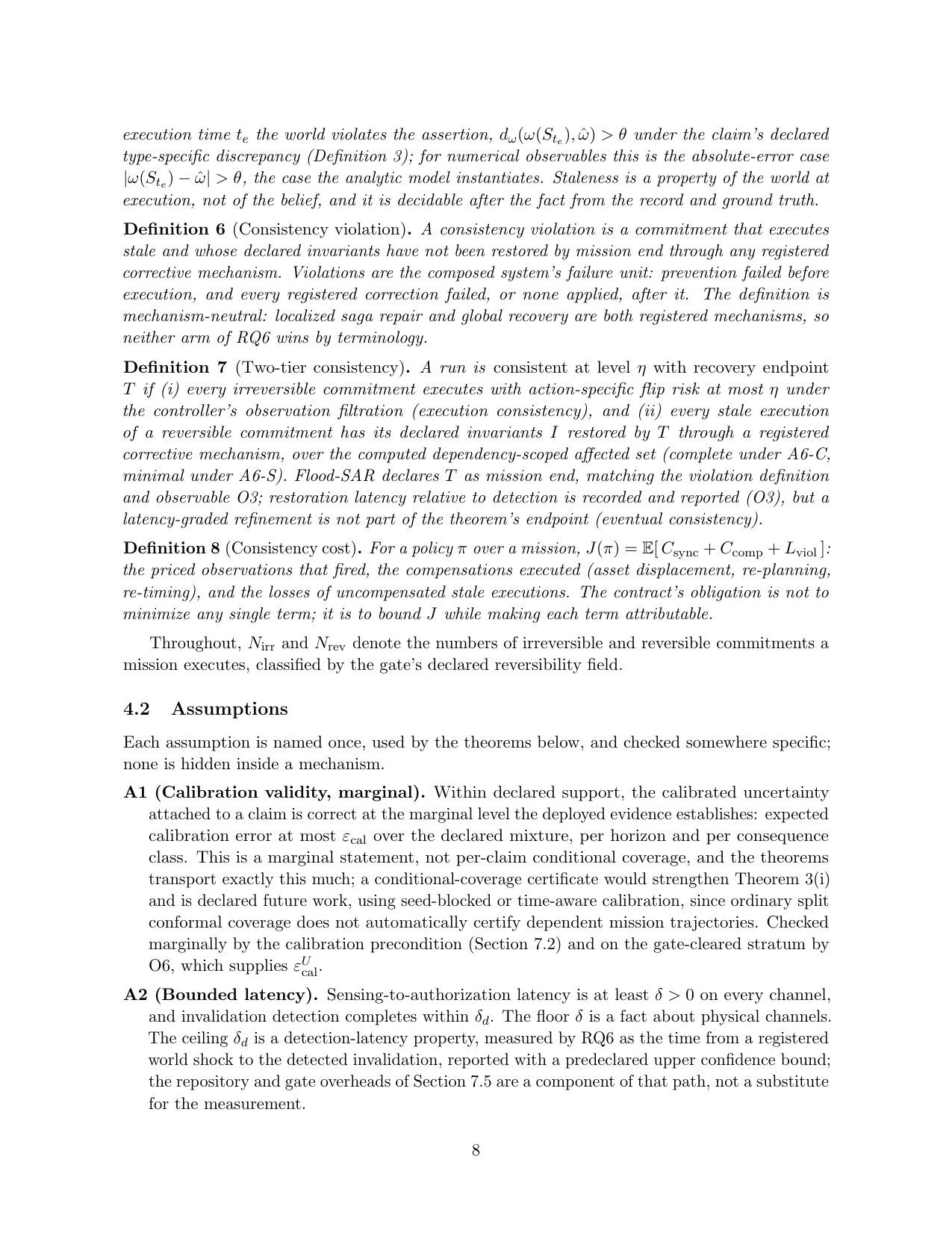 Figure 4: RQ6 composition results page — localized Saga repair vs global recovery comparison.
RQ1's held-out answer confirms adaptive refresh outperforms fixed intervals: reducing stale execution and observation cost while maintaining coverage. Theorem 1's stale floor $p_\delta$ holds. RQ6 composition confirms post-hoc invariance (Theorem 2) in 160/160 cases, localized Saga repair preserves end-state at a fraction of repair cost, with restoration rate $f_{\text{restore}}^U = 0.165$. Detection coverage is 0.83-0.89 (assumption A2), calibration error $\varepsilon_{\text{cal}}^U = 0.131$ (assumption A1/O6).
Limitations
- Predictor surrogate (stated by authors): The deployed predictor is a transparent kinematic surrogate with a frozen calibration map — every measured effect is attributable to the contract rather than predictor quality. The contract's prediction for a richer predictor is falsifiable: substituting an uncalibrated learned model should raise hold and escalate rates, not clear rates, until calibration within declared support is earned.
- Assumption approximations: Theorem 3 is a proved conditional contract whose assumptions are measured, not empirically discharged — detection coverage is 0.83-0.89 (not exact), and the affected set is approximately, not exactly, the true set.
- Simulation environment: Evaluation is in the Flood-SAR simulation, not validated in real physical deployment; Saga compensation fails to fully close in 2/58 repair missions.
Conclusion and Outlook
TRACE-RealWorld proposes the first commitment-level consistency contract, treating world-model predicted state as a materialized view. Through typed calibrated claims, consequence-conditioned adaptive refresh, dependency-scoped Saga compensation, and append-only provenance, it proves that synchronization and compensation are each insufficient but their composition bounds expected violations. The Flood-SAR evaluation confirms through six pre-registered questions: adaptive refresh outperforms fixed intervals, and the composition maintains post-hoc invariance in 160/160 cases. The contribution is not a new predictive model, but a consistency, recovery, and accountability contract for deploying learned world representations as operational data systems.
Golden quote: "Refresh relevance is a property of the pending decision, not of signal variance alone — polling the sensor is justified only when an observation could move the belief across the boundary at which the optimal commitment switches. The quantity maintained is the justification of a commitment; signal refresh is only its means."
SOURCE LINKS