PAPER DEEP DIVE
PathScale-R1: Cross-scale Reasoning for Pathological Image Analysis
Pathological diagnosis is inherently multi-scale, requiring the integration of global tissue architecture at low magnification with cellular morphology at higher magnification. However, existing pathology benchmarks and vision-language models (VLMs) are still largely developed under single-scale settings, limiting their ability to learn clinically meaningful multi-magnification reasoning. Moreover, naively constructed visual question answering (VQA) tasks may be susceptible to text-only or superficial visual shortcuts, leading to unreliable assessments of visual understanding. To address these limitations, we introduce a benchmark and training framework for shortcut-resistant cross-scale pathology reasoning. We design an Adversarial Text-only Screening strategy for semantic reasoning questions and a Structure-controlled Distractor Sampling strategy for visual grounding questions, encouraging models to rely on cross-scale visual evidence. Based on this pipeline, we construct PathScale-VQA, a high-quality cross-scale pathology VQA benchmark with 10,373 multiple-choice questions grounded in 1,368 diagnostic paths across multiple magnification levels. Building on the semantic reasoning set, PathScale-R1 is optimized through Difficulty-driven Reasoning Distillation supervised fine-tuning followed by reinforcement learning with a Scale-aware Reasoning Structure reward, which encourages the use of evidence across magnifications. Extensive experiments demonstrate state-of-the-art performance of PathScale-R1 on cross-scale reasoning tasks and effective transfer to conventional single-scale pathology VQA. Our code is available at https://github.com/iMVR-PL/PathScale-R1.
PathScale-R1: Cross-scale Reasoning for Pathological Image Analysis
Paper: PathScale-R1: Cross-scale Reasoning for Pathological Image Analysis
Authors: Chi Phan, Tianyi Zhang, Yufeng Wu, Qiaochu Xue, Jiajie Zhang, Linghan Cai, Zeyu Liu, Sudong Wang, Yueming Jin, Dan Hu
Affiliations: National University of Singapore, PuzzleLogic, Fujian Medical University Cancer Hospital
Links: arXiv:2607.23794
Code: Open source
One-Sentence Summary
PathScale-R1 introduces a cross-scale reasoning paradigm for pathological image analysis, connecting 10x/40x/200x ROIs through expert-verified diagnostic paths, constructing a shortcut-resistant VQA benchmark, and achieving 83.32% accuracy on cross-scale reasoning through two-stage optimization: difficulty-driven reasoning distillation SFT + scale-aware reasoning structure reward RL, with effective transfer to single-scale pathology VQA.
Background and Motivation
Pathological diagnosis is the gold standard for cancer diagnosis, providing essential evidence for disease characterization, treatment planning, and prognosis. Due to the hierarchical organization and heterogeneity of tissue morphology, pathological interpretation requires intensive visual analysis and substantial domain expertise. Recent developments in large language models and multimodal learning have motivated pathology-focused Vision-Language Models (VLMs), showing promising capabilities in pathological understanding, VQA, and diagnostic support. Quilt-LLaVA trains on pathology video subtitles, CLOVER combines pathology image and text alignment, and Patho-R1 trains on large-scale pathology data but focuses on single-scale analysis.
However, there is a noticeable gap between current model design and the practical workflow of pathological assessment. Real-world pathological diagnosis is fundamentally a cross-scale reasoning process: pathologists systematically navigate across magnifications to synthesize a final decision. Slide review typically begins at low power to assess global tissue architecture and lesion distribution, proceeds to intermediate magnifications to examine localized tissue organization, and finally uses high magnification to verify cellular morphology and fine-grained diagnostic features. These observations are highly interdependent—macroscopic findings direct subsequent zoom-in decisions, microscopic evidence validates earlier structural impressions, and a diagnosis is synthesized by merging architectural, structural, and cellular evidence across scales. A clinically meaningful pathology VLM should therefore not only recognize findings at one scale but also connect cross-scale evidence to support a coherent diagnostic conclusion.
Existing pathology VLMs are predominantly developed and evaluated in single-scale settings, not explicitly capturing how diagnostically related evidence is connected across magnifications. Patch-level VQA benchmarks (PathVQA, PathMMU, PathBench) typically associate each question with only a single ROI, assessing recognition and reasoning within an isolated field of view rather than whether a model can connect low-power architecture, intermediate tissue organization, and high-power cellular morphology from the same diagnostic trajectory. WSI-level benchmarks (WSI-VQA, SlideBench, WSI-Bench) evaluate slide-level understanding from gigapixel images, but existing WSI VLMs commonly aggregate patch embeddings at a specific magnification into compact slide-level representations, still providing limited assessment of cross-scale finding interactions. Under these single-scale framings, models may learn scale-specific visual recognition but receive little supervision for the hierarchical reasoning process linking low-power architectural context to high-power cellular evidence. Consequently, they may perform well on existing benchmarks while struggling with cross-scale understanding tasks, creating a critical misalignment with clinical practice.
Constructing cross-scale reasoning VQA tasks faces another critical challenge: susceptibility to text-based shortcut solutions. Studies show VLMs can achieve high benchmark performance by exploiting linguistic cues, weak distractors, or dataset-specific artifacts rather than relying on images. In medical VQA, such shortcuts may yield fluent but visually limited explanations. In cross-scale pathology VQA, magnification-specific terminology and stereotyped biomedical associations may reveal correct answers without cross-scale integration, creating an "illusion of visual understanding"—performance metrics become unreliable measures of model capability, particularly concerning in critical domains like pathology. Constructing reliable cross-scale reasoning settings requires not only collecting multi-magnification images but also actively suppressing shortcut solutions to enforce genuine visual evidence reliance.
PathScale-R1 addresses both challenges: shifting the basic unit of supervision and evaluation from isolated ROI to diagnostic path (pathologist-verified trajectories connecting 10x, 40x, 200x within the same WSI), and suppressing shortcuts through adversarial text-only screening and structure-controlled distractor sampling. At the model level, it trains cross-scale diagnostic evidence integration through two-stage optimization: difficulty-driven reasoning distillation SFT and scale-aware reasoning structure reward RL. This work substantially extends the MICCAI 2026 preliminary version: benchmark expanded from 4,685 to 10,373 questions, five visual grounding tasks added, optimization extended from single-stage to two-stage, and evaluation broadened with more model comparisons, ablation analyses, and transfer experiments.
Method Details
The method comprises three core components: cross-scale diagnostic path construction, shortcut-resistant VQA curation, and two-stage optimization.
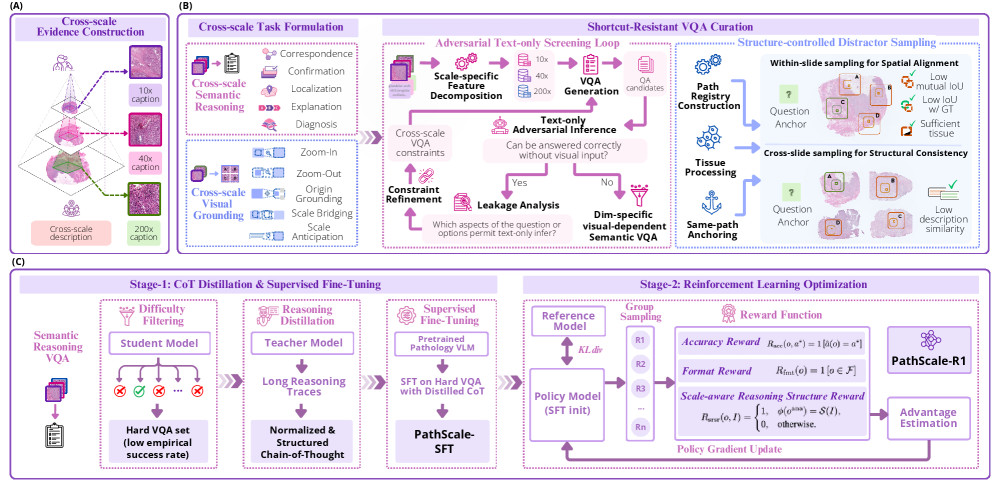
Figure 1: PathScale-R1 framework overview. (A) Diagnostic path construction: extracting 10x/40x/200x ROIs from the same WSI. (B) Shortcut-resistant VQA curation: adversarial text-only screening + structure-controlled distractor sampling. (C) Two-stage optimization: difficulty-driven reasoning distillation SFT → scale-aware reasoning structure reward RL.
Cross-scale Diagnostic Path Construction. A diagnostic path consists of {10x, 40x, 200x} ROIs from the same WSI, reflecting the clinical workflow: low-power views provide architectural context, intermediate views reveal local tissue organization, and high-power views confirm cellular morphology. Constructed from TCGA H&E-stained WSIs with clinical experts involved at the earliest stage. Each annotator selects a diagnostically informative 10x ROI, then identifies clinically relevant subregions at 40x and 200x, forming a progressive zoom-in trajectory. A senior pathologist reviews each trajectory for clinical meaningfulness. Each path provides two annotation levels: scale-specific captions and zoom-in decision rationales, from which GPT-5.2 drafts cross-scale descriptions confirmed by pathologists as high-quality evidence anchors.
Cross-scale Semantic Reasoning. Each sample is a multiple-choice VQA with textual options and a clinically linked ROI set from one diagnostic path. Each question requires evidence from at least two magnifications. Five semantic task types are defined: Correspondence (whether findings at different magnifications represent the same pathological process), Confirmation (whether higher-magnification evidence supports/contradicts a lower-magnification hypothesis), Localization (identifying where diagnostically relevant evidence appears across scales), Explanation (connecting cross-scale observations to justify a conclusion), and Diagnosis (determining the final clinical interpretation from combined cross-scale evidence).
Adversarial Text-only Screening. Since semantic reasoning uses textual options, the central challenge is preventing correct answers from being inferred from linguistic cues alone. An adversarial generate-screen-revise loop is employed: after generating candidate questions from decomposed scale-specific feature sets, all images are removed and only questions with textual options are presented to strong closed-source LLMs (Gemini 3 Pro, Qwen3-Max). If either model predicts correctly, the sample is flagged as potentially solvable without visual evidence, the leakage source is analyzed (overly specific correct options, implausible distractors, imbalanced option granularity, answer-position bias, diagnostic priors in wording), and the sample is revised and re-evaluated. This iterative process turns semantic VQA construction from one-pass generation into leakage-aware curation. Final revised VQAs are confirmed by pathologists for clinical correctness, evidence observability, and multi-magnification dependence.
Cross-scale Visual Grounding. Visual grounding is formulated as image-option MCQs where the correct option is defined by the corresponding cross-scale trajectory. By replacing textual options with visual alternatives, this scheme reduces reliance on diagnostic label priors and directly probes whether models can align, localize, and complete cross-scale visual trajectories. Five task types: Zoom-In Correspondence, Zoom-Out Correspondence, Origin Grounding, Scale Bridging (recovering the missing intermediate view between 10x and 200x), and Scale Anticipation (selecting the high-power appearance most consistent with lower-power evidence).
Structure-controlled Distractor Sampling. Image-option questions avoid text-only leakage but remain vulnerable to shortcuts from staining variation, scanner appearance, tissue coverage, background content, sharpness, or crop artifacts. A structure-controlled pipeline based on diagnostic paths is adopted: annotated ROIs are organized into a path-indexed visual registry. For spatial alignment tasks (zoom-in/out correspondence, origin grounding), distractors are sampled from other diagnostic paths within the same WSI, controlling slide-level appearance factors. For trajectory completion tasks (scale bridging, anticipation), distractors are sampled from different WSIs, filtering highly anchor-compatible distractors to reduce ambiguity.
graph TB
  A[WSI Whole Slide Image] --> B[Pathologist Annotation
10x/40x/200x ROIs]
  B --> C[Diagnostic Path
Cross-scale Trajectory]
  C --> D{Task Type}
  D --> E[Semantic Reasoning
Text-option MCQ]
  D --> F[Visual Grounding
Image-option MCQ]
  E --> G[Adversarial Text-only Screening
Generate-Screen-Revise Loop]
  F --> H[Structure-controlled Distractor Sampling
Same-WSI/Cross-WSI Distractors]
  G --> I[Shortcut-resistant VQA Benchmark
10373 Questions]
  H --> I
  I --> J[Two-stage Optimization
SFT → RL]
  style G fill:#fff3cd,stroke:#856404,stroke-width:2px
  style H fill:#e3f2fd,stroke:#1565c0,stroke-width:2px
Figure 2: PathScale-VQA construction pipeline. Diagnostic paths are split into semantic reasoning and visual grounding tasks, each with targeted shortcut-resistant curation.
Difficulty-driven Reasoning Distillation SFT. The first stage selects difficult questions where the base model repeatedly fails ($K=16$ sampling rounds, accuracy threshold $\tau=0.25$), generates reasoning traces with a teacher model (Gemini 3 Pro), normalizes them into structured chain-of-thought rationales (task focus → image-wise analysis → key visual evidence → confirmed/uncertain findings → option evaluation → cross-scale conclusion → final answer), and performs autoregressive SFT. Vision encoder is frozen; trained for 5 epochs at learning rate 1e-4. Difficulty-based filtering ensures SFT focuses on the model's weakest cross-scale association and verification capabilities.
Scale-aware Reasoning Structure Reward RL. The second stage optimizes with GRPO, with reward designed as:
$$R(o)=\lambda_{\mathrm{acc}}R_{\mathrm{acc}}(o,a^{\ast})+\lambda_{\mathrm{srsr}}R_{\mathrm{srsr}}(o,I)+\lambda_{\mathrm{fmt}}R_{\mathrm{fmt}}(o)$$
where $R_{\mathrm{acc}}(o,a^{\ast})=\mathbbm{1}[\hat{a}(o)=a^{\ast}]$ ensures answer correctness, $R_{\mathrm{fmt}}(o)=\mathbbm{1}[o\in\mathcal{F}]$ ensures format compliance. The core innovation is the Scale-aware Reasoning Structure Reward $R_{\mathrm{srsr}}$—SFT provides image-wise reasoning demonstrations, but the model may still collapse multi-image input into a brief global description without distinguishing individual image contributions. $R_{\mathrm{srsr}}$ requires the generated reasoning to explicitly reference all images in the expected scale order $(1,\ldots,N)$, using a structure extractor $\phi(\cdot)$ to identify the ordered sequence of image indices in the analysis segment, rewarding 1 only when matching the expected sequence:
$$R_{\mathrm{srsr}}(o,I)=\begin{cases}1,&\phi(o^{\mathrm{ana}})=\mathcal{S}(I)\\0,&\text{otherwise}\end{cases}$$
This penalizes hallucinated visual references and inconsistent cross-scale organization, encouraging more complete image-wise analysis. Reward weights: $\lambda_{\mathrm{acc}}=0.75$, $\lambda_{\mathrm{srsr}}=0.20$, $\lambda_{\mathrm{fmt}}=0.05$; GRPO for 700 steps with 16 sampled responses per prompt.
Experimental Results
PathScale-VQA contains 10,373 cross-scale VQA samples from 1,368 expert-verified diagnostic paths across 373 TCGA WSIs, spanning 14 organ sites. Semantic reasoning subset: 6,030 samples (3,680 train/val, 2,350 test). Visual grounding subset: 4,343 samples (evaluation only). All splits at patient-wise WSI level. Baselines include general VLMs, medical VLMs, and pathology-specific VLMs.
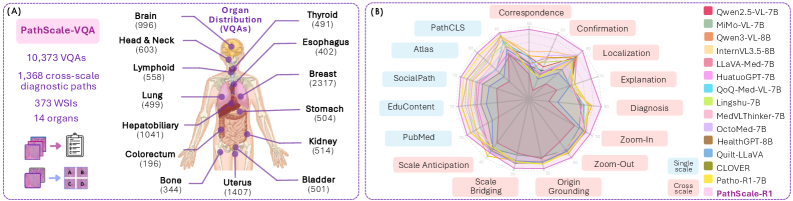
Figure 3: Dataset statistics and benchmark performance. (A) Component statistics and organ distribution. (B) Task-wise performance of representative VLMs.
Cross-scale Semantic Reasoning. PathScale-R1 achieves 83.32% overall accuracy, substantially outperforming all baselines. The runner-up InternVL3.5-8B achieves only 64.13%, best pathology-specific CLOVER 56.77%, and backbone Patho-R1 50.21%. PathScale-R1 leads across all five task dimensions: Correspondence 80.85% (runner-up 53.19%), Confirmation 91.91% (69.57%), Localization 88.72% (78.94%), Explanation 65.74% (44.47%), Diagnosis 89.36% (77.66%). Explanation shows the largest improvement (+21.27 pp), indicating cross-scale reasoning training particularly enhances evidence connection and conclusion justification.
| Model | Overall | Corr. | Conf. | Loca. | Expl. | Diag. |
|---|---|---|---|---|---|---|
| Qwen3-VL-8B | 59.83 | 48.30 | 61.28 | 75.74 | 36.17 | 77.66 |
| InternVL3.5-8B | 64.13 | 53.19 | 69.57 | 78.94 | 44.47 | 74.47 |
| CLOVER | 56.77 | 38.51 | 60.43 | 78.72 | 39.79 | 66.38 |
| Patho-R1 | 50.21 | 31.49 | 34.68 | 67.23 | 44.04 | 73.62 |
| PathScale-R1 | 83.32 | 80.85 | 91.91 | 88.72 | 65.74 | 89.36 |
Table 1: Cross-scale semantic reasoning results. PathScale-R1 leads runner-up InternVL3.5-8B by 19.19 pp.
Single-scale VQA Transfer. On PathMMU single-scale pathology VQA, PathScale-R1 also achieves the best (63.6% test), outperforming Patho-R1 (62.3%) and all baselines, demonstrating effective transfer. Cross-scale reasoning training does not harm but enhances single-scale understanding through richer visual evidence organization—PathCLS improves from 78.4% to 80.3%.
Shortcut-resistant Verification. Progressive image removal validates whether VQAs genuinely require visual evidence. Average accuracy across five strongest models decreases from 64.83% (all images) to 55.35% (one removed, -9.48), 47.52% (one remaining, -17.31), and 27.79% (text-only, -37.04). Consistent degradation confirms dependence on complementary cross-scale evidence rather than isolated recognition, with text-only priors insufficient to reproduce full-image performance. Confirmation shows the largest drop (69.15% to 27.86%, -41.29), being most dependent on cross-scale visual comparison.
| Condition | Corr. | Conf. | Loca. | Expl. | Diag. | Avg |
|---|---|---|---|---|---|---|
| All images | 49.83 | 69.15 | 80.55 | 46.94 | 77.70 | 64.83 |
| Drop 1 image | 44.28 | 53.36 | 69.40 | 43.03 | 66.67 | 55.35 (-9.48) |
| 1 image only | 33.42 | 46.93 | 60.29 | 38.68 | 58.28 | 47.52 (-17.31) |
| Text-only | 17.40 | 27.86 | 34.48 | 20.89 | 38.30 | 27.79 (-37.04) |
Table 2: Progressive image removal analysis. Accuracy decreases consistently with image removal, confirming genuine cross-scale visual evidence dependence.
Ablation. Difficulty-driven SFT improves average accuracy from 50.21% to 71.36% (+21.15 pp), with largest gains in Correspondence and Confirmation (+27.02 and +48.94 pp). RL further improves to 80.97% (+9.61 pp). Scale-aware reasoning structure reward $R_{\mathrm{srsr}}$ further increases to 83.32% (+2.35 pp), with gains across all tasks (1.28-2.78 pp), demonstrating the complementary value of explicitly rewarding cross-scale evidence use.
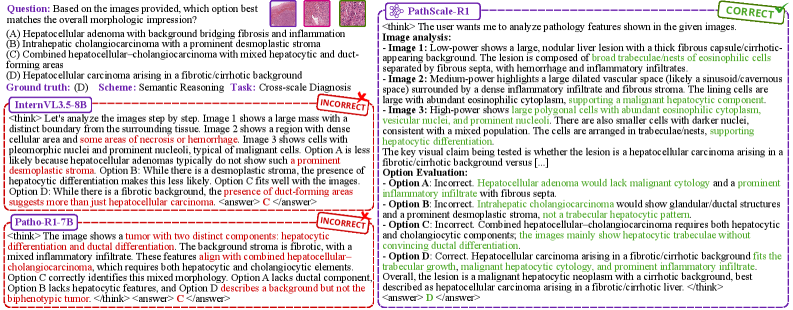
Figure 4: Cross-scale semantic reasoning case study. PathScale-R1 analyzes evidence by low-to-high magnification order, correctly rejecting unsupported ductal differentiation; baselines fixate on locally salient impressions leading to incorrect diagnosis.
组合奖励函数
$$ R(o)=\lambda_{\mathrm{acc}}R_{\mathrm{acc}}(o,a^{\ast})+\lambda_{\mathrm{srsr}}R_{\mathrm{srsr}}(o,I)+\lambda_{\mathrm{fmt}}R_{\mathrm{fmt}}(o) $$
准确率奖励
$$ R_{\mathrm{acc}}(o,a^{\ast})=\mathbbm{1}\left[\hat{a}(o)=a^{\ast}\right] $$
困难样本筛选
$$ \mathcal{D}_{\mathrm{hard}}=\left\{(I,q,\mathcal{O},a^{\ast})\in\mathcal{D}_{\mathrm{sem}}\mid c_{\mathrm{base}}(I,q,\mathcal{O})<\tau K\right\} $$
LimitationsFirst, cross-scale visual grounding performance remains suboptimal. The paper notes that fine-grained cross-scale visual grounding is an important yet underdeveloped capability of current VLMs. While semantic reasoning achieves 83.32%, visual grounding tasks (scale bridging, scale anticipation) show notably lower accuracy, indicating insufficient visual correspondence and trajectory consistency capabilities, especially for tasks requiring precise spatial alignment. This suggests cross-scale visual understanding has two levels—semantic reasoning and visual grounding—with the latter being harder and progressing more slowly.
Second, while covering 14 organ sites, the dataset primarily comes from TCGA H&E-stained sections, not encompassing immunohistochemistry or special stains. Diagnostic path construction relies on manual pathologist annotation, making scaling costly. Adversarial text-only screening reduces text leakage but cannot completely eliminate all shortcut forms—subtle linguistic cues or visual artifacts may still be exploitable.
Conclusion and Future Work
PathScale-R1 pushes pathological image analysis from single-scale recognition to cross-scale reasoning, using diagnostic paths as the basic unit connecting 10x/40x/200x clinically corresponding regions. Through the shortcut-resistant VQA benchmark (10,373 questions) constructed with adversarial text-only screening and structure-controlled distractor sampling, and two-stage optimization combining difficulty-driven reasoning distillation SFT with scale-aware reasoning structure reward RL, PathScale-R1 achieves 83.32% on cross-scale reasoning, substantially outperforming all baselines, with effective transfer to single-scale pathology VQA.
This work reveals critical deficiencies of current VLMs in cross-scale visual understanding, providing new benchmarks and methods for aligning pathology AI with clinical workflows. Future work can extend to more stain types and organ sites, explore efficient automatic diagnostic path construction, and improve visual grounding capabilities.
Golden Quotes
The essence of pathological diagnosis is not recognizing lesions at a single scale, but chaining evidence across magnifications to form a coherent diagnosis—exactly what current VLMs lack.
The core insight of adversarial text-only screening: if a text-only LLM can answer correctly, the visual question has failed—visual evidence is not truly needed.