PAPER DEEP DIVE
FA-RDP: A Frequency-Adaptive Reactive Diffusion Policy for Contact-Rich Manipulation
In contact-rich manipulation, action multimodality and reactivity dominate different stages of a single episode. Before contact, multiple trajectories might be equally valid, making it important to preserve diverse action modes. After contact, geometric constraints and force limits narrow the solution space, while successful execution demands rapid responses to force feedback. However, standard diffusion policies use a fixed inference frequency and sampling steps throughout the episode, forcing a fundamental compromise: low-frequency, multi-step sampling better preserves pre-contact multimodality but responds slowly to force feedback, whereas high-frequency sampling improves reactivity but tends to collapse distinct pre-contact modes. To resolve this tradeoff, we present FA-RDP, a frequency-adaptive reactive diffusion policy. A shared multi-frequency visual-force Transformer predicts action chunks at both low and high frequencies, while a learned multimodality indicator dynamically selects multi-step low-frequency sampling before contact and one-step high-frequency sampling as action ambiguity decreases. We further introduce Manifold Consistency Distillation (MCD), which reparameterizes the diffusion network to predict actions on the robot action manifold while retaining DDPM-based residual supervision. Experiments on three contact-rich manipulation tasks show that FA-RDP achieves the highest success rate while preserving diverse pre-contact trajectory modes. Code and videos are available at https://fa-rdp.github.io.
Paper Information
| Field | Details |
|---|---|
| Title | FA-RDP: A Frequency-Adaptive Reactive Diffusion Policy for Contact-Rich Manipulation |
| Authors | Lifeng Zhuo, Wendi Chen, Han Xue, Shirun Tang, Jun Lv, Cewu Lu, Chuan Wen (Shanghai Jiao Tong University, Shanghai Innovation Institute, Noematrix Ltd.) |
| Paper | arXiv:2607.28596 |
| Project | fa-rdp.github.io |
| Hardware | Flexiv Rizon 4R (leader) + Rizon 4s (follower) |
One-line summary: FA-RDP proposes a frequency-adaptive diffusion policy that uses a multi-frequency visual-force Transformer and a multimodality indicator to preserve diverse pre-contact trajectories via low-frequency diffusion sampling, then switches to a high-frequency distilled policy for rapid force-feedback response after contact, achieving 81.7% average success rate on three contact-rich manipulation tasks.
Background and Motivation
In contact-rich manipulation, action multimodality and reactivity dominate different stages of a single episode. Before contact, multiple trajectories may be equally valid, making it important to preserve diverse action modes. After contact, geometric constraints and force limits narrow the solution space, while successful execution demands rapid responses to force feedback.
Standard diffusion policies use a fixed inference frequency and sampling steps throughout the episode, forcing a fundamental compromise: low-frequency, multi-step sampling better preserves pre-contact multimodality but responds slowly to force feedback, whereas high-frequency sampling improves reactivity but tends to collapse distinct pre-contact modes.
Prior work has limitations: Diffusion Policy (DP) predicts temporally coherent action sequences, but control within each chunk remains open-loop—after contact, the policy cannot use newly observed force signals to update actions. RDP uses a hierarchical slow-fast design for closed-loop execution, but the fast policy relies only on compressed latent actions, losing information. ImplicitRDP removes the explicit hierarchy by learning visual and force modalities end-to-end, but multi-step diffusion sampling limits the closed-loop inference frequency.
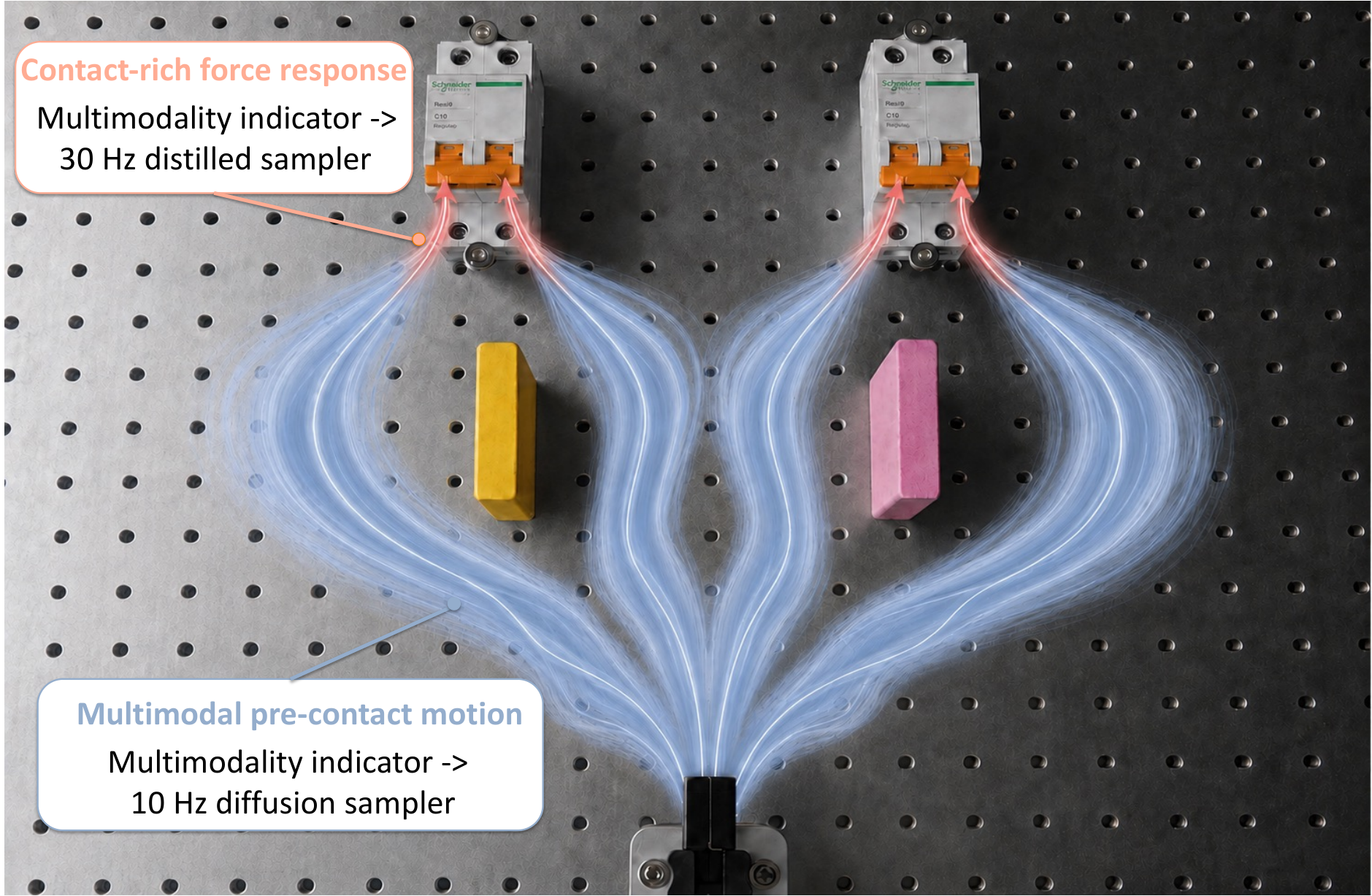
Figure 1: Multimodality-guided frequency adaptation. Low indicator value before contact selects the low-frequency diffusion sampler; the indicator rises with force response after contact, selecting the high-frequency distilled sampler.
Method Details
Multi-Frequency Visual-Force Transformer
FA-RDP's core is a shared multi-frequency visual-force Transformer. The same backbone serves both frequency modes $\nu \in \{\ell, h\}$; a single forward pass conditioned on one frequency mode predicts the action chunk for that mode. The key design is frequency-adaptive positional encoding—the frequency mode selects temporal indices on a shared temporal grid: the high-frequency mode uses consecutive positions, while the low-frequency mode uses sparse positions, so both modes are expressed on the same underlying clock.
The forward diffusion process samples timestep $k$ and noise $\boldsymbol{\epsilon} \sim \mathcal{N}(0, \mathbf{I})$, constructing the noised action:
$$\mathbf{A}^{\nu}_{k} = \sqrt{\bar{\alpha}_k} \mathbf{A}^{\nu} + \sqrt{1 - \bar{\alpha}_k} \boldsymbol{\epsilon}$$
The network predicts the action chunk $\hat{\mathbf{A}}^{\nu} = \pi_\theta(\mathbf{A}^{\nu}_k, k, \mathbf{o}_n^s, \mathbf{o}_n^{\text{force}}, \nu)$, with implied noise prediction:
$$\hat{\boldsymbol{\epsilon}} = \frac{\mathbf{A}^{\nu}_k - \sqrt{\bar{\alpha}_k} \hat{\mathbf{A}}^{\nu}}{\sqrt{1 - \bar{\alpha}_k}}$$
The per-mode diffusion objective:
$$\mathcal{L}_{\epsilon}^{\nu} = \mathbb{E}_{\mathbf{A}^{\nu}, k, \boldsymbol{\epsilon}} \left[ \| \hat{\boldsymbol{\epsilon}} - \boldsymbol{\epsilon} \|_2^2 \right]$$
The shared backbone is trained with a joint multi-frequency diffusion objective:
$$\mathcal{L}_{\text{MF}} = \mathcal{L}_{\epsilon}^{\ell} + \mathcal{L}_{\epsilon}^{h}$$
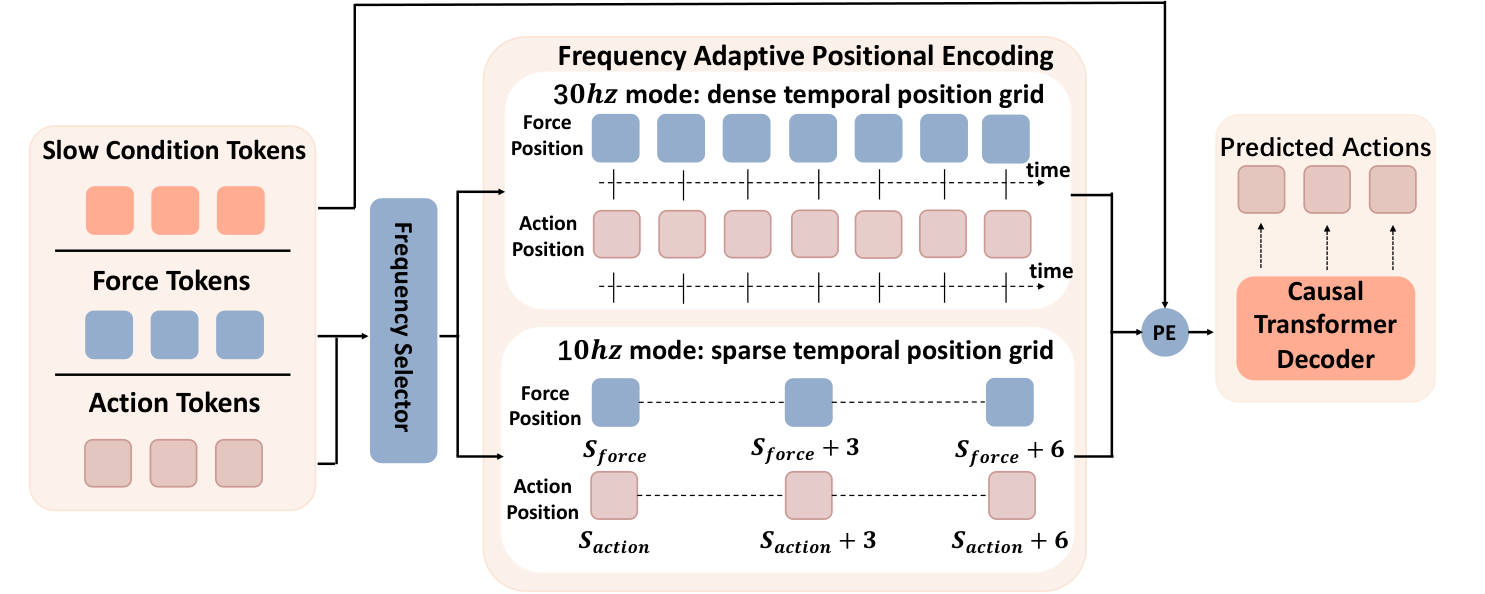
Figure 2: Multi-frequency visual-force Transformer. Frequency mode selects positional indices on a shared temporal grid—dense for high-frequency, sparse for low-frequency.
Multimodality-Based Frequency Selection
The multi-frequency Transformer provides both samplers, but the policy needs to decide which to use at different phases. FA-RDP uses a learned multimodality indicator estimating local multimodality, rather than relying on phase labels. Stage 2 trains the indicator head on an independent calibration set with the Stage 1 policy frozen. For each calibration sample, the same visual-force condition is fixed, the low-frequency policy is independently sampled $N=8$ times with different initial noise, and the empirical action residual is computed:
$$e(\mathbf{o}_n) = \frac{1}{N} \sum_{m=1}^{N} \| \hat{\mathbf{A}}^{\ell}_m - \mathbf{A}^{\ell} \|_2^2$$
High residual indicates strong multimodality (different samples produce different results), selecting the low-frequency sampler; low residual (constraints narrow after contact) selects the high-frequency distilled sampler.
Manifold Consistency Distillation (MCD)
To enable single-step inference for the high-frequency mode, FA-RDP introduces Manifold Consistency Distillation. This reparameterizes the diffusion network to predict actions on the robot action manifold while retaining DDPM-based residual supervision. Distillation on a six-step grid $\mathcal{G} = \{99, 79, 59, 39, 19, 0\}$ compresses multi-step diffusion into single-step prediction.
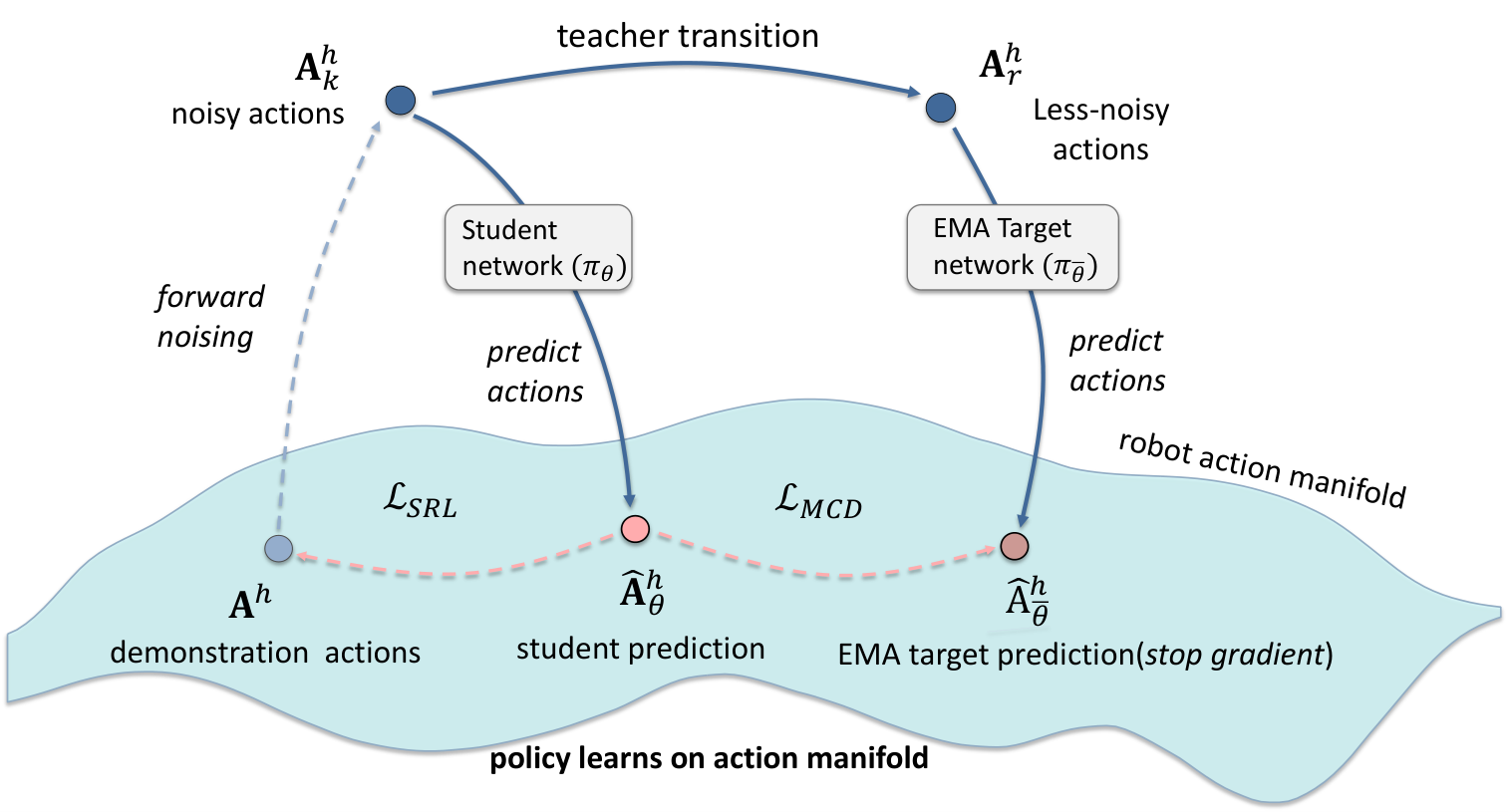
Figure 3: Manifold Consistency Distillation (MCD). Reparameterizes the diffusion network to predict on the robot action manifold for single-step high-frequency inference.
graph TD
    A["Pre-Contact Phase"] --> B["Indicator: Low Value
(Multiple Valid Trajectories)"]
    B --> C["Select Low-Freq Diffusion Sampler
10Hz, Multi-Step DDIM"]
    D["Post-Contact Phase"] --> E["Indicator: High Value
(Constraints Narrow)"]
    E --> F["Select High-Freq Distilled Sampler
30Hz, Single-Step MCD"]
    C --> G["Preserve Trajectory Diversity"]
    F --> H["Rapid Force-Feedback Response"]
Figure 4: FA-RDP frequency-adaptive inference flow. Indicator value dynamically switches between low/high-frequency samplers.
Experimental Results
Main Comparison
Three contact-rich tasks: dual box flipping, dual switch toggling, dual button pressing. 60 demonstrations per task, 20 trials per method.
| Method | Box | Button | Switch | Avg. |
|---|---|---|---|---|
| DP (vision-only) | 0/20 | 2/20 | 4/20 | 10.0% |
| RDP (hierarchical) | 5/20 | 7/20 | 9/20 | 35.0% |
| ImplicitRDP (fixed freq.) | 8/20 | 11/20 | 12/20 | 51.7% |
| Regression w/ Force | 2/20 | 4/20 | 6/20 | 20.0% |
| FA-RDP | 14/20 | 18/20 | 17/20 | 81.7% |
Table 1: Main success rates. FA-RDP achieves the highest success rate on all three tasks.
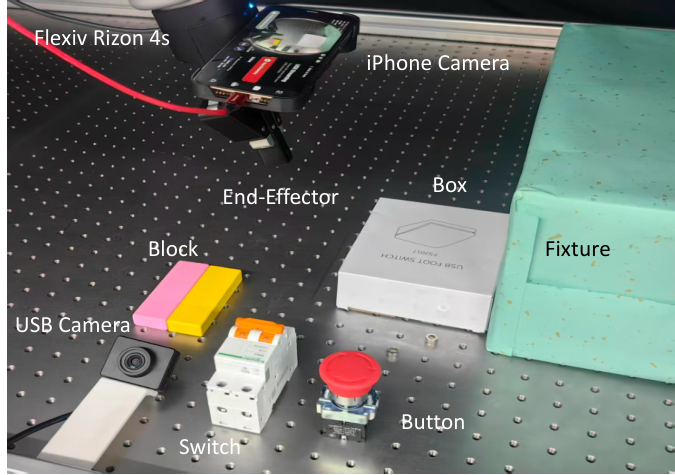
Figure 5: Robot workspace and task objects. Rizon 4s follower arm with wrist-mounted iPhone camera and fixed third-view USB camera.
Multimodality Preservation
Pre-contact trajectory distributions across four modes (right, middle-right, middle-left, left). FA-RDP and ImplicitRDP cover all four modes, while the high-frequency distilled alone policy collapses to one dominant mode. This confirms FA-RDP preserves pre-contact multimodality while enabling high-frequency force response.
Indicator-Guided Switching
| Method | Box | Button | Switch | Avg. |
|---|---|---|---|---|
| High-freq distilled alone | 12/20 | 14/20 | 11/20 | 61.7% |
| FA-RDP | 14/20 | 18/20 | 17/20 | 81.7% |
Table 2: Indicator-guided switching comparison. Frequency adaptation improves average success from 61.7% to 81.7%.
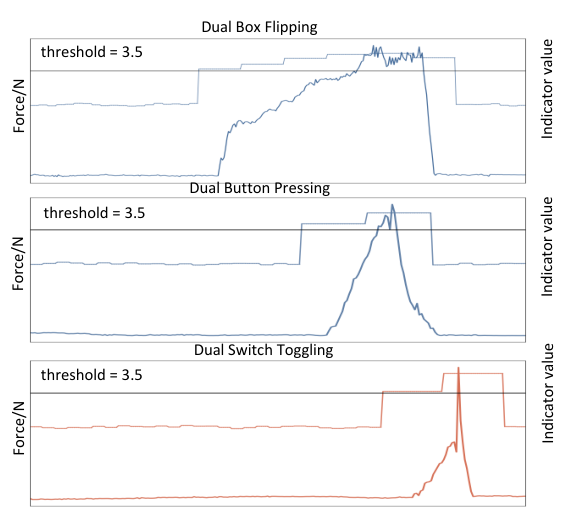
Figure 6: Multimodality indicator value and force curves. Low before contact, rises with force response after contact, supporting sampler switching.
Distillation Method Comparison
| Method | Box | Button | Switch | Avg. |
|---|---|---|---|---|
| High-freq alone (no distill.) | 4/20 | 3/20 | 5/20 | 20.0% |
| MeanFlow Policy | 0/20 | 0/20 | 1/20 | 1.7% |
| Consistency Policy | 0/20 | 0/20 | 1/20 | 1.7% |
| High-freq distilled (MCD) | 12/20 | 14/20 | 11/20 | 61.7% |
Table 3: Distillation method comparison. MCD substantially outperforms MeanFlow and Consistency Policy.
Limitations
1. Limited sensing modalities: The authors state that current evaluation is limited to visual-force input without testing other sensing modalities (e.g., tactile sensing).
2. Single-task policies: Current approach uses single-task policies rather than multi-task learning; generalization to new tasks is unverified.
3. Three-stage training: Requires a three-stage training procedure (multi-frequency backbone → indicator → distillation), increasing training complexity.
Summary and Future Work
FA-RDP elegantly resolves the phase-dependent tradeoff between pre-contact diversity and post-contact reactivity in contact-rich manipulation. Its core insight: rather than fixing the inference frequency throughout the episode, it should dynamically adapt based on the manipulation phase—low-frequency multi-step diffusion preserves multimodality before contact, while high-frequency single-step distilled policy enables rapid force feedback after contact.
The multimodality indicator is key to this adaptation: it decides which sampler to use by measuring local action multimodality, requiring no manual phase labels. Manifold Consistency Distillation (MCD) solves the precision problem of single-step inference in the high-frequency mode, substantially outperforming MeanFlow and Consistency Policy.
Experimental results are convincing: FA-RDP achieves 81.7% average success rate across three tasks, significantly outperforming ImplicitRDP (51.7%) and RDP (35.0%). Indicator-guided frequency switching improves success from 61.7% to 81.7%, demonstrating the core value of frequency adaptation.
"Should not fix the inference frequency throughout the episode"—this insight reveals a neglected dimension in robot manipulation: temporal resolution itself should be an adaptive variable, not a hyperparameter.
SOURCE LINKS