PAPER DEEP DIVE
Booster Lab: A Data-Centric Pipeline for Learning Deployable Humanoid Locomotion Policies
Humanoid robot motion learning requires not only task-oriented control policies but also physically feasible and natural behaviors that can be transferred to real robots. However, robot-feasible motion data are often scarce: raw human demonstrations may be incompatible with the robot morphology, open-source clips vary in quality, and simulation-collected robot trajectories still require feasibility checking. To address these challenges, we propose a data-centric training and deployment pipeline that integrates motion data curation, real-to-sim model adaptation, AMP-based reinforcement learning, and sim-to-real deployment. We validate the framework on the Booster T1 robot and further provide preliminary cross-platform validation on Booster K1.
Booster Lab: A Data-Centric Pipeline for Learning Deployable Humanoid Locomotion Policies
Paper: Booster Lab: A Data-Centric Pipeline for Learning Deployable Humanoid Locomotion Policies | Authors: Penghui Chen, Tinglong Zheng, Yufeng Zhang, Mingguo Zhao | Institutions: Tsinghua Univ. / Beijing Jiaotong Univ. / Booster Robotics | Link: https://arxiv.org/abs/2606.27813
One-Sentence Summary
Booster Lab proposes a data-centric closed-loop pipeline integrating motion data curation, real-to-sim model adaptation, AMP-based RL, and cross-simulator validation, learning deployable humanoid locomotion policies from heterogeneous motion sources, achieving walking, running (up to 2.0 m/s), and push-recovery on Booster T1 with cross-platform validation on K1.
Background and Motivation
Humanoid robot motion learning requires not only task-oriented control policies but also physically feasible and natural behaviors transferable to real robots. Human motion data provides rich prior knowledge—feature-based tracking rewards and adversarial motion priors (AMP) have been used to exploit such data for physics-based motion learning. However, raw motion data is rarely ready for robot deployment: human demonstrations may be noisy or inconsistent with robot morphology, open-source clips vary in quality, and simulation-collected robot trajectories still require feasibility checking.
Data processing thus becomes a central issue for deployable humanoid learning. Retargeting and optimization methods map human motions to robot kinematics while considering contacts, joint limits, and balance constraints. But many pipelines still treat data preparation, policy learning, and real-robot evaluation as separate steps, making deployment failures hard to diagnose and improve.
Booster Lab treats motion data as an optimizable component of the learning and deployment loop—its selection, repair, retargeting, augmentation, feasibility filtering, and feedback-driven update are explicitly managed. The pipeline integrates motion/skill selection, motion capture repair, motion retargeting, data augmentation, expert data selection, real-to-sim model adaptation, AMP-based RL, cross-simulator validation, and sim-to-real deployment.
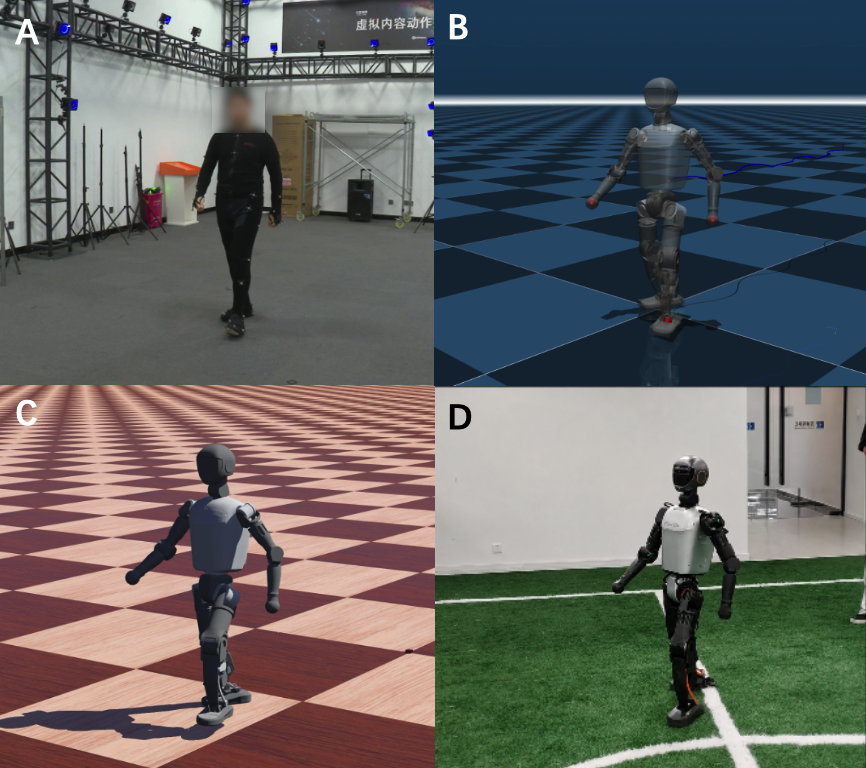
Figure 1: Pipeline overview. A: Motion data collection; B: Curated robot-feasible data; C: Policy validation in adapted simulation; D: Real-robot deployment.
Method
Problem Formulation
The goal is to learn a velocity-conditioned humanoid locomotion policy from curated robot-compatible motion data. Each motion clip in the expert database $\mathcal{D}_e$ is stored as a JSON trajectory with frame duration, motion weight, and frame sequence:
$$\tau_i = \{x_t, R_t, q_t, p_t^{ee}, v_t, \omega_t, \dot{q}_t, \dot{p}_t^{ee}\}_{t=1}^{T_i}$$
where $x_t \in \mathbb{R}^3$ and $R_t \in \mathbb{R}^4$ are root position and quaternion, $q_t, \dot{q}_t \in \mathbb{R}^{21}$ are positions and velocities of 21 controlled joints, $p_t^{ee}, \dot{p}_t^{ee} \in \mathbb{R}^{12}$ are end-effector positions and velocities, and $v_t, \omega_t \in \mathbb{R}^3$ are root linear and angular velocities. The policy maps proprioceptive observation history to 21 joint-position target offsets:
$$a_t = \pi_\theta(o_{t-9:t}), \quad q_t^{des} = q^{default} + 0.25 a_t$$
where $q^{default}$ is the default standing posture. The controller runs with a 0.005s physics step and decimation of 4, giving a 0.02s policy control period.
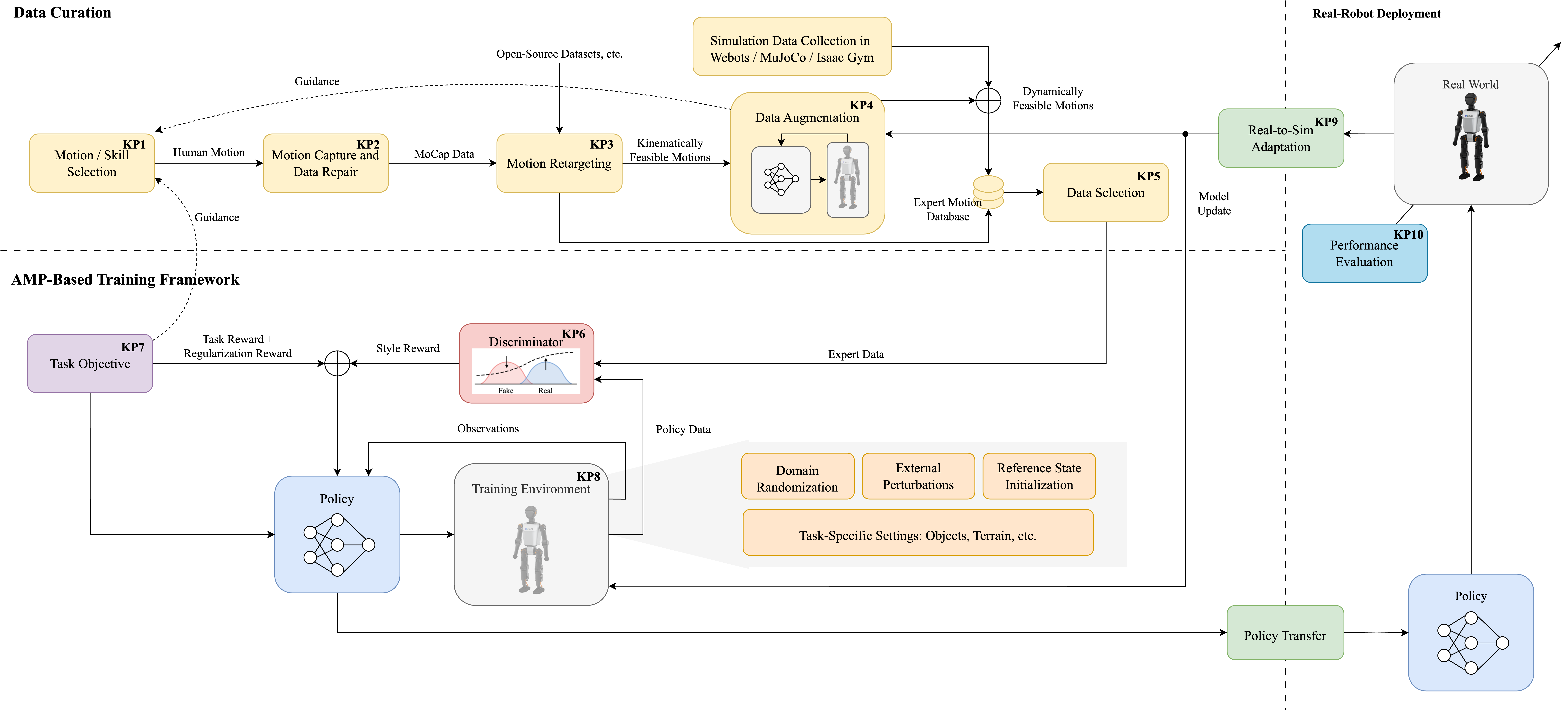
Figure 2: Data-centric training and deployment pipeline. Four stages: motion data curation, real-to-sim adaptation, AMP training, cross-simulator validation.
Data Curation
Data curation transforms heterogeneous motion sources into robot-compatible expert clips through five key processes: motion/skill selection, motion capture repair, motion retargeting (using GMR to map human motions to Booster T1), data augmentation (BeyondMimic-style tracking to generate additional expert clips), and data selection (filtering by tracking stability, contact consistency, joint/torque limits, foot slip, motion diversity, and task coverage).
Real-to-Sim Model Adaptation
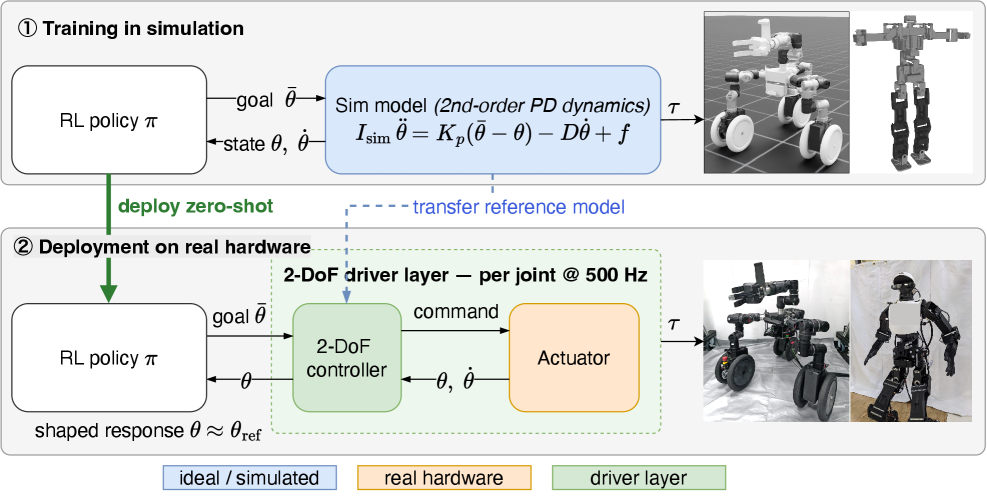
Before training, real-to-sim adaptation obtains a simulation model matching Booster T1 hardware. Actuator torque-speed characteristic curves are measured, with knee points used as motor velocity-limit and torque-limit parameters. Joint armature values are computed as:
$$J_{arm} = N^2 J_m$$
where $N$ is the gear ratio and $J_m$ is the rotor inertia. These values are incorporated into the adapted simulation model.
AMP-Based Policy Training
Training uses Isaac Lab with 4096 parallel environments. Each episode lasts up to 20s. The actor receives a 10-step history of a 72-dimensional proprioceptive vector:
$$o_t = [\omega_t^b, g_t^b, c_t, q_t - q^{default}, \dot{q}_t, a_{t-1}]$$
where $\omega_t^b$ is base angular velocity, $g_t^b$ is projected gravity, and $c_t = [v_x^{cmd}, v_y^{cmd}, \omega_z^{cmd}]$ is a sampled velocity command. A Wasserstein-style discriminator is trained to assign higher scores to expert motion snippets:
$$\mathcal{L}_D = -\mathbb{E}_{z \sim \mathcal{D}_e}[D_\psi(z)] + \mathbb{E}_{z \sim \pi_\theta}[D_\psi(z)] + \lambda_{gp} \mathcal{L}_{gp}$$
The AMP reward is derived from the discriminator score:
$$r_t^{amp} = \alpha\left(1 + \tanh\left(\beta D_\psi(z_t)\right)\right)$$
The final PPO reward is a linear blend of AMP and task rewards. Domain randomization (ground friction, joint stiffness/damping, trunk mass, initial state, terrain roughness) and external perturbations (intermittent horizontal velocity impulses) are applied during training.
flowchart TB
    A["Heterogeneous motion sources
human demos + open-source + sim trajectories"] --> B["Data Curation
repair+retarget+augment+select"]
    B --> C["Expert motion database De
JSON format trajectories"]
    D["Booster T1 hardware measurement
torque-speed characteristics"] --> E["Real-to-Sim Adaptation
motor limits+armature values"]
    E --> F["Adapted simulation model"]
    C --> G["AMP Policy Training
4096 parallel envs + PPO"]
    F --> G
    G --> H["Cross-simulator Validation
MuJoCo + Webots"]
    H --> I["Real-robot Deployment
Booster T1"]
    I -->|failure feedback| B
    I -->|failure feedback| E
    I -->|failure feedback| G
Experimental Results
Data augmentation ablation shows that the augmented policy has higher AMP imitation difficulty in early training (lower discriminator predictions), but gradually closes the imitation gap and reaches higher final policy prediction, indicating policy rollouts become closer to the expert distribution.
| Command | Range |
|---|---|
| Walking velocity $v_x$ | $[-0.6, 1.0]$ m/s |
| Lateral velocity $v_y$ | $[-0.6, 0.6]$ m/s |
| Running velocity $v_x$ | $(1.0, 2.0]$ m/s |
| Yaw rate $\omega_z$ | $[-1.5, 1.5]$ rad/s |
Table 1: Command range of the learned locomotion policy.
The policy achieves stable walking from -0.6 to 1.0 m/s and running up to 2.0 m/s on hardware. Push-recovery tests use a 10kg ball released from 1.3m height, with effective impulse approximately 50 N·s—the robot successfully recovers without falling.
| Joint | Torque limit (N·m) | Velocity limit (rad/s) |
|---|---|---|
| Waist | 25.0 | 12.57 |
| Hip Pitch | 45.0 | 16.76 |
| Hip Roll | 25.0 | 12.57 |
| Knee | 60.0 | 12.57 |
Table 2: Joint torque and velocity limit parameters (partial).
Outdoor environment tests include step stones, gravel, grass slopes, uneven ground, and speed bumps. The policy maintains stable locomotion and smooth motion patterns on these terrains. Sim-to-real analysis compares hip pitch and knee joint limit cycles between simulation and real-world execution at different speeds, showing good consistency. Cross-platform validation is preliminarily conducted on Booster K1.
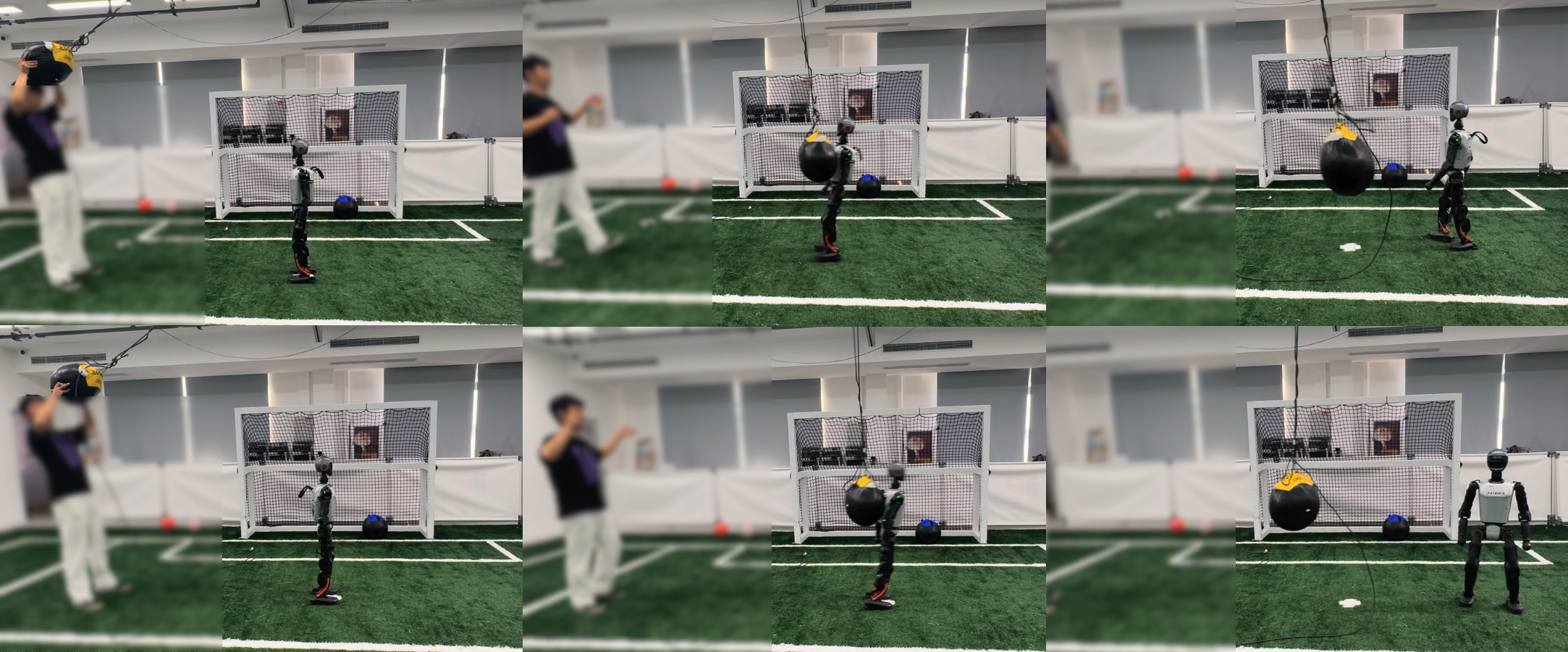
Figure 5: Push-recovery performance. 10kg ball released from 1.3m, robot successfully recovers balance.
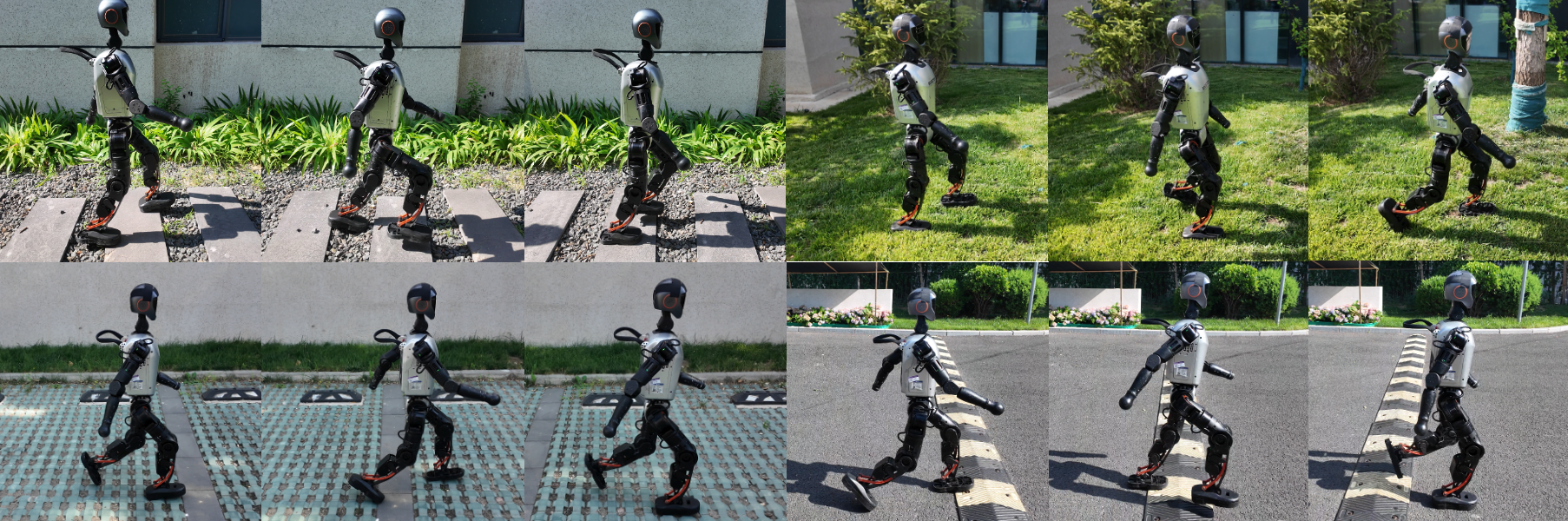
Figure 6: Walking and running in outdoor environments.
Limitations
- Preliminary cross-platform validation: K1 validation provides only preliminary results without detailed quantitative data. Cross-platform generalization requires more systematic evaluation.
- Data curation still requires human intervention: Although the pipeline automates many steps, motion/skill selection and quality checking still require human involvement, limiting full automation.
- Limited running speed: Maximum running speed is 2.0 m/s, which may be insufficient for high-speed locomotion scenarios of full-size humanoid robots. Dynamic stability and safety at higher speeds need verification.
Conclusion and Outlook
Booster Lab demonstrates the effectiveness of a data-centric closed-loop pipeline for deployable humanoid locomotion learning. Integrating motion data curation, real-to-sim adaptation, AMP training, and cross-simulator validation into a coherent process enables deployment failures to feed back into data selection, augmentation, and simulation calibration. On Booster T1, the system achieves walking and running from -0.6 to 2.0 m/s, 50 N·s push-recovery, and stable locomotion on diverse outdoor terrains.
The closed-loop design where real-robot failures guide subsequent data selection, augmentation, simulation calibration, and policy updates provides a diagnosable, improvable engineering framework for humanoid locomotion learning. Preliminary cross-platform success on K1 indicates the pipeline's cross-morphology generalization potential.
Golden insight: Motion data is not a "take what you get" raw material but a living asset that can be repaired, augmented, filtered, and feedback-optimized—Booster Lab turns data curation into the closed-loop engine of humanoid locomotion learning.