PAPER DEEP DIVE
World-Model-Augmented Visual Locomotion for Humanoids on Foothold-Constrained Terrain
Foothold-constrained terrain is characterized by sparse, discontinuous, or geometrically restricted feasible foot contacts, as encountered on stepping stones, across gaps, and on narrow stair treads. On such terrain, a single misstep often leaves little room to recover, so policies that base foot-placement decisions primarily on the immediately visible terrain are prone to failure. We ask whether a learned predictive summary of near-future observations and rewards can provide the anticipatory information required in such settings. We present World-Model-Augmented Visual Locomotion (WM-LOCO), which jointly trains a recurrent world model and a PPO policy. Conditioned on proprioception and a single onboard depth image, the world model produces a predictive recurrent feature that guides the policy, without explicit foothold labels. In simulation, WM-LOCO succeeds on gaps and stepping stones where a matched baseline fails completely, and matches the baseline's success rate on stairs while improving stride efficiency and reducing pelvis acceleration. We deploy the same policy onboard a physical Unitree G1 humanoid using onboard proprioception and a single depth stream; it traverses all three terrain classes with an average success rate of 93.3%.
Paper metadata
Title: World-Model-Augmented Visual Locomotion for Humanoids on Foothold-Constrained Terrain
Authors: Yuxi Liu (co-first), Lijun Han (co-first), Ziming Wang, Ao Zhang, Cong Yang, Wei Sui (project lead / corresponding author)
Affiliations: D-Robotics; Beijing University of Posts and Telecommunications; Harbin Institute of Technology; Soochow University
Submitted: 2 Sep 2026, arXiv:2609.02542 [cs.RO], 11 pages, 3 figures, 4 tables
Code status: the authors released a project-page repository (M0PUPPET/wm-loco) with demo videos and figures; training code is not released. Live page: m0puppet.github.io/wm-loco
One-sentence summary
WM-LOCO jointly trains a recurrent world model (RSSM) with a PPO policy so that, from onboard proprioception and a single depth image, the policy receives a predictive recurrent feature; on stepping stones, gaps and narrow stairs this yields high success where a matched PPO baseline scores zero, and 93.3% average success on a physical Unitree G1.
Background and motivation
When humans cross stepping stones, stride a gap, or climb narrow stairs, they look several steps ahead: they anticipate feasible contacts and choose footholds before placing a foot. That look-ahead is what keeps a biped upright on terrain where only a few discrete spots can be stepped on. Most reinforcement-learning locomotion policies, by contrast, are trained on continuous terrain where feasible foot contacts are dense, and they condition their actions on the current observation or a short window of it. They walk well on flat ground and fall apart when the feasible set becomes sparse.
The authors name this regime foothold-constrained terrain: feasible foot-contact regions that are sparse, discontinuous, or geometrically restricted relative to the robot's nominal step length, as on gaps, stepping stones and narrow stair treads. On such terrain a single misstep is often enough to cause a fall, and bipeds are especially exposed because, compared with quadrupeds, they have fewer supporting contacts available after a missed foothold. There is little room to recover.
Prior systems attack the sparse foothold signal with heavier machinery. BeamDojo splits dense and sparse objectives across critics and progressively raises terrain difficulty; RPL trains privileged experts and distills them into a depth-based student; PLANC wraps reduced-order references in a multi-phase teacher-distillation loop; model-based approaches solve mixed-integer quadratic programs online for footstep planning. These work, but they lean on staged training, distillation, or model-based scaffolding.
A second thread comes from world models. World-model-based perception learns a predictive latent for visual quadruped locomotion; world models have been used to reconstruct world states for humanoid control; the Perceptive Internal Model has been applied to stair traversal; DreamPolicy synthesizes future motion with diffusion. All of them inject predictive or reconstructive objectives into locomotion control and report gains on stairs or rough ground. None of them explicitly targets foothold-constrained terrain, and none measures whether the predictive signal actually helps when feasible footholds become sparse, which is precisely where looking ahead matters most for a biped.
WM-LOCO aims at exactly that gap. Instead of staged critics, distillation, or planners, it co-trains a recurrent world model with PPO end to end. The recurrent model summarizes predictive context from proprioception and a single onboard depth image and yields a predictive recurrent feature that conditions the policy, with no explicit foothold labels. The claim under test is simple: can a learned predictive summary of near-future observations and rewards supply the anticipatory information that foothold-constrained terrain demands?
Preliminaries
Locomotion as a POMDP. At each control step $t$ the policy observes $o_{t}=(p_{t},d_{t},c_{t})$, where $p_{t}$ is a 5-frame proprioception history (joint positions, joint velocities, inertial measurements and the previous action), $d_{t}$ is a depth image from a single head-mounted onboard camera, and $c_{t}$ is the commanded base-frame velocity. The task is to track $c_{t}$ while traversing the terrain and avoiding non-foot contacts.
RSSM. A recurrent state-space model compresses history into a deterministic memory $h_{t}$ plus a stochastic latent $z_{t}$. Intuitively $h_{t}$ is updated recurrently from the previous state, latent and action and carries "what I remember", while $z_{t}$ captures observation-dependent information beyond what the deterministic state represents. The Dreamer line showed this structure works for visual control; WM-LOCO ports it to humanoid locomotion and lets it share encoders and updates with the policy.
Why the standard reward is not enough. On foothold-constrained terrain, velocity tracking plus standard gait shaping is too sparse: most rollouts terminate before the agent discovers any signal distinguishing a feasible step from an infeasible one, and the irreversibility of an early misstep makes temporal credit assignment from the eventual fall difficult. The paper therefore augments the standard reward with terrain-specific shaping terms, applied identically to WM-LOCO and to the PPO baseline so the comparison stays fair.
Method
Overall framework. WM-LOCO couples two blocks: a policy block (PPO with a mixture-of-experts actor-critic) and an RSSM world-model block. The world model consumes proprioception $p_{t}$ and an egocentric depth image $d_{t}$ and maintains a recurrent state summarizing near-future observations and rewards; a feature $f^{\mathrm{WM}}_{t}$ derived from that state conditions the policy. The policy feeds a proprioceptive history, a velocity command, an egocentric depth image and $f^{\mathrm{WM}}_{t}$ into a mixture-of-experts backbone that drives the actor and critic heads.
Four learned components. Concretely the model learns (i) a transition $h_{t}=f_{\phi}(h_{t-1},z_{t-1},a_{t-1})$ that updates the memory with the last action; (ii) a posterior $z_{t}\sim q_{\phi}(z_{t}\mid h_{t},p_{t},d_{t})$ that infers the latent from memory and the current observation; (iii) a prior $\hat{z}_{t}\sim p_{\phi}(z_{t}\mid h_{t})$ that predicts the latent from memory without the current observation; and (iv) decoders that reconstruct proprioception, depth and reward. The stochastic latent has dimension 128.
Training objective. The world-model loss combines three reconstruction terms with a KL term:
$$\mathcal{L}_{\mathrm{WM}}=\underbrace{\mathrm{MSE}(\hat{p}_{t},p_{t})}_{\text{proprio recon}}+\underbrace{\mathrm{MSE}(\hat{d}_{t},d_{t})}_{\text{depth recon}}+\underbrace{\mathrm{MSE}(\hat{r}_{t},r_{t})}_{\text{reward pred}}+\beta\,\underbrace{\mathrm{KL}\!\left(q_{\phi}\,\|\,p_{\phi}\right)}_{\text{forward prediction}}$$
The first three terms push the latent to retain information about observations and rewards. The KL term regularizes the prior toward the posterior, encouraging $h_{t}$ to retain information useful for predicting the latent before the current observation arrives. That is where the "predictive" property comes from: predicting-ahead is written directly into the objective rather than bolted on.
Joint training, not pretraining. The world model is not trained in a separate stage. The standard PPO clipped surrogate objective and $\mathcal{L}_{\mathrm{WM}}$ are optimized in a single joint update, and world-model gradients propagate into the shared depth and proprioceptive encoders. At inference only the memory is passed to the policy as $f_{t}^{\mathrm{WM}}=g_{\psi}(h_{t})$: no imagined rollouts, no foothold labels. The world model acts purely as a predictive feature extractor, so deployment carries no planning overhead.
flowchart LR
  subgraph OBS["onboard observation o_t"]
    P["proprio history p_t
5 frames"]
    D["depth image d_t
32x18 crop"]
    C["velocity cmd c_t"]
  end
  subgraph WM["RSSM world model"]
    OE["observation encoder"]
    POST["posterior q
z_t | h_t, p_t, d_t"]
    PRIOR["prior p
z_t | h_t"]
    TR["state transition f
h_t from h_t-1, z_t-1, a_t-1"]
    DEC["decoders
proprio / depth / reward"]
    WFE["WM-feature g
f_t from h_t"]
  end
  subgraph POL["policy: PPO + MoE actor-critic"]
    HE["history / proprio / depth encoders"]
    MOE["MoE backbone"]
    ACT["actor -> action a_t"]
    CRI["critic"]
  end
  P --> OE
  D --> OE
  OE --> POST
  TR --> POST
  POST --> TR
  POST --> DEC
  PRIOR --> DEC
  POST --> WFE
  P --> HE
  D --> HE
  C --> HE
  WFE --> MOE
  HE --> MOE
  MOE --> ACT
  MOE --> CRI
  DEC -. "L_WM joint update" .- MOE
Terrain-specific rewards via a foot volume-point set. All terrain-specific contact terms are computed from the foot volume-point set $\mathcal{V}^{\mathrm{foot}}_{t}$: contact points sampled on each foot mesh and propagated to the world frame every control step, following the sensor design of Zhu et al. With this point set, "did the foot enter a forbidden region" becomes a countable geometric test.
Stair-boundary penalty. Two-dimensional penalty zones flank each stair structure on the surrounding flat ground, discouraging the policy from detouring around the terrain to satisfy velocity tracking without engaging the foothold constraint. The nonnegative violation term counts foot sample points inside any such zone:
$$r^{\mathrm{bdry}}_{t}\;=\;\bigl|\,\mathcal{V}^{\mathrm{foot}}_{t}\cap\mathcal{Z}^{\mathrm{bdry}}\,\bigr|$$
where $\mathcal{Z}^{\mathrm{bdry}}$ is a per-tile union of 2D rectangles beside the stair footprint (the tile's full lateral range times an $x$-strip flanking the footprint). The edge-zone construction reuses the Terrain Edge Detection primitive of Zhu et al., applied to the flat ground surrounding a stair tile rather than to terrain edges.
Riser-penetration penalty. Analogously, the per-step violation counts foot sample points that fall inside any stair riser:
$$r^{\mathrm{riser}}_{t}\;=\;\bigl|\,\mathcal{V}^{\mathrm{foot}}_{t}\cap\mathcal{Z}^{\mathrm{riser}}\,\bigr|$$
where $\mathcal{Z}^{\mathrm{riser}}$ is a per-tile union of axis-aligned 3D cuboids over each riser face, with the upper 4 cm of each riser excluded. That clearance prevents oblique foot contacts near the leading edge of the tread from being misclassified as riser penetrations. The authors report that without this penalty riser strikes appear consistently in simulation and were also observed during hardware testing; with it, the failure disappears from simulation rollouts and the policy transfers to hardware without further tuning. A small penalty term fixing a large real-robot problem.
Sequential stair-tread contact reward. The reward maintains an ordered sequence of horizontal tread contact regions $R_{1},R_{2},\dots$ along the current heading, with a per-environment index $k_{t}$ marking the current region. When a foot first attains a sole-contact ratio of $c_{\min}=0.5$ on $R_{k_{t}}$, a velocity-adaptive activation window of $\tau_{t}=\mathrm{clip}\!\left(\ell_{k_{t}}/(2\,\bar{v}^{\mathrm{cmd}}\,\Delta t),\,5,\,50\right)$ control steps opens, where $\ell_{k_{t}}$ is the region depth and $\bar{v}^{\mathrm{cmd}}$ the commanded forward speed. During the open window:
$$r^{\mathrm{tread}}_{t}\;=\;g_{t}\,\rho^{\mathrm{seq}}_{t}\;-\;0.7\,\max\!\bigl(0,\;\rho^{\mathrm{other}}_{t}-0.05\bigr)$$
where $g_{t}\in\{0,1\}$ is 1 while the window of $R_{k_{t}}$ is open, $\rho^{\mathrm{seq}}_{t}$ is the sole-contact ratio of the foot required by left-right alternation on $R_{k_{t}}$ (a wrong-foot landing receives credit discounted by 0.3 rather than zero, preserving a nonzero learning signal), and $\rho^{\mathrm{other}}_{t}$ is the other foot's overlap with the current region. The index advances to $R_{k_{t}+1}$ only after contact is sustained for at least $0.3\,\tau_{t}$ frames; contacts with later regions earn nothing until the current region is completed. This sequential gating turns stair climbing into a curriculum with explicit progress.
Stepping-stone top-contact reward. Stepping stones use a separate parallel formulation: all valid stone-top regions for the current tile are active at reset and each is consumed independently after qualifying contact, so there is no sequential ordering and no alternating-foot logic. Center-plateau shaping encourages centered footholds while per-foot lane gating penalizes wrong-foot overlap on lane-tagged stones.
Total reward. For the gap+stairs training setting the three terms combine with the standard reward as
$$r_{t}\;=\;r^{\mathrm{std}}_{t}+w_{b}\,r^{\mathrm{bdry}}_{t}+w_{r}\,r^{\mathrm{riser}}_{t}+w_{t}\,r^{\mathrm{tread}}_{t}$$
with weights $w_{b},w_{r},w_{t}$ listed in Appendix B (boundary $-0.05$, riser $-0.5$, sequential tread $+0.5$), tuned jointly with the world-model loss. Reward shaping and the world model are therefore two parts of one optimization problem, not two stacked layers.
Where the weights sit in the full schedule. Appendix B tabulates the complete reward configuration for the two terrain-training settings, and the magnitudes are instructive about what the authors consider load-bearing. Task tracking dominates: exponential linear-velocity tracking and angular-velocity tracking both carry $+3.0$, heading error $-1.0$, no-progress $-2.0$ and an alive bonus of $+0.5$ in both settings. Against that background the stair-specific terms are deliberately small in absolute value: the boundary penalty enters at $-0.05$ per counted foot point and the riser penalty at $-0.5$, while the sequential tread reward contributes $+0.5$. The stepping-stone setting is shaped differently: the stone-top contact reward is the single largest positive term at $+4.0$, pillar-body contact is punished at $-3.0$, and a termination penalty of $-10.0$ makes early episode ends explicitly costly, which is a direct response to the sparse-reward problem described in the preliminaries. The stones setting also adds a periodic gait clock (force phase $+0.5$, speed phase $+0.5$, support-force phase $+0.3$) and a stance-width anchor at $-1.0$ with a feet-too-near penalty of $-2.0$, reflecting that discrete pads force a wider, more deliberate stance than continuous ground does.
Curriculum and architecture. Both methods are trained with PPO under the same hyperparameters and budget; WM-LOCO additionally carries the RSSM pathway, its auxiliary objective and the recurrent feature supplied to the policy. The terrain curriculum advances independently for each environment according to exponential velocity-tracking scores: an environment moves up one difficulty tile when both $r^{\mathrm{xy}}_{\mathrm{exp}}>0.75$ and $r^{\mathrm{yaw}}_{\mathrm{exp}}>0.5$, and moves down when $r^{\mathrm{xy}}_{\mathrm{exp}}<0.5$. This per-environment, score-gated progression is what lets 8192 parallel environments sit at different points of the difficulty grid at any moment, and it is shared by both methods so the curriculum itself cannot explain the performance gap. On the architecture side, the policy uses a mixture-of-experts backbone feeding actor and critic heads together with an AMP motion prior, and the world-model pathway reuses the same proprioceptive and depth encoders rather than introducing parallel ones, which is what makes the joint gradient update meaningful rather than merely convenient.
Experiments
Setup and baseline. Simulation runs a Unitree G1 in IsaacLab with 8192 parallel environments on a single NVIDIA RTX 5880-Ada (48 GB). Depth comes from a simulated head-mounted Intel RealSense D435, rendered at $64\times 36$ with an $89.5^{\circ}\times 58.3^{\circ}$ field of view, cropped to $32\times 18$, clipped to 0.1-2.5 m and sampled at 50 Hz. The baseline is a PPO policy under matched training conditions: same reward, same perception stream, same proprioceptive encoder, same AMP motion prior, same MoE actor-critic and same iteration budget; it omits only the world-model pathway and its auxiliary loss, so observed differences point to the predictive recurrent feature. Evaluation uses held-out terrain instances, one terrain class per episode, a fixed generator row per tier, pushes and domain randomization disabled, and at least 50 episodes per (method, terrain, difficulty) cell; an episode succeeds if the center of mass crosses the goal line within 45 s.
Success rates: a cliff on sparse terrain. Table 1 of the paper gives the headline numbers. On gaps and stepping stones the PPO baseline reaches 0.0% at every difficulty tier while WM-LOCO lands between 78.2% (stepping stones, Hard) and 100% (gap, Medium). On stairs both methods succeed, PPO at 87.0-91.4% and WM-LOCO at 92.0-95.7%, a gap of at most 7.2 percentage points. The shape of the result, modest on stairs and decisive on sparse terrain, is exactly what the hypothesis predicts: the predictive signal pays off where looking ahead is mandatory.
| Terrain | Tier | PPO | WM-LOCO | Real |
|---|---|---|---|---|
| Stairs | Easy | 87.0% | 94.2% | 90% |
| Stairs | Medium | 91.4% | 95.7% | - |
| Stairs | Hard | 91.3% | 92.0% | - |
| Gap | Easy | 0.0% | 98.0% | 90% |
| Gap | Medium | 0.0% | 100.0% | - |
| Gap | Hard | 0.0% | 90.0% | - |
| Stepping stones | Easy | 0.0% | 87.0% | 100% |
| Stepping stones | Medium | 0.0% | 88.3% | - |
| Stepping stones | Hard | 0.0% | 78.2% | - |
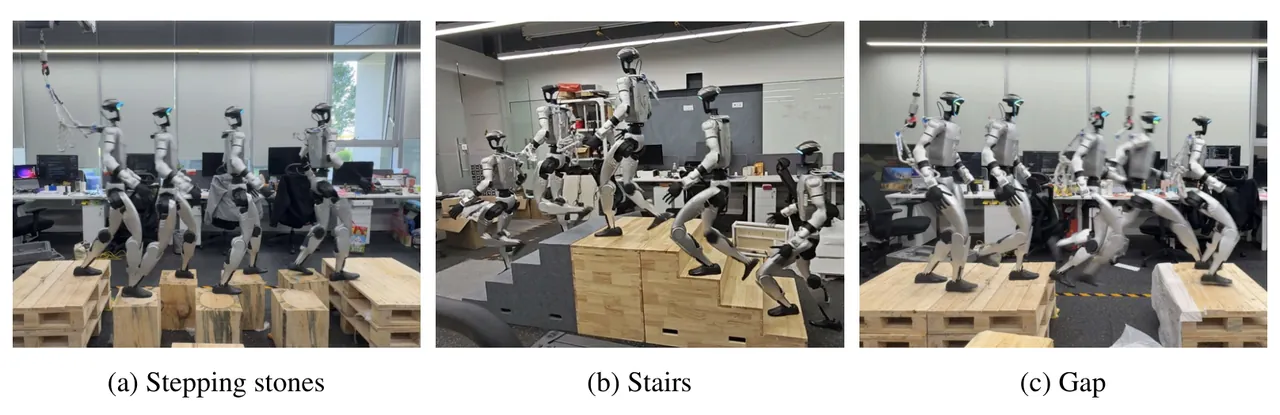
Figure 1: Hardware deployment of WM-LOCO on a Unitree G1: (a) stepping stones, (b) stairs, (c) gap. The policy runs from a single onboard depth stream with no offboard perception and no terrain map.
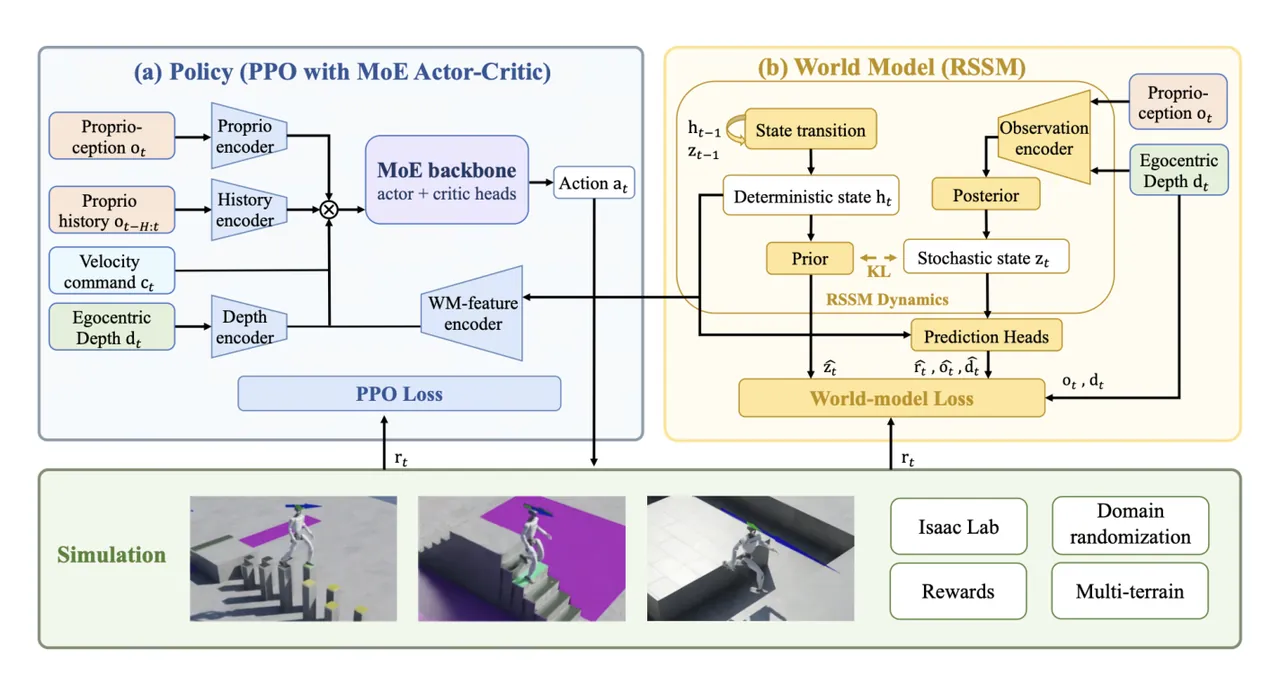
Figure 2: The WM-LOCO framework. Left: policy block (PPO with MoE actor-critic). Right: RSSM world-model block; the world-model feature $f_t$ conditions the policy backbone.
Gait quality: not just passing stairs, but passing them cheaply. Where success rates are close, gait quality separates the two methods. WM-LOCO takes longer strides (+15% to +35%), fewer steps per meter (-9% to -21%), lower pelvis acceleration (-24% to -33%) and 6-20% less normalized mechanical energy. The table below reproduces Table 4. On the Hard tier, stride length rises from 0.40 m to 0.54 m, steps per meter fall from 5.15 to 4.07, pelvis acceleration drops from 9.89 to 6.58 m/s2 and action-rate falls from 8.14 to 3.32, i.e. smoother, less jittery actuation. Notably the torque-to-limit ratio stays essentially tied (0.67 vs 0.66), so the efficiency gain is not bought by working the actuators harder.
| Metric | Unit | Tier | PPO | WM-LOCO |
|---|---|---|---|---|
| Stride length (higher better) | m | Easy / Medium / Hard | 0.45 / 0.42 / 0.40 | 0.52 / 0.53 / 0.54 |
| Steps per meter (lower better) | - | Easy / Medium / Hard | 4.91 / 5.04 / 5.15 | 4.45 / 4.26 / 4.07 |
| Normalized mechanical energy (lower better) | - | Easy / Medium / Hard | 1.01 / 1.21 / 1.43 | 0.95 / 1.01 / 1.14 |
| Pelvis acceleration (lower better) | m/s2 | Easy / Medium / Hard | 6.96 / 8.26 / 9.89 | 5.28 / 5.85 / 6.58 |
| Action-rate (lower better) | - | Easy / Medium / Hard | 3.94 / 6.19 / 8.14 | 2.61 / 2.88 / 3.32 |
Failure modes: from falling to mis-stepping. On stepping stones, when WM-LOCO fails the dominant mode is an illegal foothold (23.0% aggregated over tiers) rather than a fall (1.9%). Baseline failures are mostly falls (61.0%) or lack of progress (36.0%), often within the first few contacts of an episode. The world model does not eliminate mis-steps; it downgrades the consequence of a mis-step from "fall over" to "step wrong but stay standing", which is exactly the fault tolerance sparse terrain demands. Gaps show the same pattern: the baseline stays at 0% across tiers while WM-LOCO remains at or above 90%.
What the world model actually learned. The authors probe the world-model head with one-step posterior reconstruction: recorded observations from a rollout are encoded into the recurrent latent and reconstructed as depth and proprioception. After one warm-up step the per-step depth reconstruction MSE is generally below $1\times 10^{-3}$, apart from a transient peak of about $1.2\times 10^{-3}$ near steps 45-55 when a high-relief structure crosses the field of view; aggregate proprioceptive reconstruction MSE falls below $5\times 10^{-4}$, with base angular velocity the highest-error channel at about $1\times 10^{-3}$, consistent with a high-bandwidth IMU-derived signal. The per-panel MSE values in Figure 3(a) are 0.0117 / 0.0004 / 0.0006 / 0.0001, the large step-1 error reflecting recurrent-state initialization. The authors are explicit that this analysis characterizes encoder/decoder reconstruction fidelity rather than open-loop forward-prediction quality.
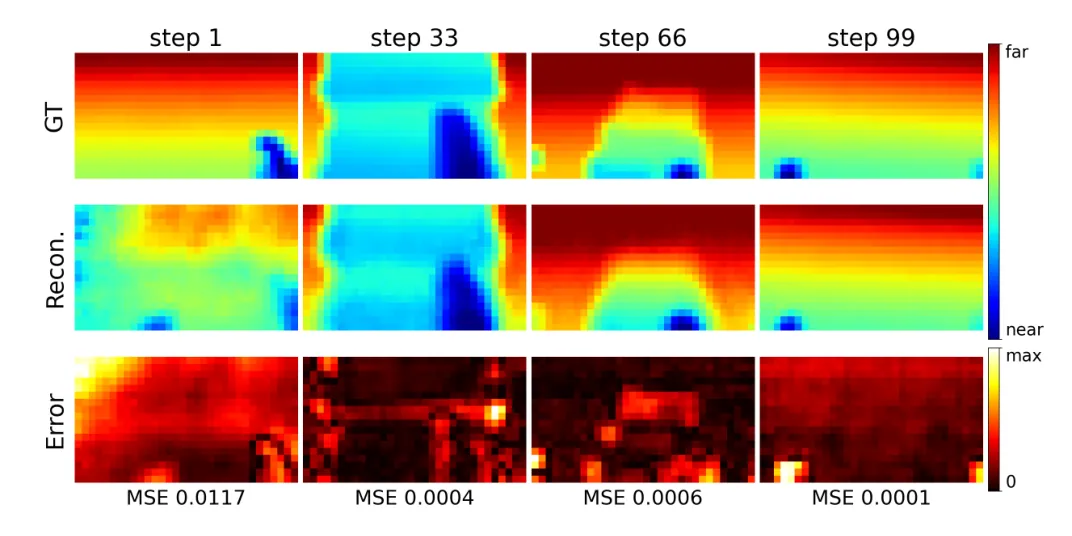
Figure 3(a): ground-truth depth, posterior reconstruction and per-pixel absolute error at four recurrent update steps, with per-step MSE; the large step-1 error reflects recurrent-state initialization.
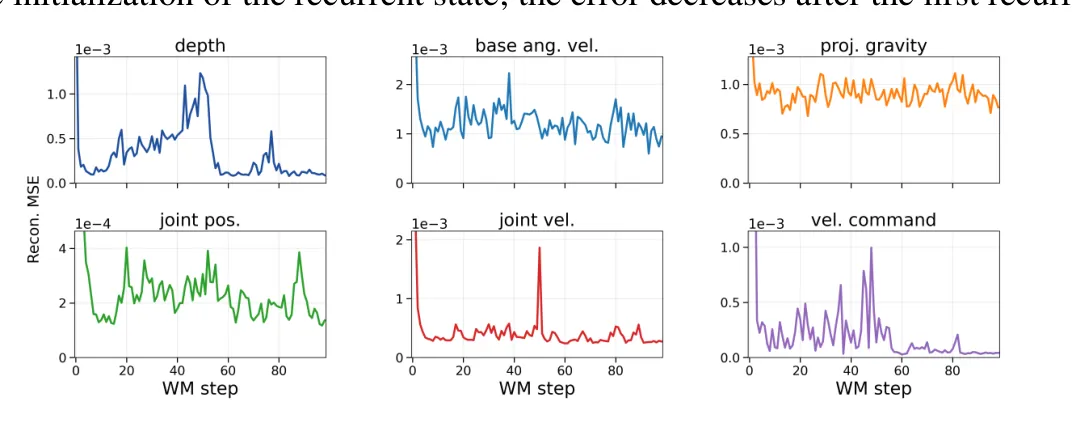
Figure 3(b): per-tick reconstruction MSE for the depth image and each proprioceptive variable group (median across 7 parallel environments).
Sim-to-real: the same policy, fully onboard. The policy is exported to ONNX and deployed on a Unitree G1 running on a Jetson Orin from proprioception and a single head-mounted depth stream (RealSense D435, matching the simulated camera), with no offboard perception, no precomputed terrain map and no extra state estimator. On stepping stones with 0.25 m wide tops and 0.45 m longitudinal gaps the policy crosses the discrete pads without observed foot-placement failures; on stairs with 0.15 m risers and 0.25 m treads it negotiates each riser and places each foot flat on the tread without additional tuning; the 0.8 m gap is crossed in a single step with a swing-and-landing pattern similar to simulation. Larger gaps were not tested for safety reasons. Ten trials per class give the real-robot column of Table 1 (stones 100%, stairs 90%, gap 90%), averaging 93.3%.
How the difficulty tiers are defined. Appendix A (Table 2) lists the physical dimensions. Stair riser height runs 9.2-10.4 cm (Easy), 12.8-14.0 cm (Medium), 18.8-20.0 cm (Hard) and 15 cm on the real course, with tread depth 25.5-30.0 cm increasing across tiers; gap width is 0.40 / 1.00 / 2.00 m (real 0.8 m); stepping-stone edge length is 33-34 / 30-31 / 25-26 cm with same-lane gaps of 7-9 / 13-15 / 23-25 cm (real 25 cm edge, 45 cm gap). At the Hard tier a 25-26 cm stone separated by 23-25 cm is genuinely a "one wrong step and it is over" regime for the G1's nominal stride.
Reading the real-robot column carefully. The hardware numbers deserve a cautious reading. Ten trials per class is a small sample, so the 90-100% per-class figures carry wide confidence intervals, and the real course is not identical to any single simulation tier: the real stairs (15 cm riser, 25 cm tread) sit between the Easy and Medium simulation rows, while the real stepping stones (25 cm edge, 45 cm gap) are closer to the Hard row in edge length but far more generous in longitudinal spacing. The honest claim the hardware supports is therefore transfer without retuning across all three terrain classes, not a precise replication of any simulation tier. Even so, the qualitative agreement is striking: the swing-and-landing pattern over the gap and the flat foot placement on treads match simulation, and no foot-placement failures were observed on the discrete pads.
Limitations
Stated by the authors, scope. The framework targets foothold-constrained terrain where feasible contacts are dominated by discrete pads or narrow geometric constraints. Continuous narrow supports such as balance beams, and stepping stones with varying elevations, combine lateral and vertical constraints and may require separate reward shaping; outdoor unstructured terrain is out of scope.
Stated by the authors, platform and architecture. Results are reported on a single Unitree G1 humanoid and a single RSSM world-model backbone. The policy consumes a generic predictive recurrent feature, so the formulation can accommodate alternative world-model architectures, but evaluating other humanoid morphologies and additional foothold-constrained tasks remains future work.
Our read: reconstruction fidelity is not prediction. The paper uses one-step posterior reconstruction to argue the world model learned a useful representation, yet the authors themselves note this measures reconstruction fidelity, not open-loop forward-prediction quality. The causal claim that success gains come from the predictive feature currently rests on the ablation (removing the world-model pathway) rather than on a direct measurement of predictive behavior; how much the policy actually exploits the KL-encouraged look-ahead lacks interpretability-level evidence.
Our read: shaping and world model are entangled. The terrain-specific rewards are identical for WM-LOCO and the baseline, which keeps the comparison fair but also means sparse-terrain success is the joint product of reward shaping and the world model. The paper does not report the crossed ablations (shaping without world model, world model without shaping), so the individual contribution of each component cannot be separated.
Conclusion and outlook
WM-LOCO's contribution is not a new world-model architecture but a deliberately minimal way of attaching a mature RSSM to a humanoid policy: joint training, feature-only usage, no imagination at inference, evaluated on a clearly defined terrain family. A small set of countable geometric reward terms (boundary, riser, sequential tread, stone-top contact) makes the sparse foothold signal learnable, and the predictive recurrent feature turns "look a few steps ahead" into an input channel for the policy. The cliff-like simulation gap, the 93.3% average real-robot success, and the shift of failure modes from falling to mis-stepping form a coherent evidence chain.
The engineering lessons are equally concrete: the 4 cm clearance in the riser penalty, the 0.3 wrong-foot discount and the $0.3\,\tau_{t}$ advance threshold in the tread reward are all tricks for keeping gradient signal alive in a sparse regime; and routing world-model gradients into shared encoders with zero inference overhead is what makes the whole thing runnable on onboard compute. Natural next steps are more humanoid morphologies, richer world-model backbones, and folding mixed-constraint terrain such as balance beams and variable-height stones into the same framework.
Golden line
"On foothold-constrained terrain the policy does not lack a clearer view of the ground under its feet; it lacks knowledge of where the next step can still land. Learning that look-ahead as a recurrent feature is cheaper, and more general, than handing it a foothold label."
SOURCE LINKS