PAPER DEEP DIVE
PriMoRetarget: Humanoid Motion Transfer Through Prioritized Motion Retargeting
Motion retargeting is a critical preprocessing step for transferring human motion data to humanoid robots. While existing methods are effective for single-character motions, interactions involving multiple characters and objects introduce additional contacts and spatial relationships that must be preserved. Retargeting is commonly formulated as a weighted multi-objective optimization problem, where conflicting objectives can require careful tuning of relative weights and can still compromise important motion characteristics. We introduce PriMoRetarget, a prioritized motion-retargeting framework that replaces relative objective weighting with an explicit priority hierarchy. Lower-priority updates are constrained to preserve higher-priority objectives, allowing critical characteristics such as foot placement and interaction contacts to take precedence over lower-priority pose objectives. The method is evaluated on four datasets spanning single-character motion, character-object manipulation, and character-character interactions. The resulting motions better preserve task-relevant interactions and provide reference trajectories that can be tracked more reliably than those produced by widely used retargeting methods.
Paper Metadata
- Title: PriMoRetarget: Humanoid Motion Transfer Through Prioritized Motion Retargeting
- Authors: Nicholas Ioannidis*, Dun Yang* (co-first authors), Max Smith, Tue Vu, Ziyu Zhang, Shayegan Omidshafiei, Xue Bin Peng
- Affiliations: Simon Fraser University, FieldAI, NVIDIA, Alberta Machine Intelligence Institute (Amii)
- Links: arXiv:2610.12642v1 (2026-10-08); project page nickioan.github.io/primoretarget-page
- Code status: The paper states that code and retargeted motion data will be released upon publication. The project page currently reads "Code (coming soon)", and the associated repository contains only the website and demo videos, so no implementation is public at the time of writing.
One-Sentence Summary
PriMoRetarget replaces the hand-tuned weight vector of multi-objective motion retargeting with an explicit priority hierarchy: gradients of lower-priority objectives are projected into the nullspace of the Jacobians of higher-priority objectives, so foot placement and interaction contacts are satisfied before pose similarity ever gets a vote.
Background and Motivation
Humanoid robots are starved for behavior data while human motion-capture archives hold decades of walking, carrying, and cooperative behavior. Motion retargeting is the bridge between the two: it maps source-character motion parameters onto a target robot's joint structure while preserving the characteristics that define the motion. For single-character motion this pipeline is mature. Inverse-kinematics-based optimizers and data-driven methods that learn embodiment-disentangled representations both produce usable results for locomotion-style clips.
The moment an object or a second actor enters the scene, the problem changes character. The hand-box contact during a lift, the relative placement of two hands on a partner's torso during an assisted stand-up, the rhythm of two carriers handing off a crate: these relationships are what make the motion meaningful. A retargeting result that preserves each body's pose but loses these relationships is physically infeasible as a reference trajectory. Hands hover outside the box, feet sink into the floor, two robots interpenetrate. Such errors do not stay in the visualization; they propagate into reinforcement learning and control, where an inconsistent reference can make a tracking policy untrainable.
The dominant formulation writes all of these requirements as a weighted multi-objective optimization: keypoint pose matching, foot placement, contact preservation, and joint limits each contribute a loss term scaled by a weight $w^k$. The trouble is that the objectives conflict. Pulling the pose closer to the source typically costs contact accuracy. Weights encode only relative preference; they cannot express the hard statement "contact error must never be paid for with pose improvement." In practice this forces per-task, per-morphology weight tuning, and a weight set that works on one clip frequently fails on the next.
The multi-objective optimization community offers two families of weight-free conflict handling. Gradient-surgery methods such as PCGrad and CAGrad modify mutually interfering gradients to reduce conflict, but they impose no ordering of importance. Prioritized optimization instead arranges objectives into a hierarchy and lets each level optimize only within the solution set left optimal by the levels above it. Robotics has used this idea for decades to exploit kinematic redundancy: in whole-body control and inverse kinematics, "keep the feet from sliding" naturally outranks "pose the arms nicely." Prior work, however, applied it almost exclusively in online control and model-predictive settings.
It is worth placing the paper against the data-driven alternative. Learned retargeting methods map between morphologies directly from motion data, sometimes across substantially different skeletal structures, and contact-aware variants fold geometric and contact information into the learned representation. Their weakness is distributional: they are bounded by the motions and morphologies present in training data. Optimization-based retargeting needs no motion- or morphology-specific training set, which the authors argue is why it has seen wider practical adoption. PriMoRetarget stays on the optimization side and changes only how conflicting objectives are reconciled, so it inherits that breadth while removing the tuning burden that made the optimization side painful.
This paper moves prioritized optimization into offline motion retargeting and solves the three engineering problems that arise on the way: the cubic cost of projecting over long sequences, the awkward position of global regularizers such as temporal smoothness inside a hierarchy, and the failure mode where projection locks the optimizer when the initialization is far from feasible. The answers are a per-frame block-diagonal batched projection, a "free objective" mechanism, and a short weighted-sum warmup. The framework is validated on four datasets spanning single-character motion, character-object manipulation, character-character assistance, and multi-character collaborative manipulation.
Preliminaries
The optimization variable is the target robot's per-frame motion: root position $r_t\in\mathbb{R}^3$, root orientation $\omega_t\in\mathbb{R}^3$, and joint configuration $\theta_t\in\mathbb{R}^{n_\theta}$, i.e. $d=6+n_\theta$ parameters per frame. When several robots appear, all of their parameters are optimized jointly. Forward kinematics maps parameters to keypoint positions $p_{t,i}$ and orientations $R_{t,i}\in SO(3)$, with keypoint correspondences between source character and target robot specified by the user. Table I of the paper collects the error functions: pose terms compare keypoint position $\hat{p}_{t,i}-s_\dagger\cdot\bar{p}_{t,i}$ and orientation $\hat{R}_{t,i}\ominus\bar{R}_{t,i}$; interaction terms preserve relative displacements between keypoint pairs (self within one character, cross between characters); contact terms act on body pairs whose source-motion distance falls below a threshold $c_{\mathrm{th}}$, split into object and character contacts. Hats and bars denote retargeted and source quantities respectively.
The standard weighted multi-objective form is
$$x^{\star}=\arg\min_{x}\sum_{k=1}^{K}w^{k}L^{k}(x)$$
where $x$ is the entire target motion and $L^k$ the $k$-th loss. The form is flexible, but conflicting objectives can only compromise: even when one term represents a more important physical requirement, its error can still be bought down by decreases elsewhere. That compromise is exactly what this paper removes.
Prioritized optimization builds on redundancy exploitation. The optimal set of a higher-priority objective is usually not a single point; the residual degrees of freedom form a solution set within which lower-priority objectives may keep optimizing without undoing what was achieved. Task-priority methods formalize this as "update only in directions that keep the higher-priority error unchanged," a principle with a long history in articulated-character inverse kinematics and humanoid whole-body control. The present work generalizes it from online control to offline optimization of entire motion sequences.
Two details of the objective construction deserve attention before the method. First, interaction keypoint pairs are not chosen by hand per clip: they are selected through a per-frame Delaunay tetrahedralization of the source configuration, following the interaction-mesh literature, which yields a sparse but structurally meaningful set of relative-displacement constraints. Second, contact objectives are gated by proximity: a body pair enters the active contact set only when its distance in the source motion falls below a threshold, so the hierarchy spends its highest slots on contacts that actually happen in the source clip rather than on every conceivable pair.
Method
The hierarchy, formally. Let objectives be ordered from highest to lowest priority as $L^1,\ldots,L^K$, and let $S^0$ be the set of all target motions. At level $k$ the objective is minimized over the solution set left by the level above:
$$x_k^{\star}\in\arg\min_{x\in S^{k-1}}L^{k}(x)$$
After solving, the solution set contracts to the subset that preserves level $k$'s optimal value:
$$S^{k}=\left\{x\in S^{k-1}\;\middle|\;L^{k}(x)=L^{k}(x_k^{\star})\right\}$$
The recursion is global, but the implementation enforces it locally at every gradient step: lower-priority updates are restricted to directions that preserve higher-priority objectives to first order. The rest of the method section unpacks that local enforcement.
Preserve the error vector, not the scalar loss. Let the vector-valued error of a higher-priority objective be $f^{\mathrm{H}}(x)\in\mathbb{R}^m$, with scalar loss $L^{\mathrm{H}}(x)=\|f^{\mathrm{H}}(x)\|^2$ (for instance the stacked 3D position errors of several corresponding bodies). The requirement is that the whole error vector stays fixed:
$$f^{\mathrm{H}}(x+\delta x)=f^{\mathrm{H}}(x)$$
This choice carries real content. Freezing only the scalar loss would still allow error components to compensate each other: one hand drifts, the other compensates, the norm is unchanged, and the contact is still broken. Freezing the vector rules out that compensation.
First-order linearization and the nullspace. Linearizing the higher-priority error around the current parameters for a small update $\delta x$ gives
$$f^{\mathrm{H}}(x+\delta x)\approx f^{\mathrm{H}}(x)+J^{\mathrm{H}}\delta x$$
with $J^{\mathrm{H}}=\partial f^{\mathrm{H}}/\partial x$. Combined with the invariance requirement this yields the constraint $J^{\mathrm{H}}\delta x=0$: admissible updates live in the nullspace of the higher-priority Jacobian. Writing the lower-priority gradient as $g^{\mathrm{L}}=\nabla_x L^{\mathrm{L}}$, the nullspace projector maps it into that space:
$$P^{\mathrm{H}}=I-(J^{\mathrm{H}})^{\top}\left(J^{\mathrm{H}}(J^{\mathrm{H}})^{\top}\right)^{-1}J^{\mathrm{H}}$$
$$x\leftarrow x-\alpha P^{\mathrm{H}}g^{\mathrm{L}}$$
Figure 2 of the paper draws the essential contrast with a weighted sum on two competing quadratic objectives: the weighted solution settles on a compromise point, while the projected update first reaches the optimal manifold of the higher-priority objective and then improves the lower-priority one only along tangent directions of that manifold. In practice $J^{\mathrm{H}}$ can be rank deficient or ill-conditioned, so the damped projector is used, regularizing the inner $m\times m$ system with a small positive $\lambda$:
$$P^{\mathrm{H},\lambda}=I-(J^{\mathrm{H}})^{\top}\left(J^{\mathrm{H}}(J^{\mathrm{H}})^{\top}+\lambda I\right)^{-1}J^{\mathrm{H}}$$
Per-frame separability: cubic to linear. Projecting over an entire sequence is prohibitively expensive. The projection matrix grows to $(Tm)\times(Tm)$ with frame count $T$ and error dimension $m$, and a dense solve costs $O(T^3m^3)$. The authors observe that most retargeting objectives are separable across frames: the error at a frame depends only on that frame's parameters. Higher-priority Jacobians are therefore block diagonal in time. Stacking the Jacobians of all higher-priority objectives at frame $t$ as
$$J_t^{{<k}}=\begin{bmatrix}(J_t^{1})^{\top}&\cdots&(J_t^{k-1})^{\top}\end{bmatrix}^{\top}$$
the sequence-wide projection decomposes into $T$ independent per-frame systems, and the projected gradient of level $k$ at frame $t$ is
$$\tilde{g}^{k}_{t}=\left(I-(J_t^{{<k}})^{\top}\left(J_t^{{<k}}(J_t^{{<k}})^{\top}+\lambda I\right)^{-1}J_t^{{<k}}\right)g^{k}_{t}$$
Each system is only an $m\times m$ linear solve, and the $T$ systems run as a batched GPU operation, cutting complexity to $O(Tm^3)$. Figure 5 measures this on an RTX 5090: the dense solve's wall-clock cost climbs steeply with sequence length while the per-frame formulation stays nearly constant over the evaluated range, where runtime is dominated by GPU overhead, and the behavior persists on LAFAN1 clips exceeding 5000 frames. This is what makes 35 minutes of multi-character collaboration tractable.
Free objectives: the right home for global regularizers. Temporal smoothness, joint limits, and ground penetration do not fit a strict hierarchy because they act on nearly all degrees of freedom. Placed at high priority they would leave almost no nullspace for later objectives; placed at low priority their influence would be largely projected away by the higher-priority Jacobians. The authors therefore declare them free objectives: they hold no priority slot, and their gradients are added directly to the accumulated projected gradient, regularizing the motion without introducing extra nullspace constraints.
Weighted-sum warmup: a starting point the projection can walk from. Because the nullspace projection clips lower-priority updates according to the current higher-priority objectives at every iteration, an initialization far from a suitable solution makes it hard to traverse large distances in parameter space. The optimizer therefore begins with a short uniform weighted-sum phase that pulls the motion into a reasonable region before the hierarchy takes over. The ablation shows this phase is decisive precisely on the data that needs large corrections.
One iteration end to end. Algorithm 1 assembles the pieces. For each priority $k$ it computes $g^k=\nabla_x L^k(x)$, projects it with the currently stacked higher-priority Jacobians $J^{{<k}}$ to obtain $\tilde{g}^k$, accumulates it into the total gradient, and appends the level's Jacobian $J^k=\partial f^k/\partial x$ to the row stack. After the loop the free-objective gradient is added and a single gradient step $x\leftarrow x-\alpha g_{\text{total}}$ is taken. The growing row stack is what guarantees that level $k+1$'s update preserves all $k$ levels above it.
The hierarchy and scaling used in experiments. A single three-level hierarchy is shared across all motions: (1) foot-position matching, which preserves the stepping pattern of the source; (2) contact preservation with objects or other characters where applicable; (3) the remaining pose and interaction objectives, which spend the leftover degrees of freedom on matching the source more closely. Scaling is scene-dependent: single-character motion is uniformly scaled by the height ratio $s_{\mathrm{s}\rightarrow\mathrm{t}}=h_{\mathrm{tgt}}/h_{\mathrm{src}}$; with objects the shared scene scale is $s_\dagger=1$, preserving object geometry and trajectory exactly; for character-character interaction one character is the anchor and $s_\dagger$ takes its source-to-target scale, keeping the pair's relative spatial relationship. Interaction keypoint pairs are selected by a per-frame Delaunay tetrahedralization of the source configuration.
Where this sits relative to gradient surgery and adaptive reweighting. Adaptive reweighting schemes adjust loss weights during optimization, and CAGrad accounts for worst-case objective performance, while PCGrad projects conflicting gradient pairs onto each other's normal planes. None of these enforce an ordering: after surgery, a lower-importance objective can still trade against a higher-importance one. In retargeting that is the wrong semantics. A foot contact that slips for the sake of a smoother elbow is not a balanced trade, it is a broken reference. The nullspace construction makes the ordering structural rather than statistical: once level one is satisfied to first order, no combination of lower-level gradients can move it, because every accumulated gradient has been stripped of its component in the row space of the higher-priority Jacobians.
flowchart TD
  S0["S^0: all target motions"] --> P1
  P1["Priority 1
foot-position error
min over S^0"] --> S1["S^1: foot placement preserved"]
  S1 --> P2["Priority 2
contact preservation
min over S^1"]
  P2 --> S2["S^2: hand contacts preserved"]
  S2 --> P3["Priority 3
pose and interaction
min over S^2"]
  P3 --> PROJ["project gradient into nullspace
of stacked Jacobians J"]
  FREE["free objectives
smoothness, joint limits, ground
gradients added directly"] --> PROJ
  PROJ --> UPD["x = x - alpha * g_total"]
  UPD --> OUT["retargeted motion
for RL tracking and hardware"]
flowchart LR
  DENSE["dense projection
(Tm) x (Tm) system
cost O(T^3 m^3)"] --> SLOW["solve time grows
with sequence length"]
  BLOCK["per-frame block diagonal
T independent m x m systems
cost O(T m^3)"] --> FAST["batched on GPU
near-constant runtime
even beyond 5000 frames"]
Experiments
Setup. Four datasets form a ladder of interaction complexity: LAFAN1 for single-character motion, the large-box category of OMOMO for character-object manipulation, the assistive subset of Inter-X where one character helps another rise from the ground, and a 35-minute in-house dataset of collaborative carrying and handoffs between two people. The target embodiment is primarily the Unitree G1. Baselines are three widely used methods: PHC (trajectory-level keypoint fitting), GMR (frame-wise inverse kinematics with a weighted-sum objective), and OmniRetarget (constrained optimization over interaction meshes); for multi-character scenes the baselines retarget each character independently. Kinematic metrics cover penetration duration and depth against ground, objects, and other robots, foot sliding velocity and floating height during source stance phases, jitter estimated from the third derivative of body positions, and the fraction of source hand contacts reproduced after retargeting. On the RL side, a separate PPO policy is trained per motion on a simulated G1 following the DeepMimic recipe, over 50 motions in total; success requires completing the reference with no robot or object deviating by more than 0.5 meters.
Main comparison: the richer the interaction, the larger the gain. Table II shows PriMoRetarget achieving the highest contact preservation in every interaction setting: 96.9% on OMOMO against 63.2% for PHC, 48.6% for GMR, and 86.4% for OmniRetarget; 78.8% on Inter-X against a best baseline of 35.2%; 92.4% on the in-house set against a best baseline of 29.3%. Downstream tracking leads across the board as well: success rates of 100% on both LAFAN1 and OMOMO with body tracking errors of 1.8 cm and 2.8 cm respectively (3.0 cm object error on OMOMO), and 93.6% success with 4.5 cm error on Inter-X. Single-character results are close across methods, with GMR and OmniRetarget also reaching 90% success, which localizes the value of prioritization to conflict-dense interaction motions. The in-house row remains the weakest cell in the table at 62.6% success and 47.4 cm object error, which the authors attribute to the intrinsic difficulty of jointly controlling multiple interacting robots and objects. The qualitative comparison in Figure 3 agrees with the numbers: baselines lose hand-box contact or distort the interaction on a box-manipulation sequence, while PriMoRetarget keeps the hands on the box.
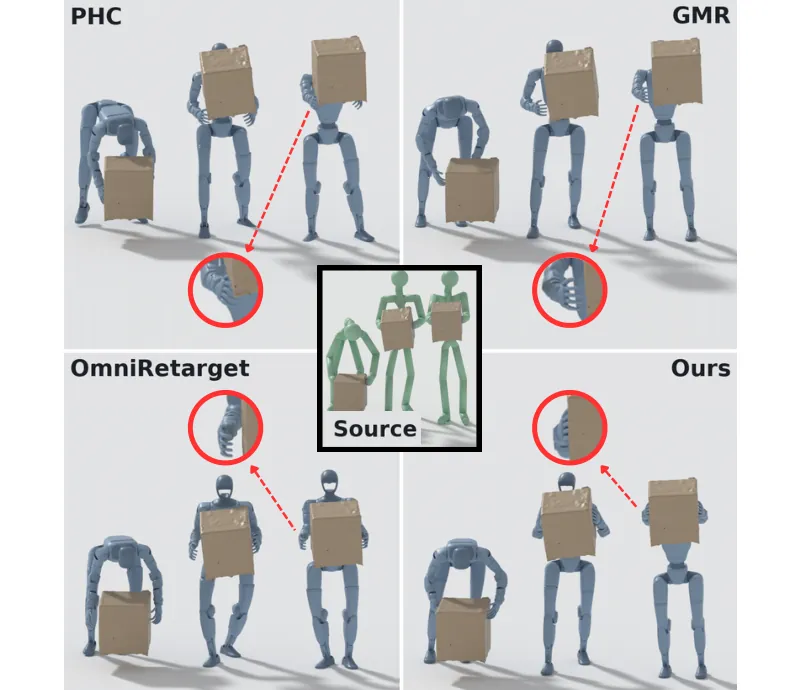
Figure 1 (paper Fig. 3): PHC, GMR, OmniRetarget, and PriMoRetarget on a box-manipulation sequence, with red circles zooming on hand-box contact. Baselines lose contact or distort the interaction; the proposed method preserves it.
Against weighted-sum variants: weights cannot buy priority. Table III isolates the contribution of the hierarchy with two weighted-sum variants: WS-uniform, which gives every objective equal weight, and WS-10x, which separates successive priority levels by a factor of ten. On single-character motion the three formulations are close, since conflicts are limited and only two priority levels exist. In interaction settings the gap opens: contact preservation on OMOMO is 96.9% versus 67.2% and 88.5%, and WS-uniform additionally shows 9.5 cm of foot floating and a jitter of 86.2; on the in-house set WS-10x drops to 71.7% contact preservation. The loss curves of Figure 4 explain the mechanism: prioritized optimization drives the first two levels (feet, contacts) to their lowest losses at the cost of a higher body-level loss, while the weighted formulations buy body-loss reductions by spending higher-priority loss. That is precisely the semantics a hierarchy is meant to express: a lower-priority objective improves only when doing so preserves the objectives above it.
Ablations: warmup and free objectives are not optional. In Table IV, removing the warmup pushes LAFAN1 penetration duration from 12.2% to 90.1% and penetration depth from 3.9 cm to 14.1 cm, and on the in-house set from 26.4% to 35.1% with contact preservation falling from 92.4% to 78.5%. On OMOMO, where the initialization is already near a suitable solution, the difference is small (12.1% versus 13.4%), confirming that the warmup's role is exactly to carry the optimizer across a large initial distance. Moving the free objectives into the final priority level (Free-last) lets higher-priority projection gut the temporal smoothness term: jitter rises from 135.6 to 160.4 on LAFAN1 and from 67.5 to 88.6 on the in-house set, while the contact-preservation gain on OMOMO (99.3%) is marginal.
Generalization and hardware. The same hierarchy transfers without modification across embodiments and scenes: a Unitree G1 and a Deep Robotics DR02 with substantially different morphologies jointly carrying a box, a Unitree H1-2 carrying a box down a ramp, and the same OMOMO motion retargeted to both a Booster T1 and a G1. When the manipulated box is enlarged by 1.5x, the retargeted hand contacts adapt to the new geometry instead of following the source motion, evidence that the contact objective genuinely dominates the pose objective. Figure 6 shows hardware deployment: the G1 executes the OMOMO kicking-and-pickup sequence, and two robots collaboratively lift and place the large in-house box.
Reading the kinematic columns. The metric pattern across Table II is instructive beyond the headline contact numbers. Jitter, estimated from the third derivative of body positions, separates trajectory-level methods from per-frame ones: on LAFAN1 the proposed method reports 135.6 against 216.7 for GMR and 229.4 for OmniRetarget, consistent with the paper's observation that PHC and PriMoRetarget optimize jointly over time while GMR and OmniRetarget retarget each frame independently. OmniRetarget wins penetration on several rows (1.5% duration on LAFAN1, 10.2% in-house) yet loses contact preservation badly, a reminder that a motion can be collision-free and still useless as an interaction reference. The source rows anchor interpretation: source jitter of 126.5 on LAFAN1 and 54.5 on OMOMO shows how much of the residual artifact budget is inherited from capture rather than introduced by retargeting.
The RL protocol behind the success rates. The tracking evaluation is deliberately plain so that differences reflect reference quality rather than policy tuning: following DeepMimic, one PPO policy is trained per motion on a simulated Unitree G1 with hyperparameters fixed across retargeting methods. Policies observe target poses and output joint PD targets; object-interaction motions additionally observe object position and target trajectory, and multi-robot motions are controlled by a single policy driving all robots. Tracking errors are computed over the full motion with early termination disabled, so a policy that falls over early still accumulates error instead of escaping the metric. This is why the success column moves so much more than the kinematic columns: a reference that is merely smooth but contact-inconsistent gives the policy a physically contradictory target.
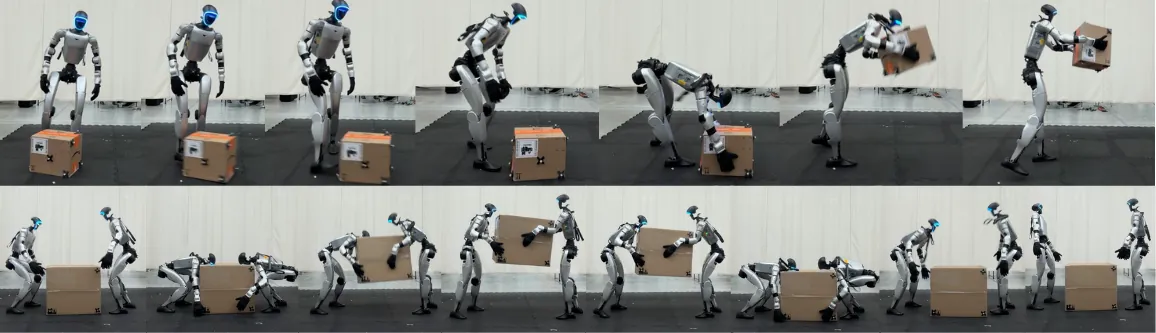
Figure 2 (paper Fig. 6): hardware deployment on the Unitree G1. Top: the OMOMO sequence with kicking and picking up a box. Bottom: the in-house two-robot collaborative lift and placement.
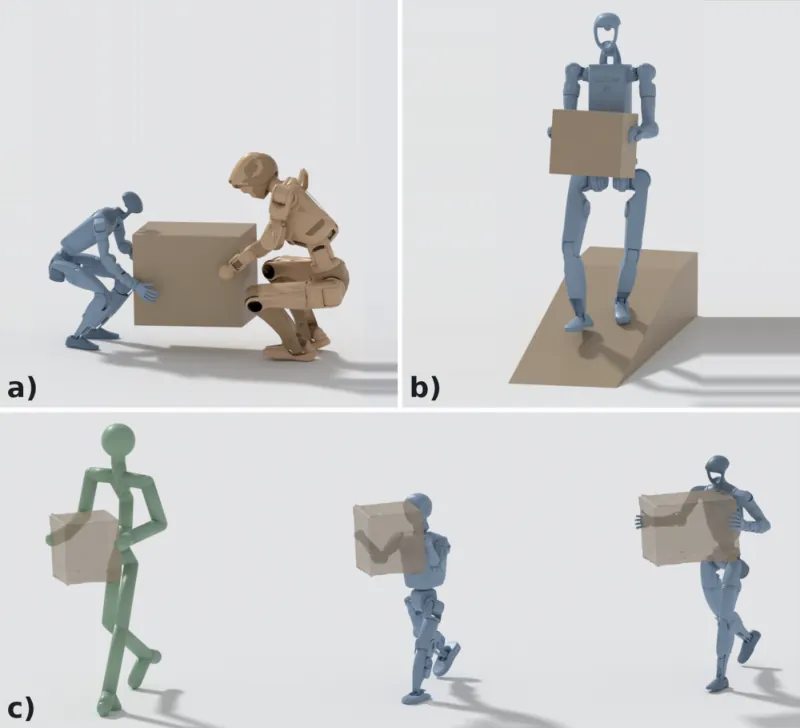
Figure 3 (paper Fig. 7): the same prioritized formulation across embodiments and scenes. a) G1 and DR02 jointly carrying a box; b) H1-2 carrying a box down a ramp; c) source motion retargeted to a Booster T1 and to a G1 holding a box enlarged by 1.5x.
| Dataset / Method | Penetration dur % | Sliding cm/s | Jitter m/s3 | Contact % | RL success % | Body err cm |
|---|---|---|---|---|---|---|
| LAFAN1 / GMR | 12.1 | 5.2 | 216.7 | - | 90.0 | 4.0 |
| LAFAN1 / OmniRetarget | 1.5 | 9.4 | 229.4 | - | 90.0 | 5.2 |
| LAFAN1 / PriMoRetarget | 12.2 | 3.5 | 135.6 | - | 100.0 | 1.8 |
| OMOMO / PHC | 94.1 | 12.9 | 76.3 | 63.2 | 86.6 | 7.4 |
| OMOMO / GMR | 65.4 | 1.7 | 94.7 | 48.6 | 79.8 | 7.9 |
| OMOMO / OmniRetarget | 21.6 | 4.9 | 205.2 | 86.4 | 99.1 | 3.5 |
| OMOMO / PriMoRetarget | 13.4 | 3.7 | 108.0 | 96.9 | 100.0 | 2.8 |
| Inter-X / PHC | 79.0 | 8.8 | 84.0 | 35.2 | 72.8 | 8.7 |
| Inter-X / GMR | 67.8 | 3.9 | 147.2 | 26.4 | 57.2 | 15.9 |
| Inter-X / OmniRetarget | 33.6 | 3.4 | 136.7 | 26.9 | 66.1 | 12.1 |
| Inter-X / PriMoRetarget | 55.7 | 2.4 | 103.9 | 78.8 | 93.6 | 4.5 |
| in-house / GMR | 39.3 | 4.4 | 102.3 | 29.3 | 24.1 | 30.9 |
| in-house / OmniRetarget | 10.2 | 2.7 | 129.6 | 26.5 | 4.3 | 36.8 |
| in-house / PriMoRetarget | 26.4 | 1.7 | 67.5 | 92.4 | 62.6 | 12.5 |
Table 1 (compiled from paper Table II): kinematic quality and RL tracking performance. PriMoRetarget leads contact preservation and tracking success in every interaction setting.
| Setting / Variant | Penetration dur % | Sliding cm/s | Floating cm | Jitter m/s3 | Contact % |
|---|---|---|---|---|---|
| OMOMO / PriMoRetarget | 13.4 | 3.7 | 2.4 | 108.0 | 96.9 |
| OMOMO / WS-uniform | 12.4 | 9.4 | 9.5 | 86.2 | 67.2 |
| OMOMO / WS-10x | 14.4 | 3.4 | 2.9 | 98.5 | 88.5 |
| in-house / PriMoRetarget | 26.4 | 1.7 | 3.2 | 67.5 | 92.4 |
| in-house / WS-uniform | 35.0 | 3.4 | 14.0 | 52.9 | 88.8 |
| in-house / WS-10x | 30.5 | 1.9 | 5.1 | 59.1 | 71.7 |
| LAFAN1 / PriMoRetarget | 12.2 | 3.5 | 1.4 | 135.6 | - |
| LAFAN1 / No warmup | 90.1 | 10.2 | 0.0 | 168.1 | - |
| LAFAN1 / Free-last | 17.3 | 2.7 | 0.4 | 160.4 | - |
Table 2 (compiled from paper Tables III and IV): weighted-sum variants and ablations. Weight separation cannot purchase hard precedence, and both the warmup and the free objectives carry irreplaceable roles.
Limitations
Source artifacts are inherited as-is (author-stated). Section VI states plainly that PriMoRetarget preserves the structure of the source motion, including its artifacts: jitter, interpenetration, and inconsistencies in the captured environment all propagate into the retargeted result. The higher penetration and floating numbers in some settings of Table II (for instance 55.7% penetration duration on Inter-X versus 33.6% for OmniRetarget) are partly attributed by the authors to artifacts already present in the source data. The method carries no learned prior that could repair the capture; that is a design trade-off rather than an oversight, but it also means retargeting cannot substitute for cleaning mocap data.
Object trajectories largely follow the source (author-stated). The trajectory of a manipulated object is mostly determined by the source motion, since object interactions fix the scene scale at $s_\dagger=1$ to preserve object geometry. When the object trajectory itself is ill-suited to the target embodiment, the interaction cannot adapt. The enlarged-box experiment shows contacts following new geometry, but the object path remains untunable.
The hierarchy is specified by hand. All experiments share one three-level hierarchy, and the authors acknowledge that priorities are set manually, listing automatic determination or adaptation of the hierarchy as future work. Table III shows the method is robust when the hierarchy semantics are right, but "which objective ranks where" still rests on the practitioner's understanding of the task, with no data-driven support for unseen task families. The 62.6% tracking success on the in-house set further shows that better retargeting alone does not solve multi-robot collaborative control.
Penetration and floating are not uniformly best (our reading). The method does not dominate every kinematic column. On Inter-X its penetration duration of 55.7% is worse than OmniRetarget's 33.6%, and foot floating on OMOMO (2.4 cm) trails PHC (0.2 cm), GMR (0.1 cm), and OmniRetarget (0.3 cm). The authors attribute part of this to source artifacts, and the hierarchy itself explains the rest: when foot position and contacts hold the top slots, ground penetration is only a free objective whose gradient can be partially projected away. Users who need collision-clean references for terrain-heavy tasks should read the hierarchy as a knob, not a guarantee.
Conclusion and Outlook
The value of PriMoRetarget is not in inventing nullspace projection, a tool with three decades of history in robot control, but in showing that it fits motion retargeting: an offline, long-sequence, multi-actor setting. Three engineering components make the fit practical. Per-frame block-diagonal projection cuts the cost from cubic to linear in sequence length. Free objectives give global regularizers a home that consumes no priority slot. The weighted-sum warmup fixes the convergence failure of projection under poor initialization. The experimental signal is consistent: the denser the interaction, the larger the advantage over weighted sums, while on single-character motion the formulations are nearly indistinguishable. The mechanism exists for conflict.
For teams running humanoid data pipelines, the paper offers a drop-in replacement: swap the weight table of an existing retargeting stage for a priority table, and contacts plus foot placement stop negotiating with pose. The authors' stated future directions, learned motion priors to repair source artifacts, automatic hierarchy adaptation, and joint optimization of robot and object trajectories, map one-to-one onto the limitations above and sketch the next generation of retargeting: from preserving the source motion to correcting it while preserving its intent.
There is also a methodological reading worth keeping. The paper's strongest result is not a single number but a shape: near-parity with weighted sums on single-character motion, and widening margins as contacts and actors are added. That shape is what one should expect if the mechanism truly targets conflict rather than acting as a general-purpose improvement, and it gives practitioners a cheap diagnostic for their own data. If a pipeline's clips are mostly solo locomotion, retargeting weights are probably fine; the moment the library fills with manipulation and collaboration, the weight table becomes the bottleneck, and a priority hierarchy is the cheaper fix.
Golden Quote
A weighted sum tells the optimizer which objective matters more; a priority hierarchy tells it which objective is non-negotiable.
SOURCE LINKS