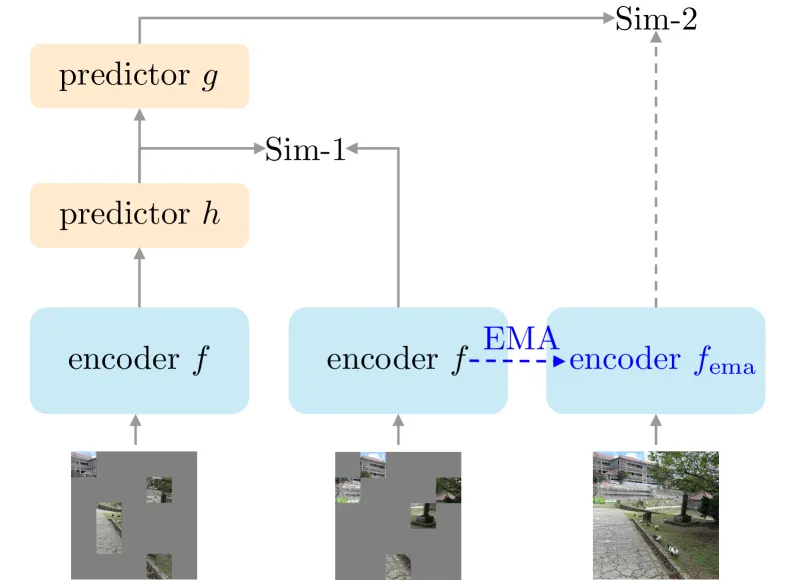
Investigates the effect of Siamese student encoders in JEPA-based self-supervised representation learning. SiamJEPA uses masked Siamese student encoders with an EMA teacher, acting as an effective regularizer that improves representation separability and accelerates early-stage learning, outperforming single-encoder JEPA variants under limited budgets.
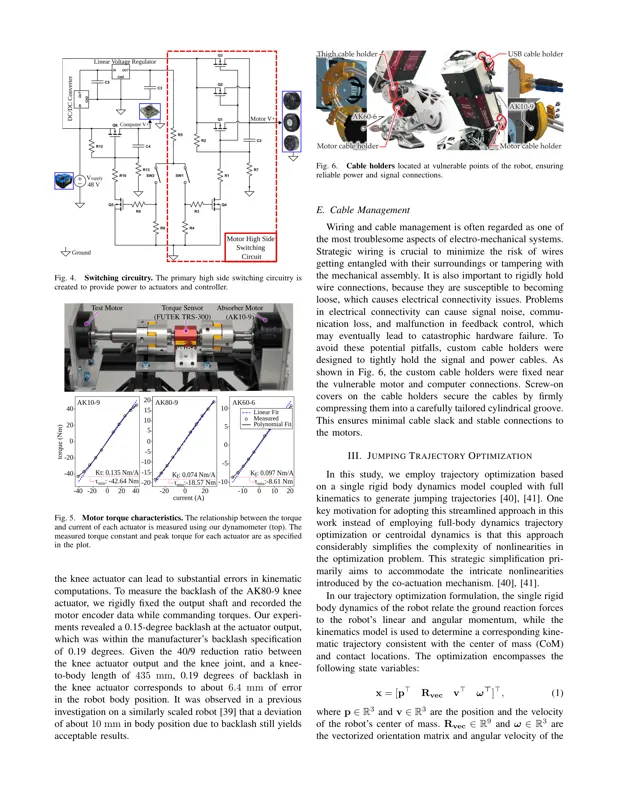
Introduces StaccaToe, a human-scale electric motor-powered single-leg robot with an actuated toe and co-actuation configuration inspired by the human leg. Without energy storage mechanisms, it demonstrates balanced tip-toe stance and dynamic jumping, providing empirical evidence for replicating human leg attributes in robotic design.
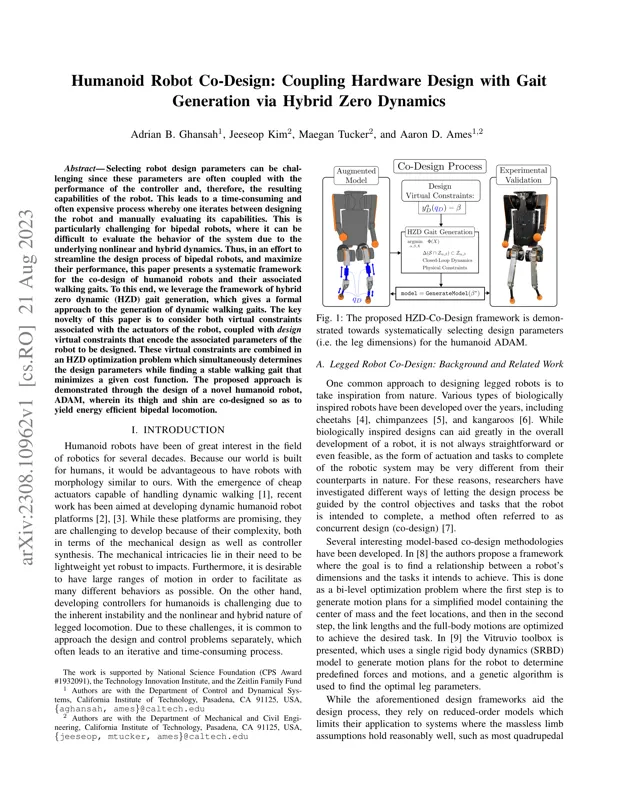
Presents a systematic co-design framework for humanoid robots using hybrid zero dynamics (HZD) gait generation, coupling actuator virtual constraints with design virtual constraints to jointly optimize robot design parameters and walking gaits. Demonstrated on the ADAM humanoid robot with co-designed thigh and shin for energy-efficient bipedal locomotion.
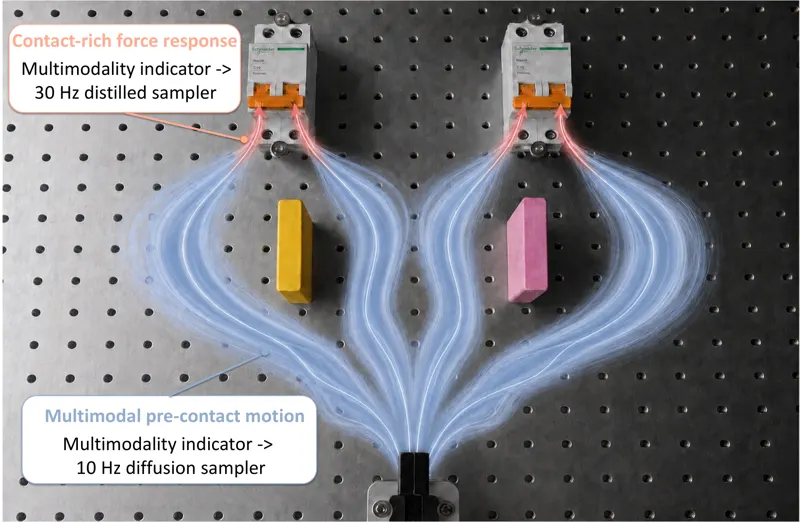
In contact-rich manipulation, action multimodality and reactivity dominate different stages of a single episode. Before contact, multiple trajectories might be equally valid, making it important to preserve diverse action modes. After contact, geometric constraints and force limits narrow the solution space, while successful execution demands rapid responses to force feedback. However, standard diffusion policies use a fixed inference frequency and sampling steps throughout the episode, forcing a fundamental compromise: low-frequency, multi-step sampling better preserves pre-contact multimodality but responds slowly to force feedback, whereas high-frequency sampling improves reactivity but tends to collapse distinct pre-contact modes. To resolve this tradeoff, we present FA-RDP, a frequency-adaptive reactive diffusion policy. A shared multi-frequency visual-force Transformer predicts action chunks at both low and high frequencies, while a learned multimodality indicator dynamically selects multi-step low-frequency sampling before contact and one-step high-frequency sampling as action ambiguity decreases. We further introduce Manifold Consistency Distillation (MCD), which reparameterizes the diffusion network to predict actions on the robot action manifold while retaining DDPM-based residual supervision. Experiments on three contact-rich manipulation tasks show that FA-RDP achieves the highest success rate while preserving diverse pre-contact trajectory modes. Code and videos are available at https://fa-rdp.github.io.
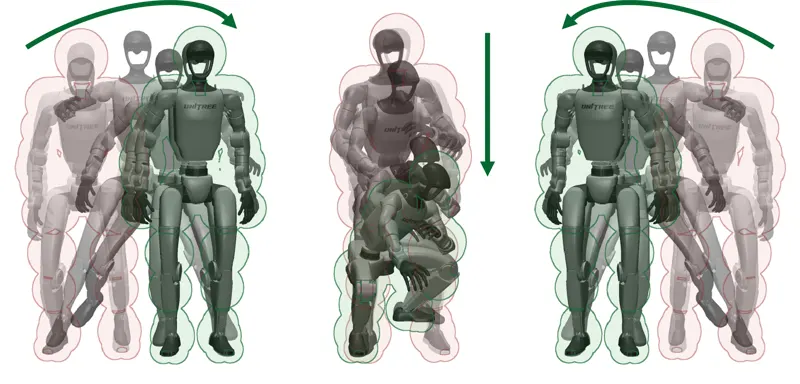
A perception-aware CBF-RL framework that couples control-barrier safety with onboard sensing for whole-body humanoid dodgeball. The deployed policy sees the ball only as segmentation-masked depth from a head-mounted camera, with CBF guidance representing clearance to every body link. Deployed zero-shot on Unitree G1, achieving 95% success rate on real-world throws.
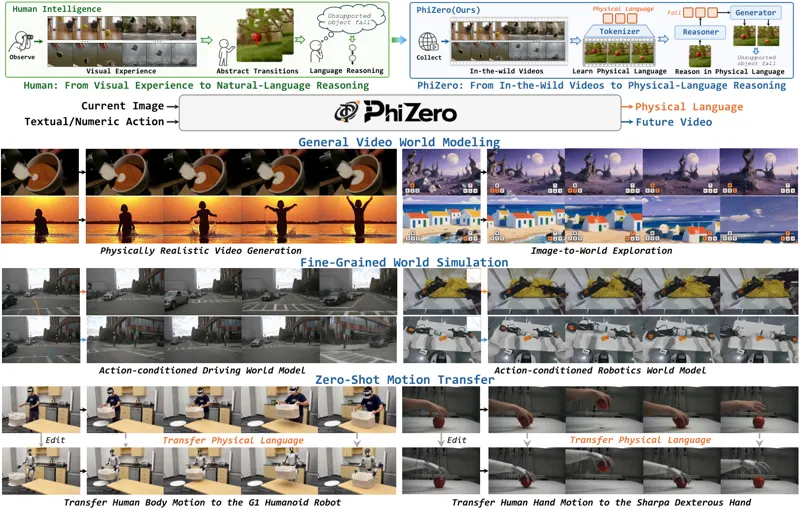
We introduce PhiZero, a physical world model built around physical language, a compact discrete representation of world-state transitions. Existing physical world models typically predict future videos directly in pixel space, leaving the underlying world dynamics implicit within high-dimensional visual predictors. Motivated by humans' ability to abstract predictive structure from visual experience and organize it in natural language for explicit reasoning, we learn physical language from in-the-wild videos through self-supervision and use it to explicitly reason about how the physical world evolves. Accordingly, PhiZero adopts a reason-then-render paradigm: it first infers future world evolution as a physical-language sequence and then renders the inferred transitions into videos. Extensive experiments across generation and understanding benchmarks validate the ability of PhiZero to model physically coherent world evolution. We further show its potential for realistic and interactive world modeling, fine-grained action-conditioned simulation, and zero-shot motion transfer.
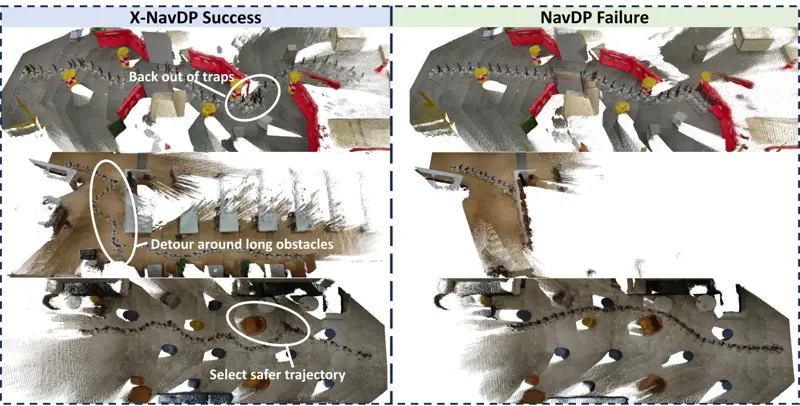
Proposes GQRM, a data-efficient diffusion RL post-training framework with self-bootstrapped exploration and group Q-score normalization for cross-embodiment visual navigation. Improves success rate from 61.20% to 84.28% in simulation and 10% to 65% in real-world hard cases.
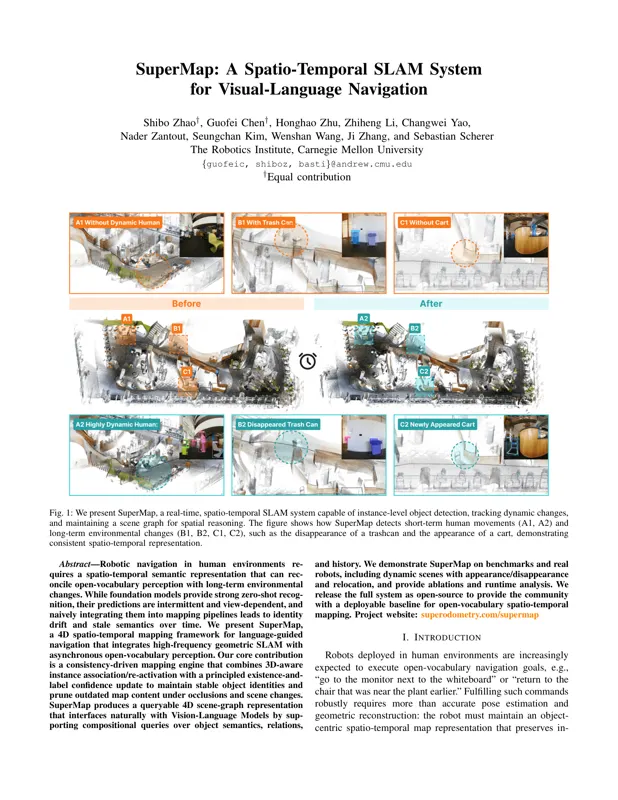
SuperMap is a real-time 4D spatio-temporal mapping framework from CMU that integrates high-frequency geometric SLAM with asynchronous open-vocabulary perception. Its consistency-driven mapping engine maintains stable object identities and prunes outdated content under occlusions and scene changes, producing a queryable 4D scene-graph interface for VLM-based zero-shot reasoning and language-guided navigation.
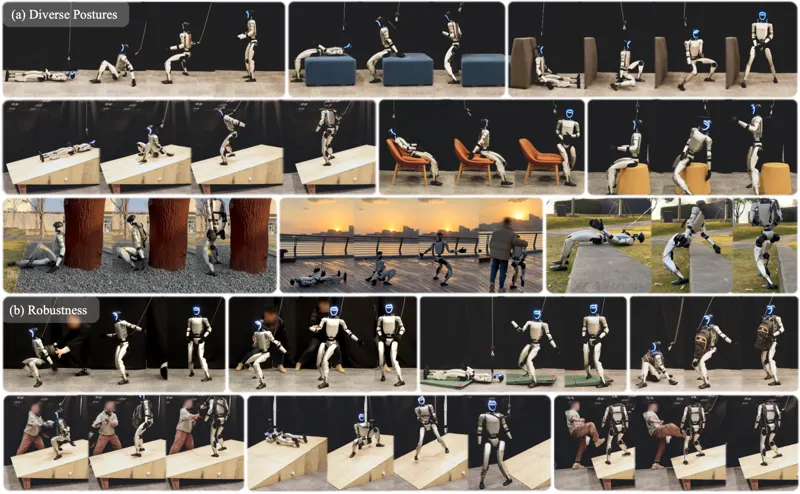
Standing-up control is crucial for humanoid robots, with the potential for integration into current locomotion and loco-manipulation systems, such as fall recovery. Existing approaches are either limited to simulations that overlook hardware constraints or rely on predefined ground-specific motion trajectories, failing to enable standing up across postures in real-world scenes. To bridge this gap, we present HoST (Humanoid Standing-up Control), a reinforcement learning framework that learns standing-up control from scratch, enabling robust sim-to-real transfer across diverse postures. HoST effectively learns posture-adaptive motions by leveraging a multi-critic architecture and curriculum-based training on diverse simulated terrains. To ensure successful real-world deployment, we constrain the motion with smoothness regularization and implicit motion speed bound to alleviate oscillatory and violent motions on physical hardware, respectively. After simulation-based training, the learned control policies are directly deployed on the Unitree G1 humanoid robot. Our experimental results demonstrate that the controllers achieve smooth, stable, and robust standing-up motions across a wide range of laboratory and outdoor environments. Videos and code are available at https://taohuang13.github.io/humanoid-standingup.github.io/.
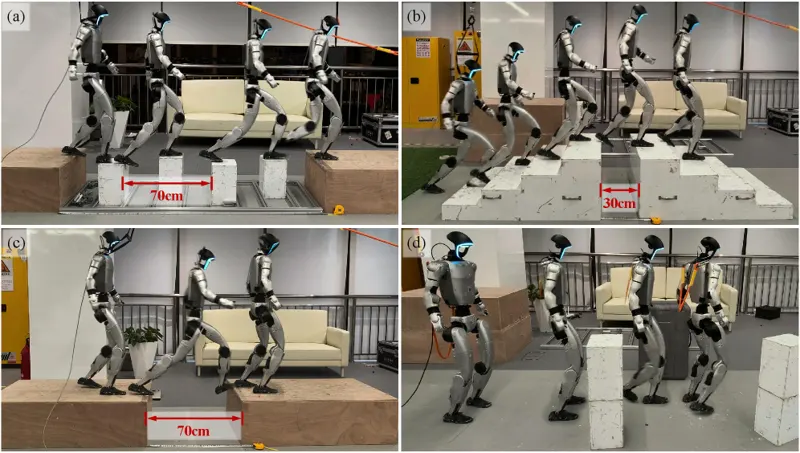
Robust humanoid locomotion in unstructured environments requires architectures that balance fast low-level stabilization with slower perceptual decision-making. We show that a simple layered control architecture (LCA), a proprioceptive stabilizer running at high rate, coupled with a compact low-rate perceptual policy, enables substantially more robust performance than monolithic end-to-end designs, even when using minimal perception encoders. Through a two-stage training curriculum (blind stabilizer pretraining followed by perceptual fine-tuning), we demonstrate that layered policies consistently outperform one-stage alternatives in both simulation and hardware. On a Unitree G1 humanoid, our approach succeeds across stair and ledge tasks where one-stage perceptual policies fail. These results highlight that architectural separation of timescales, rather than network scale or complexity, is the key enabler for robust perception-conditioned locomotion.
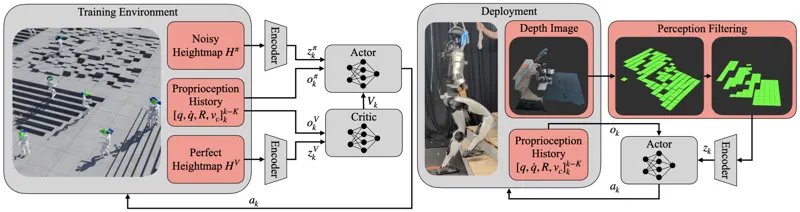
Although reinforcement learning has significantly advanced humanoid locomotion, perceptive policies still struggle on sparse-foothold terrain and constrained environments. Success in these scenarios requires both broad terrain awareness and precise foothold selection, two perceptual roles that conventional encoders often entangle. To address this challenge, we propose Global-Local Attention Decomposition (GLAD) for terrain encoding in humanoid locomotion. Realized by a coarse-to-fine encoder over a robot-centric elevation map, GLAD explicitly separates these objectives: a global attention branch utilizes attention pooling to summarize the surrounding terrain context, while a state-conditioned local attention branch sparsifies and encodes precise foothold-relevant geometry. This explicit attention decomposition prevents the dilution of fine-grained spatial cues while reducing training overhead. Experiments demonstrate that GLAD enables reliable locomotion over challenging gaps, stepping stones, and stairs. Furthermore, the learned policy exhibits emergent terrain-responsive behaviors, autonomously following narrow paths and avoiding obstacles under simple velocity commands without explicit navigation planners. In real-world deployment on a Unitree G1 humanoid robot using onboard LiDAR, the proposed method achieves robust zero-shot sim-to-real transfer across diverse sparse-foothold and obstacle-rich domains.
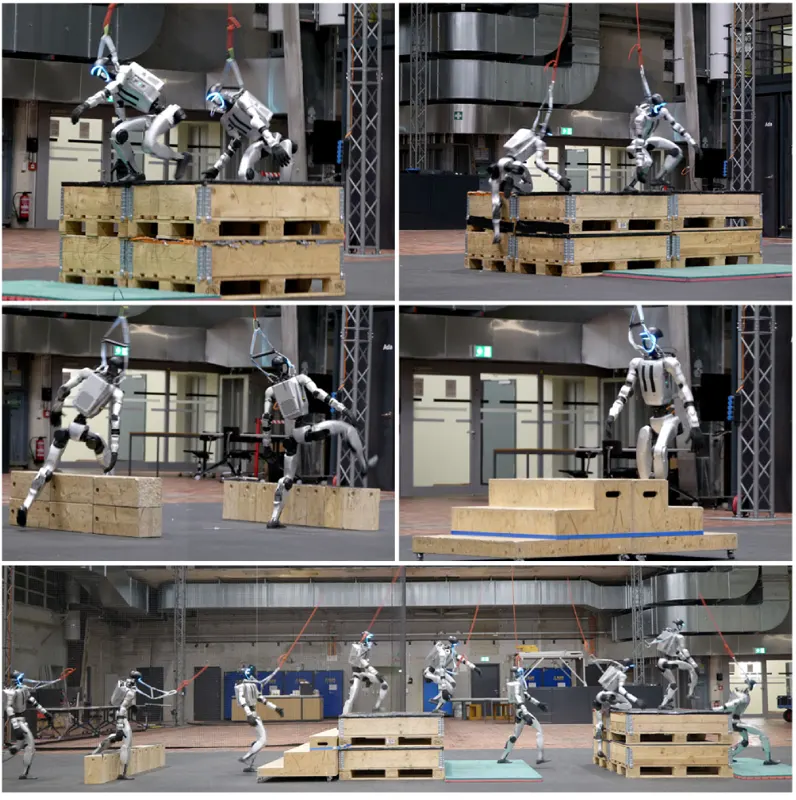
Whole-body humanoid locomotion is challenging due to high-dimensional control, morphological instability, and the need for real-time adaptation to various terrains using onboard perception. Directly applying reinforcement learning (RL) with reward shaping to humanoid locomotion often leads to lower-body-dominated behaviors, whereas imitation-based RL can learn more coordinated whole-body skills but is typically limited to replaying reference motions without a mechanism to adapt them online from perception for terrain-aware locomotion. To address this gap, we propose a whole-body humanoid locomotion framework that combines skills learned from reference motions with terrain-aware adaptation. We first train a diffusion model on retargeted human motions for real-time prediction of terrain-aware reference motions. Concurrently, we train a whole-body reference tracker with RL using this motion data. To improve robustness under imperfectly generated references, we further fine-tune the tracker with a frozen motion generator in a closed-loop setting. The resulting system supports directional goal-reaching control with terrain-aware whole-body adaptation, and can be deployed on a Unitree G1 humanoid robot with onboard perception and computation. The hardware experiments demonstrate successful traversal over boxes, hurdles, stairs, and mixed terrain combinations. Quantitative results further show the benefits of incorporating online motion generation and fine-tuning the motion tracker for improved generalization and robustness.