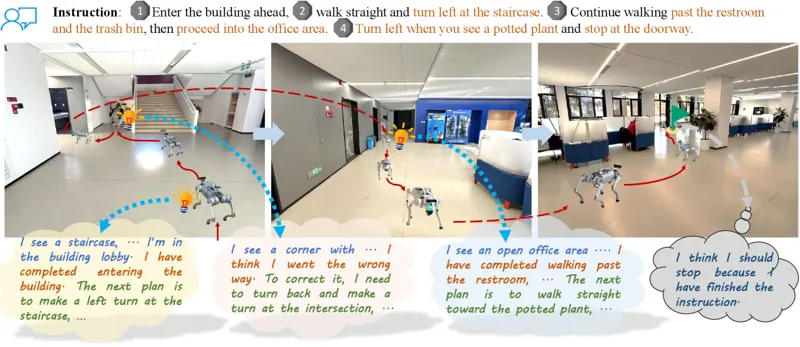
Vision-and-Language Navigation (VLN) requires an agent to ground language instructions to its own movement within a visual environment. While state-of-the-art methods leverage the reasoning capabilities of Vision-Language Models (VLMs) for end-to-end action prediction, they often lack an explicit and explainable understanding of the relationships between the agent, the instruction, and the scene. Conversely, explicitly building a scene map for heuristic planning is intuitively appealing but relies on additional 3D sensors and hinders large-scale vision-language pre-training. To bridge this gap, we propose AwareVLN, a novel framework that equips the navigation model with a self-aware reasoning mechanism, enabling it to understand the agent's state and task progress in a fully end-to-end and data-driven manner. Our approach features two key innovations: (1) a structural reasoning module that fosters spatial and task-oriented self-awareness, and (2) an automatic data engine with progress division for effective training. Extensive experiments on various datasets in Habitat simulator show our AwareVLN significantly outperforms previous state-of-the-art vision-language navigation methods. Project page: https://gwxuan.github.io/AwareVLN/.
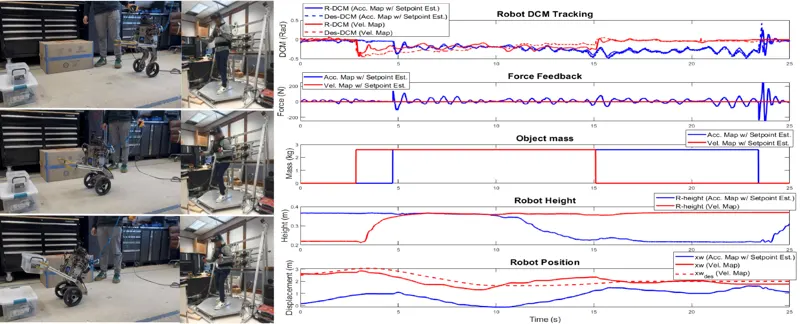
Humanoid robots can support human workers in physically demanding environments by performing tasks that require whole-body coordination, such as lifting and transporting heavy objects.These tasks, which we refer to as Dynamic Mobile Manipulation (DMM), require the simultaneous control of locomotion, manipulation, and posture under dynamic interaction forces. This paper presents a teleoperation framework for DMM on a height-adjustable wheeled humanoid robot for carrying heavy payloads. A Human-Machine Interface (HMI) enables whole-body motion retargeting from the human pilot to the robot by capturing the motion of the human and applying haptic feedback. The pilot uses body motion to regulate robot posture and locomotion, while arm movements guide manipulation.Real time haptic feedback delivers end effector wrenches and balance related cues, closing the loop between human perception and robot environment interaction. We evaluate the different telelocomotion mappings that offer varying levels of balance assistance, allowing the pilot to either manually or automatically regulate the robot's lean in response to payload-induced disturbances. The system is validated in experiments involving dynamic lifting of barbells and boxes up to 2.5 kg (21% of robot mass), demonstrating coordinated whole-body control, height variation, and disturbance handling under pilot guidance. Video demo can be found at: https://youtu.be/jF270_bG1h8?feature=shared
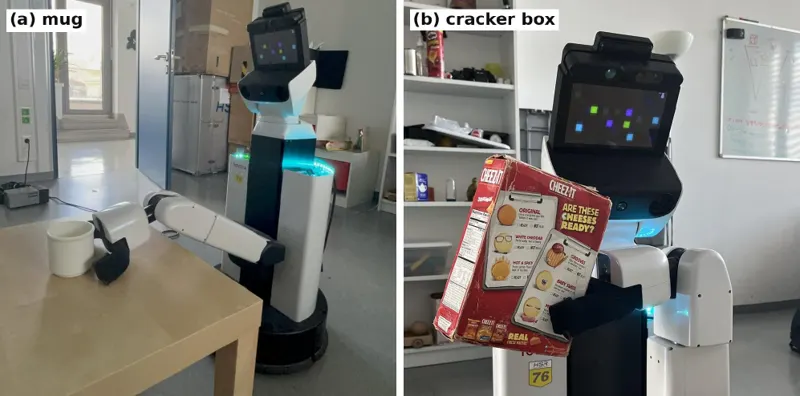
Fine-tuning Vision-Language-Action (VLA) models for mobile manipulators with heterogeneous joint spaces can produce a counterintuitive result: the checkpoint with the lowest aggregate MSE is not the one that performs best on the real robot. We argue this is a predictable consequence of collapsing heterogeneous joint groups (arm, gripper, head, wheeled base) into a single metric, where easy-to-predict joints can mask joints that still fail. We fine-tune SmolVLA (450M, action-expert only) on the 11-DoF Toyota HSR and compare it against π_0.5 (3.3B), a stronger pretrained baseline. Per-group analysis exposes two patterns: in SmolVLA, the mobile base converges slowest and limits overall performance. In expert-only fine-tuning of π_0.5 (training only the action head, backbone frozen), total MSE drops below the baseline but arm accuracy degrades. On 60 real-robot trials (20 per model), π_0.5 80k (4.0/4) significantly outperforms both fine-tuned variants (expert-only 3k: 3.75/4; HSR-SmolVLA: 3.5/4; Mann-Whitney p ≤ 0.010), despite expert-only 3k having the lowest total MSE. This separation is most consistent with the offline arm-group error, not total MSE or base-group error. We conclude that per-group error is a more reliable signal than total MSE for checkpoint selection on robots with heterogeneous action spaces. Code: https://github.com/paumontagut/per-group-mse-vla
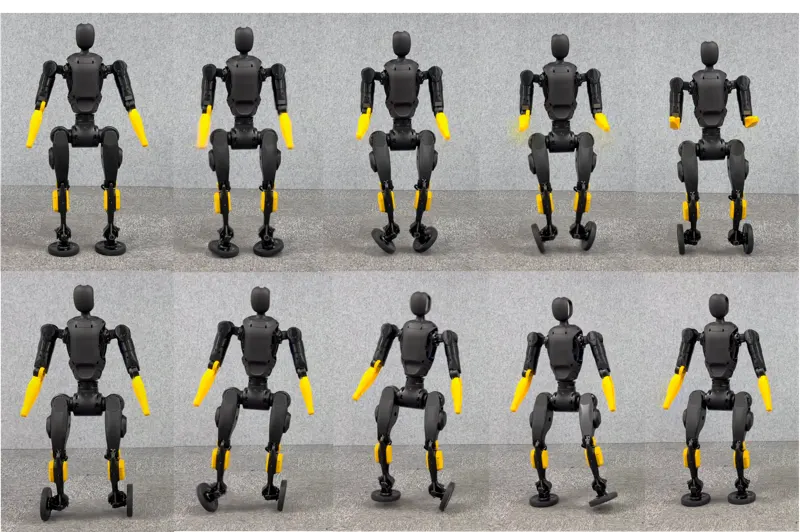
Wheel-legged robots combine the efficiency of wheeled locomotion with the versatility of legged systems, enabling rapid traversal over both continuous and discrete terrains. However, conventional designs typically employ fixed wheels as feet and limited degrees of freedom (DoFs) at the hips, resulting in reduced stability and mobility during legged locomotion compared to humanoids with flat feet. In addition, most existing platforms lack a full upper body with arms, which limits their ability to perform dexterous manipulation tasks. In this letter, we present X2-N, a high-DoF transformable robot with dual-mode locomotion and manipulation. X2-N can operate in both humanoid and wheel-legged forms and transform seamlessly between them through joint reconfiguration. We further propose a reinforcement learning (RL)-based whole-body control framework tailored to this morphology, enabling unified control across hybrid locomotion, transformation, and manipulation. We validate X2-N in a range of challenging locomotion and manipulation tasks, including dynamic skating-like motion, stair climbing and package delivery. Results demonstrate high locomotion efficiency, strong terrain adaptability, and stable loco-manipulation performance of X2-N, highlighting its potential for real-world deployment.
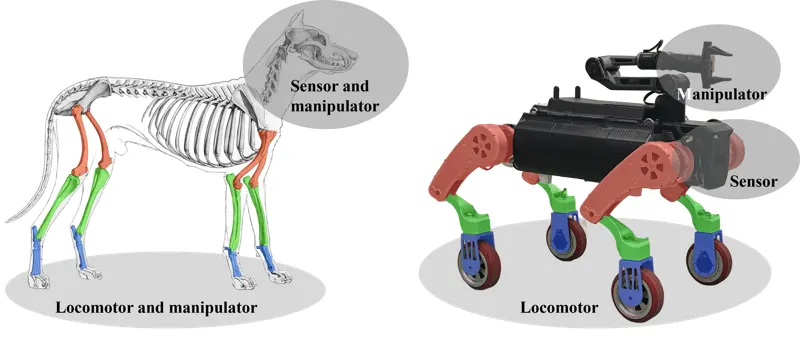
Wheel-legged robots with integrated manipulators hold great promise for mobile manipulation in logistics, industrial automation, and human-robot collaboration. However, unified control of such systems remains challenging due to the redundancy in degrees of freedom, complex wheel-ground contact dynamics, and the need for seamless coordination between locomotion and manipulation. In this work, we present the design and whole-body motion control of an omnidirectional wheel-legged quadrupedal robot equipped with a dexterous manipulator. The proposed platform incorporates independently actuated steering modules and hub-driven wheels, enabling agile omnidirectional locomotion with high maneuverability in structured environments. To address the challenges of contact-rich interaction, we develop a contact-aware whole-body dynamic optimization framework that integrates point-contact modeling for manipulation with line-contact modeling for wheel-ground interactions. A warm-start strategy is introduced to accelerate online optimization, ensuring real-time feasibility for high-dimensional control. Furthermore, a unified kinematic model tailored for the robot's 4WIS-4WID actuation scheme eliminates the need for mode switching across different locomotion strategies, improving control consistency and robustness. Simulation and experimental results validate the effectiveness of the proposed framework, demonstrating agile terrain traversal, high-speed omnidirectional mobility, and precise manipulation under diverse scenarios, underscoring the system's potential for factory automation, urban logistics, and service robotics in semi-structured environments.
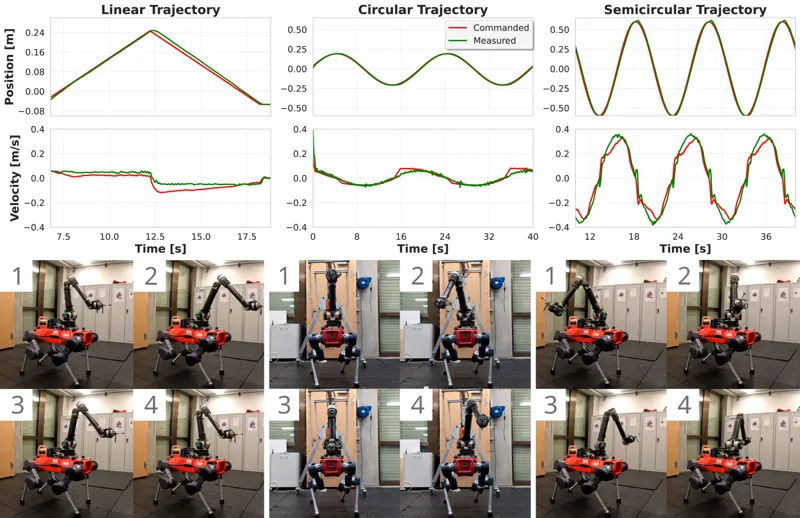
Learning whole-body control for locomotion and arm motions in a single policy has challenges, as the two tasks have conflicting goals. For instance, efficient locomotion typically favors a horizontal base orientation, while end-effector tracking may benefit from base tilting to extend reachability. Additionally, current Reinforcement Learning (RL) approaches using a pose-based task specification lack the ability to directly control the end-effector velocity, making smoothly executing trajectories very challenging. To address these limitations, we propose an RL-based framework that allows for dynamic, velocity-aware whole-body end-effector control. Our method introduces a multi-critic actor architecture that decouples the reward signals for locomotion and manipulation, simplifying reward tuning and allowing the policy to resolve task conflicts more effectively. Furthermore, we design a twist-based end-effector task formulation that can track both discrete poses and motion trajectories. We validate our approach through a set of simulation and hardware experiments using a quadruped robot equipped with a robotic arm. The resulting controller can simultaneously walk and move its end-effector and shows emergent whole-body behaviors, where the base assists the arm in extending the workspace, despite a lack of explicit formulations. Videos and supplementary material can be found at multi-critic-locomanipulation.github.io.
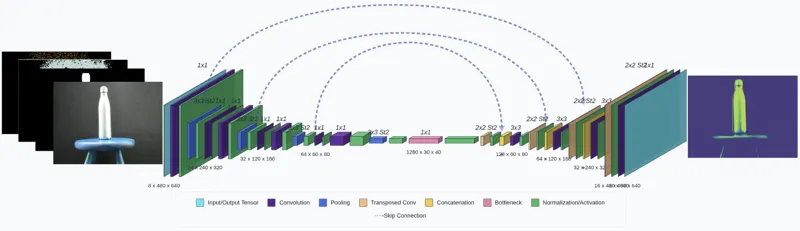
This paper presents a deep learning framework designed to enhance the grasping capabilities of quadrupeds equipped with arms, with a focus on improving precision and adaptability. Our approach centers on a sim-to-real methodology that minimizes reliance on physical data collection. We developed a pipeline within the Genesis simulation environment to generate a synthetic dataset of grasp attempts on common objects. By simulating thousands of interactions from various perspectives, we created pixel-wise annotated grasp-quality maps to serve as the ground truth for our model. This dataset was used to train a custom CNN with a U-Net-like architecture that processes multi-modal input from an onboard RGB and depth cameras, including RGB images, depth maps, segmentation masks, and surface normal maps. The trained model outputs a grasp-quality heatmap to identify the optimal grasp point. We validated the complete framework on a four-legged robot. The system successfully executed a full loco-manipulation task: autonomously navigating to a target object, perceiving it with its sensors, predicting the optimal grasp pose using our model, and performing a precise grasp. This work proves that leveraging simulated training with advanced sensing offers a scalable and effective solution for object handling.
Loco-manipulation demands coordinated whole-body motion to manipulate objects effectively while maintaining locomotion stability, presenting significant challenges for both planning and control. In this work, we propose a whole-body model predictive control (MPC) framework that directly optimizes joint torques through full-order inverse dynamics, enabling unified motion and force planning and execution within a single predictive layer. This approach allows emergent, physically consistent whole-body behaviors that account for the system's dynamics and physical constraints. We implement our MPC formulation using open software frameworks (Pinocchio and CasADi), along with the state-of-the-art interior-point solver Fatrop. In real-world experiments on a Unitree B2 quadruped equipped with a Unitree Z1 manipulator arm, our MPC formulation achieves real-time performance at 80 Hz. We demonstrate loco-manipulation tasks that demand fine control over the end-effector's position and force to perform real-world interactions like pulling heavy loads, pushing boxes, and wiping whiteboards.
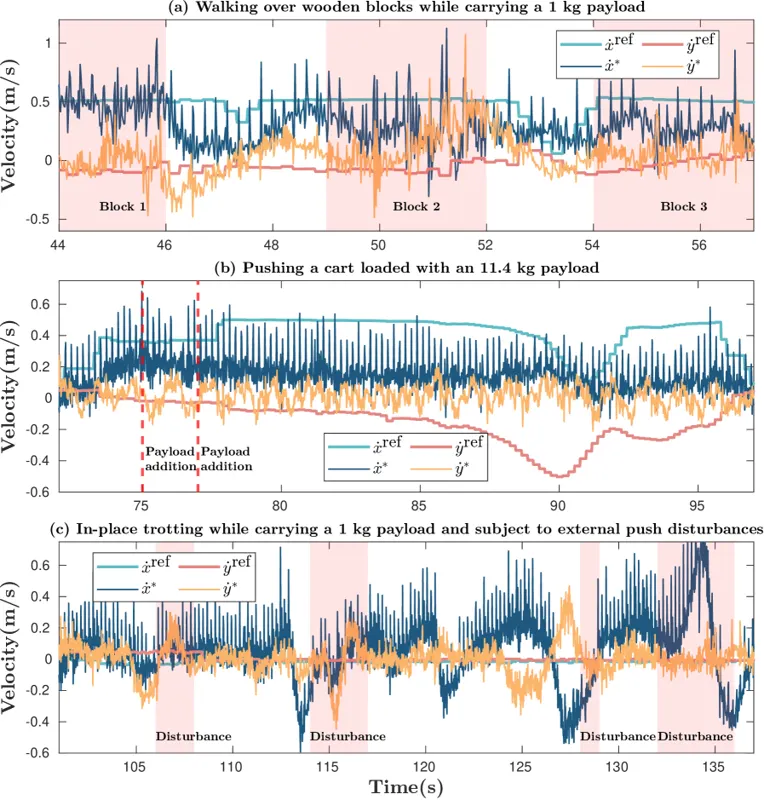
Model predictive control (MPC) combined with reduced-order template models has emerged as a powerful tool for trajectory optimization in dynamic legged locomotion. However, loco-manipulation tasks performed by legged robots introduce additional complexity, necessitating computationally efficient MPC algorithms capable of handling high-degree-of-freedom (DoF) models. This letter presents a computationally efficient nonlinear MPC (NMPC) framework tailored for loco-manipulation tasks of quadrupedal robots equipped with robotic manipulators whose dynamics are non-negligible relative to those of the quadruped. The proposed framework adopts a decomposition strategy that couples locomotion template models – such as the single rigid body (SRB) model – with a full-order dynamic model of the robotic manipulator for torque-level control. This decomposition enables efficient real-time solution of the NMPC problem in a receding horizon fashion at 60 Hz. The optimal state and input trajectories generated by the NMPC for locomotion are tracked by a low-level nonlinear whole-body controller (WBC) running at 500 Hz, while the optimal torque commands for the manipulator are directly applied. The layered control architecture is validated through extensive numerical simulations and hardware experiments on a 15-kg Unitree Go2 quadrupedal robot augmented with a 4.4-kg 4-DoF Kinova arm. Given that the Kinova arm dynamics are non-negligible relative to the Go2 base, the proposed NMPC framework demonstrates robust stability in performing diverse loco-manipulation tasks, effectively handling external disturbances, payload variations, and uneven terrain.
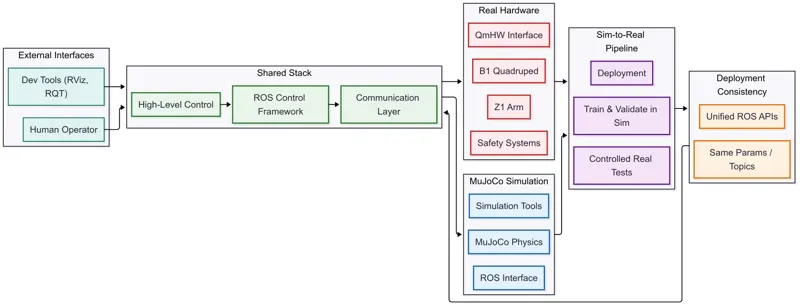
Quadruped mobile manipulators offer strong potential for agile loco-manipulation but remain difficult to control and transfer reliably from simulation to reality. Reinforcement learning (RL) shows promise for whole-body control, yet most frameworks are proprietary and hard to reproduce on real hardware. We present an open pipeline for training, benchmarking, and deploying RL-based controllers on the Unitree B1 quadruped with a Z1 arm. The framework unifies sim-to-sim and sim-to-real transfer through ROS, re-implementing a policy trained in Isaac Gym, extending it to MuJoCo via a hardware abstraction layer, and deploying the same controller on physical hardware. Sim-to-sim experiments expose discrepancies between Isaac Gym and MuJoCo contact models that influence policy behavior, while real-world teleoperated object-picking trials show that coordinated whole-body control extends reach and improves manipulation over floating-base baselines. The pipeline provides a transparent, reproducible foundation for developing and analyzing RL-based loco-manipulation controllers and will be released open source to support future research.
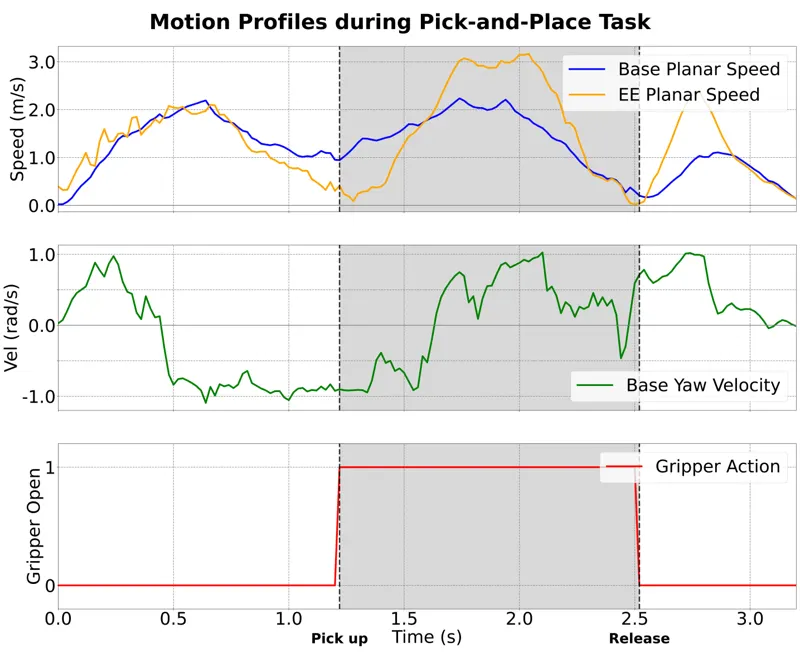
Legged manipulators extend robotic capabilities beyond static manipulation by integrating agile locomotion with versatile arm control. However, achieving precise manipulation while maintaining coordinated locomotion remains a major challenge. This work presents a hierarchical reinforcement learning framework for dynamic pick-and-place tasks using a quadruped equipped with a 6-DOF robotic arm. The framework incorporates an explicit mass estimation module enabling adaptive whole-body control for objects with varying weights. In simulation, the system achieves an 86.05% success rate with payloads up to 2.3 kg. The approach is further validated through real-world experiments across six representative scenarios with controlled variations in object physical properties (size and mass) and task heights. Specifically, within a wide vertical workspace ranging from ground level to 1.1~m-high tabletops, the system demonstrates an average success rate of 73.3% for payloads up to 1.3 kg, with an average execution time of 4.06 s. Unlike prior works that handle lightweight objects and execute pick-and-place motions with slow, piecewise motions, the proposed framework exploits concurrent locomotion and manipulation for dynamic, continuous execution. These results demonstrate the potential of quadrupedal mobile manipulators for adaptive, whole-body pick-and-place with heavier payloads and extended workspaces.
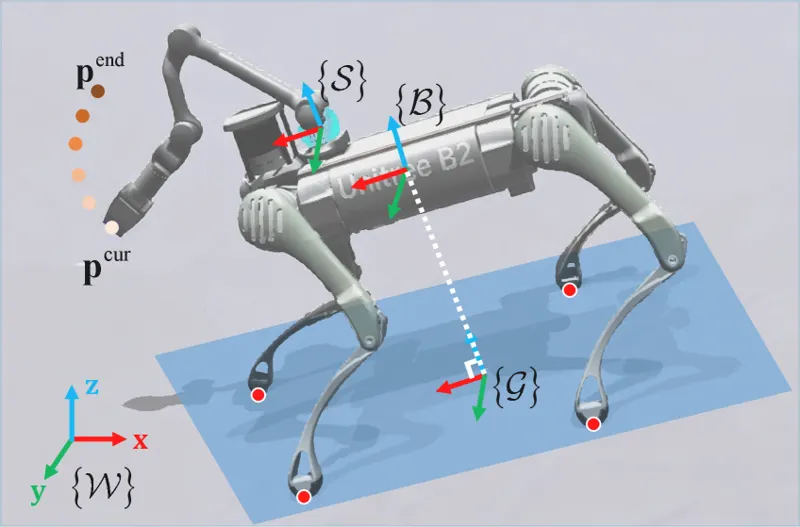
Legged manipulators integrate exceptional terrain adaptability along with mobile manipulation capabilities, which make them highly promising for deployment in human-centric environments. By coordinating the control of both legs and arms, a whole-body controller can significantly expand the operational workspace of legged manipulators. However, many existing whole-body controllers primarily depend on proprioception and do not incorporate the critical exteroception required for effective terrain topology perception. This limitation can hinder their ability to adapt to varying environmental conditions and navigate complex terrains effectively. In this paper, we introduce TA-WBC, a terrain-aware whole-body control framework for legged manipulators, which features a novel RL-based unified policy tailored to whole-body loco-manipulation tasks in various terrains. Specifically, we employ a hybrid exteroception encoder to extract terrain features, providing an essential basis for the robot to proactively adapt posture and footholds. Furthermore, to facilitate stable cross-terrain loco-manipulation, we propose a novel end-effector sampling method based on the foot contact plane, decoupling manipulation target from base fluctuations. Moreover, a dual-policy distillation module is introduced to integrate expansive whole-body motion with terrain adaptability without catastrophic forgetting. The simulation and real-world experiments validate the robustness of our proposed controller, which leads to a larger reachable space, less tracking error, and reduced unexpected stumbles. This unified policy highlights the promising capabilities of legged manipulators in performing loco-manipulation tasks across complex terrains.