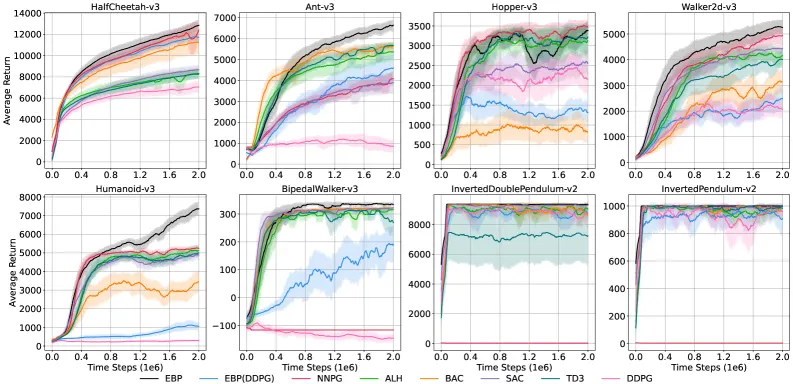
Behavior prior reinforcement learning (BPRL) has emerged as a promising paradigm to improve sample efficiency in online reinforcement learning (RL) by leveraging policy priors derived from offline demonstrations. However, most existing BPRL methods rely on static offline datasets, which often suffer from low data diversity and suboptimal trajectory quality. This reliance restricts the effectiveness of policy priors, hindering both policy exploitation and stability during online training. Consequently, agents are prone to inefficient exploration and unstable learning dynamics. To address these limitations, we deviate from existing offline pre-training methods and propose an Expert Behavior Prior (EBP) algorithm. Specifically, we introduce a Q-guided conditional variational autoencoder (Q-CVAE) that learns to generate expert policy priors directly from the online replay buffer. This enables the generation of high-value actions for guiding policy updates without relying on pre-collected expert trajectories. To further enhance policy exploitation, we propose an expert policy guidance (EPG) mechanism that selects expert actions from a generative support set, and we integrate a policy gradient correction (PGC) module to harmonize Q-guidance with expert supervision, promoting stable and consistent policy improvement. Extensive experiments conducted on robotic control (Gym, PyBullet) and industrial control (DMControl) benchmarks demonstrate that EBP significantly outperforms state-of-the-art online RL algorithms, achieving higher sample efficiency and more stable convergence.
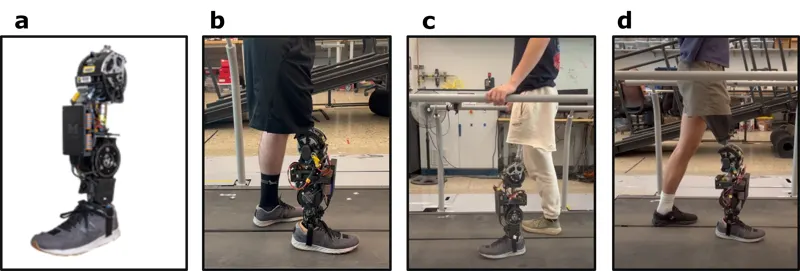
Personalization of impedance controllers for powered prosthetic legs is critical to accommodating individual gait biomechanics but remains challenging. Existing methods rely on time-intensive human-in-the-loop exploration and/or constrain optimization to low-dimensional, single-joint parameter subspaces. Sim-to-real transfer has enabled high-dimensional locomotion control for legged robots, but in assistive device control the human partner remains un-modelable. We present a replay-constrained simulation framework: a MuJoCo-based simulator reproduces prosthetic knee-ankle dynamics while replaying recorded hip kinematics and feedback-based ground reaction forces from individual walking data, bypassing the need to model complex human neuromuscular control mechanisms. We demonstrate the framework with a deep reinforcement learning policy that personalizes phase-dependent stiffness, damping, and equilibrium angle at both joints simultaneously, maximizing a biomimicry-based reward computed solely from onboard prosthesis measurements. Experiments with three participants with transfemoral amputation during level-ground walking at 0.8 m/s demonstrate strong simulation-to-hardware predictive validity (Pearson r=0.96–$0.997$). The best-performing policy on hardware was consistently predicted within the top five simulation policies for all participants. The learned controllers improved overall biomimicry rewards by 42–59% relative to the unpersonalized baseline. The framework supports scalable high-dimensional personalization of powered prosthetic legs and is amenable to extension to higher-dimensional controller parameterizations such as neural-network controllers.
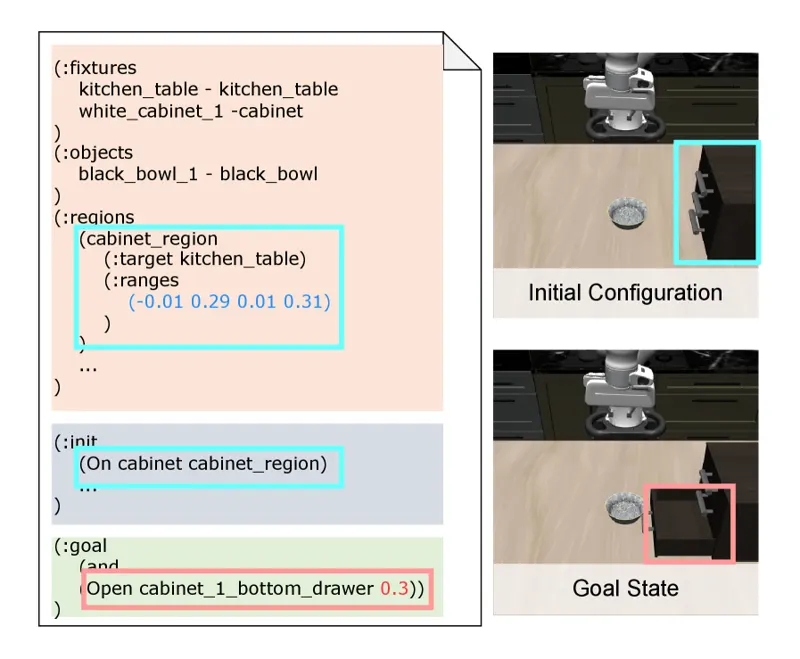
Long-horizon manipulation tasks pose significant challenges for reinforcement learning due to sparse reward signals and long horizons. Automatic curriculum learning (ACL) has been proposed to tackle these challenges by progressively training agents on a sequence of tasks, from easier to more difficult. However, the success of ACL depends heavily on task-dependent specifications-such as well-defined task parameter spaces and difficulty measures-which are often manually crafted and difficult to generalize across diverse tasks. Recent advances in large language models (LLMs) offer a promising alternative by enabling the decomposition of complex tasks into meaningful subtasks using the LLMs' web-scale common-sense knowledge. This decomposition can provide a natural curriculum structure for efficient learning of long-horizon tasks. However, existing LLM-based methods typically rely on hand-designed dense reward functions to learn each subtask, which can introduce bias and still requires significant human supervision. In this work, we propose LLM-enhanced automatic curriculum learning (LEACL), a framework that integrates LLMs and ACL to address these limitations. Specifically, LLMs are used to both decompose tasks into subtasks and to generate task-dependent specifications for each subtask. These specifications are then used by ACL algorithms to guide learning using only sparse reward signals, eliminating the need for dense reward design. We evaluate LEACL on five long-horizon manipulation tasks from the LIBERO benchmark. LEACL achieves better asymptotic performance in terms of the success rates compared to human-designed dense rewards.
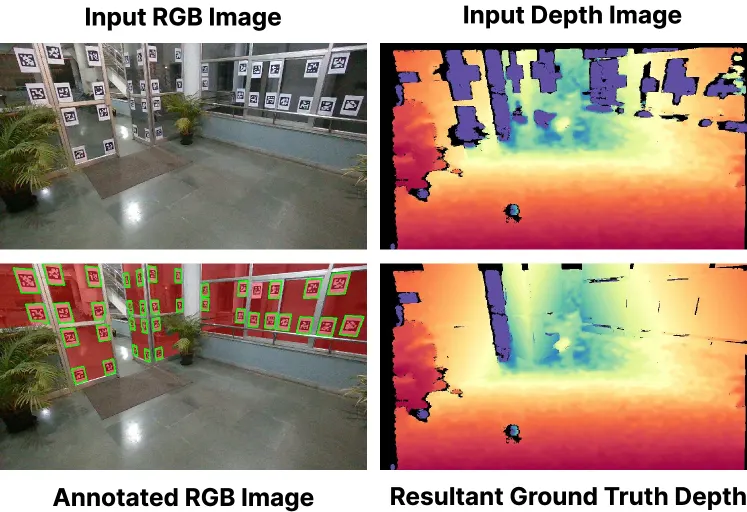
Standard depth sensors systematically fail on transparent surfaces, creating corrupted 3D maps and severe navigation hazards. While specialized hardware sensors can detect glass, they lack modularity and have extensive hardware dependencies. Consequently, learning-based monocular depth estimation has emerged as a compelling alternative. However, domain-specific glass-aware monocular depth estimators struggle with unfamiliar indoor layouts; restricted by the severe scarcity of real-world glass depth annotations, they fail to generalize zero-shot to new settings. This motivates us to explore whether the extensive priors of text-to-image diffusion models can enable generalizable perception of transparent surfaces. We introduce SILICA, a unified pipeline leveraging these priors to jointly predict glass segmentation and glass-aware depth. This mutual information exchange establishes a robust spatial hierarchy, entirely eliminating the need for paired real-world glass depth annotations. Subsequently, we use the predicted segmentation mask to explicitly filter incorrect glass depth points from standard sensors, recovering accurate metric glass depth for downstream 3D mapping and autonomous collision avoidance. Supported by our novel Mirage 18k dataset, extensive experiments demonstrate that SILICA achieves remarkable zero-shot transfer across diverse, unseen environments, outperforming state-of-the-art models by almost 20% and setting a new benchmark for transparent surface perception.
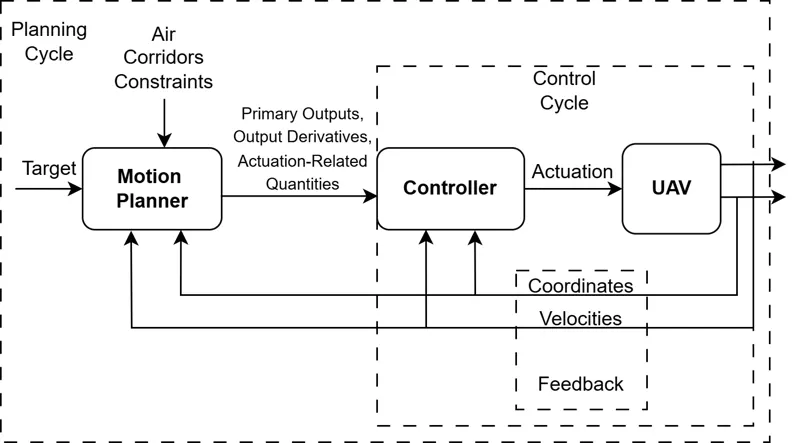
This work presents a motion planning framework for UAV navigation in non-convex urban air corridors. The planner is based on a mixed-integer tracking model predictive control formulation that enforces corridor feasibility and dynamic consistency within a single optimization problem. To guarantee convergence to the target and mitigate the occurrence of local minima induced by non-convex geometry, a shortest-path-based offset cost with feasibility constraints is embedded directly into the planning problem. Numerical simulations show that the proposed formulation generates dynamically valid trajectories that satisfy the corridor constraints and converge to the target without relying on external global planning stages.
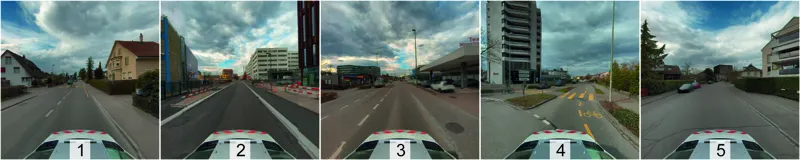
Accurate and reliable pose information with respect to a reference frame is increasingly demanded across applications such as autonomous navigation, surveying, robotics, and augmented and mixed reality. Visual localization can serve as a complementary positioning modality to GNSS, whose applicability and accuracy are often limited. Yet, the accuracy potential of visual localization has not been systematically investigated against survey-grade demands. This is mainly due to the lack of publicly available, large-scale outdoor datasets with ground-truth poses in the sub-centimeter range. In this work, we address both gaps. We introduce a scalable visual localization pipeline that employs precisely georeferenced, high-resolution street-level imagery directly as the scene representation. It combines prior-guided reference candidate selection with on-the-fly local Structure-from-Motion reconstruction and PnP-based pose estimation. We further present the FHNW Muttenz dataset, a real-world dataset covering a contiguous 10 km street network mapped in two mobile mapping campaigns approximately 1.5 years apart. It consists of high-resolution reference imagery and query sequences acquired by four different cameras across five representative scenes. All images are precisely co-registered, yielding 6-DoF ground-truth poses in the sub-centimeter range. Using this dataset, we evaluate the accuracy potential of visual localization. Our experiments demonstrate median pose accuracies in the range of 1-5 cm for translation and 0.05-0.1° for rotation, reaching as low as 1 cm and 0.03° under favorable conditions. These results show that visual localization can complement survey-grade GNSS positioning, paving the way for 3D geospatial data acquisition using consumer devices and fully automated georeferencing approaches. The dataset is publicly available at: https://fhnw-muttenz-vl-dataset.github.io/.
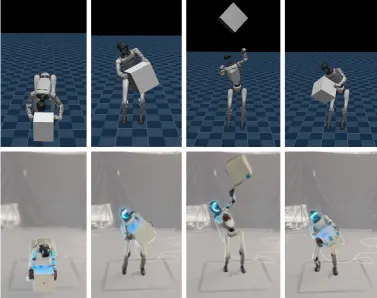
Fast planning of novel behaviors in unseen scenarios remains a fundamental challenge in robotics. The high-dimensional, hybrid, and underactuated nature of humanoid loco-manipulation continues to hinder the realization of this goal. In this paper, we address this challenge by proposing a nested kino-dynamic framework for rapid feasibility checking and dynamically consistent trajectory generation given a candidate contact sequence. By integrating this module with a feasibility-guided tree search and a Large Language Model (LLM)-based contact plan sampling strategy, we demonstrate that the proposed framework can substantially improve the search process. Furthermore, we show that the generated trajectories can be tracked using a reinforcement learning (RL)-based controller and show that the resulting trajectories are of sufficiently high quality for execution in real-world loco-manipulation scenarios. A supplementary video is available at: https://youtu.be/R6qCHoCormQ.
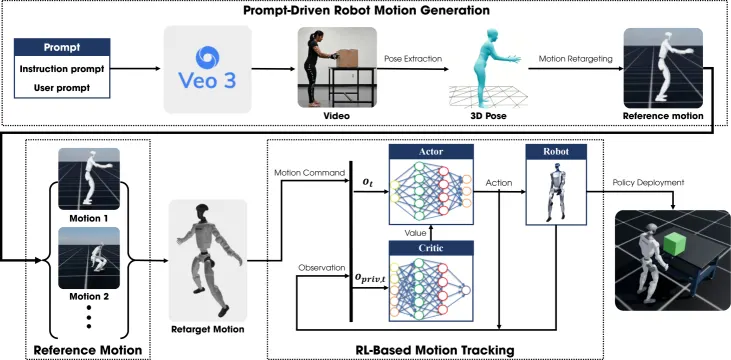
The human-like morphology of humanoid robots grants them exceptional potential for agile and versatile motor capabilities, but it also introduces significant challenges in acquiring complex skills. Traditional Learning-from-Demonstrations methods are often constrained by the high cost of collecting real-world data, the difficulty of capturing motion-specific behaviors, and the limited diversity of demonstrations across individuals. Moreover, even for the same task, humans may execute the motion in multiple distinct ways. In this paper, we propose a new framework that leverages the power of Generative AI to convert textual prompts into realistic and diverse sequences of human body movements, enabling the robot to observe multiple variations of how a single task can be performed. These synthetic demonstrations are then used as a training resource, allowing the robot to learn a broad range of task-execution styles without requiring direct human intervention. We evaluate the proposed method across four simulation scenarios. Experimental results show that the robot not only completes the tasks successfully but also demonstrates strong adaptability to complex variations in motion.
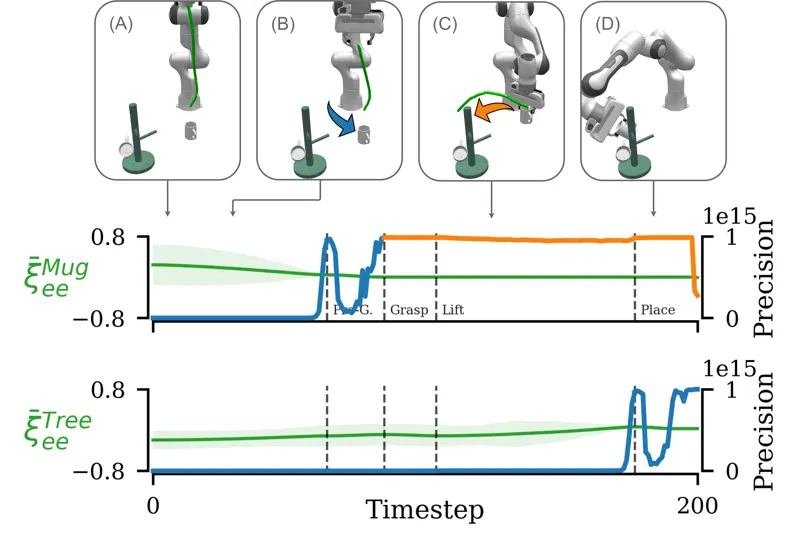
Multi-stream robot manipulation policies achieve unparalleled sample efficiency and generalization by modeling actions relative to environmental reference frames. However, existing approaches typically assume these frames to be strictly exogenous. This causal assumption collapses in dynamic settings, such as when a single robot arm manipulates a moving object or when two arms coordinate, where each arm effectively becomes part of the dynamic environment of the other. We propose DynaMAC, a lightweight, policy-agnostic framework that resolves this causal limitation while preserving the sample efficiency, computational speed, and flexibility of multi-stream policies, DynaMAC treats the opposite arm as a dynamic task parameter, thereby providing a unified formulation for dynamic manipulation and bimanual coordination without requiring an explicit leader-follower relationship. To rigorously evaluate these capabilities, we introduce DynaBench, a novel benchmark for robot manipulation in dynamic environments. Across both dynamic environments and bimanual manipulation tasks, DynaMAC outperforms leading probabilistic and generative baselines by over 35 percentage points while requiring 20 times fewer samples. Crucially, DynaMAC generalizes zero-shot from static demonstrations to dynamic environments, substantially simplifying data collection and establishing an elegant bridge toward human-robot collaboration.
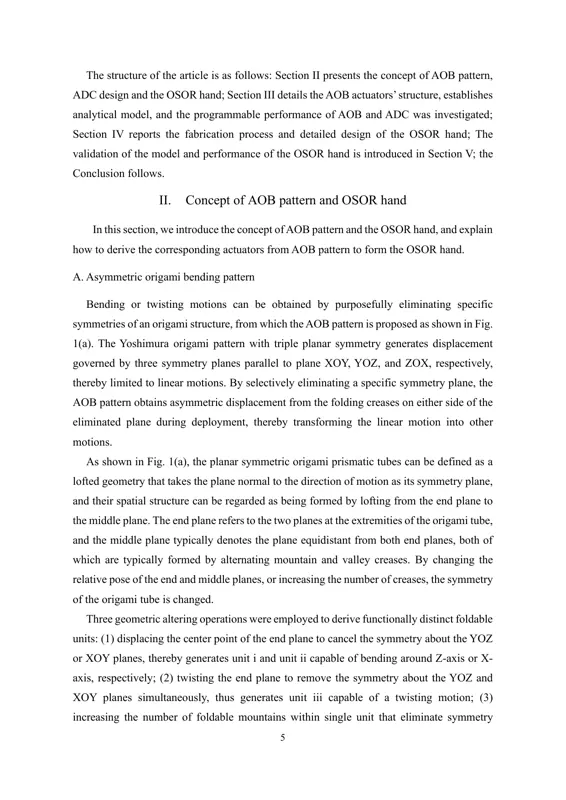
The passive adaptability inherent in soft robotic hands affords them advantages in applications that require safe and compliant interaction. However, existing soft robotic hands often struggle to simultaneously achieve adequate output performance and easy manufacturing due to their complicated structures. In this paper, we introduce the asymmetric origami bending (AOB) pattern for generating bending motion and the asymmetric dual-chamber (ADC) design for obtaining multifunction capability. The AOB single (AOB-S) chamber and AOB dual-chamber (AOB-D) units are designed and constitute the finger and palm actuators of the proposed Origami-inspired SOft Robotic (OSOR) hand. The OSOR hand achieves bio-inspired fingers-palm motions and adequate output performance within a monolithic structure that significantly simplifies the manufacturing process. By defining the asymmetric ratio to characterize the geometric asymmetry of the unit, the analytical models of the AOB and ADC structures are proposed. The Finite Element Analysis tool for the design of AOB actuators is obtained by geometric analysis. The asymmetric origami design grants the integrated manufacturing of the OSOR hand through a Selective Laser Sintering printing process with a single thermoplastic polyurethane material. The model and simulations are validated by experimental results. Experiments show the finger and palm maximum bending motion range of 203° and 40°, respectively, with output forces of 6.3 N and 16 N. The OSOR hand is capable of pinching a piece of tissue, stably grasping water bottles with two fingers, palm-only grasping, and completing the power grasps in the taxonomy of manufacturing grasps. The compactness, performance, and easy manufacturing of the proposed hand benefit the development of the soft robotic hand with new possibilities.
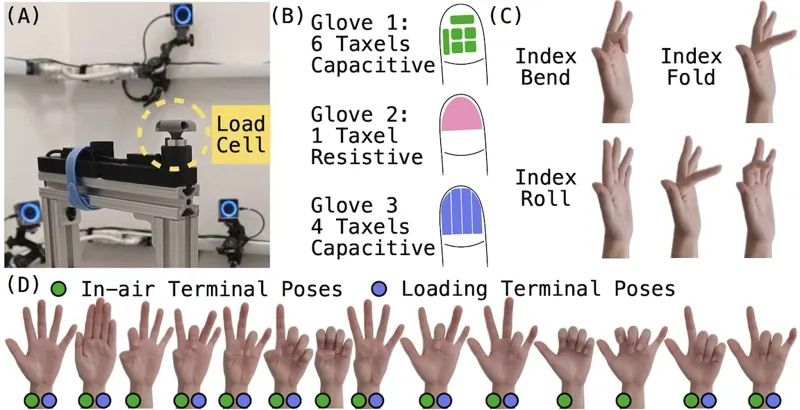
Tactile gloves digitize contact and force during hand-object interactions, enabling robotics applications in dexterous manipulation, teleoperation, and learning from demonstration. To preserve hand dexterity and capture the nuances of natural interactions, these gloves and the integrated tactile sensors are designed to be soft, flexible, and comfortable. However, such flexible sensors are sensitive not only to contact forces but also unavoidably to hand pose changes, resulting in pose-related artifacts (PRAs). PRAs are especially problematic in the low-force range, resulting in misdetections or late-onset detections of contact, which raises the minimum detectable force (MDF) of the glove. In this work, we characterize the PRAs in relation to pose and force. Building on these insights, we introduce a glove-agnostic algorithmic framework that leverages hand pose information, which is increasingly available, to mitigate PRAs without glove modifications. Our pose-aware force estimation model augments tactile-to-force pipelines with a residual prediction branch that explicitly accounts for pose-induced sensor deformations. We validate our approach across 3 glove designs and 15 users, reducing MDF by 10.4%, 12.2%, and 18.3%, with consistent improvements across all evaluated metrics. This method provides a practical path to improving the usability of tactile gloves in data collection and diverse robotic applications.
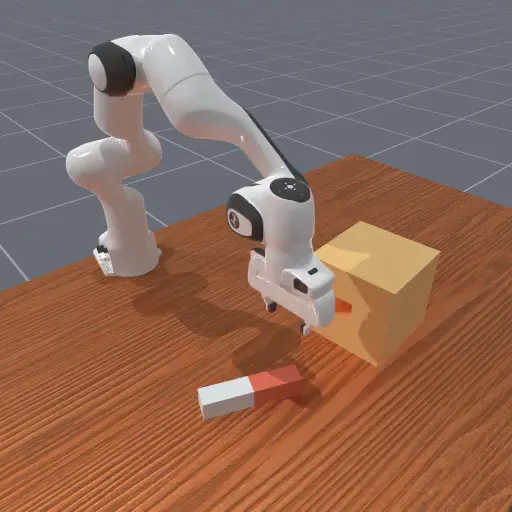
While scaling laws for imitation learning have primarily focused on generalization in open-world settings, the relationship between data and precision in closed-world tasks like robotic assembly remains largely unexplored. This paper systematically investigates this relationship and introduces a novel scaling law. We find that to achieve a fixed success rate, the required number of demonstrations N grows super-exponentially as the target precision P approaches a limit c. This relationship is accurately captured by the model log(N) ∝ 1/(P-c). Crucially, we reveal that the limit precision c is not a static physical constant of the task but an emergent property of the entire agent system, including its sensors and expert policy. Through experiments on canonical manipulation tasks, we validate this law and demonstrate that improving system components, such as adding a wrist camera or using a more effective expert, measurably lowers c, thus expanding the system's achievable precision. Our work provides a new theoretical framework for precision in robotics and a quantitative metric to evaluate system capabilities. Furthermore, these findings provide a practical methodology for guiding the development and debugging of high-precision manipulation systems.