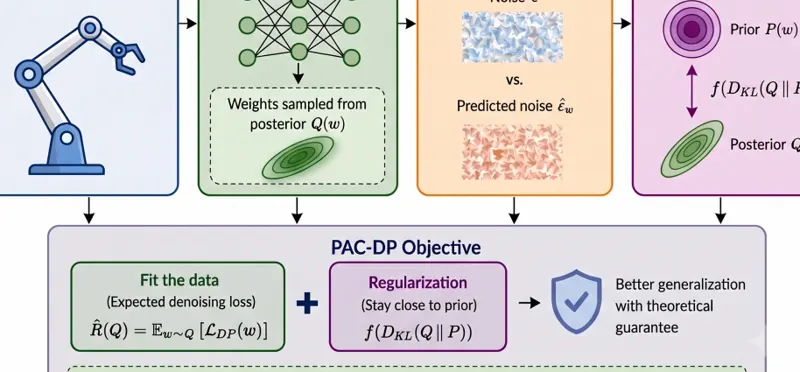
Diffusion Policies (DPs) are able to perform complex manipulation tasks. However, DPs are typically trained by minimizing a denoising objective, which provides limited control over generalization in the finite-data regimes common in robotics. In this letter, we propose PAC-DP, an approach that increases the performance of DPs in robotic manipulation tasks. By modeling the DP as a Bayesian neural network, and defining a PAC-Bayes generalization bound, we derive a novel training objective that augments the standard denoising loss with a Kullback-Leibler divergence regularizer between the posterior and prior parameter distributions. From the theoretical perspective, our approach provides a principled approach to regularize the training of DPs without significantly increasing the training time. From the practical point of view, experimental results demonstrate improved denoising performance, lower variational negative log-likelihood, and higher success rates across multiple robotic manipulation benchmarks. Crucially, the largest improvements are observed in low-data training regimes and complex tasks, establishing PAC-DP as a theoretically grounded framework for robot policy learning.
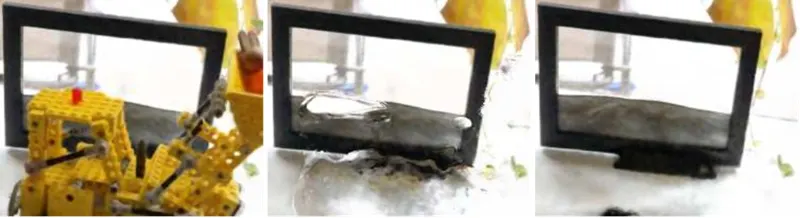
In this paper, we present NEO, a unified framework providing language-guided NeRF editing for robotic manipulation. Our paper introduces (i) a language-guided object removal that combines neural field resampling with multiview-consistent progressive inpainting, (ii) a direct NeRF weight editing method utilizing knowledge distillation, composing original and edited NeRFs via a teacher-student model, enabling coherent modeling of future scene states before a robot executes an action, and (iii) the first benchmark (NEO-Dataset) for quantitatively evaluating NeRF scene editing methods suitable for robot manipulation. We show that our approach outperforms state-of-the-art baselines in scene editing tasks, including object removal and pick-and-place robotic experiments, yielding visually coherent and geometrically consistent edits that reduce artifacts commonly introduced by prior methods.
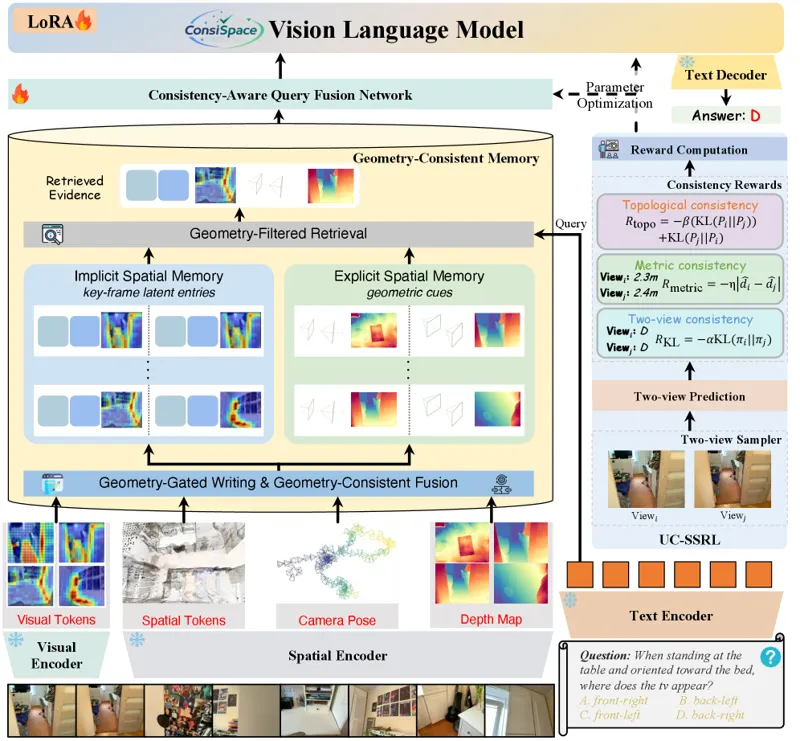
Video spatial reasoning is essential for navigation-oriented perception and long-video question answering, where models must infer spatial relations across long horizons under changing viewpoints. However, existing multimodal large language models (MLLMs) remain largely semantic-centric, and often fail to reliably aggregate consistent spatial evidence from redundant video observations, leading to inefficient or unstable reasoning. To address these issues, we propose ConsiSpace, a geometry-consistency-aware framework for geometry-sensitive video spatial reasoning that turns spatial consistency into both an evidence organization principle and an explicit post-SFT learning signal. We build a geometry-consistent memory (GCM) including implicit evidence tokens and explicit geometric cues, and leverage efficient organization strategies to compactly preserve task-related spatial evidence. Furthermore, we utilize unified consistency self-supervised reinforcement learning (UC-SSRL) after supervised fine-tuning to improve cross-view stability, with answer-, metric-, and topology-consistency rewards. Extensive experiments on three spatial-reasoning benchmarks, VSI-Bench, OSI-Bench, and MMSI-Video-Bench, show consistent gains, improving the average score by 12.6 points over the strongest baselines.
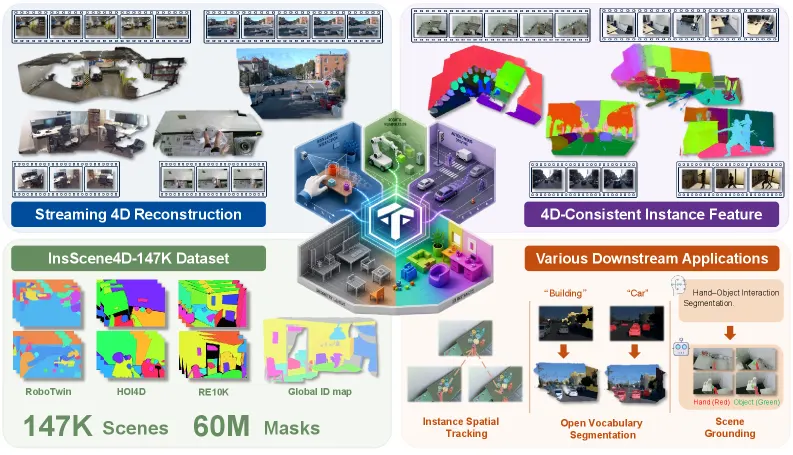
Real-world spatial intelligence requires agents to understand scenes from continuous video streams, where objects move, persist, disappear, and reappear over time. While recent spatial foundation models have enabled generalizable feed-forward 3D reconstruction, most streaming methods remain geometry-centric and lack temporally consistent object-level understanding. Meanwhile, existing semantic reconstruction and 3D-aware vision-language methods largely rely on externally extracted 2D semantic cues or loosely coupled geometry inputs, limiting unified geometry-instance learning in long dynamic scenes. In this paper, we propose IGGT4D, a streaming instance-grounded geometry Transformer for online 4D scene understanding. IGGT4D processes video frames sequentially, reuses historical context through causal spatial-temporal modeling, and incrementally updates a unified representation of camera motion, geometry, and object identity. This enables long-sequence feed-forward reconstruction with geometry-instance consistency in dynamic environments. To address the lack of high-quality 4D supervision, we further construct InsScene4D-147K, a large-scale dataset spanning real/synthetic and static/dynamic scenes, with RGB images, depth, poses, and temporally consistent instance masks generated by an automated geometry-guided annotation pipeline. Experiments on 3D reconstruction, pose estimation, instance spatial tracking, and open-vocabulary segmentation demonstrate that IGGT4D outperforms existing streaming baselines while maintaining scalable online inference for long dynamic sequences.
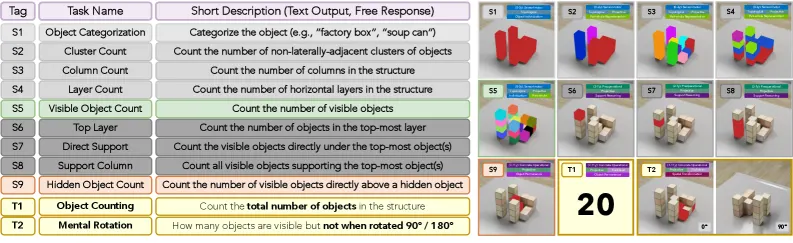
Multimodal large language models (MLLMs) excel at visual interpretation but fail on spatial reasoning tasks that humans solve reliably. Existing benchmarks evaluate these models as black boxes, limiting their ability to identify the underlying causes of lower performance: when a model fails a spatial reasoning task, it remains difficult to ascertain whether the hurdle is perceptual, such as recognizing object boundaries, or cognitive, such as reasoning about occlusion to infer hidden geometry. We introduce Spatial-IQ, a hierarchical diagnostic framework that decomposes object counting in stacked 3D structures into 9 perceptual and cognitive sub-tasks organized by the developmental stages of human spatial cognition, with mental rotation as an additional target probe. Using NVIDIA Isaac Sim, we procedurally generated a diverse dataset of roughly 80,000 stacked 3D structures with per-task ground truth. We evaluate models across three output formats (free-response text, multiple-choice images, and image editing) alongside a human baseline. The Spatial-IQ framework shows that top-performing models often succeed at the target task (object counting) without succeeding on the lower-level sub-tasks intended to support it, and that models differ in how much of these hierarchical chains they preserve, often revealing shortcut behavior that raw target-task accuracy alone would obscure. Finally, we demonstrate that training models with chain-of-thought (CoT) supervision over our hierarchical sub-tasks, combined with reinforcement learning with verifiable rewards, significantly improves both spatial consistency across sub-tasks and target-task accuracy, supporting the value of the proposed decomposition as both a diagnostic tool and a training signal.
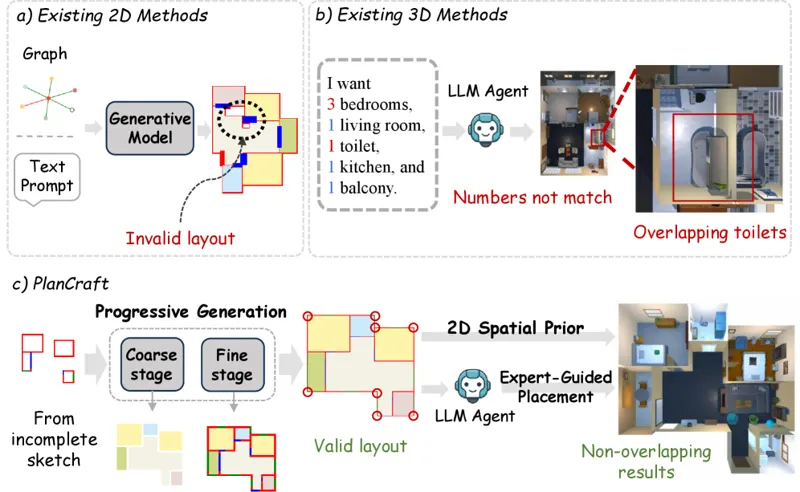
Two structural insights have been overlooked in automated residential floor plan generation. First, design is inherently progressive. Architects begin with rough strokes and refine them over time, whereas existing methods typically require their conditioning representation to be fully specified before generation, a fundamental mismatch with how design actually works. Second, the 2D floor plan is not an optional intermediate but an irreplaceable spatial contract. Once room boundaries, doors, and windows are fixed, furnishing reduces from open-ended spatial reasoning to bounded constraint satisfaction. Bypassing this contract, as existing 3D systems do by delegating layout to language models, yields overlapping rooms and implausible proportions; directly calling general-purpose language models likewise produces geometrically invalid layouts. Guided by these insights, we present PlanCraft. SketchPlan supplies the missing training signal by replaying the architect's drawing process on 80K real floor plans, producing partial sketches at every completeness level. PlanCraft-Diff progressively sharpens an incomplete sketch into a geometrically precise, vectorizable floor plan through a coarse-to-fine strategy. With the spatial contract established, PlanCraft-Agent then furnishes the scene within well-defined room boundaries. Experiments show that PlanCraft achieves a 61.1% lower FID than the best existing 2D method and surpasses existing 3D systems by 15 points in expert-rated spatial rationality, with a sketch at only 25% completion already outperforming all fully specified baselines.
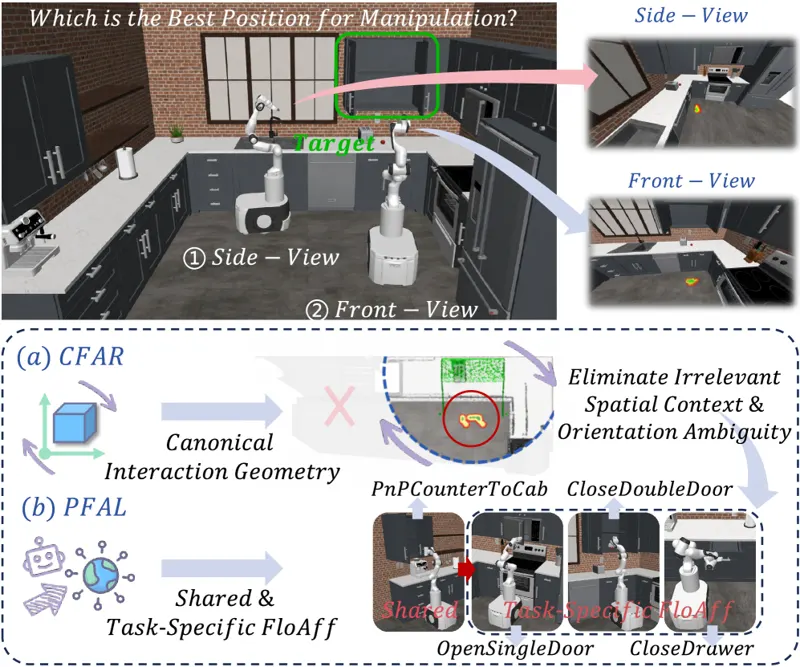
Mobile manipulation requires robots to identify Floor Affordance (FloAff) that maximizes downstream manipulation success rather than merely ensuring navigation feasibility. FloAff prediction is a target-conditioned local spatial reasoning problem, yet existing methods suffer from representation ambiguity caused by irrelevant spatial context and arbitrary object orientations, while entangling shared and task-specific knowledge across heterogeneous manipulation skills. To address these challenges, we propose a unified framework for FloAff prediction from egocentric multimodal perception, consisting of canonical representation learning and progressive affordance prior learning. Specifically, we introduce a Canonical Floor Affordance Representation (CFAR), which learns canonical interaction geometry by preserving affordance-relevant local structure while eliminating nuisance spatial variations unrelated to robot base placement. We further propose Progressive Floor Affordance Learning (PFAL), which learns transferable FloAff priors from a foundation manipulation task and progressively adapts them to heterogeneous downstream manipulation skills. To facilitate systematic evaluation, we establish the first cross-scene, multi-view FloAff-Kitchen benchmark covering diverse manipulation skills, scene layouts, furniture styles, and viewpoints. Extensive experiments on three benchmark settings demonstrate that our method consistently outperforms strong baselines, while ablation studies validate the contribution of each proposed component. Project page: https://csu-hero-lab.github.io/FloAff-Kitchen_Web/
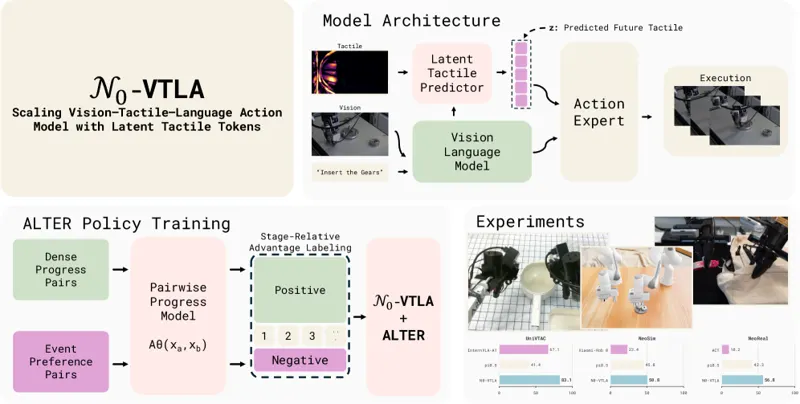
We present N₀-VTLA, a vision-tactile-language-action (VTLA) foundation model capable of (1) fine-grained contact-rich manipulation with tactile perception and tactile-feedback control, and (2) offline policy improvement from stored deployment data. Building on current vision-based backbones, we propose a training recipe for tactile integration consisting of visuo-tactile pre-training, staged tactile-pathway integration, and advantage-conditioned offline policy improvement. During pre-training, the policy learns broad contact priors from NeoData, our large-scale visuo-tactile robot dataset; to our knowledge, N₀-VTLA is the first VTLA model pretrained on tactile data at scale. During post-training, we augment the policy with a predictive tactile pathway that distills the contact patterns learned at scale into the fine motion adjustments required by downstream tactile-centric manipulation. For offline policy improvement, we introduce ALTER, an advantage-conditioned offline reinforcement learning method that converts relative progress and trajectory-event comparisons into binary advantage labels for policy training on a fixed deployment corpus, further improving task-specific learning on contact-rich skills such as deformable object manipulation. Across contact-rich benchmarks, N₀-VTLA outperforms strong baselines by wide margins: it wins all nine real-robot NeoReal tasks and reaches 63.8% mean success on a twenty-task simulation suite, against 44.0% for the strongest baseline. N₀-VTLA policies trained with ALTER reach 75-95% success on three long-horizon real-robot tasks. These results lay a foundation for versatile tactile-driven manipulation policies.
Operating constrained dynamical systems requires controllers to efficiently solve complex tasks while enforcing recursive feasibility and safety constraints. To address these competing requirements, we present Feasible Action for Optimal Control (FAOC), a novel control framework integrating Reinforcement Learning (RL) and Optimal Control (OC). The key contribution is a computationally efficient, optimization-based mapping algorithm that transforms the RL agent's action from a static abstract set into a state-dependent feasible parameter set of the Optimal Control Problem (OCP), guaranteeing strict satisfaction of the dynamical system's constraints. Thus, FAOC effectively combines the predictable safety of OC with the flexibility of RL. In contrast to prior work, the abstract action space of the RL agent does not require expert or heuristic design, and the OCP formulation is not compromised by the inability of RL to guarantee feasibility. We apply our approach to real-time motion planning for robot table tennis, which encapsulates these challenges. Via simulated experiments, we show that FAOC outperforms state-of-the-art baselines in both sample efficiency and closed-loop performance.
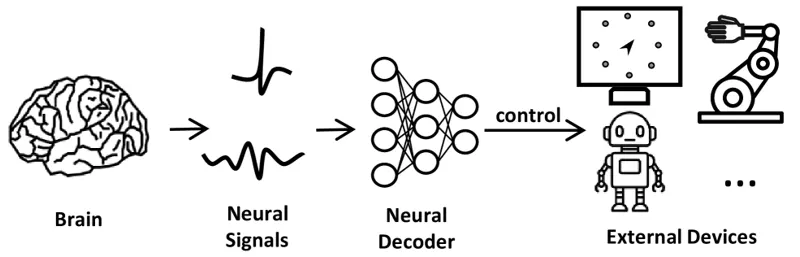
Brain-Machine Interfaces (BMIs) provide a direct communication pathway between the brain and external devices, enabling humans to control assistive and robotic technologies, with potential applications in rehabilitation, human motor augmentation, and human-centered robotics. However, due to neural drift, the performance of BMIs decreases over time, posing challenges for long-term viability, particularly for invasive BMIs (iBMIs). Existing solutions suffer from two main drawbacks: (i) difficulty in learning robust neural representations, and (ii) neglecting that neural drift varies across motor parameters (e.g., velocity, direction, and speed). To overcome these limitations, we propose Self-Supervised Consistency enhanced Disentangled Learning (SSCDL), a neural decoding generalization framework built on two key innovations. We first design a backbone model named Consistency enhanced Neural Decoder (CND), using a novel teacher-student consistency constraint with simulated neural signal perturbations to learn robust representations invariant to neural drift. Then, we employ three dedicated CNDs under the Complementary-Disentangled Generalization (CDG) mechanism, which disentangles motor signals into velocity, direction, and speed with inspiration from neural preference theory. This disentangled learning enables SSCDL to capture invariant neural representations from diverse neural preference perspectives, significantly enhancing cross-day generalization. Extensive experimental results show that SSCDL delivers state-of-the-art decoding performance, exhibiting high robustness and cross-day stability. These capabilities underscore its strong potential for long-term interaction in human-centric robotic and fine-grained assistive applications.
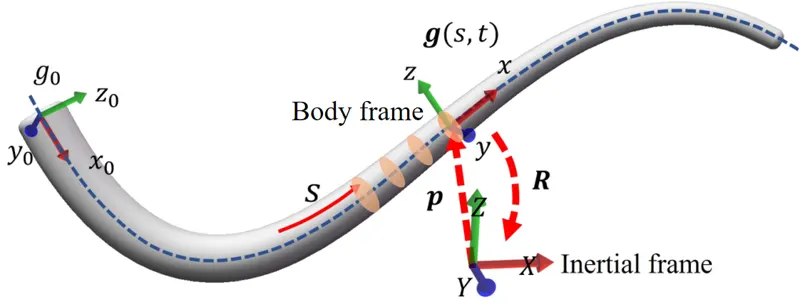
Precise control of soft manipulators remains challenging due to the difficulty of developing accurate yet computationally tractable models for model-based estimation and control. Reduced Cosserat-rod models provide a physics-based and control-oriented description of soft-robot dynamics, offering an explicit alternative to purely data-driven input-output representations. In this paper, we propose a moving-horizon estimation (MHE) and nonlinear model predictive control (NMPC) framework for cable-driven soft manipulators based on reduced Cosserat dynamics. A smooth cable-length-driven modeling formulation is developed by approximating the complementarity relationship between cable tension and cable slackness, enabling cable-length control without direct tension sensing. Based on this formulation, an MHE method is introduced to estimate the reduced state and reconstruct the manipulator configuration from end-effector pose measurements and cable-length information. An NMPC controller is then formulated to achieve task-space control under cable-length and cable-rate constraints. The proposed framework is validated through numerical simulations and experiments. Simulation results demonstrate the effectiveness of the estimator and controller for pose and strain-related regulation on a multi-cable soft manipulator. Experimental results on a four-cable prototype further show that the proposed MHE-NMPC scheme can be implemented in real time and enables accurate end-effector position tracking through cable-length control.
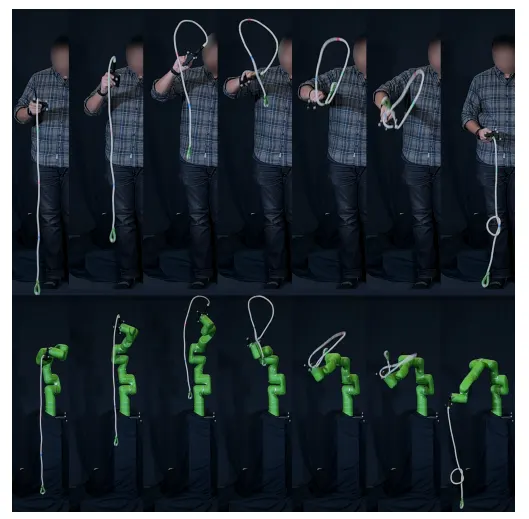
Bridging the sim-to-real gap is a central problem in robotics, and the prevailing approach is to build increasingly accurate simulators. Here, we propose another approach based on renormalization: using effective, resolution-dependent parameters to absorb details omitted by the simulator and reproduce real behavior. These parameters may differ from measured physical values because they compensate for what the simulator leaves out. We demonstrate this mechanism analytically for proportional–derivative (PD) control at finite simulation frequency, where proportional feedback changes the effective derivative gain and derivative feedback changes the effective inertia. We then interpret dynamic rope manipulation and underwater swimming through the same perspective. Finally, we present a practical procedure for choosing observables, identifying omitted physics, and determining effective parameters. Renormalization offers robotics a complementary path across the sim-to-real gap: effective parameters, real behavior.