Skip to content
SimWAM: A Simple World Action Model for End-to-End Autonomous Driving

SimWAM: A Simple World Action Model for End-to-End Autonomous Driving

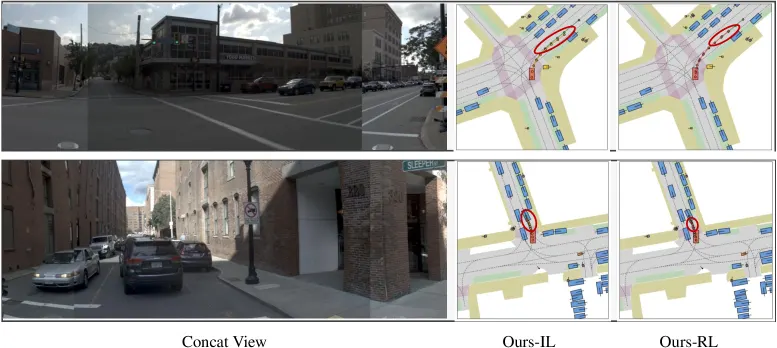
World-Action Models (WAMs) improve end-to-end autonomous driving by transferring video dynamics priors to action prediction, but existing methods require costly future generation at inference. We present SimWAM, a simple yet effective WAM that uses video generation purely as a training signal. It co-trains a pretrained video expert and a lightweight action expert with joint flow matching. An isolated attention mask keeps action prediction independent of future frames, allowing the video branch to be discarded after training and leaving a self-contained planner that directly predicts trajectories. Since the two experts share no parameters and interact only through a unified attention interface, the video backbone could be replaced and the action expert scaled independently without modifying the learning objective or inference pipeline. We further apply reinforcement learning to optimize a compositional driving reward beyond trajectory imitation. Our SimWAM achieves $91.5$ PDMS on NAVSIM, surpasses state-of-the-art WAM-based planners with substantially lower latency, and transfers zero-shot to nuScenes. These results position SimWAM as a simple yet solid baseline that could readily benefit from advances in video generation for efficient autonomous driving. The code and model weights are available at https://github.com/H-EmbodVis/SimWAM/

NAVSIMSimWAMWorld-action modelsZongchuang Zhao, Xin Zhou, Tianyang Xu·Aug 7, 2026
RL²-VLA: Adaptive RL Latent Compositional Steering with Test-Time Scaling for Vision-Language-Action Models

RL²-VLA: Adaptive RL Latent Compositional Steering with Test-Time Scaling for Vision-Language-Action Models

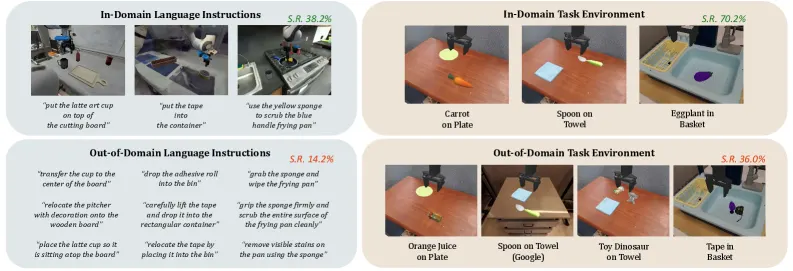
Despite the impressive visuomotor capabilities enabled by Vision-Language-Action (VLA) models, their performance often degrades on challenging and out-of-domain tasks. Recent test-time steering and scaling methods improve performance without extensive data collection and retraining, but action samples often remain concentrated around similar behaviors and therefore inherit correlated failure modes. Moreover, existing methods apply the same intervention strategy at every timestep, regardless of whether the base policy is already likely to succeed. To address these limitations, we introduce RL², an adaptive inference-time steering framework that leverages Reinforcement Learning on VLA Latents. First, we train a lightweight offline RL policy conditioned on expressive latents extracted from the VLA action expert and compose its flow velocity with that of the frozen VLA during inference. This compositional steering strategy combines the behavioral priors of large-scale imitation learning with the action diversity induced by offline RL beyond dominant demonstration modes. We further discover that inference-time steering follows fundamentally different scaling laws under success and failure states, revealing that action diversity is most beneficial when the base VLA is likely to fail, but can unnecessarily perturb already-accurate actions when success is likely. Building on this insight, RL² activates compositional steering only when failure is predicted. Across the SIMPLER and PolaRiS benchmarks, RL² improves success rates by up to +17.3% in out-of-domain settings, while ablations and scaling studies demonstrate the importance of latent representations and RL training. Finally, real-world experiments demonstrate that these gains transfer beyond simulation, establishing RL² as a practical and modular steering framework for VLA deployment.

VLARL2-VLAReinforcement LearningDerek Ming Siang Tan, Shailesh Shailesh, Srikrishna Iyer·Jul 29, 2026
Learning Whole-Body Humanoid Locomotion via Motion Generation and Motion Tracking

Learning Whole-Body Humanoid Locomotion via Motion Generation and Motion Tracking

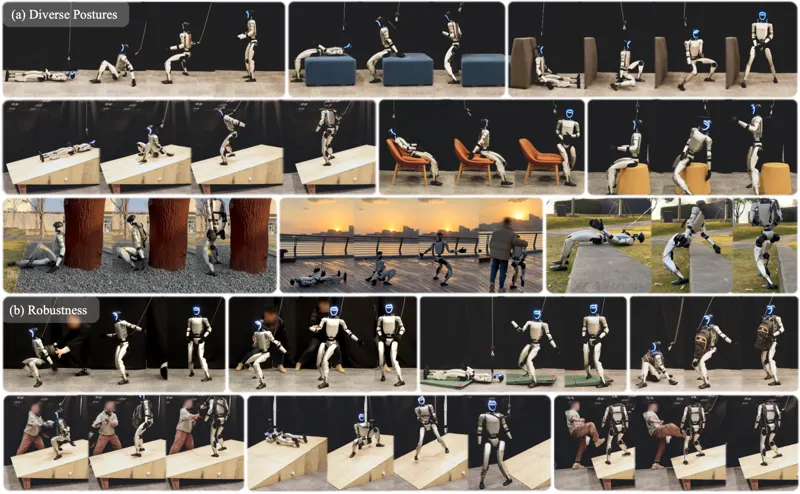
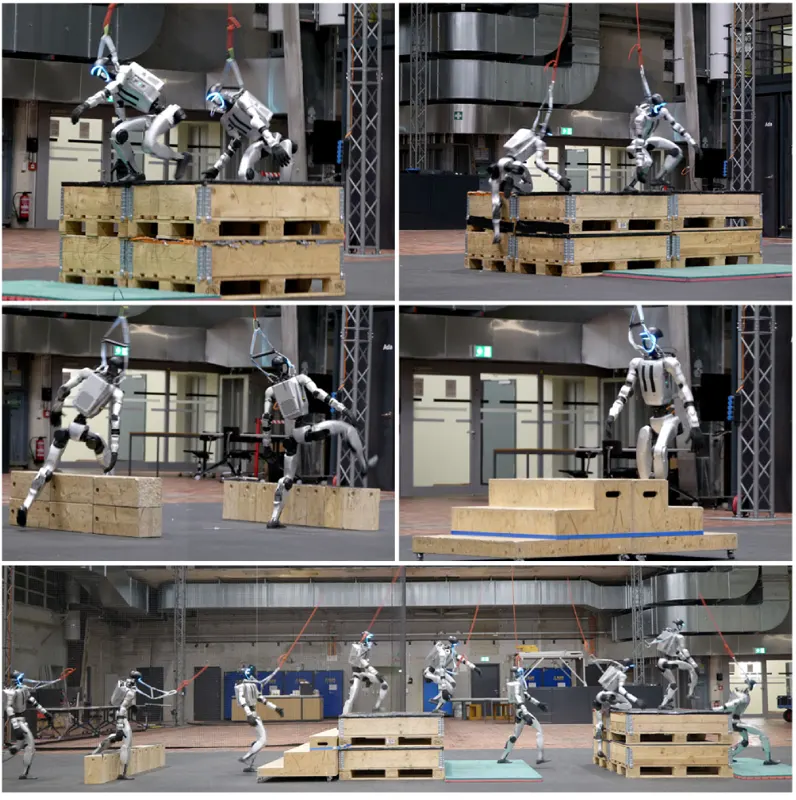
Whole-body humanoid locomotion is challenging due to high-dimensional control, morphological instability, and the need for real-time adaptation to various terrains using onboard perception. Directly applying reinforcement learning (RL) with reward shaping to humanoid locomotion often leads to lower-body-dominated behaviors, whereas imitation-based RL can learn more coordinated whole-body skills but is typically limited to replaying reference motions without a mechanism to adapt them online from perception for terrain-aware locomotion. To address this gap, we propose a whole-body humanoid locomotion framework that combines skills learned from reference motions with terrain-aware adaptation. We first train a diffusion model on retargeted human motions for real-time prediction of terrain-aware reference motions. Concurrently, we train a whole-body reference tracker with RL using this motion data. To improve robustness under imperfectly generated references, we further fine-tune the tracker with a frozen motion generator in a closed-loop setting. The resulting system supports directional goal-reaching control with terrain-aware whole-body adaptation, and can be deployed on a Unitree G1 humanoid robot with onboard perception and computation. The hardware experiments demonstrate successful traversal over boxes, hurdles, stairs, and mixed terrain combinations. Quantitative results further show the benefits of incorporating online motion generation and fine-tuning the motion tracker for improved generalization and robustness.

HumanoidWhole-body locomotionMotion GenerationZewei Zhang, Kehan Wen, Michael Xu·Apr 19, 2026
Learning Humanoid Locomotion with Perceptive Internal Model

Learning Humanoid Locomotion with Perceptive Internal Model

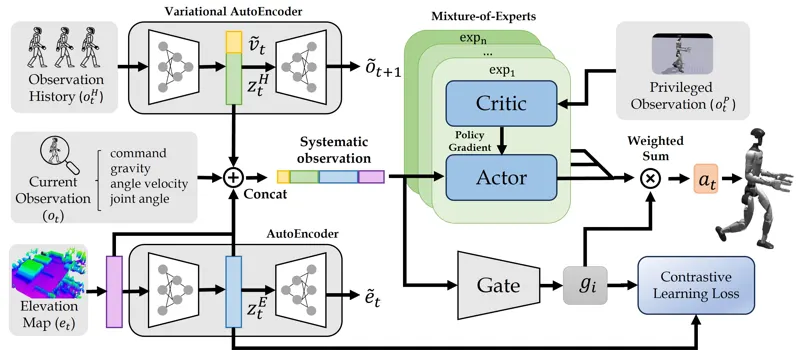
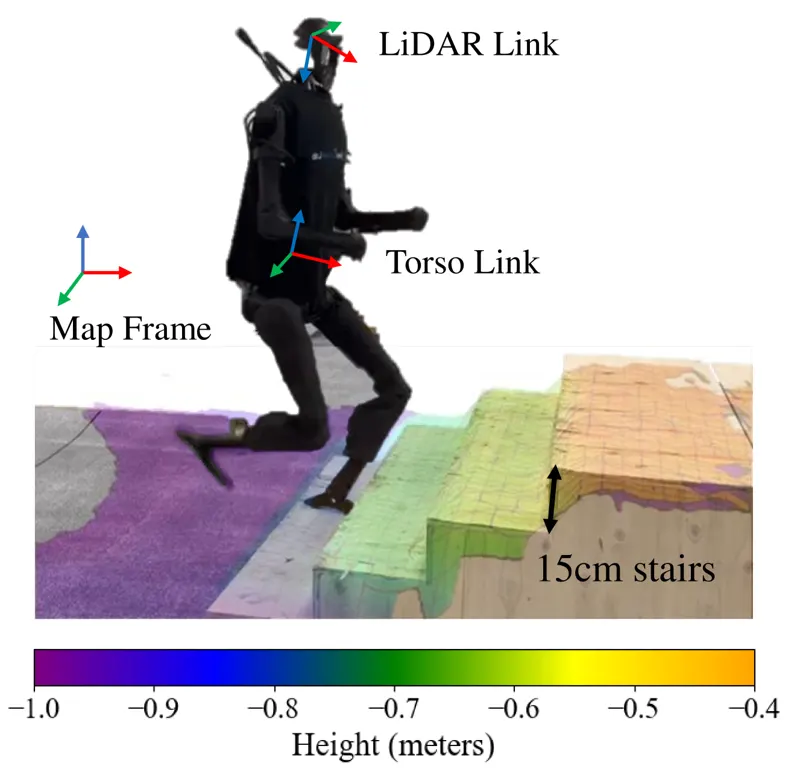
In contrast to quadruped robots that can navigate diverse terrains using a "blind" policy, humanoid robots require accurate perception for stable locomotion due to their high degrees of freedom and inherently unstable morphology. However, incorporating perceptual signals often introduces additional disturbances to the system, potentially reducing its robustness, generalizability, and efficiency. This paper presents the Perceptive Internal Model (PIM), which relies on onboard, continuously updated elevation maps centered around the robot to perceive its surroundings. We train the policy using ground-truth obstacle heights surrounding the robot in simulation, optimizing it based on the Hybrid Internal Model (HIM), and perform inference with heights sampled from the constructed elevation map. Unlike previous methods that directly encode depth maps or raw point clouds, our approach allows the robot to perceive the terrain beneath its feet clearly and is less affected by camera movement or noise. Furthermore, since depth map rendering is not required in simulation, our method introduces minimal additional computational costs and can train the policy in 3 hours on an RTX 4090 GPU. We verify the effectiveness of our method across various humanoid robots, various indoor and outdoor terrains, stairs, and various sensor configurations. Our method can enable a humanoid robot to continuously climb stairs and has the potential to serve as a foundational algorithm for the development of future humanoid control methods.

HumanoidInternal Perception ModelReinforcement LearningJunfeng Long, Junli Ren, Moji Shi·Nov 21, 2024