Skip to content
Addressing the Orchestration Gap in Generalist Robots via Physical Agency

Addressing the Orchestration Gap in Generalist Robots via Physical Agency

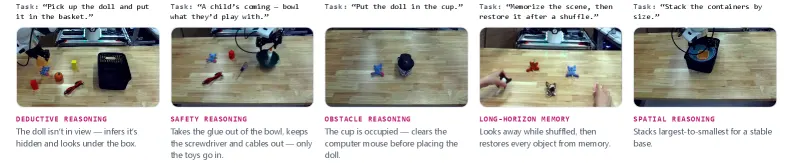
General-purpose robots need to reason about their actions, combining perception, world knowledge, planning, success detection, recovery, and low-level control. Today's state-of-the-art models attempt to combine all these capabilities into the learned policy via large-scale pre-training. Instead, we show that these capabilities can be decomposed into a general language-conditioned policy/control agent and a high-level agent manager/orchestrator. Rather than training policies to reason via pre-training, we build a closed-loop physical agent orchestrator that can do high-level planning, decompose the goal into achievable subgoals, command low-level motor commands, track and verify the outcome from low-level observations, and recover from failures. Our Physical Agency orchestrator (Pigey) can control existing vision-language-action (VLA) policies as well as parametrized skills to solve complex reasoning tasks in the real world, without any additional data collection or post-training. We evaluate Pigey extensively across simulation benchmarks and challenging real-world robotic manipulation tasks, and demonstrate significant performance improvements over existing generalist policies. On LIBERO-PRO, Pigey advances the state-of-the-art by over 4x (12.8% -> 53.3%) with no task-specific fine-tuning. On a real robot, Pigey lifts the frozen policy from near-zero to over 90% on reasoning-limited tasks. We call the difference between what frozen motor skills achieve alone and inside the agentic loop the orchestration gap.

VLAOrchestration
Liane Galanti, Dhruv Shah, Tri Dao · 564 views · Jul 23, 2026
Teachy Mini: Development and Preliminary Evaluation of a Knowledge-Based Generative Social Robot for Higher Education

Teachy Mini: Development and Preliminary Evaluation of a Knowledge-Based Generative Social Robot for Higher Education

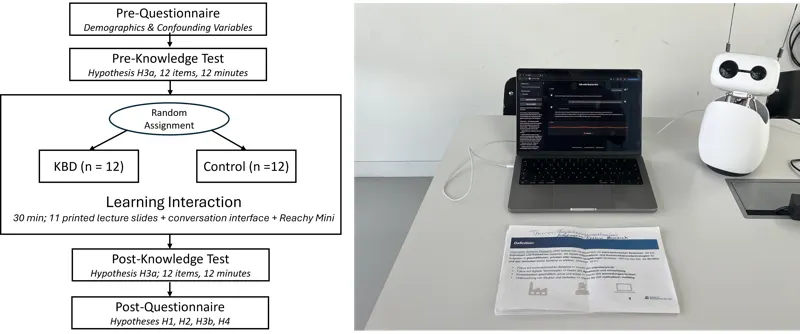
Generative social robots (GSRs) powered by large language models offer new possibilities for personalized tutoring in higher education, but also introduce risks related to misinformation, missing transparency, or reinforcing incorrect student responses. Prior work identified knowledge-based design (KBD) requirements that define the informational prerequisites for GSRs to manifest responsible and effective tutoring behavior in higher education. In this paper, we operationalized selected KBD requirements in the Reachy Mini robot platform through system prompting, retrieval-augmented generation, and stateful prompt orchestration. As a result, we present Teachy Mini, a GSR tutoring system that was developed using KBD. To test the system, we conducted a preliminary evaluation study. Participants (N = 24) completed a robot-guided learning session about research methodologies. They learned either with Teachy Mini or with a control version that did not follow KBD principles. Teachy Mini was perceived as significantly more aligned with responsible tutoring behavior than the control robot. Moreover, a manipulation check illustrated that Teachy Mini used personalization, slide-grounded explanations, Socratic questioning, affective support, and learner-anchored feedback more consistently than the control robot. No significant between-condition differences were found in system acceptance, intrinsic motivation, or learning effectiveness, although exploratory analyses suggested a positive effect of KBD on objective learning gains when accounting for learner preferences. Overall, the study offered an initial implementation and preliminary evaluation of KBD for GSR tutoring, indicating that KBD can shape responsible robot behavior and potentially increase learning effectiveness in robot-supported learning.
Social RobotEducation
Stephan Vonschallen, Karim Kaufmann, Dominique Oberle · 432 views · Jul 24, 2026
Robot Learning to Communicate through Projected Visual Abstractions

Robot Learning to Communicate through Projected Visual Abstractions

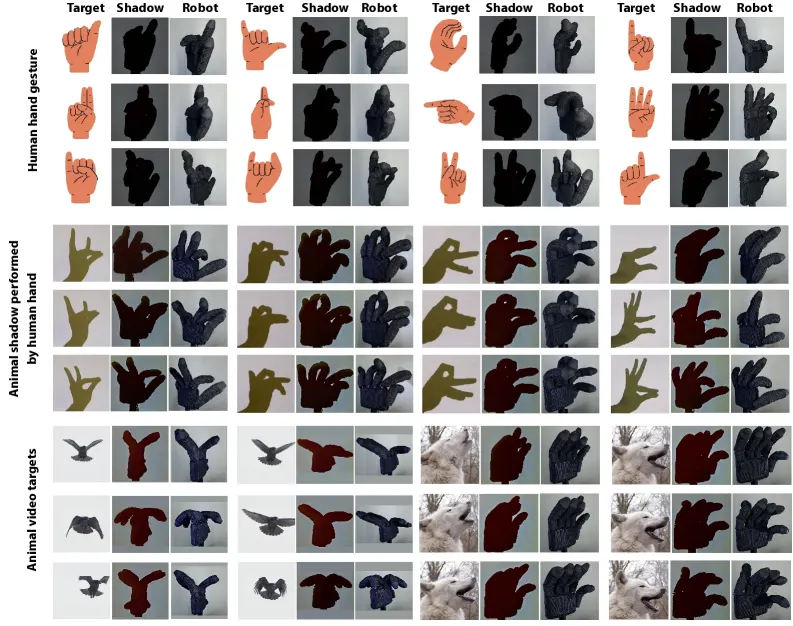
Humans routinely communicate through abstractions of their bodies, including shadows, silhouettes, and reflections. Yet robots remain largely confined to expressing themselves through their physical morphology. Enabling robots to communicate through such projected visual abstractions requires reasoning not only about bodily motion but also about how that motion is transformed into an external representation perceived by an observer. Among these abstractions, shadows provide a particularly compelling example because they emerge directly from the robot's embodiment while remaining visually distinct from the body itself. Here, we present a robotic system capable of dynamic shadow expression using a 21-degree-of-freedom dexterous hand with compliant soft skin and a learned shadow self-model. The soft-skinned embodiment reduces light leakage to produce visually continuous silhouettes, while the differentiable self-model learns the mapping between hand configurations and projected shadow appearance through task-agnostic self-exploration. Given a target shadow image or video, the robot optimizes its hand configurations through gradient-based search over 1 the learned self-model and refines the solution through collision-aware simulation to obtain physically feasible motions. For dynamic shadow performance, we further introduce expressive-region objectives, temporal smoothness regularization, and keyframe-based optimization to preserve visually important motion cues while reducing optimization complexity. We demonstrate robotic shadow expression across sign-language gestures, hand-shadow puppetry, and animal motion imitation in both simulation and physical experiments. These results establish a framework for enabling robots to manipulate projected visual abstractions of themselves for communication and visual storytelling.

Robot LearningVisual Abstraction
Danyang Yan, Boyuan Wang, Jiaxun Liu · 410 views · Jul 24, 2026
Plug, Play, and Comply: A Modular Framework for Online Variable Impedance with Arbitrarily Oriented Compliance Axes

Plug, Play, and Comply: A Modular Framework for Online Variable Impedance with Arbitrarily Oriented Compliance Axes

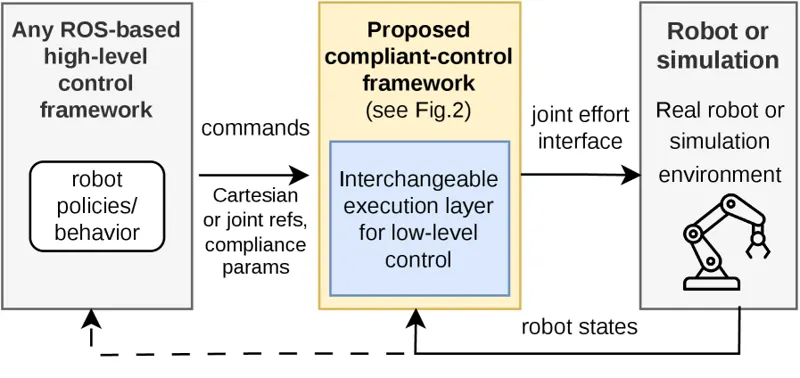
The paper proposes a robot-agnostic compliant-control framework that extends the ROS control ecosystem with standardized joint and Cartesian command interfaces. It addresses a key limitation of existing control software: no reusable infrastructure for implementing compliant-control algorithms across different manipulators while preserving a common interface to higher-level applications. A plugin-based architecture separates controller infrastructure from control-law implementation. Generic wrappers use existing hardware abstractions to interface with different manipulators, while runtime-loaded plugins implement only the control law. Command interfaces support joint- and Cartesian-space references, stiffness and damping gains, nullspace targets, and feedforward terms, enabling variable impedance and diverse compliant-control formulations. Robot kinematics and dynamics are computed from URDF models using Pinocchio. The architecture facilitates the development of compliant-control strategies and enables the same implementation to be deployed across platforms unchanged. The complete framework, including reference controllers, high-level task interfaces, and example configurations for various manipulators, is open-sourced. The reference Cartesian impedance controller supports task-dependent compliance by rotating translational and rotational stiffness and damping, allowing the principal compliance directions to be updated online according to local task geometry rather than remaining fixed in the robot base or TCP frame. This is particularly important in contact-rich manipulation, where the desired directions of motion, constraints, and compliance directions may vary throughout task execution. Real-robot experiments demonstrate task-dependent compliance in contact-rich manipulation, while simulations show portability across manipulators with distinct kinematic and dynamic characteristics.

Variable ImpedanceCompliance
Mihael Simonič, Xiaocong Li · 490 views · Jul 24, 2026
Scaling Native Multimodal Pre-Training From Scratch

Scaling Native Multimodal Pre-Training From Scratch

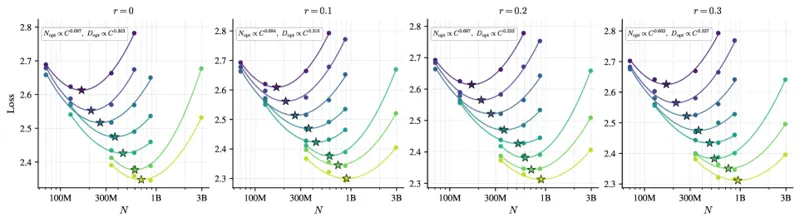
Although large language models (LLMs) exhibit remarkable reasoning capabilities, their reliance on text-only pre-training restricts the perception of the multimodal physical world. Native multimodal pre-training avoids this limitation by training models from scratch on multimodal inputs, thereby achieving deep cross-modal integration and mitigating optimization asymmetries inherent to traditional late-fusion architectures. Despite these advantages, the scaling properties of this paradigm remain systematically uncharacterized. To address this gap, we investigate the optimal model size and token count for training a transformer-based vision-language model under a fixed computational budget. We demonstrate that minimal objective loss adheres to a predictable compute law, whereas compute-optimal model sizes and token counts scale as power laws. Notably, language and multimodal objectives manifest distinct scaling behaviors. The language allocation law is largely invariant to the composition of the data, indicating stable language learning regardless of the multimodal data ratio. Conversely, the multimodal allocation law is highly sensitive to this composition. Specifically, text-heavy mixtures become compute-efficient only at larger model scales, shifting the optimal resource allocation toward greater model capacity. Additionally, by modeling the influence of data composition on compute laws and allocation exponents, we derive an efficiency frontier specifying precise configurations of model size, token count, and data mixture. Downstream evaluations further reveal that native multimodal pre-training induces positive cross-modal transfer, thereby enhancing pure-text spatial reasoning and enabling robust multimodal in-context learning. In summary, this empirical research establishes the essential groundwork for predictably scaling multimodal foundation models.

MultimodalPre-Training
Haoyuan Wu, Aoqi Wu, Hai Wang · 644 views · Jul 24, 2026

As an Amazon Associate, we earn from qualifying purchases.