Skip to content
Reinforcement Learning Enables Scaling Generalist Robot Policy Improvement

Reinforcement Learning Enables Scaling Generalist Robot Policy Improvement

The introduction of generalist robot policies has enabled a single, large model to learn to perform a variety of tasks from a vast pre-training corpus. While these models often exhibit powerful zero-shot generalization capabilities, they typically require an adaptation phase to achieve sufficient performance in deployment. Iterated self-improvement via reinforcement learning (RL) has demonstrated promise in enabling this adaptation, yet such approaches have been largely explored in single-task settings - where the goal is to simply improve on a narrow deployment task - which lies in stark contrast to the multi-task capabilities of the base policy. In this work we ask whether generalist robot policies are capable of multi-task, generalist improvement in deployment - targeting many diverse tasks simultaneously - and what algorithmic recipe enables this. To answer this question, we first develop a set of structured evaluations to test generalist improvement capabilities, and systematically evaluate algorithmic and practical design choices regarding value estimation, policy extraction and resource allocation. We show that not only can generalist policies be improved online across diverse tasks, but that the right recipe can enable generalization and increase performance on tasks not considered during online training. We characterize when this generalization occurs and show that both the training task distribution and the use of value-based RL are critical. To the best of our knowledge, this is among the first evidence for online generalist improvement for robot foundation models.

Vision-language-action (VLA)Reinforcement Learning
Michal Korniak, Marco Bagatella, Ralf Römer · 436 views · Nov 4, 2026
RoboColosseum: Evaluating Physical Intelligence at Scale In-The-Wild

RoboColosseum: Evaluating Physical Intelligence at Scale In-The-Wild

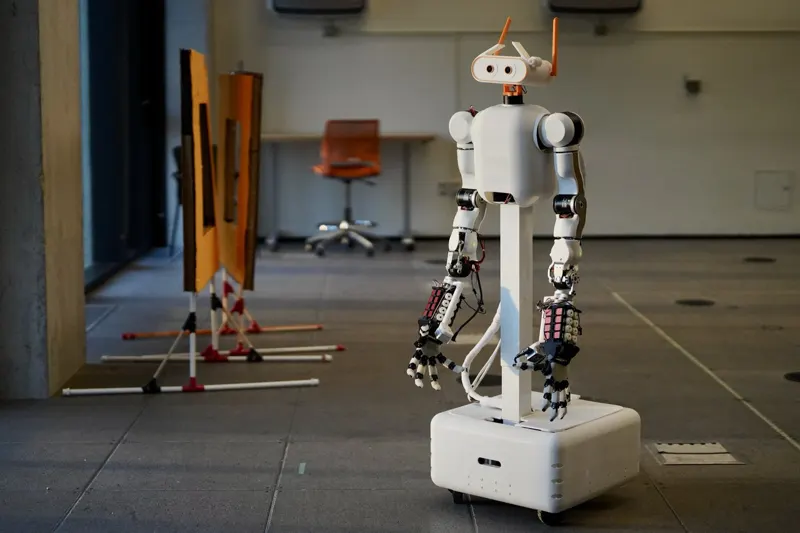
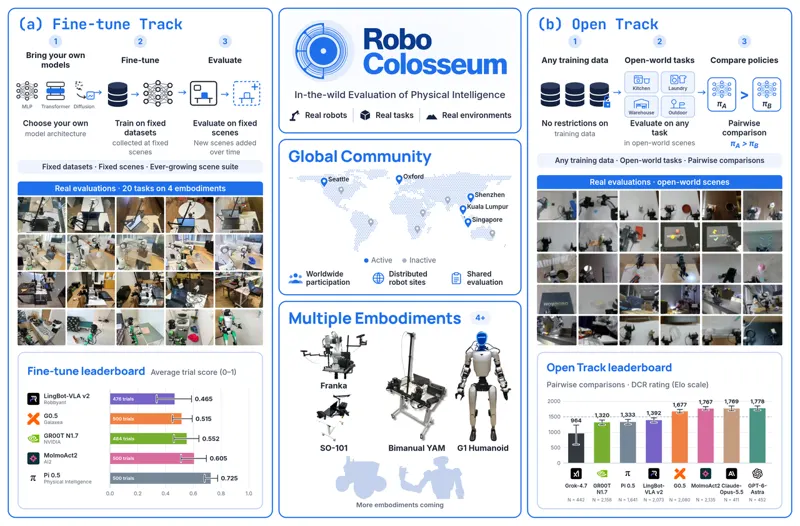
General-purpose robot policies must work across robots, tasks, and environments, yet the variation that makes physical trials informative also makes them difficult to reproduce. We introduce RoboColosseum, a distributed evaluation framework that combines unified policy serving and standardized protocols across a network of locally operated robots in diverse environments. Our initial study evaluates five vision-language-action (VLA) policies and three frontier AI agents across four embodiments (SO-101, Franka, Bimanual-YAM, and G1 Humanoid). The Open Track compares models without task-specific adaptation in blinded, pairwise trials under matched local conditions. The Fine-tune Track measures how well VLA policies adapt to 20 tasks across all four embodiments when each policy receives the same 100 demonstrations per task. Across 5,699 pairwise Open Track comparisons at 124 sites, frontier agents rival specialized VLA policies, while all systems struggle to complete open-world tasks reliably. After fine-tuning, GR00T N1.7 leads on SO-101 and pi0.5 leads on Franka and Bimanual-YAM. Policy rankings show weak agreement across embodiment-specific task suites (Kendall W = 0.24). Open Track rankings poorly predict relative performance after fine-tuning, with substantial rank reversals on all three embodiments shared between tracks. Measuring partial progress reveals differences that task success alone misses. On the G1 Humanoid, no policy completes any of the five tasks, yet average progress ranges from 13.3% to 23.2% across policies. Open Track rankings stabilize as trials accumulate, and active matchmaking achieves comparable ranking agreement with substantially fewer physical trials than uniform sampling. These results show how distributed physical evaluation can reveal where robot policies generalize, how well they adapt to new tasks, and how far they progress on tasks they fail to complete.

Physical AIVLA
Tan Sang Nguyen, Yi Ru Wang, Shailesh Shailesh · 422 views · Nov 2, 2026
Do AI Scientists Know What's New?

Do AI Scientists Know What's New?

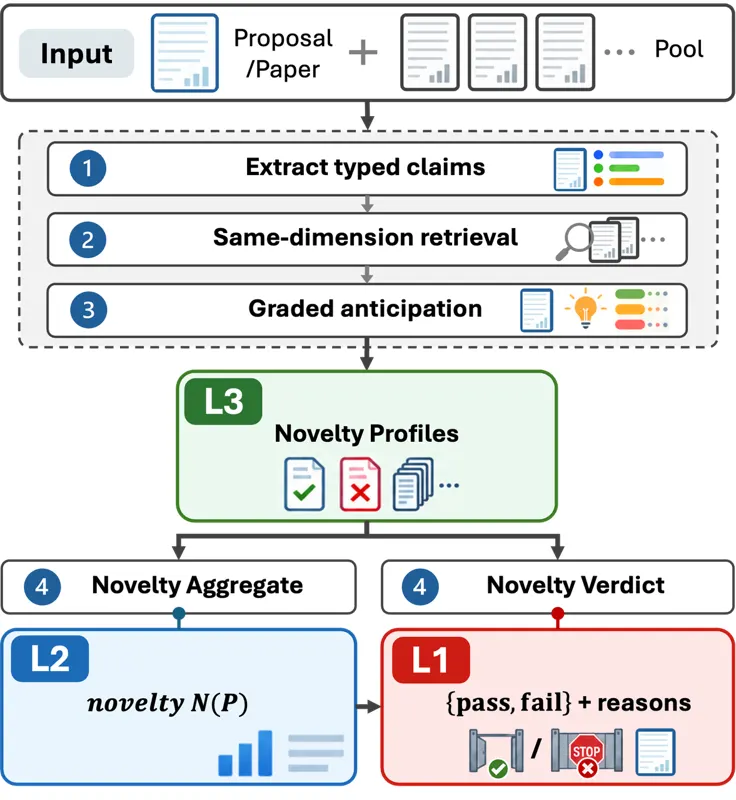
A major challenge facing AI scientific discovery pipelines is how to determine when a generated idea is meaningfully novel. Ideally, novelty checks in these pipelines must be able to reject non-novel ideas while not rejecting too many novel ideas, and they should also be able to distinguish which parts of a proposal are non-novel, as opposed to opaquely discarding entire proposals. We design an analytical framework for evaluation of novelty checks with temporal ground truth at both the proposal- and claim-level, using four datasets of 1,060 proposals built from published papers, reviewer disputes, and generated ideas matching ones the field went on to publish. Auditing existing novelty checks with this framework, we find that checks with high rejection rates on non-novel work also tend to have high false alarms on ideas that are later realized by human researchers, and observe that checks built to evaluate proposals as a whole can point to claim-level prior art only by rejecting the whole proposal. We therefore introduce ClaimNov, a fine-grained, interpretable claim-level novelty module. ClaimNov catches 97% of disguised papers at a 1.5% false-alarm rate, and its claim-level novelty profile cuts the LLM judge's false alarms from 11.8% to 1.5%. Because its verdict rests on claim-level evidence, ClaimNov also keeps proposals that build on established contributions, rejecting only 3% of ICLR-accepted proposals with a reviewer-disputed contribution and keeping 91 of 100 novel proposals with one spliced prior contribution, against 76 for the strongest existing check. Code and data are available at https://github.com/emmatliu/claimnov.

Novelty DetectionAI Scientist
Miri Liu, Xiayu Zhao, Encheng Xie · 281 views · Oct 27, 2026

As an Amazon Associate, we earn from qualifying purchases.