Skip to content
GigaBrain-0.7: Scaling Embodied Foundation Models to Emergent Capabilities with a Three-System Architecture

GigaBrain-0.7: Scaling Embodied Foundation Models to Emergent Capabilities with a Three-System Architecture

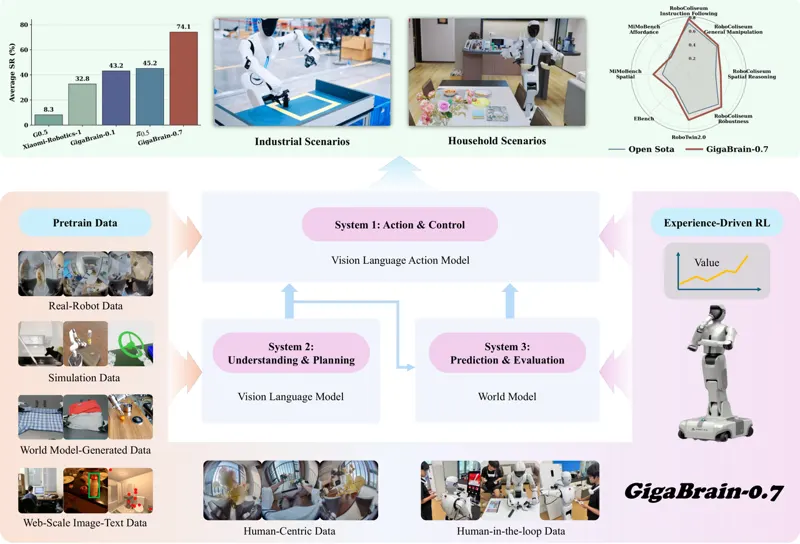
Vision-language-action (VLA) models have become a dominant paradigm for generalist embodied agents, demonstrating strong complex and long-horizon task completion in structured settings. Yet it remains an open question whether current VLA systems can benefit from more effective architectural design, scale to substantially larger and more heterogeneous data regimes, and achieve broader generalization across tasks and embodiments. To this end, we present GigaBrain-0.7, an embodied foundation model with substantially improved generalization across diverse robot embodiments. Specifically, GigaBrain-0.7 unifies understanding, prediction, and action through a three-system architecture, scales pretraining to over 37,000 hours of heterogeneous embodied data, and introduces one-stage alignment training that jointly optimizes vision-language understanding and multi-embodiment action generation. Compared with the preceding GigaBrain-0 series and prior state-of-the-art models including π_0.5, GigaBrain-0.7 achieves substantial improvements in foundation zero-shot capabilities, language-conditioned instruction following, and post-training task success rates. In particular, on our in-house Maker H01 platform and mainstream robot embodiments, GigaBrain-0.7 demonstrates strong task adaptability and completion ability across both home and industrial scenarios. All training code and pretrained model weights will be released.

VLAGigaBrain
GigaBrain Team, Angen Ye, Axiang Sun · 1k views · Aug 16, 2026
TemporalFlow-VLA: Learning Physically Grounded Execution History for Long-Horizon Robot Manipulation

TemporalFlow-VLA: Learning Physically Grounded Execution History for Long-Horizon Robot Manipulation

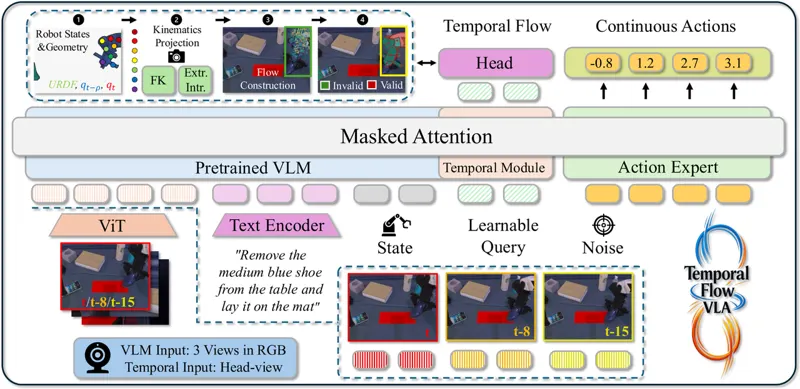
Vision-language-action (VLA) models leverage pretrained vision-language representations for robot control, yet simply adding historical frames does not reliably capture recent physical change. This is especially problematic in multi-stage manipulation, where visually similar states may require different actions depending on prior execution. To address this challenge, we present TemporalFlow-VLA, which learns compact execution history through physically grounded temporal supervision. Using recorded robot states, robot geometry, and calibrated cameras, we construct robot-surface temporal flow as a training-only target and supervise two execution-aligned temporal queries that provide structured history to the action expert. The geometric supervision path is not evaluated at deployment. TemporalFlow-VLA achieves 97.63 +/- 0.26% average success on LIBERO, including 96.60 +/- 0.87% on LIBERO Long, and 85.5%/84.2% Clean/Randomized success across 12 RoboTwin tasks. It shows its clearest advantage over prior methods on longer-horizon, multi-stage manipulation. Controlled history interventions show that action prediction depends on both historical content and temporal order. With asynchronous feature caching, temporal conditioning maintains single-frame-level server-side sampling latency without additional historical-encoding overhead. Overall, TemporalFlow-VLA provides a compact, physically grounded interface for exploiting ordered execution history without explicit motion estimation or geometric processing at deployment.

VLATemporal Flow
Jiarui Yang, Yehao Lu, Yuning Su · 752 views · Aug 27, 2026
Zero-WAM: In-Context World-Action Modeling from Human Videos for Open-Ended Task Generalization

Zero-WAM: In-Context World-Action Modeling from Human Videos for Open-Ended Task Generalization

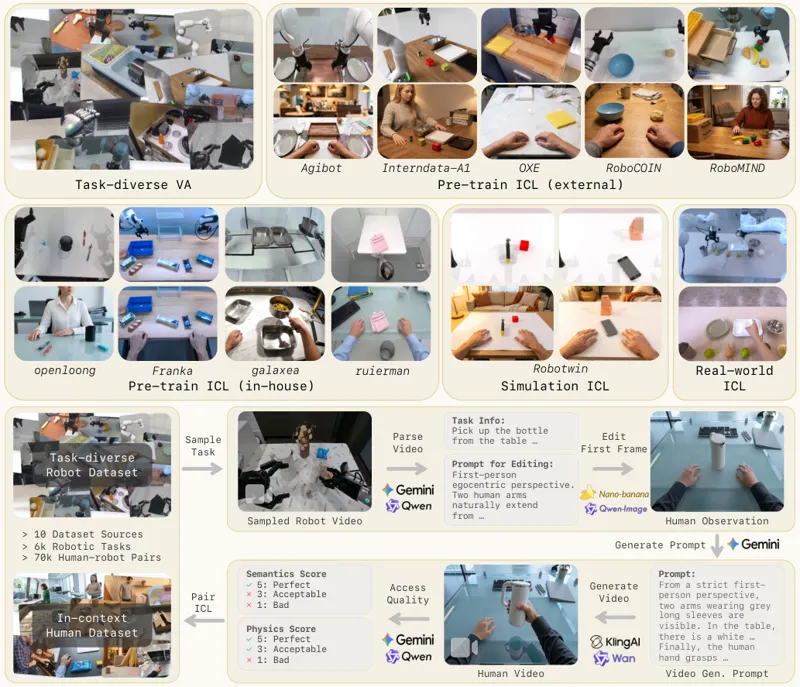
Zero-shot cross-task generalization, where a policy must execute manipulation tasks never seen during training, remains a central challenge in robot learning. In large language models, a novel task can be performed simply by specifying it in the context, without any parameter update. This form of in-context learning (ICL) turns generalization into a problem of task specification. To achieve cross-task generalization, we bring this paradigm to robotic manipulation, and argue that the natural task specification for manipulation is a human video: unlike language, it provides rich visual cues about the intended task evolution. We present Zero-WAM, a causal video-action model that executes unseen tasks by following in-context human video guidance. To address the scarcity of task-rich paired human-robot data, we propose an automatic pipeline that converts task-sampled robot trajectories into semantically matched human videos, yielding HumanGen, a dataset of 74.2K human-robot ICL pairs across 8.6K tasks. For model training, we further introduce an in-context future chunk prediction (IFP) objective that suppresses shortcuts learned from seen tasks and forces the policy to draw task information from the video prompt. On seven unseen tasks in RoboTwin 2.0 simulation, Zero-WAM achieves a 47.0% average success rate, an absolute improvement of 29.5 percentage points over the strongest video-action baseline. In real-world evaluations, it follows human video guidance to generalize to unseen task configurations involving multi-object scenes, long-horizon manipulation, and fine-grained insertion.

Zero-WAMHumanGen
Jiaming Zhou, Qihang Zhang, Gangwei Xu · 825 views · Aug 26, 2026
EATR-Stereo: Embodiment-Aware Token Routing of Paired Stereo Evidence for Humanoid Vision-Language-Action Control

EATR-Stereo: Embodiment-Aware Token Routing of Paired Stereo Evidence for Humanoid Vision-Language-Action Control

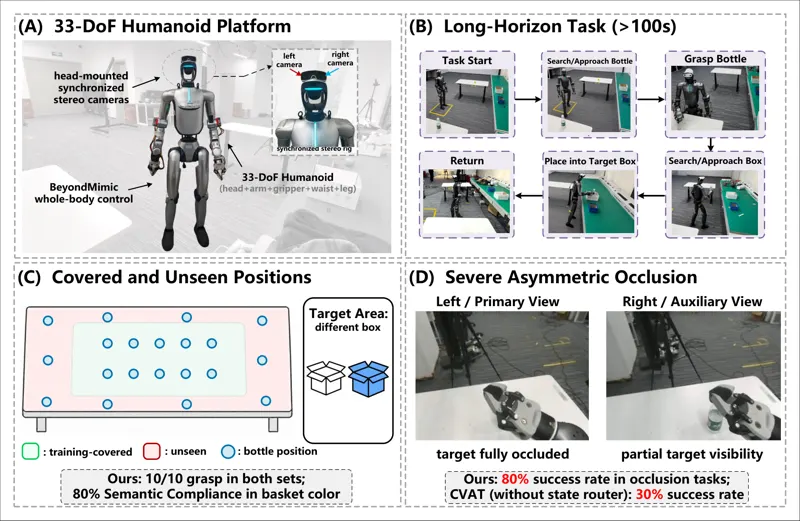
Long-horizon humanoid vision–language–action (VLA) control with head-mounted stereo cameras requires visual interfaces that can exploit complementary views while maintaining compatibility with pretrained representations. Existing interfaces often discard complementary stereo evidence or fuse additional observations without preserving the native primary-view pathway and adapting auxiliary information to robot embodiment. We present EATR-Stereo, an embodiment-aware token-routing framework that retains primary-view tokens and constructs primary-aligned Cross-View Auxiliary Tokens (CVATs) by querying the synchronized auxiliary-view token sequence. A body-segmented proprioceptive encoder further conditions token-wise auxiliary usage on robot configuration history, enabling selective incorporation of stereo evidence during action generation. The routed auxiliary stream augments the language and primary-visual context of a pretrained VLA while keeping its vision–language model frozen. On a 33-DoF physical humanoid with a 37-D proprioceptive state, we evaluate nine configurations in over-100-s search–approach–grasp–place–return tasks. EATR-Stereo achieves 60.0% full-task success, 100.0% grasp success, and 80.0% stage success. Under severe asymmetric occlusion, it improves recovery to 80% compared with 30% for CVAT alone. Ablation studies further show the importance of preserving primary tokens and combining cross-view auxiliary features with structured proprioceptive routing. These results demonstrate that selectively routed paired stereo evidence improves spatial grounding for reliable long-horizon humanoid VLA control.

VLAStereo vision
Songwei Wu, Rui Zhao, Fan Yang · 675 views · Aug 18, 2026
ABot-AgentOS: A General Robotic Agent OS with Lifelong Multi-modal Memory

ABot-AgentOS: A General Robotic Agent OS with Lifelong Multi-modal Memory

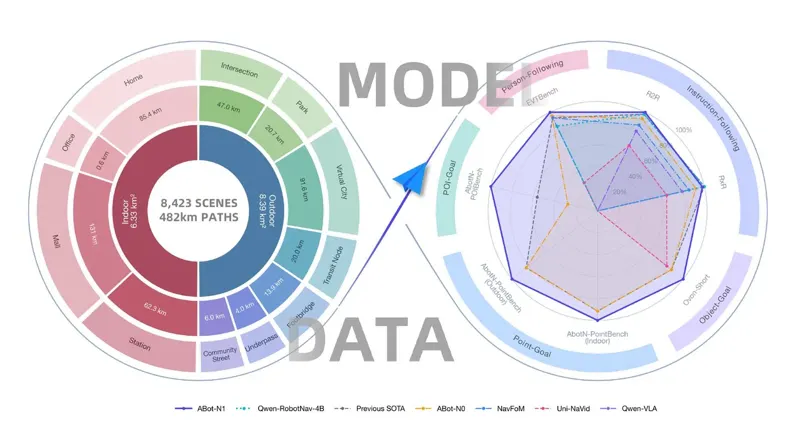
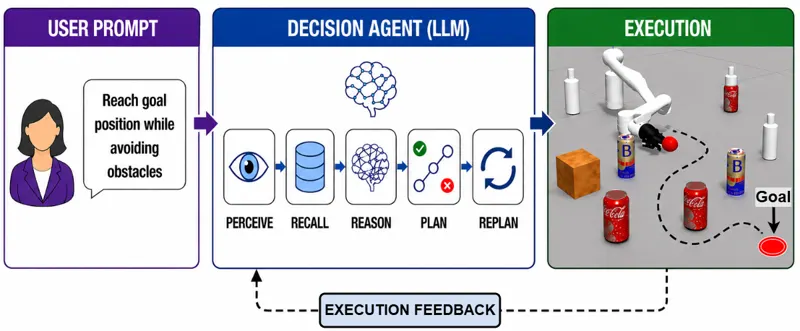
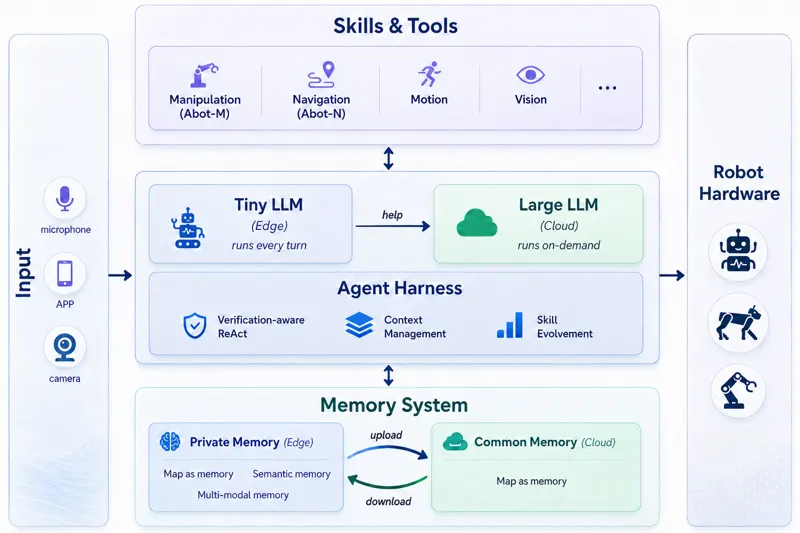
Recent VLM and VLA systems have improved robotic perception and action prediction, yet long-horizon embodied agents still require a general runtime layer for reasoning, memory, tool use, verification, and cross-embodiment execution. We present ABot-AgentOS, a general robotic Agent Operating System that sits above low-level controllers and provides a deliberative agent layer for scene-conditioned planning, context-isolated skill execution, multi-stage verification, multi-modal memory, and edge-cloud collaboration. To evaluate such systems, we introduce EmbodiedWorldBench, an executable benchmark with 16 indoor, outdoor, and hybrid scenes, four difficulty levels, and over 200 tasks involving navigation, object search, NPC dialogue, dynamic events, and trace-grounded scoring. ABot-AgentOS further introduces Universal Multi-modal Graph Memory, a persistent source-grounded substrate that converts dialogue, visual observations, spatial context, temporal relations, and task traces into typed nodes and edges. A failure-driven self-evolution loop converts diagnosed memory failures into gated runtime evo-assets that are promoted only to later evaluation splits, preventing current-split ground-truth leakage while enabling continual improvement. On an initial EmbodiedWorldBench subset, ABot-AgentOS improves over a single-controller baseline in both task success and goal completion. Across memory benchmarks, ABot-AgentOS Static achieves 87.5 on LoCoMo, 59.9 on OpenEQA EM-EQA, 88.6 on Mem-Gallery, and 76.5 Acc@All on NExT-QA; self-evolution further improves LoCoMo to 88.7, OpenEQA to 60.4, and Mem-Gallery to 89.0. These results suggest that a general Agent OS layer can improve long-horizon embodied execution while providing persistent, auditable memory for continual interaction.
AgentOSEmbodiedWorldBench
Jiayi Tian, Shiao Liu, Yuting Xu · 868 views · Jul 11, 2026

As an Amazon Associate, we earn from qualifying purchases.