PAPER DEEP DIVE
Humanoid Seated Locomotion on Passive Mobile Chair
Research on omnidirectional seated locomotion for humanoids on passive chairs. Policies use proprioception only, outperforming standing in tracking. Analyzes regularization effects on convergence.
Stay Seated: Omnidirectional Humanoid Locomotion Learned While Sitting on a Passive Chair
Paper: Stay Seated: Learning Omnidirectional Humanoid Locomotion on a Passive Mobile Chair with Casters · Kango Yanagida, Kazuki Miyazawa, Takato Horii (The University of Osaka / IRN, The University of Tokyo) · arXiv:2608.28090 · Code: not released (built on the open-source mjlab framework)
One-line summary: By minimally extending a standard standing velocity-tracking environment with a passive caster-chair model, seated-state rewards and critic-only chair observations, a Unitree G1 learns omnidirectional locomotion while remaining seated — without any motion imitation, contact sensing or chair-state feedback — and transfers zero-shot to the physical robot.
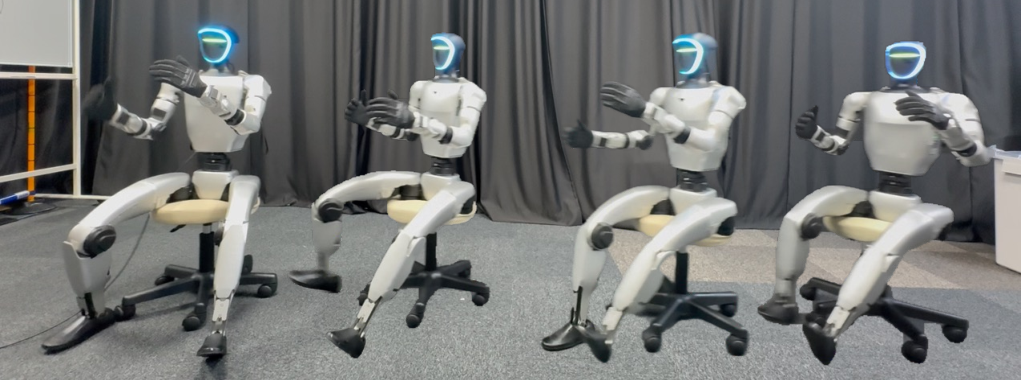
Fig. 1: Seated locomotion on a passive caster chair during translation and turning, deployed zero-shot on a physical Unitree G1.
1. Why teach a humanoid to stay seated
Almost every deep-reinforcement-learning humanoid locomotion task in the literature assumes a standing posture. That assumption carries a hidden energy cost: robots with quasi-direct-drive (QDD) actuators must continuously generate joint torque just to hold themselves upright, so even standing still draws nonzero holding current and produces heat. Humans solve the same problem differently — they sit down and let a chair carry their weight during desk work. A caster chair additionally allows small relocations and viewpoint changes without standing up.
This paper is a first step toward seated loco-manipulation: a humanoid that moves and manipulates objects without ever leaving its chair. The sub-problem studied here is omnidirectional seated locomotion — the robot tracks target planar velocities $(v_x, v_y)$ and yaw rate $\omega_z$ while remaining seated on a passive mobile chair with casters. Unlike prior work on wheeled or sliding platforms, where the body is rigidly attached to a device, seated locomotion combines unfixed pelvis–seat contact with intermittent foot–floor propulsion of the coupled robot–chair system. The chair is neither powered nor instrumented; the robot must keep itself seated on it and push the whole system around purely with its feet.
The central question is deliberately conservative: can this behaviour be acquired by minimally extending a standard standing velocity-tracking environment, without a dedicated motion reference, human demonstrations, or a new learning algorithm? The authors show that it can, and then run a full $2^3$ factorial study to isolate what three common training ingredients — symmetry regularization (SY), foot-slip regularization (FS) and command curriculum (CC) — actually do in this task.
2. Method: minimal extensions to a standing environment
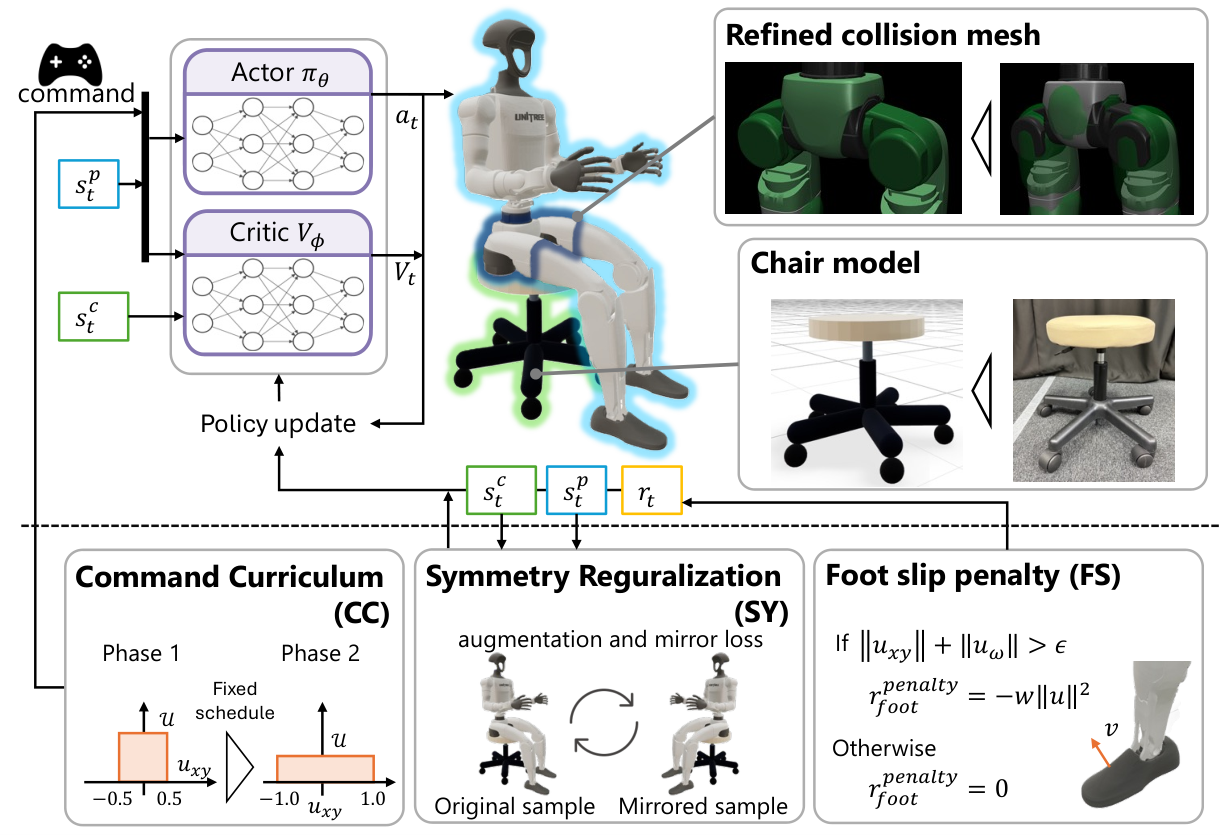
Fig. 2: Framework overview — asymmetric actor–critic, refined pelvis collision mesh, passive-chair model, and the factorial study over CC, SY and FS.
flowchart TB
  A["Standing velocity-tracking
environment (mjlab)"] --> B["Add passive caster chair
5 spheres + ball joints"]
  A --> C["Add seated-state rewards
position + contact terms"]
  A --> D["Add critic-only observations
chair pose, caster & pelvis-seat contacts"]
  A --> E["Refine pelvis collision mesh
elliptic friction cone"]
  B --> F["PPO training
asymmetric actor-critic"]
  C --> F
  D --> F
  E --> F
  F --> G{"Factorial study
SY / FS / CC"}
  G --> H["8 conditions x 4 seeds"]
  F --> I["Zero-shot transfer
physical Unitree G1"]
2.1 Problem formulation and the robot–chair system
The task is formulated as a discrete-time Markov decision process $\mathcal{M}=(\mathcal{S},\mathcal{A},P,r,\gamma)$. At each step the actor receives an observation built from the state and samples an action $\bm{a}_t \sim \pi_\phi(\bm{a}_t \mid \bm{o}^{\mathrm{actor}}_t)$, optimizing the discounted return
$$J(\phi)=\mathbb{E}_{\pi_\phi}\left[\sum_{t=0}^{T-1}\gamma^{t}r_t\right].$$
The policy is conditioned on the velocity command $\bm{u}_t=[v_x^{\mathrm{cmd}}, v_y^{\mathrm{cmd}}, \omega_z^{\mathrm{cmd}}]^\mathsf{T}$. The system is a 29-DoF Unitree G1 plus a mobile chair with five passive casters and a rotating seat; each caster is modeled as a sphere attached to a chair leg through a ball joint. Command ranges are $v_x^{\mathrm{cmd}}, v_y^{\mathrm{cmd}} \in [-1.0, 1.0]$ m/s and $\omega_z^{\mathrm{cmd}} \in [-0.5, 0.5]$ rad/s. Episodes last 20 s (1,000 control steps) and terminate early if the torso or chair tilts more than $70^\circ$ from gravity, or if pelvis–seat contact is lost continuously for at least 1 s.
Contact fidelity matters unusually here. The pelvis collision mesh is refined to match the visual mesh, the contact solver's friction cone is switched from pyramidal to elliptic, and the MuJoCo solver runs with impratio = 10, 15 solver iterations, 20 line-search iterations and 50 continuous-collision-detection iterations (simulation step 0.005 s, decimation 4). These settings suppress the excessive pelvis–seat penetration and unnatural lateral slipping that coarse pelvis geometry and default contact settings produced.
2.2 Asymmetric observations: the actor sees no chair
For sim-to-real transfer the authors use an asymmetric actor–critic. The actor observation $\bm{o}^{\mathrm{actor}}_t \in \mathbb{R}^{96}$ contains only proprioception and the velocity command — torso angular velocity, projected gravity, 29 joint positions and velocities, last action, and the command. It deliberately excludes pelvis–seat contact, foot–floor contact and all chair states. The critic receives the same observation plus simulator-only privileged information ($\bm{o}^{\mathrm{critic}}_t \in \mathbb{R}^{217}$): torso linear velocity, foot heights, air times, contact states and forces, chair-relative pose and velocity, caster contacts, pelvis–seat contacts and chair–leg contacts. The actor outputs a normalized joint-position command converted to a PD target $\bm{q}_{\mathrm{target},t}=\bm{q}_{\mathrm{default}}+\bm{s}\odot\bm{a}_t$ around the initial seated posture.
2.3 Reward design
The per-step reward decomposes into task, posture, seated-state and penalty terms:
$$r = r_{\mathrm{task}} + r_{\mathrm{posture}} + r_{\mathrm{seat}} + r_{\mathrm{foot}}^{\mathrm{penalty}} + r_{\mathrm{reg}}^{\mathrm{penalty}}.$$
The task reward tracks translational and yaw velocity; the posture reward keeps the torso and chair upright and limits deviation from the seated posture. The seated-state reward is where the task departs most clearly from standing locomotion. It uses pelvis position $\bm{p}_{\mathrm{pelvis}}$, chair position $\bm{p}_{\mathrm{chair}}$ and pelvis–seat contact:
$$r_{\mathrm{seat}} = w_{\mathrm{seat,pos}}\exp\left(-\frac{\left\|\bm{p}_{\mathrm{pelvis},xy}-\bm{p}_{\mathrm{chair},xy}\right\|_2^2}{\sigma_{\mathrm{seat}}^2}\right) + w_{\mathrm{seat,contact}}\,\mathbb{I}_{\mathrm{contact}}.$$
Note that chair velocity is never directly rewarded — the chair moves only because the robot tracks its own velocity while in contact with it. The foot penalty includes foot clearance, landing impact, and the slip penalty used in the factorial study ($\epsilon_{\mathrm{slip}}=0.05$):
$$r_{\mathrm{slip}}^{\mathrm{penalty}} = -w_{\mathrm{slip}}\,\mathbb{I}\left(\left\|\bm{u}_{xy,t}\right\|_2 + \left|u_{\omega,t}\right| > \epsilon_{\mathrm{slip}}\right)\cdot\sum_{i\in\mathcal{F}}\mathbb{I}_{\mathrm{contact},t}^{i}\left\|\bm{v}_{\mathrm{foot},xy,t}^{i}\right\|_2^2.$$
This penalty fires only when the command is non-negligible (so standing still is not penalized) and scales with the squared tangential foot velocity of feet in contact. Regularization terms cap torso angular velocity, whole-body angular momentum, self-collision, joint-limit violations, accelerations and action rates.
2.4 The three factorial ingredients
Every condition is trained with PPO in mjlab with identical hyperparameters; only the three ingredients vary. Symmetry regularization (SY) applies left–right symmetric data augmentation together with a mirror loss of coefficient $\lambda_{\mathrm{mir}}=1.0$ on the actor. Foot-slip regularization (FS) is the slip penalty above with $w_{\mathrm{slip}}=0.25$ (off at 0). Command curriculum (CC) restricts translational commands to $[-0.5, 0.5]$ m/s for the first 2,000 PPO iterations, then expands to $[-1.0, 1.0]$ m/s; yaw stays at $[-0.5, 0.5]$ rad/s throughout. The study compares all 8 combinations across 4 seeds each. A standing policy trained on mjlab's Mjlab-Velocity-Flat-Unitree-G1 (with torso linear velocity removed from the actor observation and the same arm posture) serves as a reference.
3. Results: SY+CC is the most reliable configuration
3.1 Random-command evaluation
| Condition | RMSE $v_x$ [m/s] | RMSE $v_y$ [m/s] | RMSE $\omega_z$ [rad/s] | Timeout success [%] | Seat-relative RMS [m] |
|---|---|---|---|---|---|
| Baseline | 0.1650±0.0084 | 0.1441±0.0071 | 0.1506±0.0014 | 99.45±0.17 | 0.0153±0.0008 |
| SY | 0.1523±0.0043 | 0.1284±0.0033 | 0.1444±0.0006 | 99.68±0.52 | 0.0157±0.0008 |
| FS | 0.1964±0.0432 | 0.1879±0.0473 | 0.1411±0.0099 | 99.53±0.17 | 0.0151±0.0009 |
| CC | 0.1524±0.0023 | 0.1341±0.0024 | 0.1498±0.0021 | 99.73±0.17 | 0.0152±0.0011 |
| SY+FS | 0.1542±0.0028 | 0.1382±0.0033 | 0.1457±0.0028 | 99.68±0.17 | 0.0159±0.0012 |
| SY+CC | 0.1512±0.0002 | 0.1268±0.0036 | 0.1453±0.0025 | 99.80±0.14 | 0.0156±0.0023 |
| FS+CC | 0.1562±0.0017 | 0.1335±0.0032 | 0.1501±0.0026 | 99.78±0.10 | 0.0156±0.0009 |
| SY+FS+CC | 0.1522±0.0040 | 0.1292±0.0016 | 0.1442±0.0006 | 99.75±0.13 | 0.0156±0.0004 |
Table 1: Random-command evaluation, mean ± std over 4 seeds, 1,000 rollouts per policy (20 s each).
Two findings stand out. First, all seated policies complete nearly every 20-second rollout (timeout success ≥ 99.4%), meaning the seated state itself is reliably maintained — though as the authors note, a stationary policy could also survive, which is why tracking RMSE and command area are reported alongside. Second, SY+CC achieves the lowest translational tracking errors and highest timeout success; both SY+CC and SY+FS+CC beat the Standing policy numerically on all three tracking RMSEs. FS alone is the worst tracker and the most seed-sensitive (note its ±0.043–0.047 standard deviations).
3.2 The stationary failure mode of FS alone
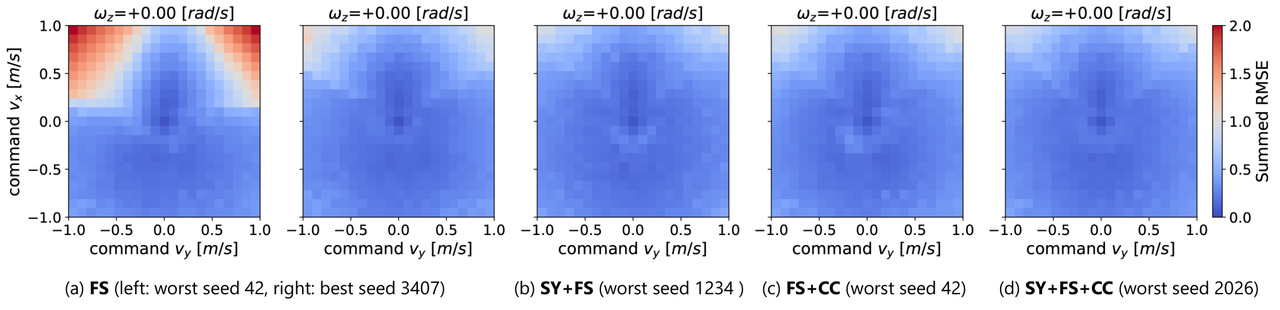
Fig. 3: Fixed-command tracking-error heatmaps for FS, SY+FS, FS+CC and SY+FS+CC. The worst FS seed (right panel) barely moves on diagonal-forward commands.
In the fixed-command grid evaluation, some FS-only seeds converged to a local optimum in which the robot remained completely stationary under diagonal-forward velocity commands — the slip penalty had suppressed not just slipping but the foot motions required for propulsion. The heatmap of the worst FS seed shows the error plateauing across the command plane. Crucially, adding either SY or CC to FS avoided this failure without retuning the slip weight: even the worst SY+FS and FS+CC seeds outtracked the best FS seed. The paper's explanation: SY's symmetry augmentation effectively doubles the training samples, diluting the influence of samples that push toward the stationary optimum; CC lets the policy first learn foot-trajectory patterns in the easier low-speed command range.
3.3 Direction- and speed-resolved gait analysis
| Condition / direction | Command [m/s] | RMSE [m/s] | CoT | Flight [%] | Force T/N [N] |
|---|---|---|---|---|---|
| SY+CC forward | +0.5 | 0.039±0.008 | 0.255±0.007 | 36.1±5.3 | 45.3 / 80.8 |
| +1.0 | 0.308±0.004 | 0.543±0.040 | 63.3±2.6 | 111.8 / 188.0 | |
| SY+CC backward | −0.5 | 0.033±0.015 | 0.146±0.004 | 0.0±0.0 | 40.8 / 109.1 |
| −1.0 | 0.132±0.020 | 0.209±0.009 | — | — |
Table 2: Direction- and speed-resolved tracking, cost of transport and contact forces (excerpt, forward–backward).
Cost of transport is computed as $\mathrm{CoT} = W_{+}/(Mgd)$ with $W_{+}=\sum_t\sum_m\max(\tau_{m,t}\dot{q}_{m,t}, 0)\Delta t$ — only positive mechanical work counts. At 1.0 m/s, CoT orders as backward ≪ lateral < forward for both SY+CC and SY+FS+CC, with forward CoT roughly twice the lateral value. The rollouts reveal why: backward and lateral motion use a planted-leg extension pattern (foot flat on the floor, knee extending, heel planted), while forward motion plants the heel first and then flexes the knee to pull the robot toward the planted foot. Forward contact at high speed carries greater tangential force despite lower normal force — the T/N ratio suggests fast forward locomotion operates closer to the friction limit $T \leq \mu N$, inviting slip and wasting joint work, which matches its higher CoT and tracking error.

Fig. 4: Forward-motion gait snapshots — heel-first contact followed by knee flexion.

Fig. 5: Backward-motion gait snapshots — planted-leg extension with the heel anchored.
Symmetry has a measurable effect on contact behaviour: CC alone produces left–right differences in contact fraction and force during longitudinal motion (e.g., forward contact force 156.8 N left vs 179.4 N right), while SY+CC yields nearly identical left and right values (155.4 vs 156.1 N). Since seated locomotion can be solved with asymmetric leg motions — the chair supports the body — symmetry does not emerge spontaneously the way it does in standing.
3.4 Zero-shot transfer to a physical Unitree G1
The policy was deployed directly on a physical Unitree G1 without fine-tuning. It qualitatively generated forward, backward, lateral and turning motions while staying seated, using only proprioception and velocity commands — no contact sensing, no chair states. Velocity tracking accuracy and disturbance robustness were not quantified on hardware, so the transfer evidence is qualitative but consistent across directions.
4. Limitations
- Qualitative hardware evaluation (author-stated): sim-to-real results are demonstrated but not quantified — no tracking RMSE or disturbance-rejection numbers on the physical robot.
- Energy–tracking trade-off unresolved: FS reduces CoT but worsens tracking; the paper characterizes the trade-off rather than optimizing it.
- Narrow operational envelope: a single chair model, flat floor, and command ranges up to 1.0 m/s / 0.5 rad/s; terrain variation, chair diversity and manipulation coupling remain open.
5. Takeaways
This paper makes two contributions that outlive the specific task. First, it demonstrates that contact-rich, device-coupled locomotion like seated driving can be learned with the exact toolchain used for standing locomotion — no motion references, no algorithmic novelty, just careful contact modeling and a few task-specific rewards. Second, the factorial methodology itself is the lesson: SY, FS and CC are all common ingredients, but their interactions are not — FS alone can silently produce stationary policies, and either SY or CC rescues it without retuning. For anyone adding regularization terms to locomotion policies, this is a concrete argument for factorial evaluation over single-ablation comparisons.
Golden sentence: The chair supports the body, so asymmetric leg motions suffice — but symmetry regularization is precisely what keeps the solution from degenerating into standing still.
Why Seated Locomotion Is a Distinct Contact Problem
Wheeled and sliding-platform humanoid tasks typically pre-constrain the body-device contact geometry, so the ground interaction happens almost entirely through the device. Seated locomotion breaks that assumption in two ways. First, the pelvis-seat contact is not rigidly fixed: the policy must actively maintain it, and losing it for more than one second terminates the episode. Second, propulsion comes from intermittent foot-floor contact rather than from wheels or a sliding base. The robot and chair form a coupled two-body system that the policy must steer with nothing but its legs. This is why the authors emphasize that the task is not simply "locomotion while sitting" but a genuinely new contact configuration.
The asymmetric actor-critic design is central to making this tractable on hardware. The actor sees only proprioception and the velocity command, while the critic additionally receives foot contact states, chair-relative pose and velocity, caster contact states, and pelvis-seat contact forces. This means the policy can be trained with privileged information about the chair that is difficult to sense on a real robot, yet deployed with a contact-sensorless actor. The result is a clean separation between what is needed for learning and what is needed for transfer.
Reading the Factorial Results
The full-factorial design over symmetry regularization (SY), foot-slip penalty (FS), and command curriculum (CC) is one of the most informative parts of the paper. FS alone can drive some seeds into a stationary local optimum where the robot ignores diagonal-forward commands entirely, because the slip penalty suppresses exactly the foot motions needed for propulsion. Adding either SY or CC rescues these seeds without retuning the FS weight. The authors hypothesize that symmetry augmentation increases the effective sample count, diluting the influence of samples that would otherwise pull the policy toward the stationary solution, while the curriculum lets the policy first learn the required foot-trajectory patterns in an easier low-speed command range.
SY+CC emerges as the most consistent condition, with the lowest translational tracking RMSE and the highest timeout success rate, and SY+FS+CC is close behind. SY also improves bilateral leg symmetry during longitudinal motion, which matters for avoiding persistent unilateral loading on hardware. Standing locomotion naturally requires coordinated use of both legs for support, so it produces balanced contacts even without SY; seated locomotion does not have that constraint, which is why the symmetry term plays a larger role here.
Direction-Resolved Efficiency
The direction-resolved analysis reveals that the cost of transport follows backward << lateral << forward at 1.0 m/s, with forward CoT roughly twice the lateral value. The rollouts show that backward and lateral motion use a planted-leg extension pattern, while forward motion involves heel-first contact followed by knee flexion. The forward case also exhibits greater tangential force despite lower normal force at high speed, suggesting it operates closer to the friction limit and is therefore more susceptible to foot slip. This helps explain both the higher CoT and the larger tracking error in fast forward motion.
These findings are not just descriptive; they point to a concrete design consideration. If a seated loco-manipulation system is expected to travel primarily forward, the controller may need to trade tracking accuracy for energy efficiency, or the hardware may need better foot-floor friction management. The authors note that FS reduces CoT while increasing tracking error, making this trade-off explicit and tunable.
Limitations and Open Questions
The paper is candid about several limitations. Velocity-command tracking accuracy and disturbance robustness were not quantified on the physical robot, so the sim-to-real transfer evidence remains qualitative. The policy was evaluated on a single chair model with fixed geometry, and generalization to different chair designs, caster configurations, or floor surfaces was not tested. The seated state is maintained by reward rather than by an explicit constraint, so the policy can still drift off the seat under sufficiently aggressive commands.
A broader open question is how this foundation extends to seated loco-manipulation, the stated end goal. The current task tracks only velocity commands; adding an arm manipulation objective would require reasoning about how arm torques couple back into the pelvis-seat contact and the chair's motion. That coupling is exactly what makes the seated setting harder than standing manipulation, and it is the natural next step this work sets up.
Takeaway
This paper demonstrates that a standard standing velocity-tracking environment can be minimally extended to learn omnidirectional seated locomotion on a passive mobile chair, without motion-imitation rewards and with a contact-sensorless actor that transfers zero-shot to a Unitree G1. The factorial study of SY, FS, and CC provides actionable guidance for avoiding stationary local optima and for balancing energy efficiency against tracking accuracy. For the robotics community, the clearest message is that seated locomotion is not a curiosity but a practical contact regime with its own failure modes and design levers, and this work gives a reproducible baseline for exploring it.
SOURCE LINKS