Skip to content
Reasoning as a Double-Edged Sword: Architecture and Cross-Stage Robustness in Vision-Language-Action Models

Reasoning as a Double-Edged Sword: Architecture and Cross-Stage Robustness in Vision-Language-Action Models

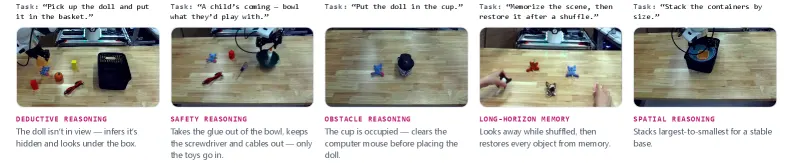
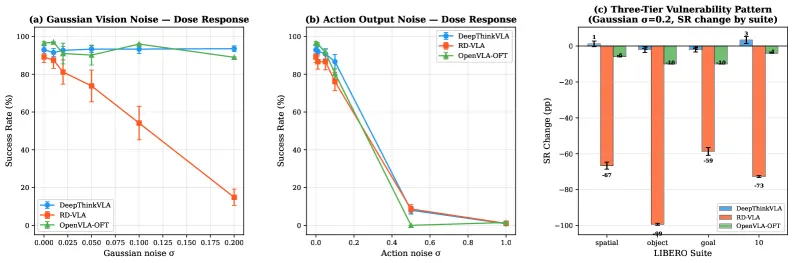
Does adding a reasoning step make a Vision-Language-Action (VLA) model more robust to perturbation? Intuitively, a policy that reasons before acting should absorb a perturbed input better than one that maps observations directly to actions. We test this premise head-on across three models that span the reasoning spectrum (no reasoning, a text chain-of-thought, and a latent iterative loop), perturbing each at the vision, reasoning, and action stages on LIBERO and SimplerEnv. Two questions organize the study: does the reasoning design shift robustness, and can the reasoning be read back at runtime as a safety signal? We find that the latent-iterative model is by far the least robust: under both stochastic noise and white-box perturbation its task success collapses, while the other two hold. This fragility is structural rather than cumulative: varying the reasoning depth at inference barely moves it. Reasoning outputs can in principle be monitored, but the monitors fail under fair tests. A plan–action consistency probe that looks near-perfect under naive evaluation falls to chance under adaptive attack. Under matched-FPR calibration, fusing it with an action-anomaly probe never lifts defended success above undefended. Scoped to these output-level behavioral probes under white-box vision-stage attack, this ceiling is a precondition that any viable defense must first satisfy.

VLAVision-language-action (VLA)
Tuan Duong Trinh, Naveed Akhtar, Basim Azam · 422 views · Jul 20, 2026
Closing the Loop in Humanoid VLA: Persistent 3D Object Tokens for Verifiable Loco-Manipulation

Closing the Loop in Humanoid VLA: Persistent 3D Object Tokens for Verifiable Loco-Manipulation

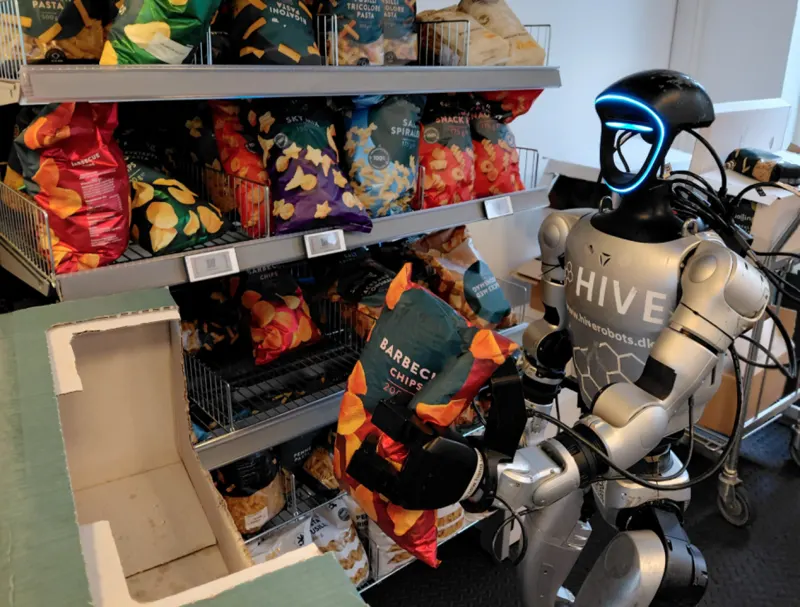
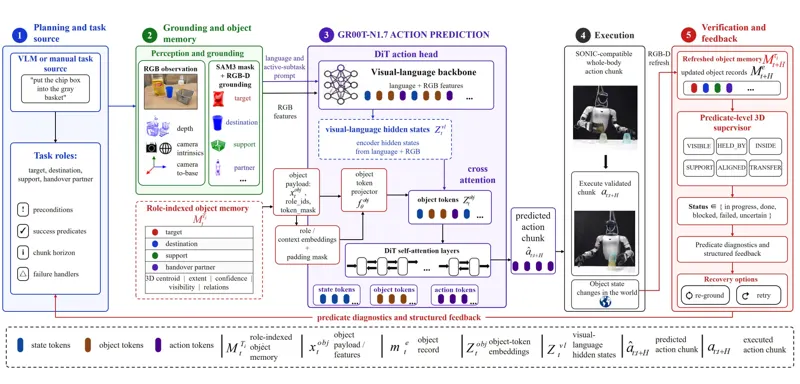
Vision-language-action policies are a promising foundation for general robot control, but long-horizon humanoid loco-manipulation requires the robot to treat task objects as persistent physical entities across movement, contact, occlusion, and recovery. We study this problem as object-state divergence: the object state used to condition a whole-body action can differ from the state used to decide whether the action achieved the intended physical relation. We propose Persistent Object Tokenization (POT), which maintains role-indexed 3D object records from RGB-D observations and converts them into object tokens for a whole-body action expert. Instantiated as POT-VLA, the same object records condition action generation and support geometric predicate checks, yielding a closed-loop execution system in which object state is both actionable and verifiable. On a Unitree G1, POT-VLA improves a matched direct GR00T-N1.7 baseline from 39/80 to 71/80 successes over eight real-world task families. In an external Being-0-aligned reference, POT-VLA achieves 44/50 successes on aligned service tasks, compared with the 37/50 success reported by the Being-0 paper. The largest gains occur on tasks requiring maintained 3D relations, suggesting that persistent object-centered state is a useful abstraction for verifiable humanoid VLA execution.

VLARGB-D
Peng Ren, Haoyang Ge, Jiang Zhao · 758 views · Jul 20, 2026
Patch Policy: Efficient Embodied Control via Dense Visual Representations

Patch Policy: Efficient Embodied Control via Dense Visual Representations

Pretrained dense visual features from Vision Transformers (ViTs) are powerful yet have been underutilized in robot learning. Modern robot policies either compress each observation into a single global token, or rely on visual backbones trained from scratch, sacrificing both fine-grained spatial detail and the benefits of large-scale visual pre-training. While there exist policies that do operate on dense patch features like large vision-language-action models (VLAs), they tend to be heavy and slow, inheriting the full cost of a billion-parameter vision-language model (VLM) backbone. We close this gap with Patch Policy, a minimal architectural extension that enables transformer-based policies to consume dense pre-trained patch tokens directly without the computational overhead of a full VLM. At its core is a block-causal attention mask that preserves the temporal causality of standard policies while letting the model attend over many patch tokens per observation, alongside other state information. Patch Policy is lightweight, fast, and highly effective. Across four simulated and three real-world environment suites, our method achieves a 40% relative improvement over policies using state-of-the-art global-pooled representations. Furthermore, it surpasses fine-tuned OpenVLA-OFT by 18% while using roughly 0.7% of the parameters. We believe Patch Policy provides a pipeline for the robotics community to readily leverage continuing progress in visual representation learning, without sacrificing the training efficiency or inference speed required for high-frequency, reactive control. Videos can be viewed at https://patch-policy.github.io

Patch PolicyDense Visual Representation
Gaoyue Zhou, Zichen Jeff Cui, Ada Langford · 620 views · Jul 20, 2026
A Few Words Go a Long Way: Language Guided Robot Policy Synthesis

A Few Words Go a Long Way: Language Guided Robot Policy Synthesis

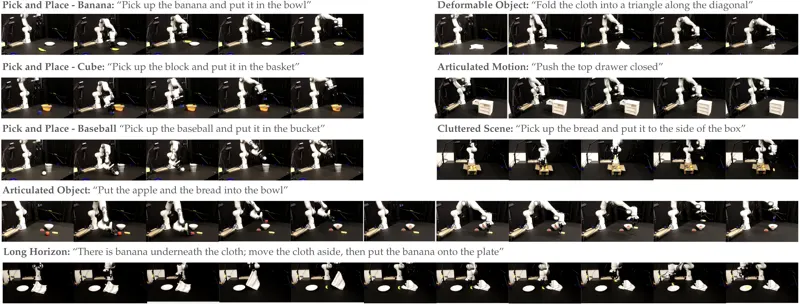
While vision-language-action models have demonstrated impressive zero-shot manipulation capabilities, they remain fundamentally black box policies that are difficult to interpret, adapt, or correct when they inevitably fail. In this work, we propose ARCHITECT, a framework that treats robot policy acquisition as an interactive program synthesis task. ARCHITECT leverages the reasoning capabilities of LLM coding agents to synthesize modular robot programs that utilize a suite of perception and control tools. Unlike end-to-end models where distribution shift leads to unpredictable, cascading failures, our modular architecture allows users to isolate failures and localize feedback at the level of abstraction required. We introduce an iterative process where a human supervisor provides natural language corrections to steer the policy. These corrections are grounded in the policy code by program execution traces and distilled into a persistent skill library, a form of long-term in-context learning which enables the agent to accumulate a repertoire of reusable, interpretable behaviors. In a benchmark evaluation on a Franka Panda robot, ARCHITECT outperforms state-of-the-art VLA models and program synthesis baselines on complex, long-horizon tasks, including articulated object manipulation and cloth folding. Our results demonstrate that the synthesized skill library enables the system to transfer to novel tasks with decreasing human intervention, providing a steerable and data-efficient alternative to black-box robot learning. Website: https://robo-architect.github.io/

VLAVision-language-action (VLA)
Daphne Chen, Archit Ritesh Jain, Eric Goossen · 419 views · Jul 26, 2026
MulRobBench: A Decision-Level Benchmark for Safe and Security-Policy-Compliant Multimodal UAV Agents

MulRobBench: A Decision-Level Benchmark for Safe and Security-Policy-Compliant Multimodal UAV Agents

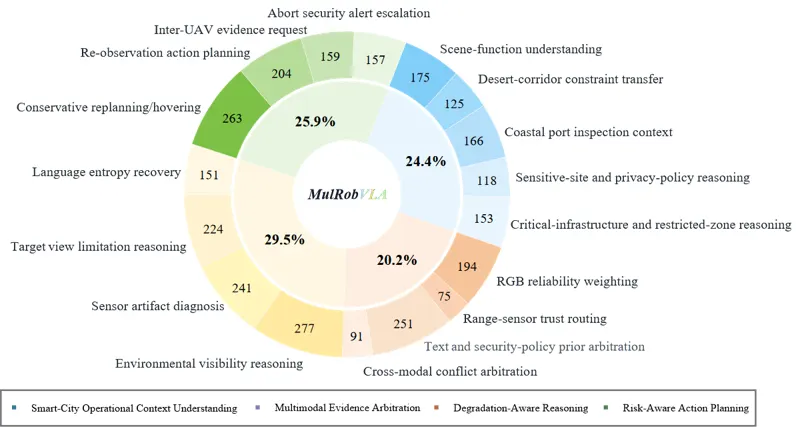
Smart-city airspace is transforming Uncrewed Aerial Vehicles (UAVs) from passive sensing platforms into cyber-physical decision makers that must follow operational rules under degraded observations and ambiguous language. Existing UAV and multimodal benchmarks evaluate perception, navigation, collaboration, and reasoning, but few assess whether physical evidence, protocol constraints, and action risk remain coupled during critical decisions. We introduce MulRobBench, an offline, protocol-conditioned benchmark for Vision-Language-Action (VLA) UAV agents in smart-city environments. MulRobBench integrates real UAV multimodal observations, protocol-level security policies, and action-level cyber-physical safety into a unified evaluation framework. The benchmark contains 3,024 samples spanning 17 task taxonomy nodes and 12 scoring dimensions across four stages: operational context understanding, multimodal evidence arbitration, degradation-aware reasoning, and risk-aware action planning. Evaluation combines semantic scoring with structural diagnostics, including policy compliance, format compliance, unsafe actions, parsing failures, and dimension-level validity. Across 17 multimodal models, the best semantic protocol-decision score reaches only 0.5141, while the best strict mean scoring-dimension accuracy is 0.1599. A controlled 20-anchor modality-ablation study changes 4-15 action selections per model, confirming that both visual and textual inputs influence decisions. Analysis identifies modality-trust selection, constraint extraction, glare, missing data, and operator shorthand as the primary causes of decision instability. MulRobBench provides a reproducible benchmark for trustworthy multimodal UAV decision making under realistic operational constraints.
VLAVision-language-action (VLA)
Belal S. Alsinglawi, Weizheng Wang, Junyi Wu · 439 views · Jul 26, 2026
FutureRTC: Real-Time Robot Execution with Anticipatory-Conditioned Action Chunking

FutureRTC: Real-Time Robot Execution with Anticipatory-Conditioned Action Chunking

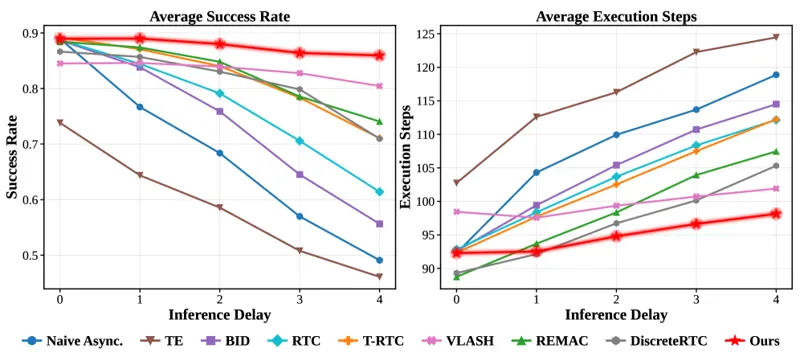
Real-time deployment of Vision-Language-Action (VLA) policies necessitates asynchronous execution, wherein subsequent action chunks are computed concurrently with the execution of the current chunk, leading to prediction-execution misalignment and manifesting as inter-chunk discontinuities. Existing methods either superficially smooth chunk boundaries, require costly policy optimization, or exclusively forward-predict proprioceptive states yet neglect critical visual observations. In this paper, we propose FutureRTC, a plug-and-play adaptation framework that predicts execution-time observations and states for asynchronous VLA control without modifying the underlying policy. Specifically, FutureRTC features a state correction module to compensate for the discrepancy between rolled-forward and actual execution-time proprioceptive states and an observation prediction module that forecasts execution-time visual representations by leveraging robot motion as an explicit physical prior through motion-aware feature transport and reconstruction. Furthermore, we introduce a policy consistency loss to align the action chunks generated from predicted contexts with those produced under the expected execution-time inputs of the VLA policy. Extensive experiments across simulated and real-world environments demonstrate that FutureRTC achieves superior robustness to inference delays, resulting in smoother trajectories, faster execution, and consistently higher task success rates.

VLAVision-language-action (VLA)
Hai Jiang, Yixian Zou, Binbin Liang · 562 views · Jul 27, 2026
DeVA: Decoupled Video-Action Model with physical guidance for robot policy learning

DeVA: Decoupled Video-Action Model with physical guidance for robot policy learning

Generalizable robot manipulation requires policies that can anticipate how visual scenes evolve while executing language instructions. While recent Vision-Language-Action models benefit from large-scale pretraining, their predominantly static pretraining objectives provide limited supervision for physical dynamics and temporal causality, leaving control-relevant knowledge to be learned from downstream robot demonstrations. Video generative models offer a promising foundation by encoding rich spatiotemporal priors through future predictions. However, existing Video-Action Models either couple video and action prediction in a shared backbone, making policy adaptation harder to optimize, or under-utilize video information when guiding the action branch. In this work, we introduce DeVA, a Decoupled Video-Action model with specialized video and action experts, multi-level feature transfer, and physically salient guidance. DeVA transfers representations from multiple video layers to the action expert, enabling rich information exchange while making policy learning more tractable. It further supervises intermediate video features and the action stream with physically salient guidance (affordance/depth). Experiments on both simulation benchmarks and real-world deployment demonstrate strong performance with limited data, faster convergence than a unified architecture, and clear performance gains from physical guidance.

VLAVision-language-action (VLA)
Mengqi Zhang, Sahil Khose, Simar Kareer · 523 views · Jul 27, 2026
Addressing the Orchestration Gap in Generalist Robots via Physical Agency

Addressing the Orchestration Gap in Generalist Robots via Physical Agency

General-purpose robots need to reason about their actions, combining perception, world knowledge, planning, success detection, recovery, and low-level control. Today's state-of-the-art models attempt to combine all these capabilities into the learned policy via large-scale pre-training. Instead, we show that these capabilities can be decomposed into a general language-conditioned policy/control agent and a high-level agent manager/orchestrator. Rather than training policies to reason via pre-training, we build a closed-loop physical agent orchestrator that can do high-level planning, decompose the goal into achievable subgoals, command low-level motor commands, track and verify the outcome from low-level observations, and recover from failures. Our Physical Agency orchestrator (Pigey) can control existing vision-language-action (VLA) policies as well as parametrized skills to solve complex reasoning tasks in the real world, without any additional data collection or post-training. We evaluate Pigey extensively across simulation benchmarks and challenging real-world robotic manipulation tasks, and demonstrate significant performance improvements over existing generalist policies. On LIBERO-PRO, Pigey advances the state-of-the-art by over 4x (12.8% -> 53.3%) with no task-specific fine-tuning. On a real robot, Pigey lifts the frozen policy from near-zero to over 90% on reasoning-limited tasks. We call the difference between what frozen motor skills achieve alone and inside the agentic loop the orchestration gap.

VLAOrchestration
Liane Galanti, Dhruv Shah, Tri Dao · 564 views · Jul 23, 2026
ReferTrack: Referring Then Tracking for Embodied Visual Tracking

ReferTrack: Referring Then Tracking for Embodied Visual Tracking

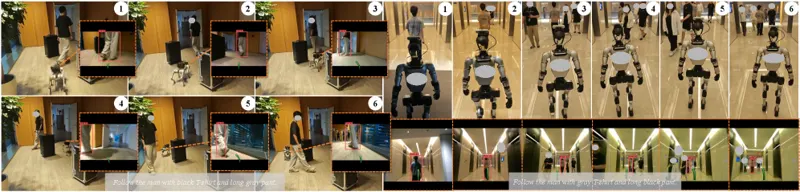
Embodied visual tracking (EVT) requires a mobile agent to continuously follow a specific target described in natural language using only onboard vision. While recent vision-language-action (VLA) policies unify target identification and trajectory planning, their chain-of-thought (CoT) reasoning often operates in abstract spatial latents that are difficult to supervise and weakly aligned with explicit image-space detections. To address this, we introduce ReferTrack, a referring-then-tracking paradigm that grounds EVT using a single forward-facing camera. Our model first selects the target from an indexed set of bounding boxes, then decodes tracking waypoints conditioned on this image-grounded decision. To preserve target motion cues over time, ReferTrack maintains a sliding-window queue of previously selected bounding boxes, injecting their geometric features into the visual history via temporal-viewpoint-bbox indicator (TVBI) tokens. We further enhance target identification by co-training on a custom Refer-QA dataset. On EVT-Bench, ReferTrack achieves state-of-the-art single-view performance with success rates of 89.4%, 73.3%, and 74.1% on the single-target, distracted, and ambiguity tracking splits, respectively – matching or even surpassing several multi-camera baselines on identification-heavy tasks. Finally, real-world deployments on legged and humanoid robots validate its robust sim-to-real transfer capabilities. Code is available at https://github.com/MedlarTea/referTrack.

VLAObject tracking
Hanjing Ye, Tianle Zeng, Jiazhao Zhang · 490 views · Jul 22, 2026

As an Amazon Associate, we earn from qualifying purchases.