Skip to content
RobotWorld

Papers

FlashVLA: Streaming Action Decoding for Fast and Asynchronous VLA Inference

FlashVLA: Streaming Action Decoding for Fast and Asynchronous VLA Inference

Vision-Language-Action (VLA) models are increasingly promising for robotic manipulation, yet their real-world deployment remains bottlenecked by high inference latency and unstable asynchronous execution. This challenge is particularly pronounced in flow-matching-based VLA models, where action decoding requires multiple iterative steps conditioned on the VLM context. While efficient inference methods improve control frequency and asynchronous methods reduce execution idle time, existing approaches often fail to jointly achieve low-latency inference and accurate, temporally consistent asynchronous execution. We introduce \textbf{FlashVLA}, a streaming action decoding framework that addresses both challenges in a unified formulation. FlashVLA maintains a streaming action buffer with multiple chunks at different noise levels and decodes them using chunk-wise causal attention. This design allows FlashVLA to produce one executable action chunk per inference step. Moreover, its chunk-wise autoregressive formulation implicitly preserves action continuity, enabling smooth asynchronous execution without extra future-state conditioning. Across extensive simulated and real-world experiments, FlashVLA substantially improves inference speed while maintaining strong task performance. It can achieve $\geq$30\,Hz control frequency on a single GPU with smooth asynchronous inference in real-world deployment.

VLAflow matching流式解码Zekai Li, Jiaming Tang, Zhijian Liu·Aug 27, 2026
GigaBrain-0.7: Scaling Embodied Foundation Models to Emergent Capabilities with a Three-System Architecture

GigaBrain-0.7: Scaling Embodied Foundation Models to Emergent Capabilities with a Three-System Architecture

Vision-language-action (VLA) models have become a dominant paradigm for generalist embodied agents, demonstrating strong complex and long-horizon task completion in structured settings. Yet it remains an open question whether current VLA systems can benefit from more effective architectural design, scale to substantially larger and more heterogeneous data regimes, and achieve broader generalization across tasks and embodiments. To this end, we present GigaBrain-0.7, an embodied foundation model with substantially improved generalization across diverse robot embodiments. Specifically, GigaBrain-0.7 unifies understanding, prediction, and action through a three-system architecture, scales pretraining to over 37,000 hours of heterogeneous embodied data, and introduces one-stage alignment training that jointly optimizes vision-language understanding and multi-embodiment action generation. Compared with the preceding GigaBrain-0 series and prior state-of-the-art models including $π_{0.5}$, GigaBrain-0.7 achieves substantial improvements in foundation zero-shot capabilities, language-conditioned instruction following, and post-training task success rates. In particular, on our in-house Maker H01 platform and mainstream robot embodiments, GigaBrain-0.7 demonstrates strong task adaptability and completion ability across both home and industrial scenarios. All training code and pretrained model weights will be released.

VLA具身智能世界模型 GigaBrain Team, Angen Ye, Axiang Sun·Aug 16, 2026
TemporalFlow-VLA: Learning Physically Grounded Execution History for Long-Horizon Robot Manipulation

TemporalFlow-VLA: Learning Physically Grounded Execution History for Long-Horizon Robot Manipulation

Vision-language-action (VLA) models leverage pretrained vision-language representations for robot control, yet simply adding historical frames does not reliably capture recent physical change. This is especially problematic in multi-stage manipulation, where visually similar states may require different actions depending on prior execution. To address this challenge, we present TemporalFlow-VLA, which learns compact execution history through physically grounded temporal supervision. Using recorded robot states, robot geometry, and calibrated cameras, we construct robot-surface temporal flow as a training-only target and supervise two execution-aligned temporal queries that provide structured history to the action expert. The geometric supervision path is not evaluated at deployment. TemporalFlow-VLA achieves 97.63 +/- 0.26% average success on LIBERO, including 96.60 +/- 0.87% on LIBERO Long, and 85.5%/84.2% Clean/Randomized success across 12 RoboTwin tasks. It shows its clearest advantage over prior methods on longer-horizon, multi-stage manipulation. Controlled history interventions show that action prediction depends on both historical content and temporal order. With asynchronous feature caching, temporal conditioning maintains single-frame-level server-side sampling latency without additional historical-encoding overhead. Overall, TemporalFlow-VLA provides a compact, physically grounded interface for exploiting ordered execution history without explicit motion estimation or geometric processing at deployment.

VLA视觉-语言-动作时间流Jiarui Yang, Yehao Lu, Yuning Su·Aug 27, 2026
EATR-Stereo: Embodiment-Aware Token Routing of Paired Stereo Evidence for Humanoid Vision-Language-Action Control

EATR-Stereo: Embodiment-Aware Token Routing of Paired Stereo Evidence for Humanoid Vision-Language-Action Control

Long-horizon humanoid vision--language--action (VLA) control with head-mounted stereo cameras requires visual interfaces that can exploit complementary views while maintaining compatibility with pretrained representations. Existing interfaces often discard complementary stereo evidence or fuse additional observations without preserving the native primary-view pathway and adapting auxiliary information to robot embodiment. We present EATR-Stereo, an embodiment-aware token-routing framework that retains primary-view tokens and constructs primary-aligned Cross-View Auxiliary Tokens (CVATs) by querying the synchronized auxiliary-view token sequence. A body-segmented proprioceptive encoder further conditions token-wise auxiliary usage on robot configuration history, enabling selective incorporation of stereo evidence during action generation. The routed auxiliary stream augments the language and primary-visual context of a pretrained VLA while keeping its vision--language model frozen. On a 33-DoF physical humanoid with a 37-D proprioceptive state, we evaluate nine configurations in over-100-s search--approach--grasp--place--return tasks. EATR-Stereo achieves 60.0% full-task success, 100.0% grasp success, and 80.0% stage success. Under severe asymmetric occlusion, it improves recovery to 80% compared with 30% for CVAT alone. Ablation studies further show the importance of preserving primary tokens and combining cross-view auxiliary features with structured proprioceptive routing. These results demonstrate that selectively routed paired stereo evidence improves spatial grounding for reliable long-horizon humanoid VLA control.

VLAstereo visiontoken routingSongwei Wu, Rui Zhao, Fan Yang·Aug 18, 2026
ABot-AgentOS: A General Robotic Agent OS with Lifelong Multi-modal Memory

ABot-AgentOS: A General Robotic Agent OS with Lifelong Multi-modal Memory

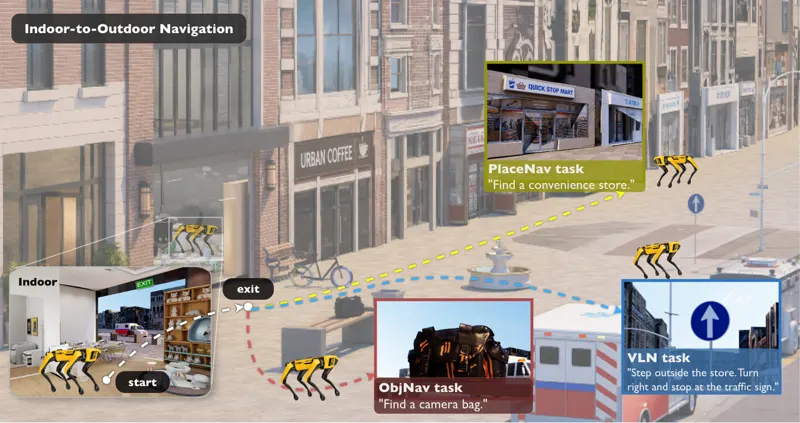
Recent VLM and VLA systems have improved robotic perception and action prediction, yet long-horizon embodied agents still require a general runtime layer for reasoning, memory, tool use, verification, and cross-embodiment execution. We present ABot-AgentOS, a general robotic Agent Operating System that sits above low-level controllers and provides a deliberative agent layer for scene-conditioned planning, context-isolated skill execution, multi-stage verification, multi-modal memory, and edge-cloud collaboration. To evaluate such systems, we introduce EmbodiedWorldBench, an executable benchmark with 16 indoor, outdoor, and hybrid scenes, four difficulty levels, and over 200 tasks involving navigation, object search, NPC dialogue, dynamic events, and trace-grounded scoring. ABot-AgentOS further introduces Universal Multi-modal Graph Memory, a persistent source-grounded substrate that converts dialogue, visual observations, spatial context, temporal relations, and task traces into typed nodes and edges. A failure-driven self-evolution loop converts diagnosed memory failures into gated runtime evo-assets that are promoted only to later evaluation splits, preventing current-split ground-truth leakage while enabling continual improvement. On an initial EmbodiedWorldBench subset, ABot-AgentOS improves over a single-controller baseline in both task success and goal completion. Across memory benchmarks, ABot-AgentOS Static achieves 87.5 on LoCoMo, 59.9 on OpenEQA EM-EQA, 88.6 on Mem-Gallery, and 76.5 Acc@All on NExT-QA; self-evolution further improves LoCoMo to 88.7, OpenEQA to 60.4, and Mem-Gallery to 89.0. These results suggest that a general Agent OS layer can improve long-horizon embodied execution while providing persistent, auditable memory for continual interaction.

机器人智能体AgentOS智能体操作系统Jiayi Tian, Shiao Liu, Yuting Xu·Jul 11, 2026
HAF: Adapting Generalist VLAs to Humanoid Whole-Body Loco-manipulation via Hierarchical Action Flow and Spectral Latent RL

HAF: Adapting Generalist VLAs to Humanoid Whole-Body Loco-manipulation via Hierarchical Action Flow and Spectral Latent RL

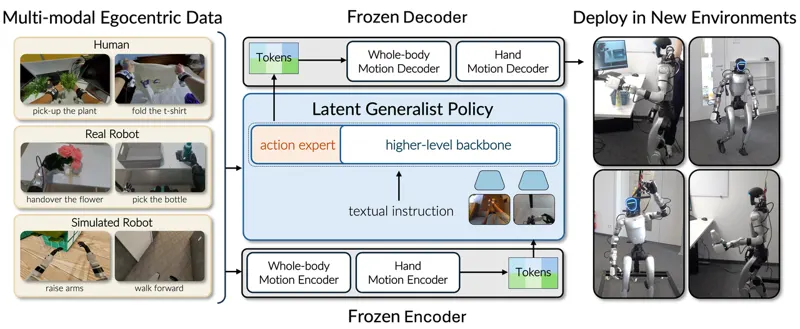
Humanoid robots hold great promise as general-purpose agents in human-centered environments, yet generalist vision-language-action (VLA) foundation models are not readily applicable to humanoid whole-body loco-manipulation. The high dimensionality and interdependence of humanoid motions make it challenging for conventional single-stage VLA architectures to coordinate locomotion, waist posture, and dual-arm manipulation effectively. Moreover, policies trained through offline behavior cloning can remain suboptimal during real-world deployment. Although online reinforcement learning can refine policies through real-world interaction, directly tuning large VLA backbones demands excessive computation and may introduce safety risks during real-robot exploration. To address these bottlenecks, we introduce HAF (Humanoid Adaptation Framework), a two-part framework consisting of HAF-VLA and HAF-Steer that transfers off-the-shelf generalist VLA foundation models to humanoid whole-body loco-manipulation. HAF-VLA is a hierarchical action-flow generator built on a pretrained flow-matching VLA. It splits full-body action denoising into three sequential stages with stage embeddings and cross-stage KV caches that retain kinematic dependencies, avoiding incoherent whole-body actions from one-shot generation. On top of the frozen HAF-VLA, HAF-Steer is a latent offline-to-online RL pipeline that leverages flow-matching invertibility and DCT-based dimensionality reduction to restrict RL optimization to a compact noise subspace and train a regularized SAC policy. This avoids updating the large VLA backbone and enables efficient real-world policy refinement. Evaluated on seven real-world humanoid loco-manipulation tasks, HAF surpasses vanilla single-stage VLA baselines and improves whole-body coordination and task performance. Project website: https://grange007.github.io/HAF .

VLA人形机器人humanoidLangzhe Gu, Chengkai Hou, Meng Li·Aug 17, 2026