Skip to content
GSQ: Highly-Accurate Low-Precision Scalar Quantization for LLMs via Gumbel-Softmax Sampling

GSQ: Highly-Accurate Low-Precision Scalar Quantization for LLMs via Gumbel-Softmax Sampling

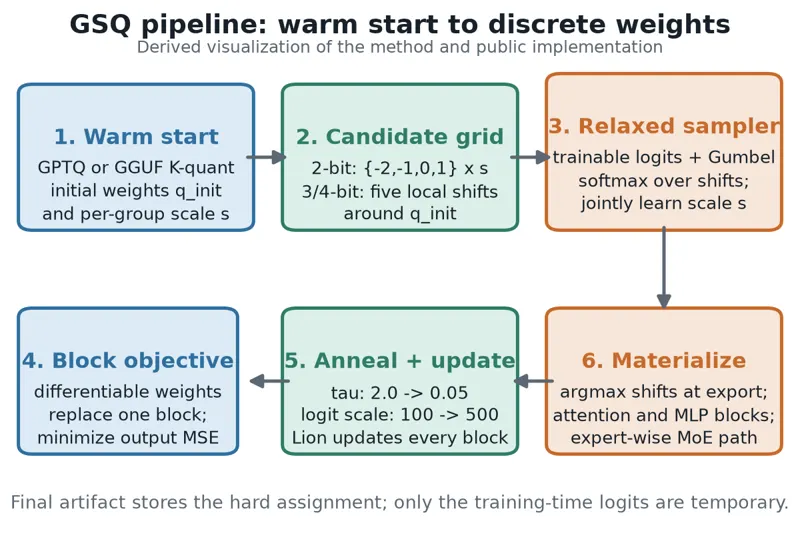
Quantization has become a standard tool for efficient LLM deployment, especially for local inference, where models are now routinely served at 2-3 bits per parameter. The state of the art is currently split into simple scalar quantization techniques, such as GPTQ or AWQ, which are widely deployed but plateau in accuracy at 3-4 bits per parameter (bpp), and "second-generation" vector- or trellis-quantized methods, such as QTIP, GPTVQ and AQLM, which push the accuracy frontier but are notoriously hard to implement and to scale. In this paper, we ask whether this gap is fundamental, or whether a carefully optimized scalar quantizer can recover most of it. We answer in the affirmative, by introducing GSQ (Gumbel-Softmax Quantization), a post-training scalar quantization method which jointly learns the per-coordinate grid assignments and the per-group scales using a Gumbel-Softmax relaxation of the discrete grid. GSQ matches the cardinality of the relaxation to the small number of levels available in the target bit-width regime (e.g., 3-8 levels for ternary and 3 bpp, respectively), making optimization tractable. Practically, on the standard Llama-3.1-8B/70B-Instruct models, GSQ closes most of the gap between scalar quantization and the QTIP frontier at 2 and 3 bits, while using a symmetric scalar grid with group-wise quantization, and thus remains compatible with existing scalar inference kernels. We further show that the same discrete-assignment optimization can be applied to practical GGUF K-Quant checkpoints: starting from publicly released GGUF models, GSQ improves accuracy while projecting the result back into the same deployment format. Finally, GSQ scales to trillion-scale Mixture-of-Experts models such as Kimi-K2.5, where vector-quantized methods are difficult to apply. The source code is publicly available at https://github.com/IST-DASLab/GSQ.
LLMModel Quantization
Alireza Dadgarnia, Soroush Tabesh, Mahdi Nikdan · 342 views · Apr 20, 2026
KlaskTron: An Open-Source Platform for Physical Adversarial Multi-Agent RL

KlaskTron: An Open-Source Platform for Physical Adversarial Multi-Agent RL

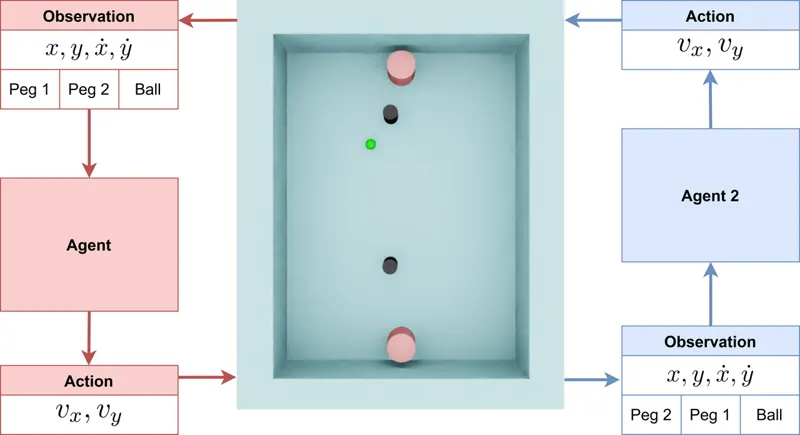
Progress in robot learning, particularly physical multi-agent reinforcement learning (MARL), is currently challenged by a limited availability of accessible, standardized benchmarks. While simulation-based MARL has produced remarkable emergent behaviors, from coordinated team play to complex tool use, translating these advances to physical systems remains difficult. A key barrier is infrastructural: physical platforms are often prohibitively expensive, require specialized facilities, or lack open mechanisms and designs for reproducibility. We introduce KlaskTron, an open-source, low-cost (<$2500 USD), desktop-scale robotic testbed for adversarial MARL based on the dynamic tabletop game KLASK. The platform features dual CoreXY gantries with high-torque brushless motors, enabling the high-speed, precise manipulation required for competitive play. Crucially, we provide a complete ecosystem: hardware designs (CAD, BOM), a GPU-native digital twin in NVIDIA Isaac Lab for high-fidelity modeling and simulation, and a validated sim-to-real baseline using a learned neural actuator model. We demonstrate that this baseline enables zero-shot policy transfer, with trained agents exhibiting emergent adversarial behaviors. To ensure full reproducibility of our results, all project assets are released publicly: hardware CAD/BOM and assembly documentation at [https://idscethzurich.github.io/klask_hardware], inference software stack at [https://github.com/IDSCETHZurich/klask_software] and the simulation and MARL setup at [https://github.com/IDSCETHZurich/klask_rl].

Physical Multi-Agent RLRobot Learning
Aswin Ramachandran, Jona Schulz, Maurus Derungs · 343 views · Nov 2, 2026
D&A: Decoupling Description and Assessment Enables VLMs as Zero-Shot Robotic Reward Models

D&A: Decoupling Description and Assessment Enables VLMs as Zero-Shot Robotic Reward Models

Vision-Language Models (VLMs) hold promise for zero-shot video task-progress estimation in robot learning, yet existing frameworks frequently suffer from confirmation bias, hallucinating progress in failed executions due to implicit success assumptions or relative temporal ranking designs. Naive prompting of frontier models collapses into a binary success detector that fails to capture nuanced, non-linear progress and failures. While post-training approaches can mitigate this through explicit training, they demand expensive real-world robotics data and require computationally intensive post-training for every individual base model. To resolve these limitations, we introduce D&A (Describe & Assess): our approach decouples progress estimation into an objective, task-grounded textual description of scene dynamics followed by an assessment phase using explicit rubrics. By compelling the VLM to synthesize an explicit, text-based definition of absolute success before scoring, the framework anchors evaluations to an external, global criterion rather than the video's internal timeline. Empirical results demonstrate that our method calibrates zero-shot estimates and mitigates confirmation bias, providing fine-grained, partial progress metrics that accurately penalize failed executions while correctly interpolating successful runs. Being purely prompt-based, D&A generalizes across tasks, embodiments, and benchmarks—matching or surpassing post-trained reward models—and its reward estimates enable efficient downstream reinforcement learning.

VLMRobot Reward Modeling
Marius Memmel, Shawn Yin, Urvi Rutia · 341 views · Nov 2, 2026
Real2Sem2Real: 3D Semantic Augmentations for Robot Learning from a Single Human RGB Demonstration

Real2Sem2Real: 3D Semantic Augmentations for Robot Learning from a Single Human RGB Demonstration

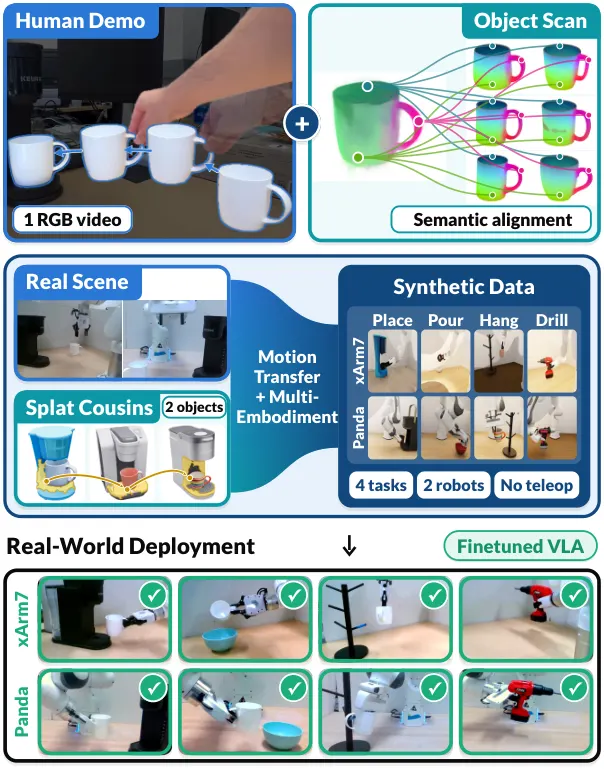
Human video scales easily and does not need robot hardware, but existing methods require depth sensing, overlay the robot onto 2D video, or generate data only for the demonstrated objects. We present Real2Sem2Real (R2Sem2R), a real-to-semantic-to-real pipeline that turns one monocular RGB video of a human demonstration into thousands of robot demonstrations across the semantic object instances of a category. R2Sem2R tracks the SE(3) pose of each object with DINOv3-distilled Gaussian splats, outperforming existing methods and FoundationPose with estimated metric depth. R2Sem2R then aligns digital cousins, each generated from one or a few photographs, to the demonstrated objects with a semantic alignment. This alignment matches whole objects and the functional regions of target objects, such as a coffee machine's tray. R2Sem2R maps the human hand to a feasible robot grasp that extends to the cousins. Robot demonstrations are generated either in IsaacSim, for photorealistic rendering, or MuJoCo, for contact physics, and R2Sem2R can generate over 2,000 episodes in about two hours. On two real robots and four tasks, we train a vision-language-action policy on data from one human video per task, and policies trained on our data match or exceed policies trained on teleoperation across diverse object instances. The project page is available at https://real2sem2real.github.io/.

Robot LearningHuman demonstrations
Matthew Strong, Ankush K. Dhawan, Julien Poffet · 409 views · Oct 20, 2026
T2-z: Test-Time Optimization of Environment Latents for Robotic World Models

T2-z: Test-Time Optimization of Environment Latents for Robotic World Models

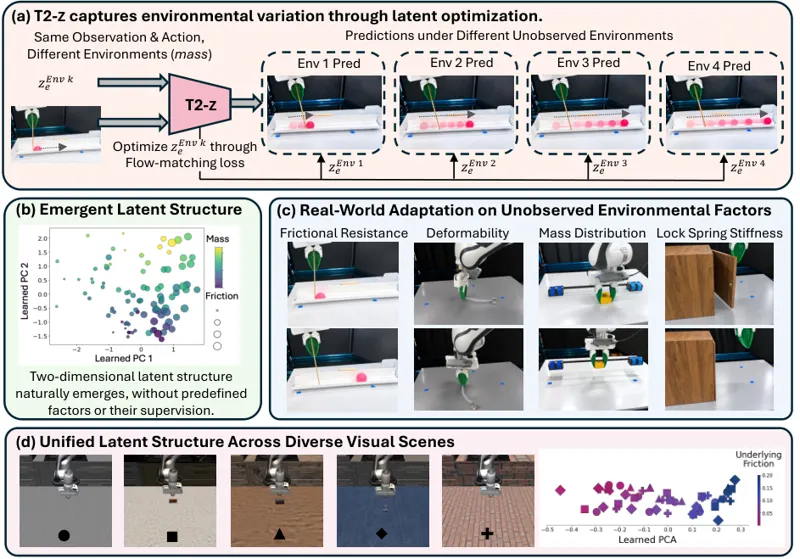
Predicting how the world responds to an action requires more than what can be seen: robots must account for environmental factors that are neither directly observable nor explicitly specified, from physical properties such as friction and mass to human-defined environmental rules. We introduce T2-Z for test-time optimization of environment latents, which augments a robotic world model with a learnable environment latent to condition world predictions. This compact latent captures underlying environmental variation without supervision of what environmental factors exist or what values they take. During training, T2-Z alternates between two stages: a world-model optimization stage that fixes the latents and learns general action-conditioned dynamics across environments; and an environment-latent optimization stage that freezes the world model and optimizes the conditioning latents, allowing latent structure to emerge purely through world prediction. At test time, the world model remains frozen and a newly initialized environment latent is optimized from one or more test-time interactions, adapting the model to previously unseen environmental configurations. Across 7 simulated settings and 4 real-world robotic tasks, T2-Z reduces object prediction error metric from 15.20 to 7.00 and raises action success from 33.73% to 72.96%. Its emergent latents capture structured representations of individual and compounded factors across diverse visual scenes. Ablations further show that T2-Z can efficiently infer environment latents from as little as a single test-time interaction trajectory.

Robotic World ModelsTest-Time Optimization
Chenyuan Zhou, Yining Hong, Huang Huang · 287 views · Oct 15, 2026
OmniEgoCap: Device-Agnostic Sequence-Level Egocentric Motion Reconstruction

OmniEgoCap: Device-Agnostic Sequence-Level Egocentric Motion Reconstruction

Commercial egocentric devices capture human behavior in everyday settings, yet full-body motion reconstruction must generalize across diverse cameras and mountings. This is challenging because head trajectories under-determine body motion, while hand observations are intermittent and camera-dependent: a hand may disappear simply because it has left the camera's field of view. Existing methods treat such absences as missing data, relying on fixed visibility regimes or post-hoc optimization, and fail to generalize across devices. We present OmniEgoCap, a sequence-level diffusion framework for device-agnostic egocentric full-body motion reconstruction. Our key insight is that egocentric videos contain sequence-level evidence about both the wearer and the camera-induced visibility structure, enabling OmniEgoCap to infer consistent body shape and coherent motion from sparse head and hand cues. To prevent overfitting to a single camera setup, we further introduce geometry-aware visibility augmentation, which synthesizes visibility patterns from realistic variations in camera geometry. We also present OmniEgoDB, the first mocap benchmark that pairs ground-truth motion with recordings from multiple consumer egocentric devices. Experiments on synthetic, real-device, and in-the-wild settings demonstrate superior motion reconstruction, robust cross-device generalization, and coherent in-the-wild results.

Egocentric VisionMotion Capture
Kyungwon Cho, Jeonghyeon Na, Hanbyul Joo · 282 views · Dec 22, 2025

As an Amazon Associate, we earn from qualifying purchases.