Skip to content
SimWAM: A Simple World Action Model for End-to-End Autonomous Driving

SimWAM: A Simple World Action Model for End-to-End Autonomous Driving

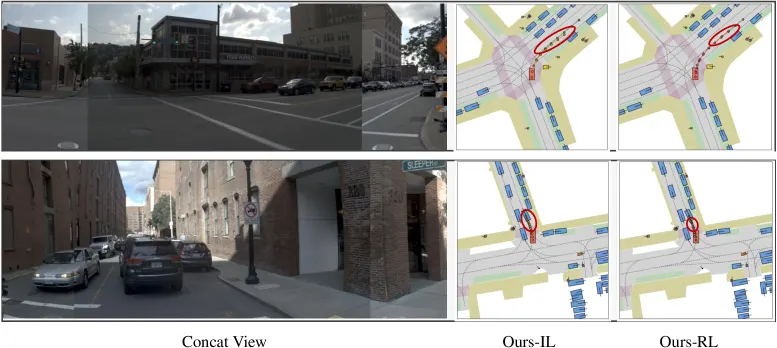
World-Action Models (WAMs) improve end-to-end autonomous driving by transferring video dynamics priors to action prediction, but existing methods require costly future generation at inference. We present SimWAM, a simple yet effective WAM that uses video generation purely as a training signal. It co-trains a pretrained video expert and a lightweight action expert with joint flow matching. An isolated attention mask keeps action prediction independent of future frames, allowing the video branch to be discarded after training and leaving a self-contained planner that directly predicts trajectories. Since the two experts share no parameters and interact only through a unified attention interface, the video backbone could be replaced and the action expert scaled independently without modifying the learning objective or inference pipeline. We further apply reinforcement learning to optimize a compositional driving reward beyond trajectory imitation. Our SimWAM achieves $91.5$ PDMS on NAVSIM, surpasses state-of-the-art WAM-based planners with substantially lower latency, and transfers zero-shot to nuScenes. These results position SimWAM as a simple yet solid baseline that could readily benefit from advances in video generation for efficient autonomous driving. The code and model weights are available at https://github.com/H-EmbodVis/SimWAM/

NAVSIMSimWAM
Zongchuang Zhao, Xin Zhou, Tianyang Xu · 818 views · Aug 7, 2026
RL²-VLA: Adaptive RL Latent Compositional Steering with Test-Time Scaling for Vision-Language-Action Models

RL²-VLA: Adaptive RL Latent Compositional Steering with Test-Time Scaling for Vision-Language-Action Models

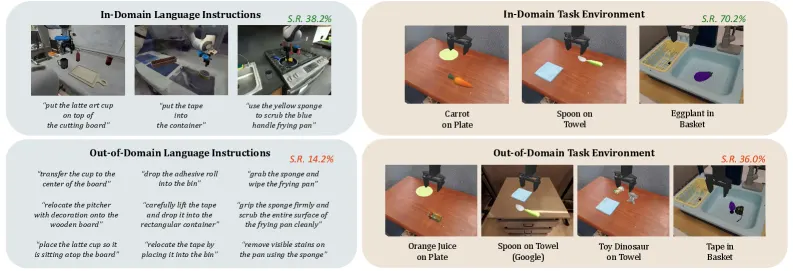
Despite the impressive visuomotor capabilities enabled by Vision-Language-Action (VLA) models, their performance often degrades on challenging and out-of-domain tasks. Recent test-time steering and scaling methods improve performance without extensive data collection and retraining, but action samples often remain concentrated around similar behaviors and therefore inherit correlated failure modes. Moreover, existing methods apply the same intervention strategy at every timestep, regardless of whether the base policy is already likely to succeed. To address these limitations, we introduce RL², an adaptive inference-time steering framework that leverages Reinforcement Learning on VLA Latents. First, we train a lightweight offline RL policy conditioned on expressive latents extracted from the VLA action expert and compose its flow velocity with that of the frozen VLA during inference. This compositional steering strategy combines the behavioral priors of large-scale imitation learning with the action diversity induced by offline RL beyond dominant demonstration modes. We further discover that inference-time steering follows fundamentally different scaling laws under success and failure states, revealing that action diversity is most beneficial when the base VLA is likely to fail, but can unnecessarily perturb already-accurate actions when success is likely. Building on this insight, RL² activates compositional steering only when failure is predicted. Across the SIMPLER and PolaRiS benchmarks, RL² improves success rates by up to +17.3% in out-of-domain settings, while ablations and scaling studies demonstrate the importance of latent representations and RL training. Finally, real-world experiments demonstrate that these gains transfer beyond simulation, establishing RL² as a practical and modular steering framework for VLA deployment.

VLARL2-VLA
Derek Ming Siang Tan, Shailesh Shailesh, Srikrishna Iyer · 795 views · Jul 29, 2026
Learning Whole-Body Humanoid Locomotion via Motion Generation and Motion Tracking

Learning Whole-Body Humanoid Locomotion via Motion Generation and Motion Tracking

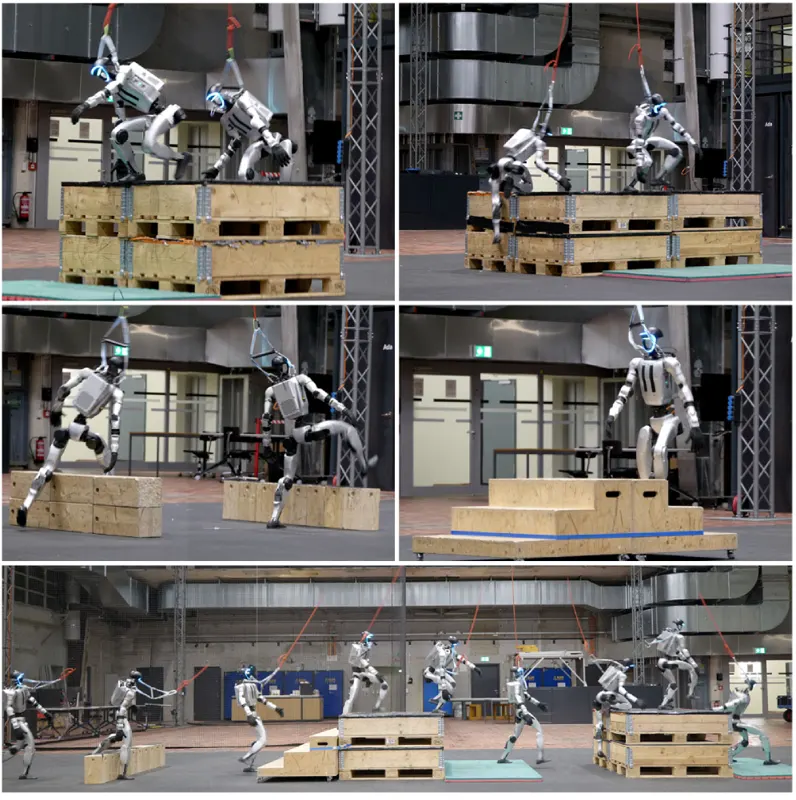
Whole-body humanoid locomotion is challenging due to high-dimensional control, morphological instability, and the need for real-time adaptation to various terrains using onboard perception. Directly applying reinforcement learning (RL) with reward shaping to humanoid locomotion often leads to lower-body-dominated behaviors, whereas imitation-based RL can learn more coordinated whole-body skills but is typically limited to replaying reference motions without a mechanism to adapt them online from perception for terrain-aware locomotion. To address this gap, we propose a whole-body humanoid locomotion framework that combines skills learned from reference motions with terrain-aware adaptation. We first train a diffusion model on retargeted human motions for real-time prediction of terrain-aware reference motions. Concurrently, we train a whole-body reference tracker with RL using this motion data. To improve robustness under imperfectly generated references, we further fine-tune the tracker with a frozen motion generator in a closed-loop setting. The resulting system supports directional goal-reaching control with terrain-aware whole-body adaptation, and can be deployed on a Unitree G1 humanoid robot with onboard perception and computation. The hardware experiments demonstrate successful traversal over boxes, hurdles, stairs, and mixed terrain combinations. Quantitative results further show the benefits of incorporating online motion generation and fine-tuning the motion tracker for improved generalization and robustness.

HumanoidWhole-body locomotion
Zewei Zhang, Kehan Wen, Michael Xu · 563 views · Apr 19, 2026
Learning Humanoid Locomotion with Perceptive Internal Model

Learning Humanoid Locomotion with Perceptive Internal Model

In contrast to quadruped robots that can navigate diverse terrains using a "blind" policy, humanoid robots require accurate perception for stable locomotion due to their high degrees of freedom and inherently unstable morphology. However, incorporating perceptual signals often introduces additional disturbances to the system, potentially reducing its robustness, generalizability, and efficiency. This paper presents the Perceptive Internal Model (PIM), which relies on onboard, continuously updated elevation maps centered around the robot to perceive its surroundings. We train the policy using ground-truth obstacle heights surrounding the robot in simulation, optimizing it based on the Hybrid Internal Model (HIM), and perform inference with heights sampled from the constructed elevation map. Unlike previous methods that directly encode depth maps or raw point clouds, our approach allows the robot to perceive the terrain beneath its feet clearly and is less affected by camera movement or noise. Furthermore, since depth map rendering is not required in simulation, our method introduces minimal additional computational costs and can train the policy in 3 hours on an RTX 4090 GPU. We verify the effectiveness of our method across various humanoid robots, various indoor and outdoor terrains, stairs, and various sensor configurations. Our method can enable a humanoid robot to continuously climb stairs and has the potential to serve as a foundational algorithm for the development of future humanoid control methods.
HumanoidInternal Perception Model
Junfeng Long, Junli Ren, Moji Shi · 544 views · Nov 21, 2024
PRIOR: Perceptive Learning for Humanoid Locomotion with Reference Gait Priors

PRIOR: Perceptive Learning for Humanoid Locomotion with Reference Gait Priors

Training perceptive humanoid locomotion policies that traverse complex terrains with natural gaits remains an open challenge, typically demanding multi-stage training pipelines, adversarial objectives, or extensive real-world calibration. We present PRIOR, an efficient and reproducible framework built on Isaac Lab that achieves robust terrain traversal with human-like gaits through a simple yet effective design: (i) a parametric gait generator that supplies stable reference trajectories derived from motion capture without adversarial training, (ii) a GRU-based state estimator that infers terrain geometry directly from egocentric depth images via self-supervised heightmap reconstruction, and (iii) terrain-adaptive footstep rewards that guide foot placement toward traversable regions. Through systematic analysis of depth image resolution trade-offs, we identify configurations that maximize terrain fidelity under real-time constraints, substantially reducing perceptual overhead without degrading traversal performance. Comprehensive experiments across terrains of varying difficulty-including stairs, boxes, and gaps-demonstrate that each component yields complementary and essential performance gains, with the full framework achieving a 100% traversal success rate. We will open-source the complete PRIOR framework, including the training pipeline, parametric gait generator, and evaluation benchmarks, to serve as a reproducible foundation for humanoid locomotion research on Isaac Lab.

Isaac LabHumanoid
Chenxi Han, Shilu He, Yi Cheng · 497 views · Mar 19, 2026
Explicit Stair Geometry Conditioning for Robust Humanoid Locomotion

Explicit Stair Geometry Conditioning for Robust Humanoid Locomotion

Robust humanoid stair climbing remains challenging due to geometric discontinuities, sensitivity to step height variations, and perception uncertainty in real-world environments. Existing learning-based locomotion policies often rely on implicit terrain representations or blind proprioceptive feedback, limiting their ability to generalize across varying stair geometries and to anticipate required gait adjustments. This paper proposes an explicit stair geometry conditioning framework for robust humanoid stair climbing. Instead of encoding terrain as high-dimensional latent features, we extract a compact set of interpretable geometric parameters, including step height, step depth, and current yaw angle relative to the robot heading. These explicit stair parameters directly condition a Proximal Policy Optimization (PPO)-based locomotion policy, enabling proactive modulation of swing-foot clearance and stride characteristics according to stair structure. Simulation experiments demonstrate improved generalization across unseen stair heights beyond the training distribution. Real-world experiments on the Unitree G1 humanoid validate reliable indoor and outdoor stair traversal. In challenging outdoor scenarios, the robot successfully ascends 33 consecutive steps without failure, demonstrating robustness and practical deployability.

HumanoidStair Climbing
Jianguo Zhang, Wentai Xu, Shusheng Ye · 539 views · May 11, 2026
Multi-critic Learning for Whole-body End-effector Twist Tracking

Multi-critic Learning for Whole-body End-effector Twist Tracking

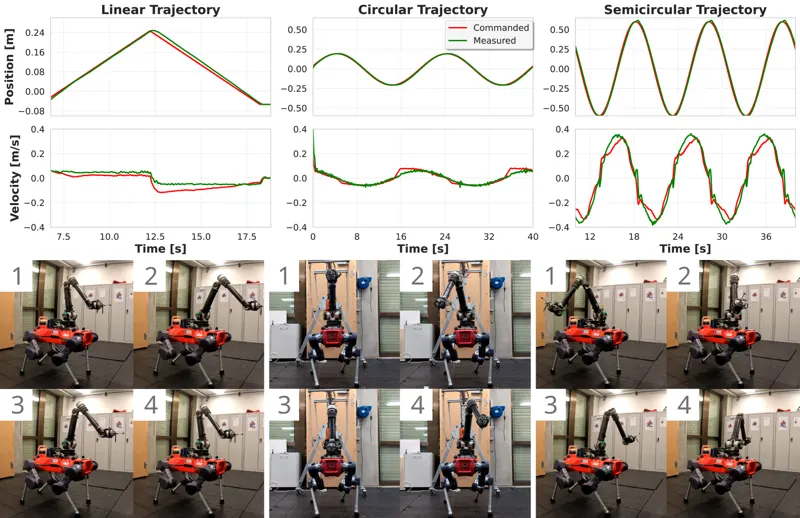
Learning whole-body control for locomotion and arm motions in a single policy has challenges, as the two tasks have conflicting goals. For instance, efficient locomotion typically favors a horizontal base orientation, while end-effector tracking may benefit from base tilting to extend reachability. Additionally, current Reinforcement Learning (RL) approaches using a pose-based task specification lack the ability to directly control the end-effector velocity, making smoothly executing trajectories very challenging. To address these limitations, we propose an RL-based framework that allows for dynamic, velocity-aware whole-body end-effector control. Our method introduces a multi-critic actor architecture that decouples the reward signals for locomotion and manipulation, simplifying reward tuning and allowing the policy to resolve task conflicts more effectively. Furthermore, we design a twist-based end-effector task formulation that can track both discrete poses and motion trajectories. We validate our approach through a set of simulation and hardware experiments using a quadruped robot equipped with a robotic arm. The resulting controller can simultaneously walk and move its end-effector and shows emergent whole-body behaviors, where the base assists the arm in extending the workspace, despite a lack of explicit formulations. Videos and supplementary material can be found at multi-critic-locomanipulation.github.io.

Reinforcement LearningWhole-Body Control
Aravind Elanjimattathil Vijayan, Andrei Cramariuc, Mattia Risiglione · 475 views · Jul 11, 2025

As an Amazon Associate, we earn from qualifying purchases.