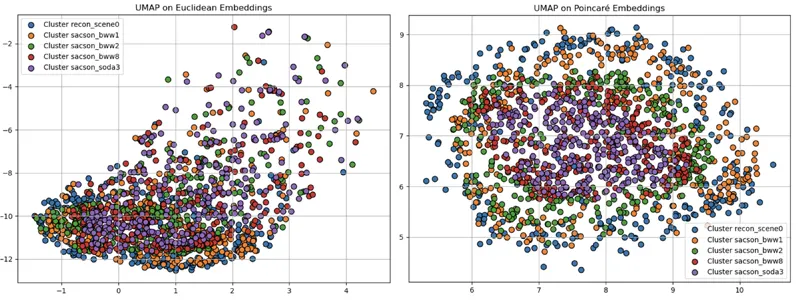
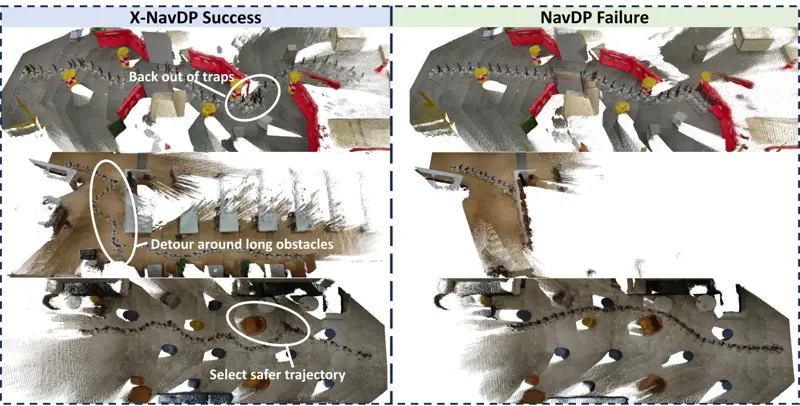
Continual learning in visual navigation remains challenging due to catastrophic forgetting and the difficulties associated with adapting to diverse and evolving environments. To address these issues, we propose Hyperbolic Dynamic Cluster Memory (HyperDCM), a structure-aware memory mechanism that enhances diffusion policy-based navigation through scene graph modeling and principled memory replay. HyperDCM extracts semantic scene triples from RGB observations using large vision-language models, encodes them into scene graph embeddings via a Relational Graph Convolutional Network (R-GCN), and projects the embeddings into hyperbolic space to enhance structural separability and retention in continual navigation. A dynamic clustering and structure-sensitive update strategy selects representative samples for memory replay, thereby preserving knowledge diversity and mitigating catastrophic forgetting. Experiments on multi-scene indoor and outdoor datasets demonstrate that HyperDCM achieves superior retention of past navigation capabilities and improved generalization compared to representative continual learning baselines adapted to diffusion policy navigation.
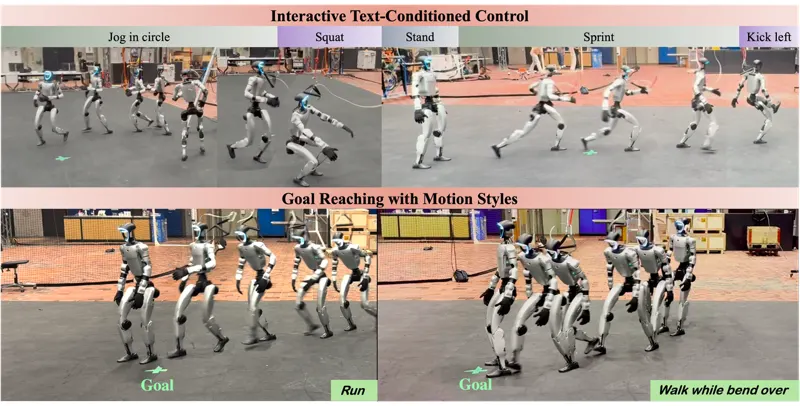
We present ADAPT, an end-to-end framework for interactive, text-conditioned humanoid whole-body control. Unlike dominant text-to-motion pipelines that generate kinematic motions for a separate tracker, ADAPT solves language control with an end-to-end closed-loop control framework, where the robot must continuously respond to changing commands while maintaining balance, natural motion, and smooth transitions. ADAPT learns a diffusion-based action prior from text-labeled humanoid state-action trajectories, enabling diverse motion skills to be directly executed from language commands. To improve long-horizon robustness and smooth prompt switching, we train a lightweight residual reinforcement learning policy on top of the frozen diffusion controller. We further show that the same diffusion policy can be reused as a steerable text-conditioned motion prior for downstream task adaptation. Experiments demonstrate robust language-grounded skill execution, smooth interactive transitions, and style-preserving downstream control.
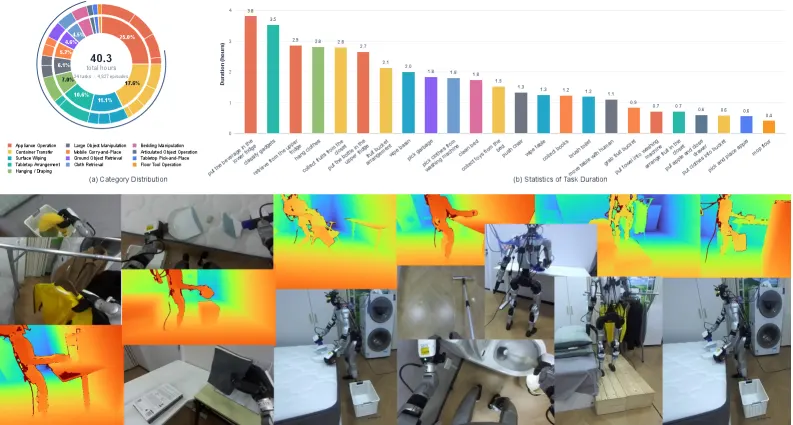
ω-0 is a latent predictive whole-body world-action model for real-world humanoid concurrent loco-manipulation: given a language instruction, visual observation, and proprioceptive state, it directly predicts controller-compatible whole-body action latents, coupling compact future-observation embedding prediction with diffusion-based action generation. A 40+ hour real-world dataset ω-HOME is collected; a single model outperforms IL, VLA, humanoid, and WAM baselines on 11 household tasks.
Action chunking—predicting and executing multiple actions instead of a single action—has proven to be a critical component for learning effective robotic control policies. However, our precise understanding of why action chunking improves performance has remained limited. In this work we seek to close this gap. Through rigorous experimental evaluations in both simulated and real-world settings, we show that existing hypotheses for the success of action chunking—temporal consistency, horizon reduction, and representation learning—fail to explain the success of action chunking. Instead, we find that action chunking benefits from greater non-Markovian expressivity and reduced compounding error compared to Markovian policies, but, in many settings of interest, these effects can be fully captured by delayed policies, which at each step predict a single action based on the observation k steps in the past. We then show that there exists an additional benefit of action chunking that we refer to as implicit ensembling. In particular, by learning a diversity of temporal relationships (that is, aₜ | oₜ, aₜ | o_t-1, …), action-chunked policies exhibit behavior matching that of a model ensemble, increasing their robustness and generalization ability over policies that only learn a single temporal relationship. Building on these insights, we show that in simulated and real-world robotic control settings, we can match the performance of action chunking without action chunking—by deploying an action chunking policy as an ensemble of policies with randomized delays. Furthermore, we propose a policy class that amplifies the benefits of action chunking by explicitly instantiating an ensemble, and which we show significantly improves over the performance of action chunking in many domains.
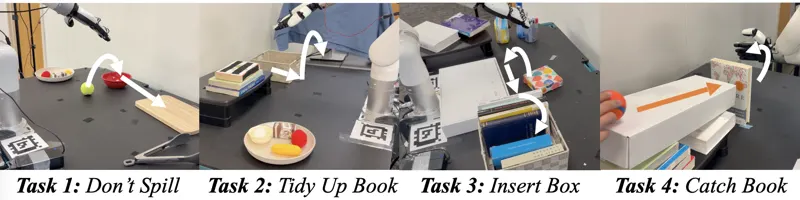
Generalist manipulation policies increasingly take the form of action-chunking flow policies built on large pretrained backbones. Such chunks run open-loop, so the policy cannot react to sensory input arriving mid-execution, sacrificing reactivity. Replanning more often would restore it, but the perception-to-action pipeline (a large backbone plus multiple denoising steps) is too slow: this latency forbids frequent replanning and leaves committed actions stale, making such policies ill-suited for dynamic, closed-loop control. We present πR², which makes these policies reactive and real-time while retaining large backbones, expressive multi-modal policies, and multi-action prediction. Built on the per-position noise schedule of diffusion forcing, πR² contributes two ideas. First, it splits conditioning into a fast channel (proprioception, fresh every tick) and an asynchronously updated slow channel (vision-language features), so the policy reacts to proprioception within a chunk while tolerating stale vision. Second, a latency-adaptive flow schedule treats in-flight actions as inpainting conditioning and emits actions in one denoising step per call, letting one trained model adapt to varying hardware latency. Requiring minimal modification to existing architectures, πR² can be finetuned from a pretrained policy: applied to GR00T-N1.7 on a real xArm6+XHand platform, it replans closed-loop roughly 4× faster than the base policy (~$25$Hz on an A5000 GPU), acting on a fresh observation every $40$ms. Across simulation and real-world manipulation tasks, πR² improves the success rate by up to 23% in simulation and 30% in the real world over the strongest baseline. Project page: https://pi-r2-flow.github.io/
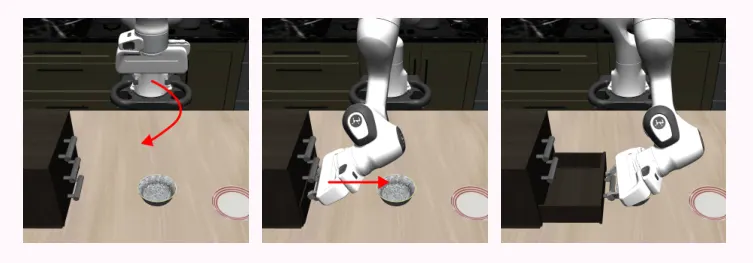
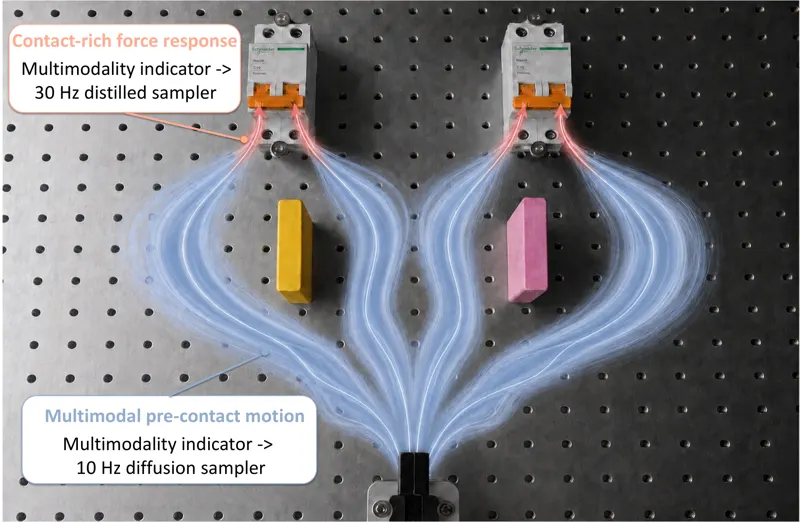
In contact-rich manipulation, action multimodality and reactivity dominate different stages of a single episode. Before contact, multiple trajectories might be equally valid, making it important to preserve diverse action modes. After contact, geometric constraints and force limits narrow the solution space, while successful execution demands rapid responses to force feedback. However, standard diffusion policies use a fixed inference frequency and sampling steps throughout the episode, forcing a fundamental compromise: low-frequency, multi-step sampling better preserves pre-contact multimodality but responds slowly to force feedback, whereas high-frequency sampling improves reactivity but tends to collapse distinct pre-contact modes. To resolve this tradeoff, we present FA-RDP, a frequency-adaptive reactive diffusion policy. A shared multi-frequency visual-force Transformer predicts action chunks at both low and high frequencies, while a learned multimodality indicator dynamically selects multi-step low-frequency sampling before contact and one-step high-frequency sampling as action ambiguity decreases. We further introduce Manifold Consistency Distillation (MCD), which reparameterizes the diffusion network to predict actions on the robot action manifold while retaining DDPM-based residual supervision. Experiments on three contact-rich manipulation tasks show that FA-RDP achieves the highest success rate while preserving diverse pre-contact trajectory modes. Code and videos are available at https://fa-rdp.github.io.
Proposes GQRM, a data-efficient diffusion RL post-training framework with self-bootstrapped exploration and group Q-score normalization for cross-embodiment visual navigation. Improves success rate from 61.20% to 84.28% in simulation and 10% to 65% in real-world hard cases.
Diffusion policies have shown strong potential for robotic imitation learning, and recent extensions incorporate additional modalities to improve manipulation performance. However, these modalities often differ not only in information content but also in sensing rates and inference latencies. Existing multimodal diffusion policies typically rely on synchronous fusion or manually designed multi-frequency architectures, which either slow down high-frequency feedback or limit extensibility to new modality combinations. We propose LAG-Fusion, a latency-aware guidance fusion framework for asynchronous multimodal diffusion policy composition. LAG-Fusion allows modality-specific policies to operate at their native inference rates and contribute denoising guidance whenever available. To make asynchronous composition consistent, we derive a reference-frame rebasing rule for diffusion variables under relative action representations, enabling delayed guidance to be aligned before fusion. We instantiate LAG-Fusion in contact-rich manipulation by composing a low-frequency vision policy with a high-frequency force policy. Experiments under heterogeneous modality latencies show that LAG-Fusion improves policy responsiveness and task performance over synchronous fusion and specially designed force-aware baselines.