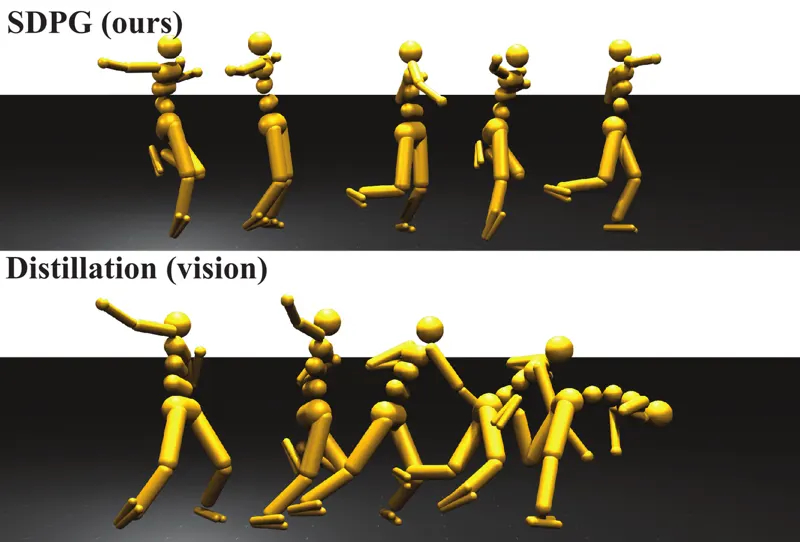
We present the stochastic decoupled policy gradient (SDPG), a lightweight visual reinforcement learning (RL) method that trains diverse visuomotor control policies end-to-end within a few hours on a single NVIDIA RTX 4080 GPU. SDPG estimates policy gradients via random perturbations of trajectory rollouts, requiring orders of magnitude fewer batch-rendered environments and substantially reducing compute and memory overhead. On visual MuJoCo benchmarks, SDPG consistently outperforms baseline methods in training time, memory usage, and rewards. Finally, to support future research, we introduce a suite of realistic visual robotics benchmarks spanning dexterous manipulation, challenging locomotion, and demonstrate effective sim-to-real transfer on physical hardware.
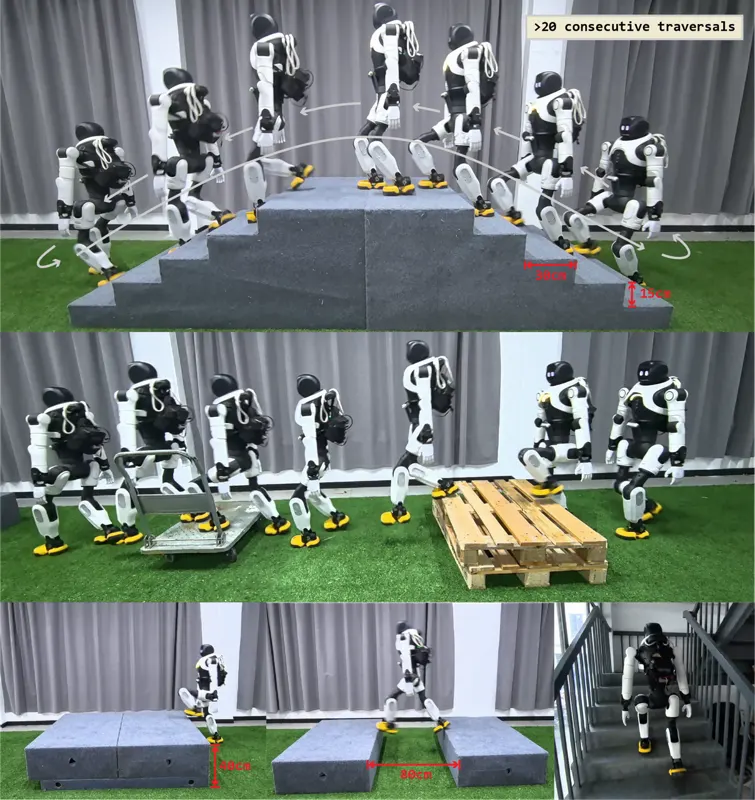
CReF is a single-stage depth-conditioned humanoid locomotion framework that maps onboard proprioception and forward-facing depth directly to joint position targets, without explicit geometric intermediates. It couples proprioception and depth tokens via proprioception-queried cross-modal attention, fuses them with a gated residual block, and integrates temporal context with a GRU regulated by a highway-style output gate. A terrain-aware foothold placement reward extracts supportable candidates from foot-end point-cloud windows and rewards touchdowns near them. Full CReF leads all terrain categories and difficulty levels in simulation and transfers zero-shot to a physical AGIBOT X2 Ultra across handrail stairs, hollow pallets, reflective interference, and cluttered outdoor scenes.
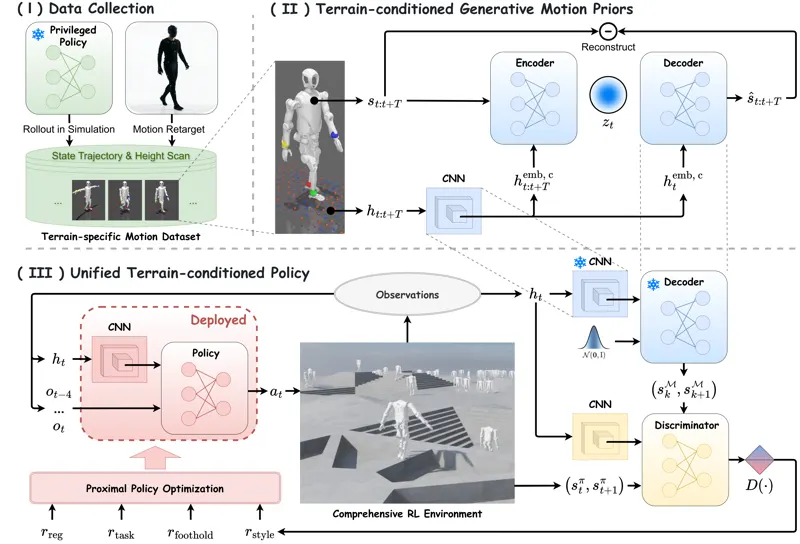
Achieving both anthropomorphic naturalness and robust terrain traversal remains a fundamental challenge in humanoid locomotion. Existing Reinforcement Learning (RL) approaches typically rely on fixed motion priors, limiting their adaptability to varying environments. We propose Terrain-conditioned Generative Motion Priors (T-GMP), a module that captures a terrain-conditioned latent motion manifold from a few expert state-terrain demonstrations using a Conditional Variational Autoencoder (CVAE). The learned priors enable smooth style transitions, facilitating a unified policy that adapts to terrain variations. We integrate T-GMP into an adversarial learning pipeline with our proposed Foothold Penalty, where a discriminator dynamically modulates naturalness constraints conditioned on local terrain features, guiding the generation of versatile and human-like motions. Experimental results demonstrate that our method outperforms existing baselines in traversal success rate and motion smoothness, while preserving biomimetically natural and physically coordinated motions.
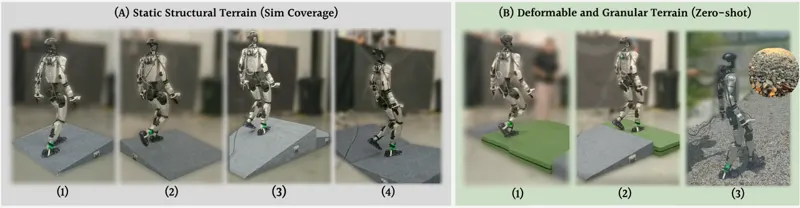
Humanoid robots are expected to traverse complex terrains, where the plantar support may vary dramatically due to foot placement errors, ground properties, and transient dynamics. To achieve robust locomotion, the robots are required to adapt to uneven terrain and uncertain foot–ground interactions. Existing locomotion policies rely primarily on proprioception or exteroceptive terrain perception, where the former provides only indirect evidence of plantar support, while the latter predicts contact conditions before touchdown but cannot observe the actual support in real-time. Although some studies incorporate plantar contacts as an auxiliary perception, they rely mainly on summary statistics, overlooking the spatial topology of plantar pressure, which provides a more direct characterization of the realized contact state. To bridge this gap, we present Tac4Loco, a tactile-perceptive framework that incorporates multi-array plantar pressure as direct feedback for humanoid locomotion. We formulate a topology-preserving ordinal representation to map simulated and physical sensor signals into a shared observation space, with a dual-branch encoder for extracting their spatial and temporal representations. Subsequently, the learned spatiotemporal features are integrated with augmented proprioception including terrain estimation cues, and provided to an asymmetric actor-critic architecture for policy learning. Extensive simulation and real-world experiments demonstrate improved tracking performance and support adaptation on terrains with inclined, partial, asymmetric, and changing support. We further demonstrate its zero-shot deployment on unseen compliant and unstructured terrains, including a foam platform and a gravel road. All code and experimental configurations will be released as open-source to facilitate reproducibility.
Humans exhibit remarkable motor agility, which highlights the great potential of humanoid robots for athletic locomotion. Long rope skipping requires two rope turners to cooperatively swing the rope while adapting to a player under different jumping rhythms. We propose Marope, a multi-agent reinforcement learning (MARL) framework for cooperative long rope skipping with multiple humanoid robots. It adopts a hierarchical RL framework: the lower level learns decentralized rope manipulation policies through MARL, while the upper level trains a centralized scheduling policy to coordinate execution. Diverse jumping policies are incorporated to improve generalization across player behavioral styles. Experiments on Unitree G1 robots in simulation and the real world show that Marope outperforms baselines.
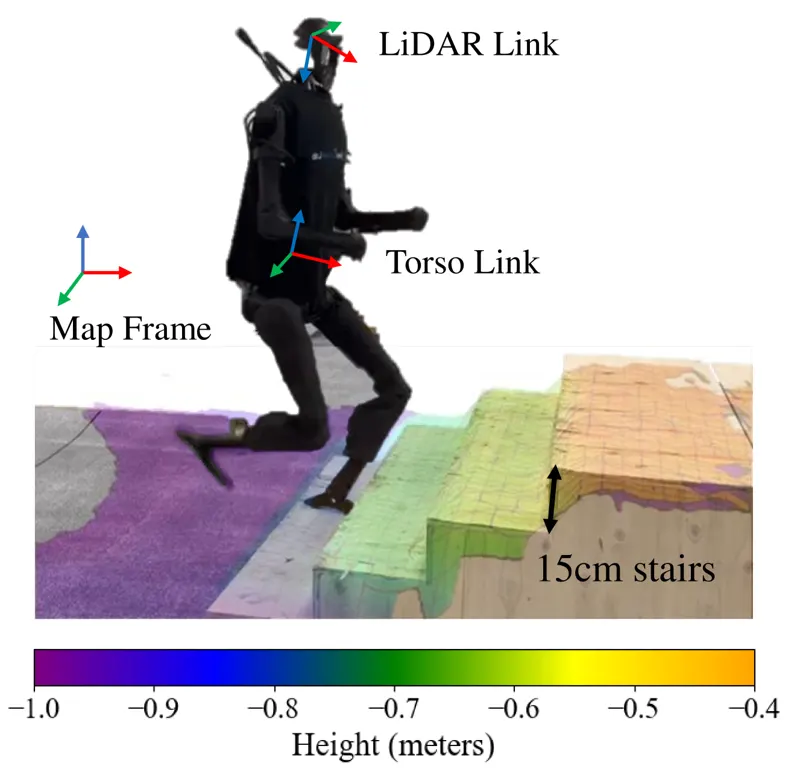
In contrast to quadruped robots that can navigate diverse terrains using a "blind" policy, humanoid robots require accurate perception for stable locomotion due to their high degrees of freedom and inherently unstable morphology. However, incorporating perceptual signals often introduces additional disturbances to the system, potentially reducing its robustness, generalizability, and efficiency. This paper presents the Perceptive Internal Model (PIM), which relies on onboard, continuously updated elevation maps centered around the robot to perceive its surroundings. We train the policy using ground-truth obstacle heights surrounding the robot in simulation, optimizing it based on the Hybrid Internal Model (HIM), and perform inference with heights sampled from the constructed elevation map. Unlike previous methods that directly encode depth maps or raw point clouds, our approach allows the robot to perceive the terrain beneath its feet clearly and is less affected by camera movement or noise. Furthermore, since depth map rendering is not required in simulation, our method introduces minimal additional computational costs and can train the policy in 3 hours on an RTX 4090 GPU. We verify the effectiveness of our method across various humanoid robots, various indoor and outdoor terrains, stairs, and various sensor configurations. Our method can enable a humanoid robot to continuously climb stairs and has the potential to serve as a foundational algorithm for the development of future humanoid control methods.
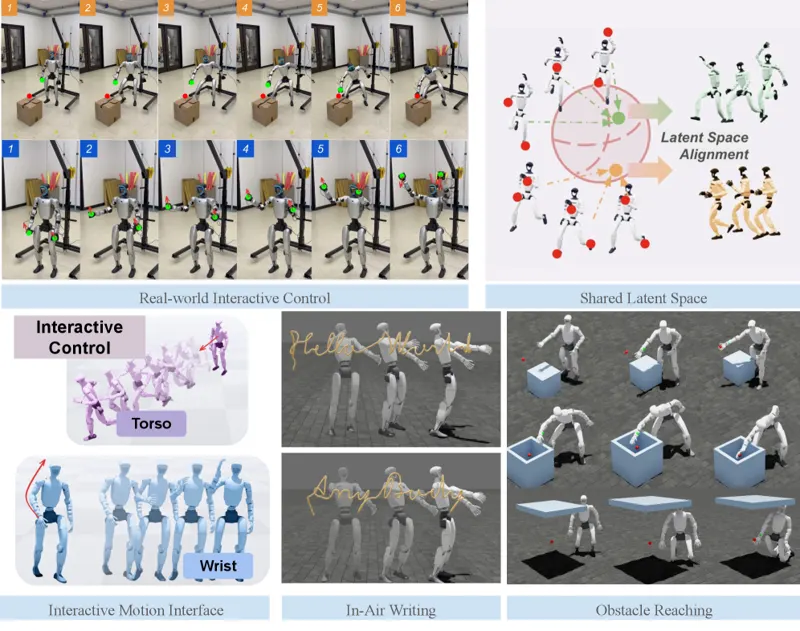
We present AnyBody, a unified whole-body humanoid controller driven by an arbitrary subset of body keypoints chosen at deploy time. Prior physics-based trackers either rely on expensive full-body motion capture and error-prone trajectory retargeting, which bottleneck scalable data collection and policy learning, or decompose upper- and lower-body control into separate hierarchical representations, sacrificing the coordinated whole-body motions that loco-manipulation requires. We close this gap by learning a single latent motion representation that any keypoint subset can address. To achieve this, we first train a privileged teacher tracker on a large unstructured motion corpus and distill it online into a deterministic encoder-decoder student whose latent space is a unit sphere. We then train a transformer keypoint encoder that admits any subset of body keypoints through masked self-attention, aligning it to the privileged latent. Additionally, we treat the frozen decoder as a motor prior and specialize downstream tasks with a lightweight residual corrector in the latent space. We demonstrate the effectiveness of AnyBody by tracking large-scale human motions from arbitrary keypoint subsets, free-form control, flexibly teleoperating, and learning downstream behaviors including locomotion, in-air writing, and obstacle-reach.
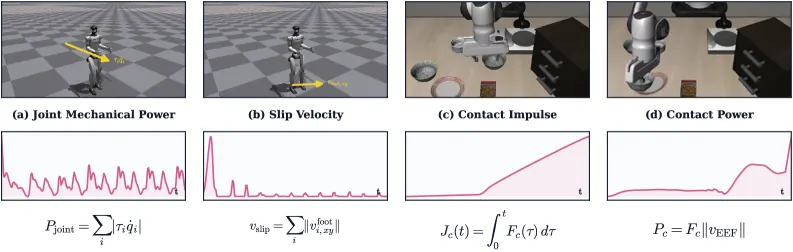
Robot policies are typically MLPs mapping observations to actions. Yet robot observations are physical variables, and many action-relevant cues arise not from individual variables but from their interactions; power, inertial effects, contact, slip, and compliance depend on products among observable signals. We introduce PRISM, a policy representation that makes polynomial interactions among observable physical variables explicit, learnable, and compact. Rather than listing all polynomial terms, PRISM uses a factorized polynomial module to expose higher-order interaction features efficiently. In reinforcement learning, it keeps the standard MLP backbone but applies a gradually activated element-wise polynomial function after it. In imitation learning, it replaces linear proprioceptive conditioning in Diffusion Policy with a polynomial layer trained end-to-end. Across humanoid locomotion and contact-rich manipulation, PRISM improves performance over standard MLP policies and larger MLPs with matched capacity, showing that interaction structure cannot be replaced by capacity alone. It also yields sensorless compliant behavior without force, wrench, tactile input, contact labels, or admittance control. These results suggest that polynomial representations should become a standard architectural choice for embodied motor control. The project page is available at https://lsh3163.github.io/prism/
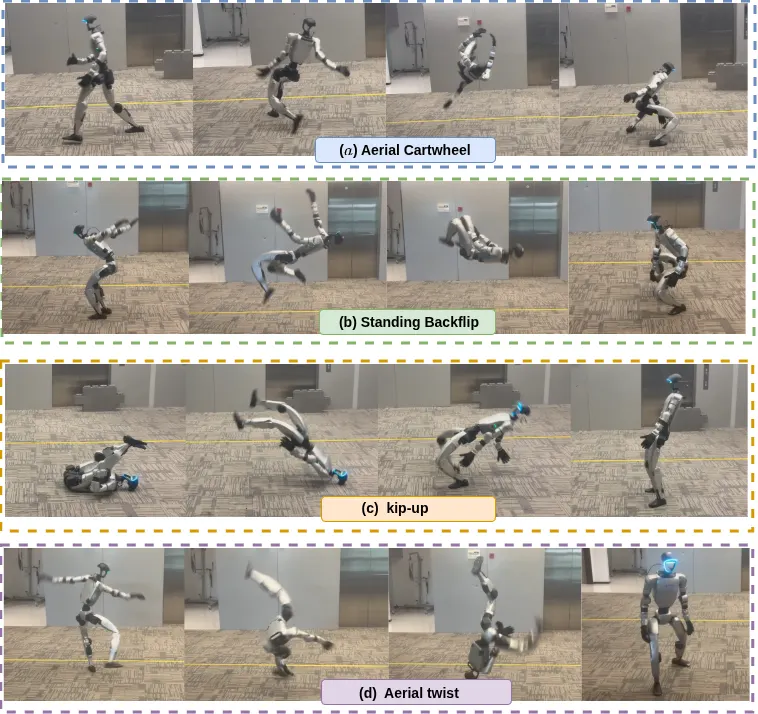
Humans can progressively acquire highly dynamic motor skills while preserving reliable everyday motor abilities. In contrast, existing humanoid controllers face a trade-off between generalist and specialist capabilities: generalist motion tracking policies struggle to reliably execute rare highly dynamic motions, whereas specialist training can degrade previously acquired behaviors. We introduce Extreme-RGMT, a two-stage continual learning framework for robust generalist humanoid control. The method first learns a generalist motion-tracking base policy from diverse multi-source motion data, then employs an asymmetric skill acquisition and capability consolidation mechanism to constrain policy drift on mastered motions while emphasizing difficult dynamic segments. To address the scarcity of highly dynamic motions, their high failure rates, and the resulting shortage of informative samples, Extreme-RGMT combines difficulty-aware sampling with advantage-prioritized trajectory resampling to emphasize critical segments. Experiments show that Extreme-RGMT achieves state-of-the-art generalist whole-body motion-tracking performance, including substantially improved completion of challenging highly dynamic motions. The resulting controller directly executes diverse unseen highly dynamic motions under fixed references and online inertial motion-capture inputs, advancing generalist whole-body motion-tracking controllers toward highly dynamic motor capabilities at the human-expert level.