Skip to content
PAPERJul 24, 2026

A Monolithic Hand with Asymmetric Origami Bending and Dual-chamber Actuators

The passive adaptability inherent in soft robotic hands affords them advantages in applications that require safe and compliant interaction. However, existing soft robotic hands often struggle to simultaneously achieve adequate output performance and easy manufacturing due to their complicated structures. In this paper, we introduce the asymmetric origami bending (AOB) pattern for generating bending motion and the asymmetric dual-chamber (ADC) design for obtaining multifunction capability. The AOB single (AOB-S) chamber and AOB dual-chamber (AOB-D) units are designed and constitute the finger and palm actuators of the proposed Origami-inspired SOft Robotic (OSOR) hand. The OSOR hand achieves bio-inspired fingers-palm motions and adequate output performance within a monolithic structure that significantly simplifies the manufacturing process. By defining the asymmetric ratio to characterize the geometric asymmetry of the unit, the analytical models of the AOB and ADC structures are proposed. The Finite Element Analysis tool for the design of AOB actuators is obtained by geometric analysis. The asymmetric origami design grants the integrated manufacturing of the OSOR hand through a Selective Laser Sintering printing process with a single thermoplastic polyurethane material. The model and simulations are validated by experimental results. Experiments show the finger and palm maximum bending motion range of 203° and 40°, respectively, with output forces of 6.3 N and 16 N. The OSOR hand is capable of pinching a piece of tissue, stably grasping water bottles with two fingers, palm-only grasping, and completing the power grasps in the taxonomy of manufacturing grasps. The compactness, performance, and easy manufacturing of the proposed hand benefit the development of the soft robotic hand with new possibilities.

Nan Huang, Yuming Zhu, Zicong Zhang

ManipulationDexterous Manipulation
PAPERJul 24, 2026

Visual Relocalization from Sparse Views in Aliased and Low-Texture Environments via Novel View Synthesis

Visual localization becomes extremely challenging in planetary-like terrains characterized by low texture, perceptual aliasing, harsh illumination, and sparse, weakly overlapping viewpoints induced by forward rover motion and unconstrained driving directions. Under these conditions, state-of-the-art image-to-image and image-to-map matching pipelines suffer significant performance degradation. In this work, we propose a visual relocalization method that departs from classical correspondence-based pipelines by directly estimating camera poses against a differentiable map representation built with 3D Gaussian Splatting (3DGS). Our key contribution is a geometry-aware training strategy that combines photometric and geometric losses, where the geometric supervision is provided for the first time by combining multi-view stereo (MVS) and LiDAR depths. We show that this joint optimization produces a 3DGS model that better fits the underlying scene geometry, leading to improved photometric and geometric consistency and more robust, accurate single-image 6-DoF pose estimation. Extensive experiments on data acquired in planetary-analog environments validate the effectiveness of our approach, showing substantial gains in relocalization accuracy under challenging conditions. Code is available at https://github.com/DLR-RM/multimodal-gsplat-relocalization.

Maria Peribañez, Javier Civera, Rudolph Triebel

3D Gaussian Splatting
PAPERJul 24, 2026

One Hand Watches The Other: Dynamic Multi-Agent Cooperation for Sample-Efficient Bimanual Manipulation in Dynamic Environments

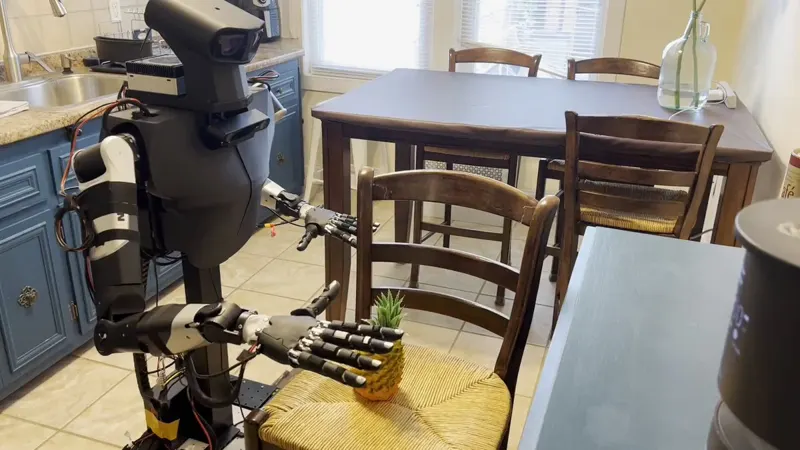
Multi-stream robot manipulation policies achieve unparalleled sample efficiency and generalization by modeling actions relative to environmental reference frames. However, existing approaches typically assume these frames to be strictly exogenous. This causal assumption collapses in dynamic settings, such as when a single robot arm manipulates a moving object or when two arms coordinate, where each arm effectively becomes part of the dynamic environment of the other. We propose DynaMAC, a lightweight, policy-agnostic framework that resolves this causal limitation while preserving the sample efficiency, computational speed, and flexibility of multi-stream policies, DynaMAC treats the opposite arm as a dynamic task parameter, thereby providing a unified formulation for dynamic manipulation and bimanual coordination without requiring an explicit leader-follower relationship. To rigorously evaluate these capabilities, we introduce DynaBench, a novel benchmark for robot manipulation in dynamic environments. Across both dynamic environments and bimanual manipulation tasks, DynaMAC outperforms leading probabilistic and generative baselines by over 35 percentage points while requiring 20 times fewer samples. Crucially, DynaMAC generalizes zero-shot from static demonstrations to dynamic environments, substantially simplifying data collection and establishing an elegant bridge toward human-robot collaboration.

Jan Ole von Hartz, Abhinav Valada, Joschka Boedecker

ManipulationDexterous Manipulation
PAPERJul 23, 2026

GS-Agent: Creating 4D Physical Worlds With Generative Simulation

Creating dynamic and physically realistic 4D worlds from natural language descriptions is both fascinating and challenging. Traditional computer graphics methods rely on manual creation, requiring extensive human effort to fine-tune materials, motions, and visual fidelity. Recent advances in generative foundation models have sparked interest in learning to generate such 4D worlds from large-scale data; however, existing methods still struggle to ensure physical plausibility and controllability. In this work, we take a different path by leveraging foundation models to construct an agentic system that emulates how humans traditionally create 4D worlds, yet automates the entire process. We present GS-Agent, an end-to-end multi-agent framework that integrates physics engines in the loop to generate realistic, dynamic, and controllable 4D physical worlds from natural language. Inspired by how humans build 4D worlds, GS-Agent decomposes the task into entity management, covering 3D asset curation, material tuning, placement, and motion control, and rendering configuration, including camera and lighting manipulation. Multiple agents with distinct expertise interact with the physics engine via code, seek multimodal feedback, and collaborate to iteratively construct 4D worlds that align with the given descriptions. Experimental results show that GS-Agent effectively converts natural language into diverse and physically plausible 4D worlds exhibiting rich interactions among liquids, deformable objects, and rigid bodies, while achieving cinematic camera and lighting control. We envision GS-Agent as a foundation for a new paradigm in 4D world generation, empowering creative content creation and physical AI. Project page at https://umass-embodied-agi.github.io/gs-agent/

Hongxin Zhang, Chunru Lin, Junyan Li

3D Gaussian Splatting4D GenerationWorld ModelsPhysics simulation
PAPERJul 23, 2026

GrainGS: Gradient-Decoupled Gaussian Splatting for Efficient Dynamic Novel View Synthesis

Dynamic scene reconstruction with 3D Gaussian Splatting requires a balance between fine-grained motion modeling, structural stability, and compact representation. Existing per-primitive methods provide flexible local deformation but often suffer from redundant primitive growth, while anchor-based methods improve spatial regularity at the cost of suppressing locally varying motion. To address these issues, we present GrainGS, a dynamic Gaussian framework that combines a hierarchical anchor scaffold with per-Gaussian deformation. A static warm-up stage first establishes a time-invariant canonical representation from observations across all timestamps. During joint training, a stop-gradient operation blocks the deformation-mediated gradient pathway to the canonical positions while preserving their direct refinement through the reconstruction objective. Each Gaussian then predicts independent temporal offsets for position, rotation, and scale, enabling detailed local motion within a structurally constrained scaffold. A canonical-residual appearance decomposition further models frame-dependent photometric changes without forcing them into geometric deformation. Experiments on synthetic monocular and real-world multiview benchmarks show that GrainGS achieves high reconstruction quality, real-time novel view synthesis, and compact storage. Under the synthetic benchmark setting, it reaches an average peak signal-to-noise ratio of 36.98 decibels, renders at 435.6 frames per second, and requires 4.67 megabytes of storage.

Jiahao He, Yihua Shao, Zhengkai Zhao

3D Gaussian SplattingDynamic SceneNovel view synthesisGradient Decoupling
PAPERJul 23, 2026

GLAM-SLAM: Real-time Gaussian Large-scale Mapping via Flow Densification and Spatial Decomposition

Existing Gaussian-splatting-based monocular Simultaneous Localization and Mapping (SLAM) systems are either tailored to short sequences, are not real-time, or suffer from prohibitive GPU memory requirements, limiting their applicability in realistic, long-horizon scenarios. To address this, we present GLAM-SLAM, a real-time, decoupled Gaussian-splatting SLAM system designed for large-scale outdoor scenes. We ensure lightweight tracking using a robust, feature-based SLAM frontend, while for mapping, we adopt a structured, sparse anchor grid representation that ensures scalable operation and maintains scene coherence across long-term sequences. To satisfy the dense initialization requirements of 3D Gaussian Splatting (3DGS), we introduce a geometry-based flow-densification anchoring strategy using epipolar constraints. Furthermore, by treating mapping as a multi-scene problem, we propose a scene-partitioning strategy that introduces a strong spatial inductive bias via MLP initializations to generate localized Gaussians. We evaluate our system on the challenging, long-sequence KITTI Odometry, Oxford RobotCar, and M'alaga datasets. Extensive ablations and comparisons demonstrate a 15% improvement in reconstruction quality over the second-best performer, while maintaining real-time performance and the ability to scale to longer sequences. Code is publicly available for the benefit of the community.

Panagiotis Mermigkas, Argyris Manetas, Petros Maragos

3D Gaussian SplattingSLAMReal-TimeLarge Scale

As an Amazon Associate, we earn from qualifying purchases.