PAPER DEEP DIVE
One Hand Watches The Other: Dynamic Multi-Agent Cooperation for Sample-Efficient Bimanual Manipulation in Dynamic Environments
Multi-stream robot manipulation policies achieve unparalleled sample efficiency and generalization by modeling actions relative to environmental reference frames. However, existing approaches typically assume these frames to be strictly exogenous. This causal assumption collapses in dynamic settings, such as when a single robot arm manipulates a moving object or when two arms coordinate, where each arm effectively becomes part of the dynamic environment of the other. We propose DynaMAC, a lightweight, policy-agnostic framework that resolves this causal limitation while preserving the sample efficiency, computational speed, and flexibility of multi-stream policies, DynaMAC treats the opposite arm as a dynamic task parameter, thereby providing a unified formulation for dynamic manipulation and bimanual coordination without requiring an explicit leader-follower relationship. To rigorously evaluate these capabilities, we introduce DynaBench, a novel benchmark for robot manipulation in dynamic environments. Across both dynamic environments and bimanual manipulation tasks, DynaMAC outperforms leading probabilistic and generative baselines by over 35 percentage points while requiring 20 times fewer samples. Crucially, DynaMAC generalizes zero-shot from static demonstrations to dynamic environments, substantially simplifying data collection and establishing an elegant bridge toward human-robot collaboration.
DynaMAC: Dynamic Multi-Agent Cooperation for Sample-Efficient Bimanual Manipulation in Dynamic Environments
Institution: University of Freiburg | arXiv: 2607.22119v1
One-Sentence Summary
DynaMAC is a lightweight, policy-agnostic framework that resolves the causal limitation of multi-stream policies in dynamic environments by treating the opposite arm as a dynamic task parameter, unifying dynamic manipulation and bimanual coordination, outperforming baselines by 35+ percentage points with 20× fewer samples.
Background and Motivation
Multi-stream robot manipulation policies achieve high sample efficiency by modeling actions relative to environmental reference frames. However, they assume these frames are strictly exogenous — unaffected by robot actions. This causal assumption collapses in dynamic settings: when a robot manipulates a moving object or two arms coordinate, each arm becomes part of the other's dynamic environment.
Existing bimanual approaches: (1) Monolithic policies increase action space, reducing sample efficiency; (2) Leader-follower requires pre-defined leaders, can't adapt to role changes; (3) Hierarchical methods need separate coordination modules. DynaMAC requires no explicit leader or coordination module — coordination is learned from demonstration with dynamically changing roles.
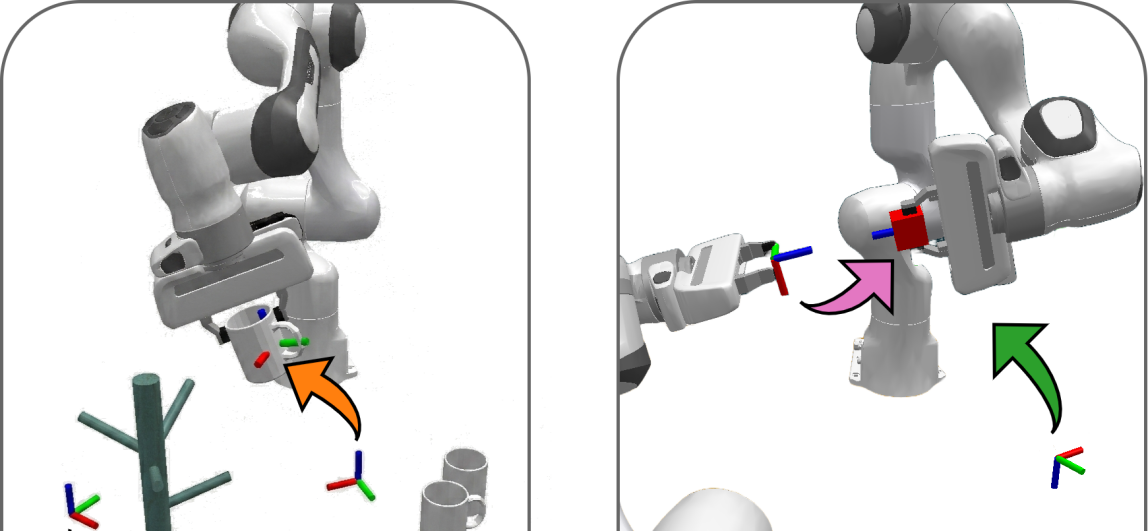
Figure 1: DynaMAC unifies bimanual manipulation as dynamic multi-agent cooperation.
Multi-Stream Policy Learning
Imitation learning seeks policy $p(\boldsymbol{a} | \boldsymbol{o})$. Multi-stream policies decompose into object-centric frames, learning local models $p(\boldsymbol{\xi}_{\text{ee}} | f)$ fused via product-of-experts:
$$p(\boldsymbol{\xi}_{\text{ee}}) = \frac{\prod_{f=1}^{F} p(\boldsymbol{\xi}_{\text{ee}} | f)}{\int \prod_{f=1}^{F} p(\boldsymbol{\xi}_{\text{ee}} | f) d\boldsymbol{\xi}_{\text{ee}}}$$Local pose in frame $f$ at time $t$:
$$\boldsymbol{\xi}_{\text{ee},t}^{(f)} = \begin{bmatrix} \boldsymbol{q}_{f,t}^{-1}(\boldsymbol{x}_{\text{ee},t} - \boldsymbol{x}_{f,t}) \boldsymbol{q}_{f,t} & \boldsymbol{q}_{f,t}^{-1} \boldsymbol{q}_{\text{ee},t} \end{bmatrix}^T$$Precision-weighted fusion:
$$p(\boldsymbol{\xi}_{\text{ee}}) \propto \prod_{f=1}^{F} \mathcal{N}(\boldsymbol{\xi}_{\text{ee}}; \boldsymbol{\mu}_f, \boldsymbol{\Sigma}_f)$$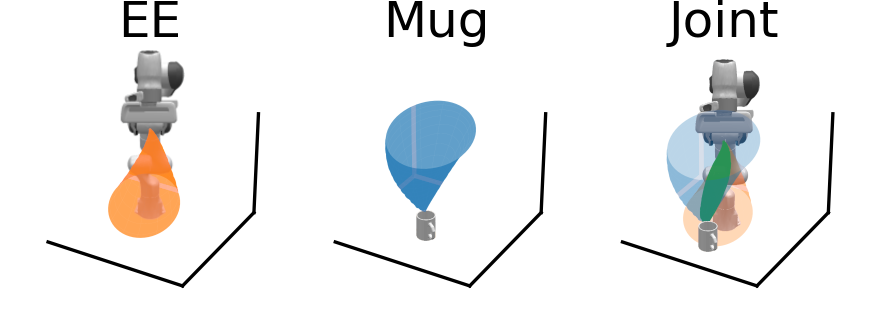
Figure 2: Multi-stream policy — local models fused in shared world frame.
Core Problem: Causal Assumption Collapse
Each stream $p(\boldsymbol{\xi}_{\text{ee}} | f)$ treats frame $f$ as exogenous ($f \rightarrow \boldsymbol{\xi}_{\text{ee}}$). After grasping, causal direction reverses ($\boldsymbol{\xi}_{\text{ee}} \rightarrow f$). The conditional density variance approaches zero, causing that stream to dominate and policy collapse. DynaMAC dynamically filters kinematically linked frames:
$$\text{link}(f, t) = \begin{cases} \text{True} & \text{if } \det(\boldsymbol{\Sigma}_f^{-1}(t)) > \tau \\ \text{False} & \text{otherwise} \end{cases}$$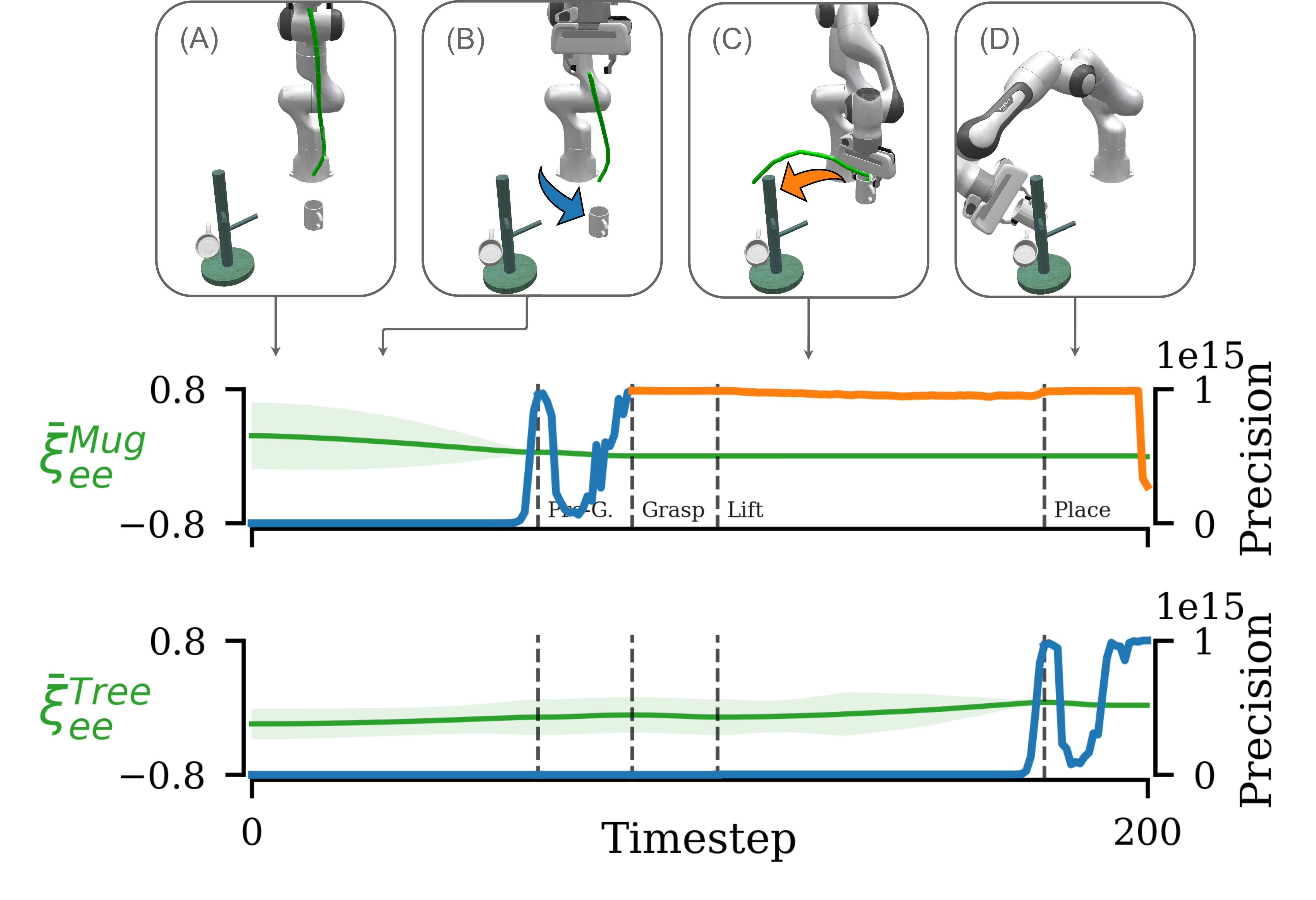
Figure 3: Kinematic link detection — precision surges when grasped, indicating causal reversal.
DynaMAC Algorithm (4 Steps)
- Skill segmentation: TAPAS segments long-horizon demonstrations
- Kinematic link detection: Stream precision identifies linked frames
- Virtual EE frames: Supplement at skill boundaries to compensate removed frames
- Task parameter selection: TAPAS selects relevant parameters per skill
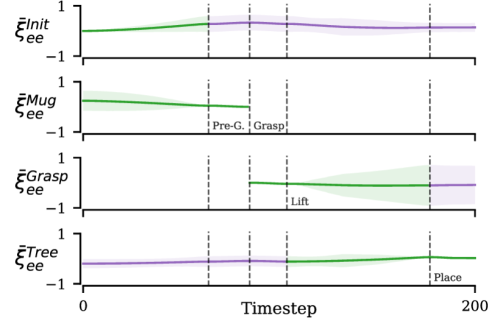
Figure 4: Virtual EE frames supplement dynamic object frames — mug masked after grasping, virtual Grasp frame created.
Bimanual as Multi-Agent Cooperation
Each arm operates independently; the opposite arm is a dynamic task parameter:
$$C_{\text{right}} = \{\boldsymbol{\xi}_f\}_{f=1}^{F} \cup \{\boldsymbol{\xi}_{\text{left}}\}, \quad C_{\text{left}} = \{\boldsymbol{\xi}_f\}_{f=1}^{F} \cup \{\boldsymbol{\xi}_{\text{right}}\}$$Stream $p(\boldsymbol{\xi}_{\text{right}} | \boldsymbol{\xi}_{\text{left}})$ models left arm's influence on right. Temporary leader roles emerge naturally from task-parameter selection.
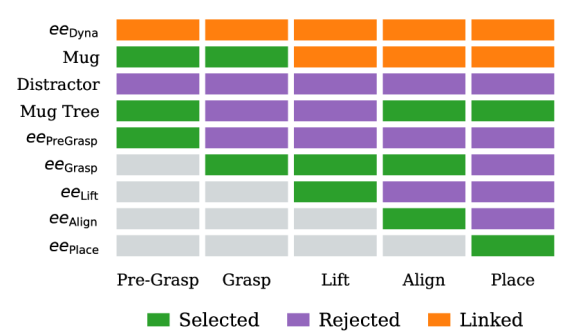
Figure 5: PlaceCups frame selection — mug frame used initially, ignored after kinematic linking.
graph TD
    A["Multi-Stream Policy
Object-centric decomposition"] --> B["Causal Assumption
f→EE vs EE→f"]
    B --> C["DynaMAC: Link Detection
Dynamically filter linked frames"]
    C --> D["Virtual Frame Supplement
Create EE frames at boundaries"]
    D --> E["Task Parameter Selection
TAPAS selects relevant frames"]
    E --> F["Dynamic Env Manipulation
Zero-shot generalization"]
    E --> G["Bimanual Coordination
Opposite arm = dynamic parameter"]
    G --> H["No Leader Required
Roles emerge dynamically"]
    F --> I["DynaBench Evaluation
Dynamic env benchmark"]
    H --> I
DynaBench
Built on RLBench with dynamic task augmentation (object poses vary at inference). Maximizes task instance variability — poses randomized per instance to prevent memorization.
Results
| Method | Static | Zero-Shot Dynamic | Zero-Shot Teleport | Avg |
|---|---|---|---|---|
| Diffusion Policy (100 demos) | 0.58 | 0.59 | 0.59 | 0.59 |
| TAPAS-GMM (5 demos) | 0.49 | 0.16 | 0.16 | 0.27 |
| MiDiGaP (5 demos) | 0.99 | 0.00 | 0.00 | 0.32 |
| DynaMAC (5 demos) | 1.00 | 0.94 | 0.94 | 0.96 |
Bimanual Dynamic Coordination
| Method | Static Bimanual | Dynamic Env | Arm Perturbation | Notes |
|---|---|---|---|---|
| Diffusion Policy | Medium | Modest drop | Complete failure | Cannot re-coordinate |
| MiDiGaP | Strong | Fails | Fails | Static-frame limitation |
| DynaMAC | Strong | Robust | Robust | Dynamic re-coordination |
Table 2: Bimanual dynamic coordination — DynaMAC robust under both environment dynamics and arm perturbations.
Real World
Validated on bimanual Franka Emika with RealSense D405. 5 demos/task, 25 episodes/scenario. DynaMAC matches MiDiGaP in static, generalizes to dynamic variants, excels in free-space handover. Human-robot collaboration: modified HandOver with opposite arm pose withheld — DynaMAC still collaborates effectively using tracked object.
Figure 6: Real-world bimanual Franka — object storage, handover, joint lifting, asymmetric coordination.
Limitations
- Remaining failures mainly from perception errors, especially faulty depth measurements
- Kinematic link detection depends on precision threshold $\tau$, requiring tuning
- Human-robot collaboration validation is preliminary
- DynaBench's dynamic models are simple (linear motion); complex dynamics need integration
Conclusion and Outlook
DynaMAC resolves the causal limitation of multi-stream policies in dynamic environments by treating the opposite arm as a dynamic task parameter, unifying dynamic manipulation and bimanual coordination. The four-step algorithm (segmentation → link detection → virtual frames → parameter selection) is lightweight and policy-agnostic. DynaBench establishes a rigorous benchmark. Experiments show DynaMAC outperforms baselines by 35+ points with 20× fewer samples, with zero-shot generalization from static demonstrations to dynamic environments, bridging toward human-robot collaboration.
Key Insight: When a robot grasps an object, causal direction reverses — the object no longer guides the robot but is guided by it. DynaMAC resolves this causal dilemma by dynamically filtering kinematically linked frames.
SOURCE LINKS