PAPER DEEP DIVE
GLAM-SLAM: Real-time Gaussian Large-scale Mapping via Flow Densification and Spatial Decomposition
Existing Gaussian-splatting-based monocular Simultaneous Localization and Mapping (SLAM) systems are either tailored to short sequences, are not real-time, or suffer from prohibitive GPU memory requirements, limiting their applicability in realistic, long-horizon scenarios. To address this, we present GLAM-SLAM, a real-time, decoupled Gaussian-splatting SLAM system designed for large-scale outdoor scenes. We ensure lightweight tracking using a robust, feature-based SLAM frontend, while for mapping, we adopt a structured, sparse anchor grid representation that ensures scalable operation and maintains scene coherence across long-term sequences. To satisfy the dense initialization requirements of 3D Gaussian Splatting (3DGS), we introduce a geometry-based flow-densification anchoring strategy using epipolar constraints. Furthermore, by treating mapping as a multi-scene problem, we propose a scene-partitioning strategy that introduces a strong spatial inductive bias via MLP initializations to generate localized Gaussians. We evaluate our system on the challenging, long-sequence KITTI Odometry, Oxford RobotCar, and M'alaga datasets. Extensive ablations and comparisons demonstrate a 15% improvement in reconstruction quality over the second-best performer, while maintaining real-time performance and the ability to scale to longer sequences. Code is publicly available for the benefit of the community.
1. Paper Overview
This paper from HERON Hellenic Robotics Center of Excellence, Athena Research Center, and National Technical University of Athens presents GLAM-SLAM — a real-time, decoupled Gaussian Splatting SLAM system designed for large-scale outdoor scenes. Existing 3DGS-based monocular SLAM systems face three dilemmas: tailored only for short sequences, not real-time, or prohibitive GPU memory requirements. GLAM-SLAM addresses these through three core innovations.

The system is evaluated on three challenging long-sequence datasets: KITTI Odometry, Oxford RobotCar, and Málaga, achieving a 15% improvement in reconstruction quality over the second-best performer while maintaining real-time performance and long-sequence scalability. Code is open-sourced on GitHub.
2. Problem Background and Motivation
Visual SLAM has evolved from sparse feature representations, through semi-dense point clouds, to NeRF and 3DGS SLAM, with map quality continuously improving. However, effectively scaling 3DGS for photorealistic reconstruction in long-duration sequences remains significantly underexplored.
The core tension lies in the trade-off between sparse and dense methods:
- Sparse methods (e.g., ORB-SLAM2) excel in trajectory accuracy and long-term stability, but their maps are unusable for interaction tasks.
- Dense methods (e.g., 3DGS SLAM) offer unparalleled scene representational capacity, but at high operational cost — significant memory and GPU computation demands, vulnerability in dynamic environments, and sensitivity to overexposure and motion blur.
When applying classic 3DGS to long-sequence sparse feature SLAM, two inherent limitations exist:
- Geometric density mismatch: Insufficient landmark density in sparse tracking, while 3DGS traditionally relies on dense initial point clouds for faster, stable Gaussian optimization.
- Prohibitive memory footprint: Conventional 3DGS memory footprint restricts reconstruction to single isolated environments.
3. GLAM-SLAM Method in Detail
3.1 System Architecture
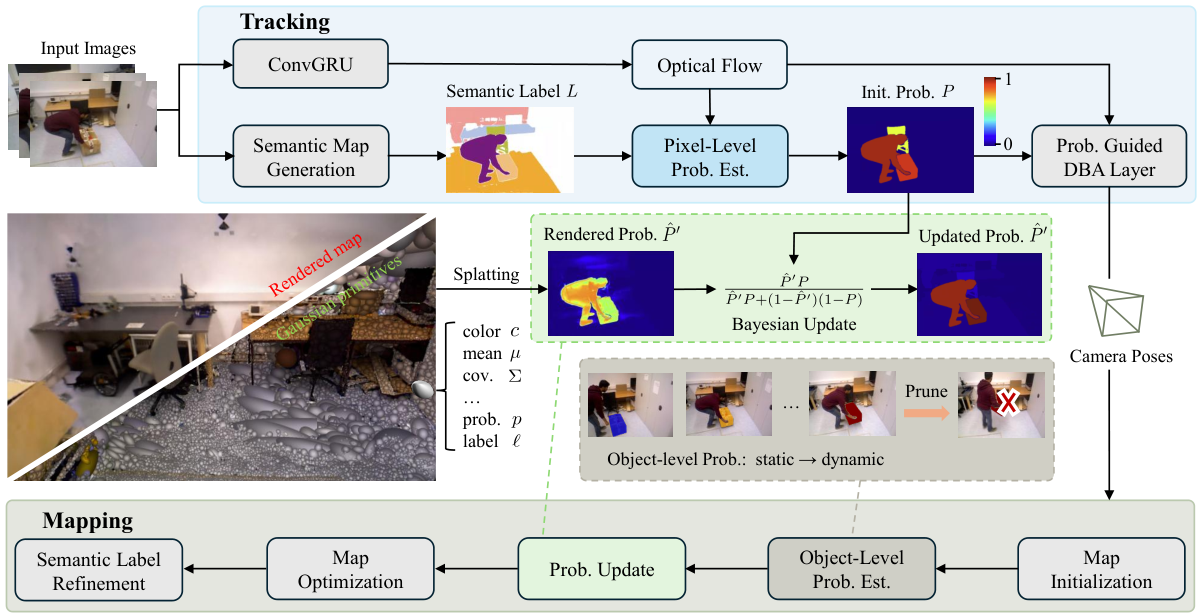
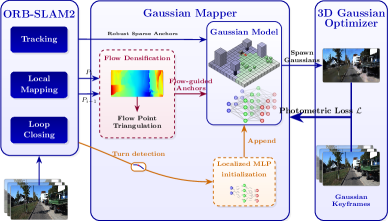
GLAM-SLAM adopts a decoupled architecture: an ORB-SLAM2-based feature tracking frontend ensures real-time localization, while a 3DGS reconstruction module concurrently builds a photorealistic map on a dedicated GPU.
graph LR
    A["Monocular image stream"] --> B["ORB-SLAM2 frontend
Feature tracking+localization"]
    B --> C["Keyframes+sparse map"]
    C --> D["Flow densification module
Optical flow+epipolar constraints"]
    D --> E["Anchor initialization"]
    E --> F["Localized MLP
Scene partitioning"]
    F --> G["3DGS reconstruction
Photorealistic map"]
    B --> H["Loop closure detection"]
    H --> G
3.2 Flow-Guided Densification
To address the geometric density mismatch between sparse tracking and dense 3DGS initialization, the paper proposes a Flow-Guided Densification Module. This module leverages optical flow to recover epipolar-consistent correspondences, providing geometric priors for 3DGS.
Optical flow estimation uses the LiteFlowNet3 ultra-lightweight network at a fixed step size of 7 keyframes. For keyframe pair $(I_1, I_2)$, the flow field $\mathbf{F}$ maps pixel $\mathbf{p}_1$ in $I_1$ to its correspondence in $I_2$:
$$\mathbf{p}_2 = \mathbf{p}_1 + \mathbf{F}(\mathbf{p}_1)$$
Correspondence quality is verified using epipolar constraints — for correct correspondences, point $\mathbf{p}_2$ should lie on the epipolar line defined by the fundamental matrix $F$:
$$\mathbf{p}_2^T F \mathbf{p}_1 = 0$$
Correspondences satisfying the epipolar constraint are triangulated to generate new 3D anchors, filling sparsely tracked regions. The anchor voxel size is set to 0.001; larger sizes cause multiple initialization points to collapse into a single anchor.
3.3 Localized MLP Initialization and Scene Partitioning
Traditional Scaffold-GS uses a global MLP to estimate Gaussian parameters, struggling with environmental and illumination variability in long sequences. GLAM-SLAM treats long-sequence reconstruction as a multi-scene challenge, proposing a spatial conditioning strategy: partitioning the environment and assigning localized MLP sets to each region.
For an anchor $\mathbf{a}_i$ in region $r$, Gaussian parameters are generated by that region's local MLP:
$$\Theta_i = \text{MLP}_r(\mathbf{f}_i, \mathbf{c}_i)$$
where $\mathbf{f}_i$ is the anchor descriptor feature and $\mathbf{c}_i$ is the position encoding. This localized design enables each region's MLP to specialize in local lighting and geometric characteristics.
3.4 Training Strategy
During each Gaussian model training iteration, samples are drawn from the most recent $k = 25$ keyframes with a high uniform probability of 0.7, and from older keyframes with 0.3 probability to mitigate forgetting:
$$P(\text{frame}) = \begin{cases} 0.7 / k & \text{if recent} \\ 0.3 / (N - k) & \text{if older} \end{cases}$$
This sampling strategy maintains recent scene quality while preventing quality degradation in older regions. The overall objective minimizes reconstruction error:
$$\mathcal{L} = \sum_{i \in \mathcal{B}} \lambda_i \, \mathcal{L}_{\text{render}}(I_i, \hat{I}_i)$$
where $\mathcal{B}$ is the sampled keyframe batch, $\lambda_i$ is the weight for frame $i$ (higher for recent frames), and $\mathcal{L}_{\text{render}}$ is the photometric rendering loss.
4. Experimental Results
4.1 Photometric Reconstruction Quality
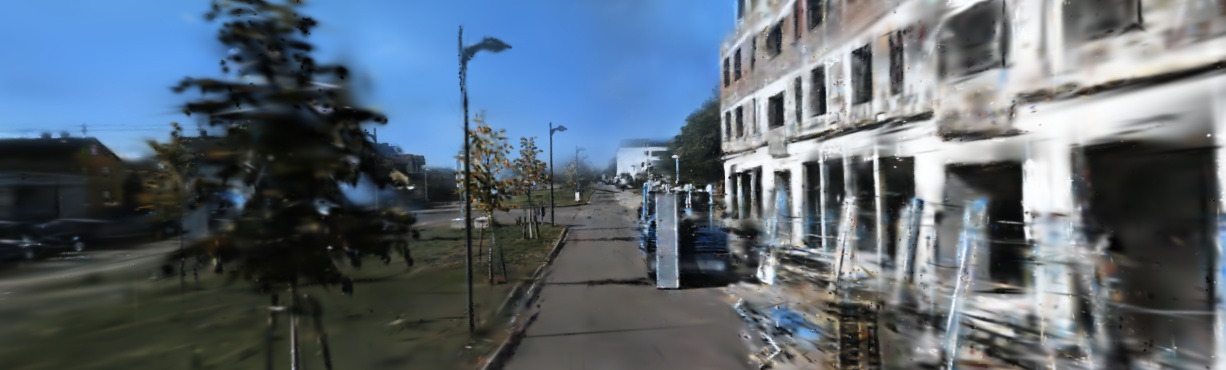
On 11 KITTI Odometry sequences, compared to the second-best GigaSLAM (pre-opt), GLAM-SLAM's average improvements are: PSNR +11.6%, SSIM +9.2%, LPIPS +28.0%.
| Method | KITTI PSNR ↑ | Oxford PSNR ↑ | Málaga PSNR ↑ | Real-time |
|---|---|---|---|---|
| PhotoSLAM | 12.97 | 19.50 | — | ✅ 10 FPS |
| GigaSLAM (pre-opt) | 15.63 | 19.97 | — | ❌ 3 FPS |
| MonoGS | 8.12 | 16.62 | — | ❌ Failed |
| GLAM-SLAM | 19.80 | 23.11 | — | ✅ 10 FPS |
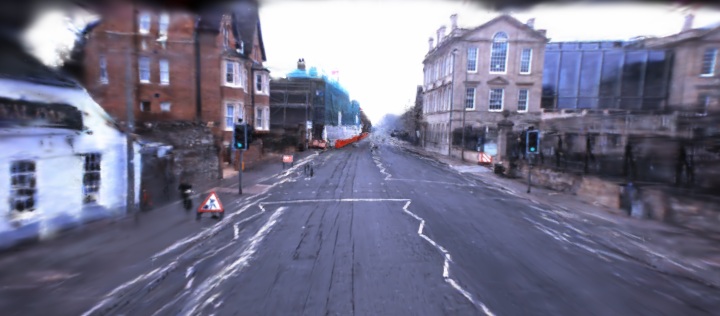
On Oxford RobotCar, improvements over GigaSLAM are even larger: PSNR +26.6%, SSIM +15.7%, LPIPS +35.3%.
4.2 Computational Performance
| Method | KITTI FPS | Avg GPU Memory (GiB) | Max Sequence |
|---|---|---|---|
| PhotoSLAM | ~10 | 15.8 | OOM after 2000 frames |
| GigaSLAM (pre-opt) | 3.17 | 18.7 | OOM after 3200 frames |
| MonoGS | — | — | Fails on most sequences |
| GLAM-SLAM | ~10 | 11.6 | Full 4541 frames |
Key finding: GLAM-SLAM and PhotoSLAM are the only two systems that operate in real-time across all datasets. GLAM-SLAM has the lowest peak GPU memory (11.6 GiB), despite the optical flow model's constant ~3 GiB allocation. Other methods fail with Out-of-Memory on KITTI Seq. 00, 02, 05, 08, requiring sequence truncation.
4.3 Trajectory Accuracy (ATE)
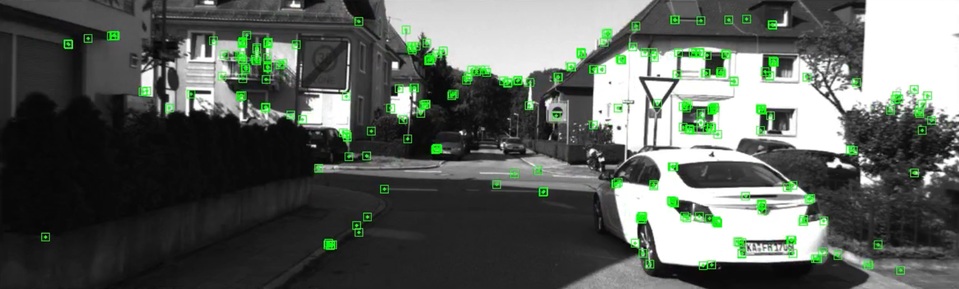
GLAM-SLAM achieves real-time tracking comparable to PhotoSLAM due to their shared ORB-SLAM2 frontend. GigaSLAM achieves lower average ATE (3.4m vs 10.8m), but at the cost of non-real-time performance (~3 FPS) and 32GB VRAM consumption. GLAM-SLAM is the only method that completes the entire KITTI Seq. 00 (4541 frames) and Seq. 05 (2761 frames).
4.4 Ablation Studies
Flow Densification: Incorporating optical flow correspondences yields substantial improvement in photometric reconstruction metrics across all KITTI sequences, with a 32% richer representation of Gaussian primitives, bringing average memory to 6.5 GiB (up from 1.8 GiB), with the optical flow model inherently accounting for ~3 GiB.
Localized MLP: Scene partitioning and localized MLP initialization significantly outperform global MLP in long sequences, as different regions' lighting and geometric variations require different parameter estimation.
5. Limitations and Shortcomings
- Lower trajectory accuracy than GigaSLAM: Average ATE of 10.8m vs GigaSLAM's 3.4m, with both having catastrophic failure on Seq. 01. Trajectory accuracy is sacrificed for real-time performance and memory efficiency.
- Fixed optical flow model memory overhead: The optical flow model's constant ~3 GiB GPU memory allocation is a significant burden for resource-constrained platforms.
- Monocular depth limitations: Depth estimation in monocular setups is inherently ambiguous, affecting reconstruction quality.
- Anchor voxel size sensitivity: Voxel size 0.001 is empirical; larger sizes cause initialization point collapse, lacking an adaptive mechanism.
- No post-optimization: GigaSLAM's post-optimization can boost photometric scores (though sacrificing real-time), an option GLAM-SLAM doesn't provide.
6. Summary
GLAM-SLAM's core contribution lies in demonstrating that decoupled architecture + flow densification + scene partitioning combined enables 3DGS SLAM to scale in real-time to large-scale outdoor long-sequence scenarios. Flow-guided densification addresses the geometric density mismatch between sparse tracking and dense 3DGS through epipolar-constrained optical flow correspondences; localized MLP scene partitioning addresses the environmental and illumination variability problem of global MLP in long sequences.
The experimental results are convincing: reconstruction quality improves 15%+ over the second-best, with the lowest peak GPU memory (11.6 GiB), being the only method to complete the full 4541-frame sequence while maintaining 10 FPS real-time performance. While trajectory accuracy is sacrificed (ATE 10.8m vs GigaSLAM 3.4m), this is a reasonable trade-off for real-time capability and memory efficiency. Future work can explore adaptive voxel sizes, lightweight optical flow models, and optional post-optimization.