Skip to content
BLOGSep 9, 2026

How to Build a Humanoid Robot: A Seven-Layer Constraint Chain from Joint Modules to Sim-to-Real

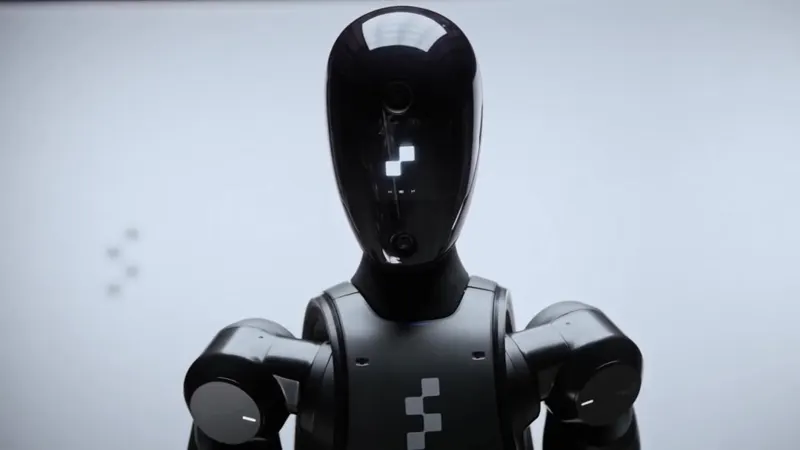
A humanoid robot is not an assembly of seven modules but a stack of physics equations that set each other's boundary conditions. This article computes the whole-machine stack layer by layer: joint motor modules (declared torque versus real quasi-static CoP demand — knee margins across three vendors converge to 2.23-2.42x while BHL's knee has only 1.51x) -> IMU (lever-arm pseudo-acceleration is 21,752x the sensor noise floor, so mounting position matters four orders of magnitude more than the datasheet) -> materials and structure (three BOM revisions of AgiBot's X1 as a load-path history: every part entering the closed-chain drivetrain upgraded to 7075-T6 / TC4 / 17-4PH) -> sensors (fix the observation space before the shopping list) -> battery and BMS ('all joints at peak simultaneously' is physically impossible: G1's 46,062 W against a 421 Wh pack is 109 C) -> software control and the CAN-level low-side boards (22 nodes at 500 Hz on one bus is 130.9% load, so it must be split into four) -> simulation training and sim-to-real: domain randomization, sim2sim, zero calibration (ATOM01's 2.093 rad waist-yaw assembly offset, the |q| < 1e-2 rad acceptance gate, and write_motor_flash() being a no-op in three of the four motor drivers), plus 10 of 13 real failure modes being hardware calibration rather than simulation fidelity. Every figure comes from programmatic parsing of the five machines' public model files, deployment and calibration source, plus official vendor specifications, and is recomputable.

HumanoidJoint modulesIMUBMS
PAPERSep 8, 2026

TANGO: Humanoid Navigation in Cluttered Environments with a Whole-Body Vision-Language-Action Model

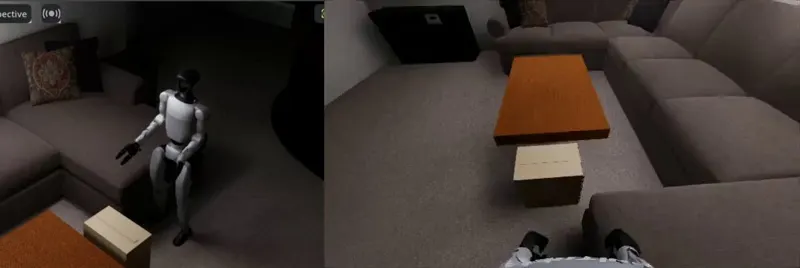
We study the problem of navigating cluttered indoor environments with a humanoid robot. Unlike conventional methods that model navigation as a 2D path planning problem, humanoid traversal in cluttered environments requires continuous geometry-aware whole-body adaptation, including coordinated arm placement, torso adjustment, and gait modulation for collision-free movement through complex 3D spaces. We introduce TANGO, the first whole-body vision-language navigation framework for language-conditioned humanoid traversal in cluttered environments. Given a natural-language instruction and egocentric RGB observations, TANGO directly predicts 29-DoF joint-space actions for downstream whole-body control. We train TANGO entirely in simulation by synthesizing diverse collision-free traversal behaviors via global path planning, kinematic whole-body motion generation, obstacle-aware motion editing, and RL-based tracking. This pipeline provides dynamically feasible action supervision for learning language-conditioned whole-body policies. In extensive simulation experiments, TANGO demonstrates state-of-the-art performance in vision-language navigation, while outperforming strong modular baselines in navigating challenging scenes requiring obstacle negotiation. Lastly, we deploy TANGO zero-shot on a Unitree G1 humanoid robot, and observe robust language-guided traversal in cluttered real-world scenes without training on any real-world navigation data.

Anqi Li, Yuxin Chen, Zhaobo Li

HumanoidVLANavigationVision-language navigation
As an Amazon Associate, we earn from qualifying purchases.