Skip to content
← Tags
Recursive Game Creator: An Agentic Product-Level Experience-Oriented Game Harness

Recursive Game Creator: An Agentic Product-Level Experience-Oriented Game Harness

Recent game design agents have made substantial progress in generating playable games. However, program correctness does not ensure an enjoyable experience for players. We present Recursive Game Creator, an experience-oriented harness to advance agentic game development from rough game prototypes into entertaining games. Recursive Game Creator organizes recursive development around four components: Designer, Builder, Player, and Reviewer. The Designer translates user instructions and Reviewer's feedback into detailed plans. The Builder turns these plans into candidate games. The coding-native Player creates and executes reusable policies through programmatic interfaces to efficiently collect diverse gameplay trajectories, mitigating evaluation bias caused by slow GUI-based collection. The Reviewer uses carefully designed trajectory-based metrics to induce player preferences, integrating with visual evidence and explicit textual preferences to evaluate games against game-specific criteria. Finally, the Reviewer accepts the better version and provides improvement reviews for the next round, closing the recursive loop. Our method achieves state-of-the-art overall performance of 77.89 on GameCraft-Bench. On GameASG-Bench, it achieves a strict task success rate of 53.2%, a 34.1% improvement over the same-model baseline, and the highest mean runtime-check pass rate at 93.4% among compared methods. A user study shows longer playtime and higher ratings. Code is coming soon.
Jiajun Chen, Haoyu Wu, Mingda Jia · 335 views · Oct 6, 2026
Agentic Game DevelopmentRecursive self-improvement
Oct 6, 2026
Dream-RSI: Recursive Self-Improvement through Evolving Worlds

Dream-RSI: Recursive Self-Improvement through Evolving Worlds

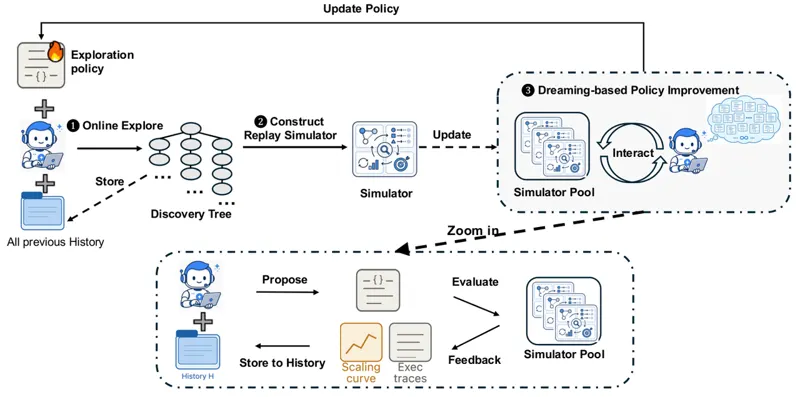
Recursive self-improvement is becoming increasingly vital for autonomous AI agents, where progress hinges on discovering high-value solutions across complex domains. The driver of this process is effective exploration, however, managing and improving exploration strategies remains a major bottleneck. Current systems face a fundamental dilemma: fixed strategies fail to adapt as search spaces scale, while online policy optimization requires navigating vast meta-search spaces under delayed and expensive feedback over long-horizon rollouts. We introduce {Dream-RSI}, a framework for scalable and recursively self-improving exploration. A lightweight orchestration layer makes exploration explicit and programmable while leaving the underlying coding agent unchanged. Our key insight is that accumulated discovery history can serve as a replay simulator over the realized search space. By performing dreaming in the replay simulator constructed from historical discovery trees, {Dream-RSI} secures immediate, low-cost off-policy feedback to evaluate and refine exploration policies without invoking repetitive, expensive online evaluations. The improved policy is subsequently redeployed online to drive further discovery, continuously expanding the simulator pool in a self-improving loop. Across algorithm engineering, mathematical optimization, and GPU kernel engineering, {Dream-RSI} achieves competitive or improved discovery quality while substantially reducing discovery cost in several settings.

Tong Zheng, Xidong Wu, Zheng Zhang · 1.1k views · Sep 14, 2026
Recursive self-improvementWorld Models
Sep 14, 2026

As an Amazon Associate, we earn from qualifying purchases.