Skip to content
← Tags

#Agent Harness (41)

langchain-ai/deepagentsMIT

Deep Agents: an off-the-shelf agent harness reverse-engineered from Claude Code

The README opens by calling itself an off-the-shelf agent harness: MIT licensed, Python (plus deepagents.js), built on LangGraph, so streaming, durability and checkpoints are inherited rather than rewritten. The key to reading it is the acknowledgement - inspired by Claude Code, trying to figure out what makes it general and pushing that further - which makes this a reverse-engineering exercise: take a closed coding agent that is known to work well, open it up, and ask what actually lets it handle long tasks. Its answer is four bundled things: a pluggable-backend file system (the artefacts of long tasks are files, not messages, so context keeps only pointers), sub-agents each with their own window (context isolation and compression, not extra helpers), long-thread summarisation with tool output offloaded to disk, and on-demand Skills. Also sandboxed shell execution, cross-session persistent memory, human-in-the-loop approval/edit/reject before a tool call runs, and any MCP server as a tool. Model agnostic: frontier APIs, open weights hosted on Baseten or Fireworks, and self-hosted Ollama/vLLM/llama.cpp all work, with three lines of create_deep_agent giving you a planning, file-reading-and-writing agent. The security section is unusually blunt - it follows a trust-the-LLM model, boundaries must be enforced at the tool and sandbox layer, and you should not expect the model to restrain itself. 29.7k stars. Not run yet; sub-agent isolation quality and summarisation information loss are unverified, so this is graded as pending reproduction.

Agent HarnessCoding AgentSub-Agents
Python30k4.2k139
XiaomiMiMo/MiMo-CodeMIT

MiMo Code: Xiaomi terminal coding agent betting on memory and self-evolution

Xiaomi open-sourced terminal-native AI coding assistant, TypeScript built with bun. The source is MIT but usage is additionally bound by USE_RESTRICTIONS.md, the MiMo terms of service and the trademark policy - read those before treating it as plain MIT. The README states it is a fork of OpenCode: it keeps the multi-provider, TUI, LSP, MCP and plugin core and adds persistent memory (SQLite FTS5 full-text search across four kinds - project MEMORY.md, session checkpoints, scratch notes and task progress - injected automatically on session resume), intelligent context management (near the limit it rebuilds from the latest checkpoint plus project memory plus task progress plus retained recent messages, ranked by importance against a token budget), goals and stop conditions (/goal sets the condition, and when the agent wants to stop a separate judge model assesses whether it was truly met, which targets optimistic early quitting), and deterministic JS workflows in a sandbox (compose splits independent tasks into isolated git worktrees with per-task TDD; also deep-research, fact-check with three-reviewer adversarial voting, and research-experiment with an anti-metric-gaming audit). Twenty built-in skills (arxiv, claude-code, codex, docx, pdf, pptx, xlsx, html-to-video, product-design and more), compatible with four skill roots - .agents/skills, .claude/skills, .codex/skills, .opencode/skills - where a user skill of the same name overrides the built-in. /dream and /distill are its signature: the first distils recent session trajectories into project memory and prunes stale entries, the second finds your repeated manual routines and packages high-confidence candidates into reusable skills. Model agnostic - the Xiaomi platform, Codex/ChatGPT OAuth, or any OpenAI-compatible endpoint. 13.4k stars. Not installed or run yet; memory-restore accuracy, judge-model effectiveness and the vendor-stated cache hit rates are unverified, so this is graded as pending reproduction.

Coding AgentAgent HarnessPersistent Memory
TypeScript13k1.4k76
The Agentic Scientist: Orchestrating Coding Agents for Automated Scientific (Co-)Discovery

The Agentic Scientist: Orchestrating Coding Agents for Automated Scientific (Co-)Discovery

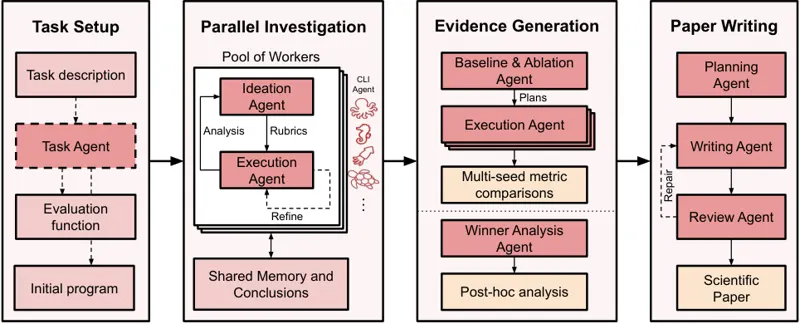
Modern coding agents are fundamentally reshaping the role of human input for computational research: they write code, launch in silico experiments, analyze their results, and autonomously operate with ever-increasing time horizons. Despite these developments, fully autonomous research agents suffer from a limited ideation radius and myopic hill-climbing search dynamics. To bridge this gap, we introduce The Agentic Scientist, an end-to-end distributed pipeline for human researchers to conduct computational research alongside modern coding agents. Building on its predecessor, our system decomposes research into task drafting, idea generation, planning, sandboxed experimentation, result aggregation, baseline and ablation construction, post-hoc analysis, and report writing. Importantly, each step in the pipeline is powered by the next generation of coding agents and leverages agentic self-verification. The overall research process is driven by a meta-controller that manages parallel research agents and enforces rubric verification at each stage. This design enables the same orchestration layer to be reused across heterogeneous domains with different execution environments, agentic coding harnesses, and evaluation metrics. Our system can be used across a spectrum of autonomy: either as a co-scientist tool or to perform end-to-end scientific investigation. Within the co-scientist setting, we leveraged a development version of our system to submit a single research paper, which got accepted for publication at ALIFE 2026. We further apply The Agentic Scientist fully autonomously to open problem-solving tasks in machine learning, and demonstrate the system's capability of scientific discovery across different domains of computational research. Our ablations suggest that reliable scientific autonomy depends not only on base model capabilities, but also on the cross-agent orchestration layer.

Robert Tjarko Lange, Luca Grillotti, Yutaro Yamada · 139 views · Oct 13, 2026
AI ScientistCoding AgentAgent HarnessOct 13, 2026
SuperNav: An Agentic Navigation System for Any Task in Any Scene

SuperNav: An Agentic Navigation System for Any Task in Any Scene

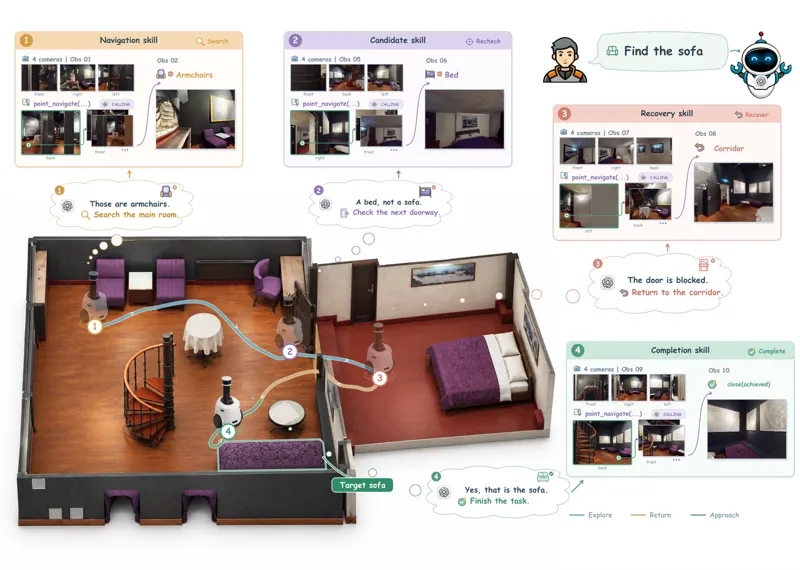
General-purpose service robots need navigation systems that can handle diverse human requests in unfamiliar environments, combining task generality with scene generality. Some existing methods fine-tune multimodal large language models (MLLMs) to predict navigation actions, making their behavior dependent on the coverage of navigation training data and potentially limiting generalization to new requests and environments. Our key insight is to let the MLLM focus on interpreting requests, understanding scenes, and making decisions while preserving its general-purpose capabilities and delegating motion execution to navigation tools. To realize this idea, we introduce SuperNav, which equips a pretrained MLLM with a specialized agent harness without navigation-specific fine-tuning of the MLLM. Our harness supports these decisions with Navigation Skills, agent-oriented Tools for physical interaction, and task-progress and context management. A unified visual-point interface connects decision-making to motion by allowing the model to specify destinations directly in images and revise its decisions from execution feedback. Together, these components support sustained navigation across different task requirements and environments. SuperNav outperforms four evaluated baselines on instance-level, multi-object, and demand-driven tasks. Category-level evaluation on HM3D and deployment on a real quadruped robot further demonstrate its applicability across environments. Project Page: https://zju3dv.github.io/SuperNav/

Jinkai Zhang, Jingyi Xu, Yuanhong Yu · 193 views · Oct 8, 2026
Object NavigationEmbodied AgentMultimodal LLMOct 8, 2026
LongHarness: Stateful Evidence Management for Agentic Reasoning over 100M-Token Corpora

LongHarness: Stateful Evidence Management for Agentic Reasoning over 100M-Token Corpora

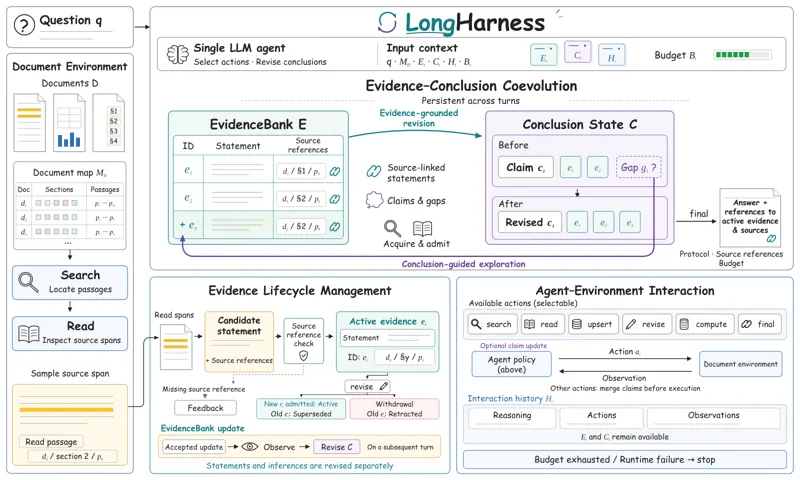
Corpus-level long-context reasoning requires agents to acquire and integrate evidence across document collections that exceed their context windows. Existing agent harnesses enable incremental access to these corpora, but acquired evidence and evolving conclusions often remain entangled in a growing interaction history. This implicit state management can lead to two coupled failure modes: unbounded exploration, where retrieval expands the interaction history without resolving decision-relevant information gaps, and evidence-state drift, where previously acquired evidence or subsequent corrections fail to inform the current conclusion. We present LongHarness, a model-agnostic harness that makes the interaction between acquired evidence and evolving conclusions explicit. Its core mechanism, Evidence-Conclusion Coevolution, uses unresolved conclusions to guide exploration toward missing information, while newly acquired evidence strengthens or revises the conclusions that directed the search. LongHarness couples this process with Evidence Lifecycle Management, which keeps accumulated evidence current and traceable throughout the interaction. Together, these mechanisms focus retrieval on remaining information needs and keep conclusions aligned with current evidence. We evaluate LongHarness on OfficeQA Pro V1 and V2, AA-LCR, and LongBench v2 using GLM-5.3-Flash and Qwen3.8-Flash. Compared with direct reasoning using the same backbone, LongHarness improves GLM-5.3-Flash exact match on OfficeQA Pro from 15.8% to 60.2% on V1 and from 4.4% to 61.1% on V2. Against state-of-the-art agent harnesses, it surpasses Claude Code by 12.0 percentage points on V1 and Codex by 18.9 points on V2. With Qwen3.8-Flash, LongHarness reaches 61.7% on V1, outperforming Claude Code by 8.3 points and Codex by 12.0 points.

Songtao Huang, Zhijie Zhong, Xiaohan He · 179 views · Oct 9, 2026
Agent HarnessLong-Context ReasoningEvidence ManagementOct 9, 2026
Recursive Game Creator: An Agentic Product-Level Experience-Oriented Game Harness

Recursive Game Creator: An Agentic Product-Level Experience-Oriented Game Harness

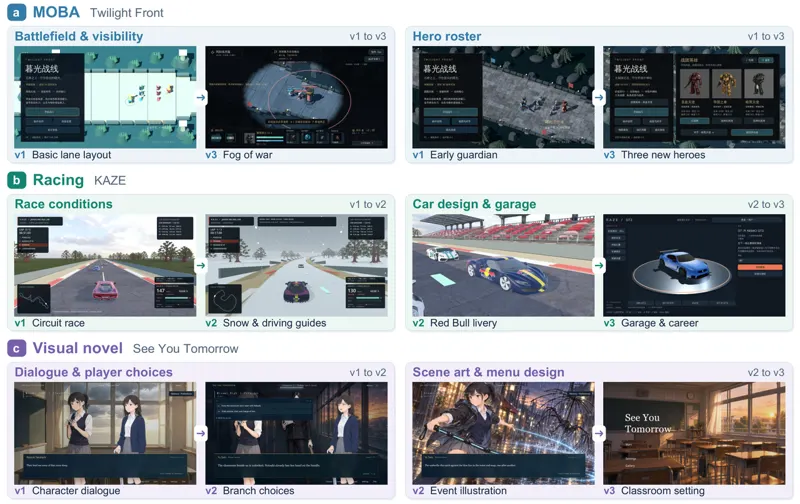
Recent game design agents have made substantial progress in generating playable games. However, program correctness does not ensure an enjoyable experience for players. We present Recursive Game Creator, an experience-oriented harness to advance agentic game development from rough game prototypes into entertaining games. Recursive Game Creator organizes recursive development around four components: Designer, Builder, Player, and Reviewer. The Designer translates user instructions and Reviewer's feedback into detailed plans. The Builder turns these plans into candidate games. The coding-native Player creates and executes reusable policies through programmatic interfaces to efficiently collect diverse gameplay trajectories, mitigating evaluation bias caused by slow GUI-based collection. The Reviewer uses carefully designed trajectory-based metrics to induce player preferences, integrating with visual evidence and explicit textual preferences to evaluate games against game-specific criteria. Finally, the Reviewer accepts the better version and provides improvement reviews for the next round, closing the recursive loop. Our method achieves state-of-the-art overall performance of 77.89 on GameCraft-Bench. On GameASG-Bench, it achieves a strict task success rate of 53.2%, a 34.1% improvement over the same-model baseline, and the highest mean runtime-check pass rate at 93.4% among compared methods. A user study shows longer playtime and higher ratings. Code is coming soon.

Jiajun Chen, Haoyu Wu, Mingda Jia · 162 views · Oct 6, 2026
Agentic Game DevelopmentRecursive self-improvementCoding AgentOct 6, 2026

As an Amazon Associate, we earn from qualifying purchases.