Thinking Before Thinking: Scaling Agentic Inference Through Meta-Reasoning
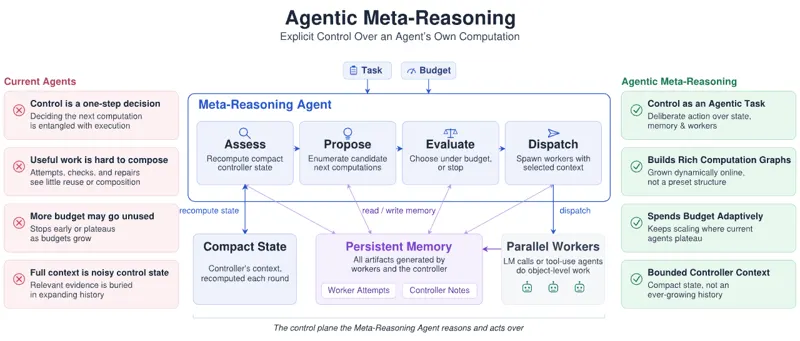
Meta's agentic meta-reasoning harness separates control from work: a controller runs Assess, Propose, Evaluate and Dispatch over a compact state and persistent artifact memory. On ProgramBench it reaches 71.5% with GPT-5.5, versus 58.0% for Codex.
Paras Dahal, Anton Bakhtin, Taco Cohen · 623 views · Sep 29, 2026
Agent HarnessMeta-Reasoning
Sep 29, 2026