πR²: Reactive Real-time Flow Policies
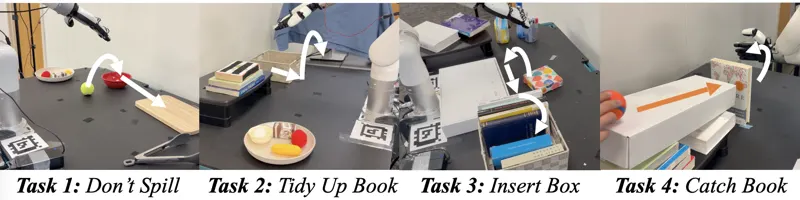
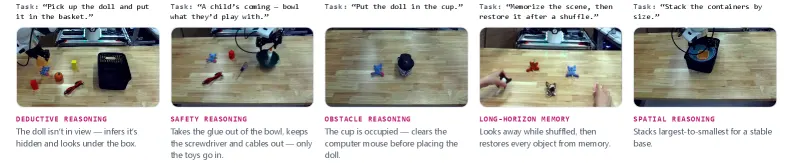
Generalist manipulation policies increasingly take the form of action-chunking flow policies built on large pretrained backbones. Such chunks run open-loop, so the policy cannot react to sensory input arriving mid-execution, sacrificing reactivity. Replanning more often would restore it, but the perception-to-action pipeline (a large backbone plus multiple denoising steps) is too slow: this latency forbids frequent replanning and leaves committed actions stale, making such policies ill-suited for dynamic, closed-loop control. We present πR², which makes these policies reactive and real-time while retaining large backbones, expressive multi-modal policies, and multi-action prediction. Built on the per-position noise schedule of diffusion forcing, πR² contributes two ideas. First, it splits conditioning into a fast channel (proprioception, fresh every tick) and an asynchronously updated slow channel (vision-language features), so the policy reacts to proprioception within a chunk while tolerating stale vision. Second, a latency-adaptive flow schedule treats in-flight actions as inpainting conditioning and emits actions in one denoising step per call, letting one trained model adapt to varying hardware latency. Requiring minimal modification to existing architectures, πR² can be finetuned from a pretrained policy: applied to GR00T-N1.7 on a real xArm6+XHand platform, it replans closed-loop roughly 4× faster than the base policy (~$25$Hz on an A5000 GPU), acting on a fresh observation every $40$ms. Across simulation and real-world manipulation tasks, πR² improves the success rate by up to 23% in simulation and 30% in the real world over the strongest baseline. Project page: https://pi-r2-flow.github.io/
Sungjae Park, Shubham Tulsiani·Jul 28, 2026
VLAreactivediffusionJul 28, 2026
 0:33
0:33