Skip to content
Tags

#Depth perception (5)

Hiking in the Wild: A Scalable Perceptive Parkour Framework for Humanoids

Hiking in the Wild: A Scalable Perceptive Parkour Framework for Humanoids

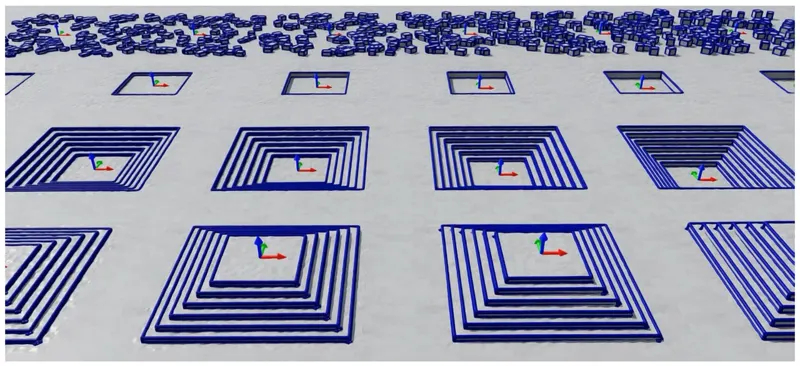
Achieving robust humanoid hiking in complex, unstructured environments requires transitioning from reactive proprioception to proactive perception. However, integrating exteroception remains a significant challenge: mapping-based methods suffer from state estimation drift; for instance, LiDAR-based methods do not handle torso jitter well. Existing end-to-end approaches often struggle with scalability and training complexity; specifically, some previous works using virtual obstacles are implemented case-by-case. In this work, we present Hiking in the Wild, a scalable, end-to-end parkour perceptive framework designed for robust humanoid hiking. To ensure safety and training stability, we introduce two key mechanisms: a foothold safety mechanism combining scalable Terrain Edge Detection with Foot Volume Points to prevent catastrophic slippage on edges, and a Flat Patch Sampling strategy that mitigates reward hacking by generating feasible navigation targets. Our approach utilizes a single-stage reinforcement learning scheme, mapping raw depth inputs and proprioception directly to joint actions, without relying on external state estimation. Extensive field experiments on a full-size humanoid demonstrate that our policy enables robust traversal of complex terrains at speeds up to 2.5 m/s. The training and deployment code is open-sourced to facilitate reproducible research and deployment on real robots with minimal hardware modifications.
Shaoting Zhu, Ziwen Zhuang, Mengjie ZhaoJan 12, 2026
HumanoidHikingParkourJan 12, 2026
NSL-SLAM: High-Fidelity Neural Structured-Light Depth for Practical SLAM and Reconstruction

NSL-SLAM: High-Fidelity Neural Structured-Light Depth for Practical SLAM and Reconstruction

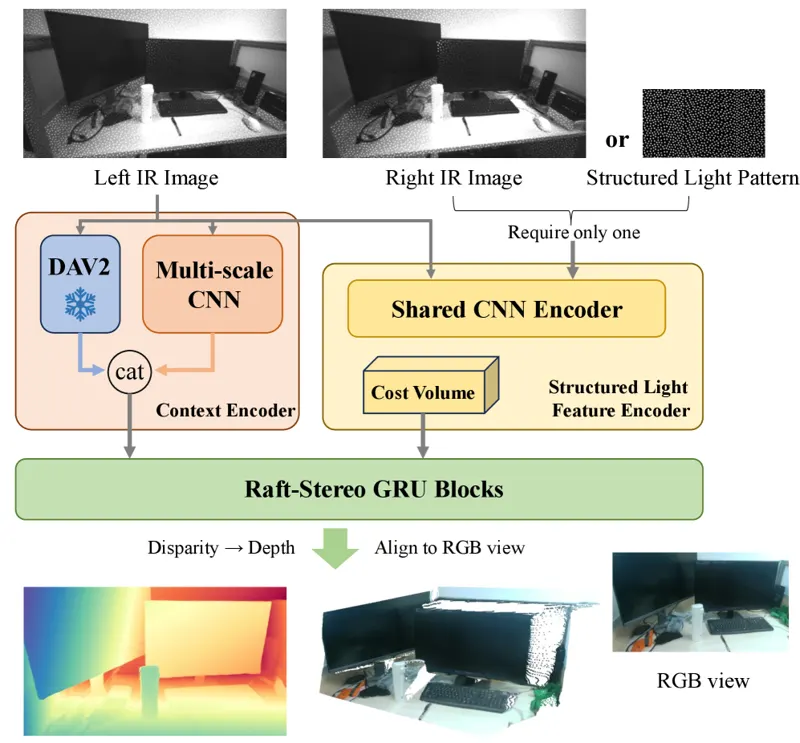
Structured-light (SL) cameras power depth sensing in millions of devices, and recent neural SL decoding methods have substantially improved their depth quality. SLAM systems can benefit greatly from such strong depth sensing, where reliable geometry enables stable tracking and faithful reconstruction. In this work, we present NSL-SLAM, a practical SLAM system tailored for high-fidelity structured-light depth. We first strengthen SL depth sensing: inspired by the neural structured-light (NSL) method, we further incorporate strong monocular depth priors into the SL stereo decoding, reducing depth RMSE by 35% on Replica-SL compared to NSL. We then build a depth-centric SLAM pipeline with this stronger depth: because structured-light geometry is dense and metrically accurate, we keep it as the primary tracking signal, and add only sparse visual correspondences for geometrically degenerate cases and lightweight bundle adjustment for long-range drift. Our depth estimator and SLAM design reinforce each other: stronger depth makes a simple SLAM pipeline effective, and the depth-centric pipeline ensures this advantage transfers to downstream reconstruction. Experimentally, on the synthetic Replica-SL benchmark, NSL-SLAM achieves the best tracking accuracy and improves reconstruction F-score by 1.6 points over the SOTA baseline under a shared-depth protocol. On a real benchmark of 8 challenging scenes, it is the only method that avoids catastrophic failure on all sequences while achieving 43.3% lower trajectory deviation than selected baselines. The SLAM system runs online at 20.9 FPS, demonstrating that stronger structured-light depth and depth-centric system design together enable practical, robust SLAM.

Jiaheng Li, Binsheng Zhang, Xinhai ChangJul 27, 2026
SLAMStructured Light DepthNeural Depth EstimationJul 27, 2026