1:37Odyssey-3: A Foundation World Model for Physical Agents@odysseyml · 16 views · 2026-09-15World ModelsFoundation ModelsPhysical AI
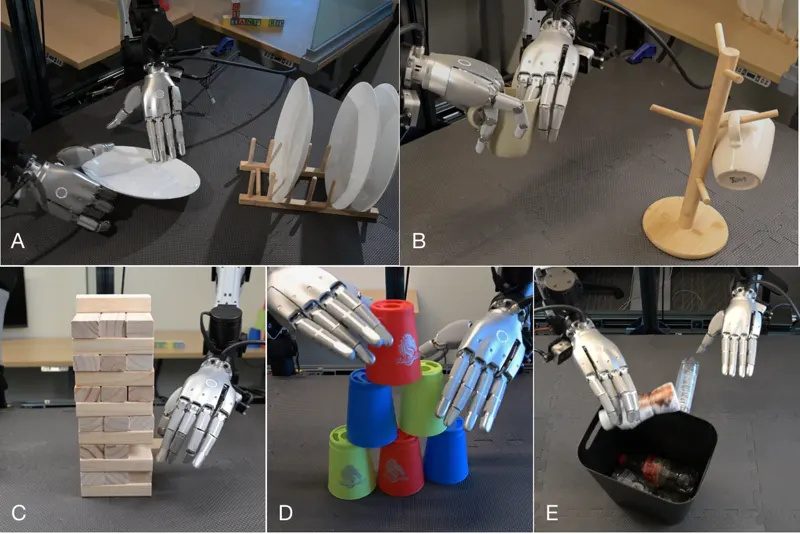
Pre-training Visual Dexterity in SimulationLarge-scale pre-training has made robot policy fine-tuning increasingly data-efficient, but this progress has largely been driven by datasets and embodiments built around simple parallel-jaw grippers. Dexterous, multi-fingered hands remain comparatively data-starved because real teleoperation is costly to scale, while human hand video is off-embodiment and requires lossy pose estimation and retargeting. We introduce Simulation Pre-training for Dexterity (SPD), a pre-training framework for dexterous manipulation that uses data entirely collected in simulation. In SPD, humans manipulate virtual objects inside a VR headset, enabling on-embodiment trajectories and robot-free collection. With the help of five operators, we collect 75 hours of multi-task dexterous manipulation over one week, and use it to pre-train a causal transformer on a sequence modeling objective. We study the benefits of simulation pre-training on real-world tasks by fine-tuning on 1-2 hours of physical demonstrations on a 56-DoF bimanual dexterous setup. We find that our approach outperforms training behavior cloning policies from scratch, showing that simulation teleoperation is a viable pre-training source for real-world dexterous manipulation. We perform ablation studies, measuring the benefits of history conditioning and short action chunks for reactive control.Sarthak Kamat, Adam Rashid, Satvik Sharma·Aug 16, 2026Sim-to-RealDexterous ManipulationDexterous HandAug 16, 2026
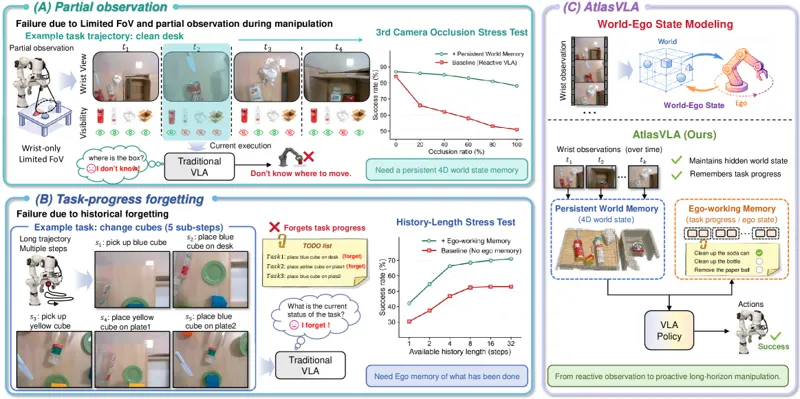
AtlasVLA: Persistent World-Ego State Modeling for Vision-Language-Action ModelsWhile Vision-Language-Action (VLA) models have advanced embodied AI, their fundamentally reactive paradigm severely limits performance in partially observable and long-horizon tasks. When restricted to a single wrist-mounted camera, they inevitably suffer from perception forgetting as objects exit the field of view, and temporal task-progress forgetting} during multi-step execution. To overcome these bottlenecks, we propose AtlasVLA, a novel framework that transitions from direct reactive manipulation to proactive reasoning through a persistent world-ego state. AtlasVLA features a dual-memory architecture: a 4D Persistent World State Memory that lifts transient 2D observations into a globally updated, voxel-hashed spatial state to resolve visual blind spots, and an Ego-Working State Memory that tracks historical ego state and task progress. By conditioning a diffusion transformer (DiT) on this joint World-Ego state, AtlasVLA enables robust spatial reasoning. Extensive evaluations across LIBERO, RLBench, and real-world benchmarks demonstrate that AtlasVLA achieves state-of-the-art performance using solely a wrist camera. Remarkably, it decisively outperforms multi-view baselines, yielding absolute success rate improvements of 9.4% on LIBERO-Long and 17.5% in real-world long-horizon tasks.Guiyu Zhao, Longteng Guo, Yanghong Mei·Aug 7, 2026VLAPhysical AIWorld-Self StateAug 7, 2026
 1:37
1:37