Skip to content
Tags

#First-person (9)

EgoWAM: World Action Models Beyond Pixels with In-the-Wild Egocentric Human Data

EgoWAM: World Action Models Beyond Pixels with In-the-Wild Egocentric Human Data

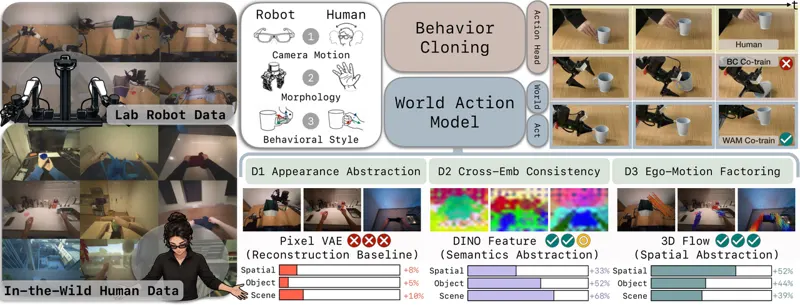
Egocentric human data offers scalable supervision for robot manipulation. However, behavior cloning entangles transferable content like objects, scenes, and task semantics, with non-transferable factors like human morphology, head motion, and behavioral style. We study whether World Action Models (WAMs) provide a better training signal by requiring policies to predict not only actions, but also how the scene evolves. The central question is what world representation best enables human-to-robot transfer. We hypothesize that an effective world target should abstract appearance, capture agent-invariant physical effects, and separate camera motion from environment change. We introduce EgoWAM, a controlled human-robot co-training framework that fixes the policy backbone, action head, and data mixture while varying only the world prediction target, comparing Pixel, DINO, and 3D motion flow. Across three real-world bimanual tasks, WAM co-training scales more effectively with in-the-wild egocentric human data than behavior cloning. Pixel-based prediction transfers weakly, while DINO and 3D flow yield substantial gains: DINO improves out-of-distribution object and scene generalization by up to 4x, and 3D flow improves in-domain performance by 20-30%. More details: https://gatech-rl2.github.io/egowam.github.io

Baoyu Li, Xinchen Yin, Mengying LinJul 8, 2026
World ModelsRobot ManipulationImitation LearningJul 8, 2026
Reinforcing Egocentric Spatial Perception in Multimodal Large Language Models via Ego Scene Augmentation

Reinforcing Egocentric Spatial Perception in Multimodal Large Language Models via Ego Scene Augmentation

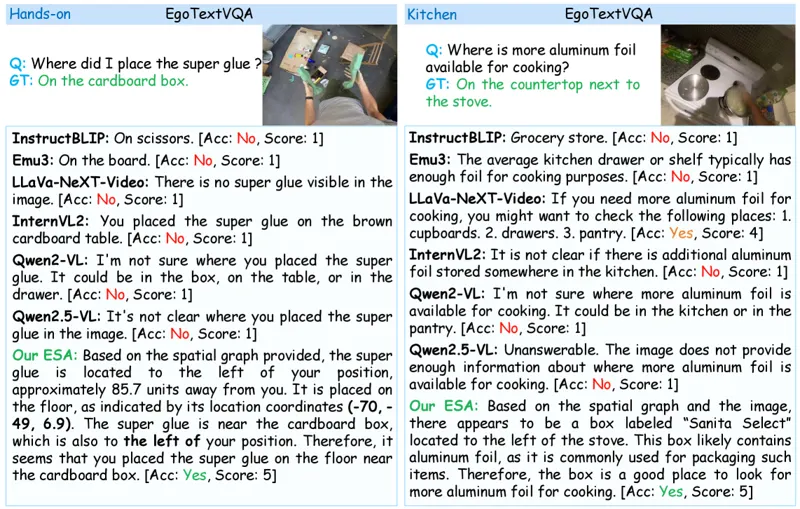
Egocentric Visual Question Answering (VQA) has attracted widespread attention as an important task for enabling Multimodal Large Language Models (MLLMs) to interact with the real world. However, existing MLLMs struggle to perform effective spatial reasoning in complex egocentric scenes due to their limited spatial perception capabilities. To this end, we introduce Ego Scene Augmentation (ESA), an egocentric spatial perception framework, which actively enhances the spatial perception capabilities from the egocentric perspective, powered by the proposed Ego-element Graph. Our core insight is leveraging the Ego-element Graph as an intermediary representation to augment the egocentric spatial perception of MLLMs via visual foundational models. Specifically, we 1) construct the Ego-element Graph, which encapsulates and integrates egocentric spatial features enabled by visual foundational models; 2) enhance the spatial perception capabilities of MLLMs via the Ego-element Graph for ego-perspective scenes. Our proposed ESA framework presents significant performance improvement on the EgoTextVQA benchmark. We achieve an 8.14% gain on the indoor setting and an 8.72% gain on the outdoor setting. Furthermore, our ESA shows the most impressive performance improvement in the shopping subset of the indoor setting. The project code is publicly available.

Chi Kit Wong, Ye Pan, Yuanhuiyi LyuJul 16, 2026
MLLMFirst-personVQAJul 16, 2026
Exo2EgoPose: Leveraging Exocentric Demonstrations for Vision-Language guided Egocentric 3D Hand Pose Forecasting

Exo2EgoPose: Leveraging Exocentric Demonstrations for Vision-Language guided Egocentric 3D Hand Pose Forecasting

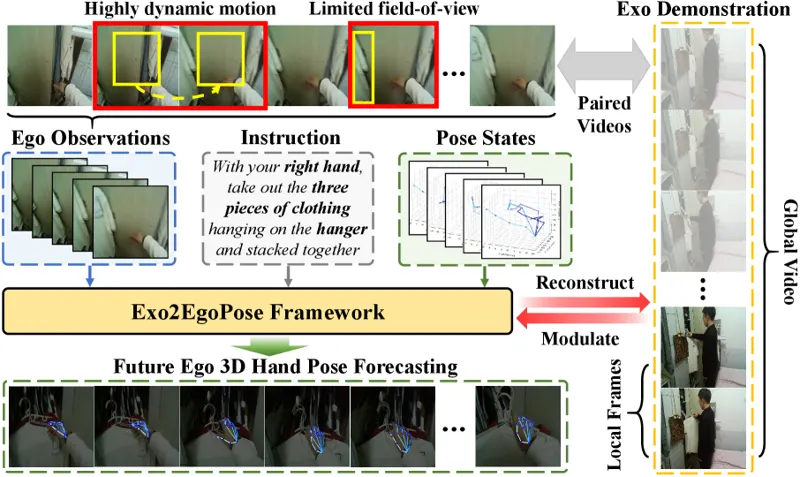
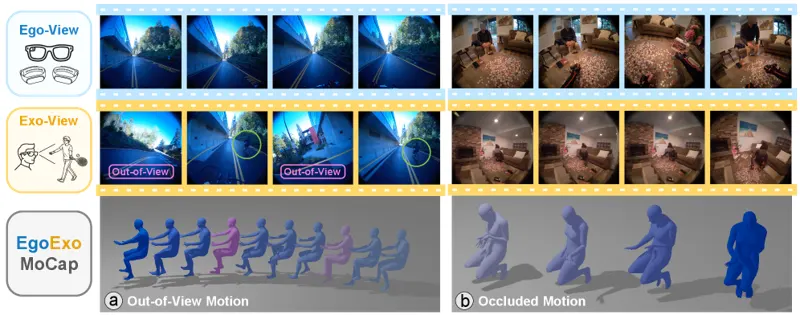
Perceiving multimodal cues and forecasting fine-grained actions from an egocentric (Ego) perspective is vital for applications like robot manipulation. However, previous studies either rely mainly on under-informed visual inputs to predict coarse human motions or follow the VRM/VLA paradigm, which suffers from insufficient robot data and the gap between human and robot embodiments. We observe that 3D hand pose naturally serves as a unified representation to bridge human-robot actions. Hence, we investigate an under-explored Vision-Language guided Egocentric 3D Hand Pose Forecasting (VL-EHPF) task, which aims to predict future Ego 3D hand poses from visual observations, a language instruction, and pose states. To overcome the limited field-of-view and highly dynamic motions in the Ego view, we propose a framework dubbed Exo2EgoPose, which innovatively leverages holistic and stable exocentric (Exo) demonstrations as guidance to compensate for partial and dynamic Ego-view cues. Specifically, we introduce a Dual-level Exocentric Reconstruction Module (DERM), which incorporates the paired Exo videos as supervision to reconstruct their video-level and chunked frame-level representations, thereby modeling spatial contexts and temporal dynamics. Then, the Global-to-Local Modulation Module (GLMM) utilizes the reconstructed hierarchical Exo representations for progressive feature refinement via attention mechanisms and adaptive modulation, enabling comprehensive Exo guidance for accurate Ego hand pose forecasting. Extensive experiments on AssemblyHands, Ego-Exo4D, and our newly constructed EgoMe-pose benchmarks show the superiority of our method, which outperforms state-of-the-art methods by a large margin. Moreover, it demonstrates an effective human-to-robot transfer capability and yields improvements on the CALVIN dataset. Code will be released.

Zhaofeng Shi, Heqian Qiu, Lanxiao WangJul 17, 2026
First-personHand PoseVLMJul 17, 2026
Open-AoE: An Open Egocentric Manipulation Dataset and Toolchain for Embodied Learning

Open-AoE: An Open Egocentric Manipulation Dataset and Toolchain for Embodied Learning

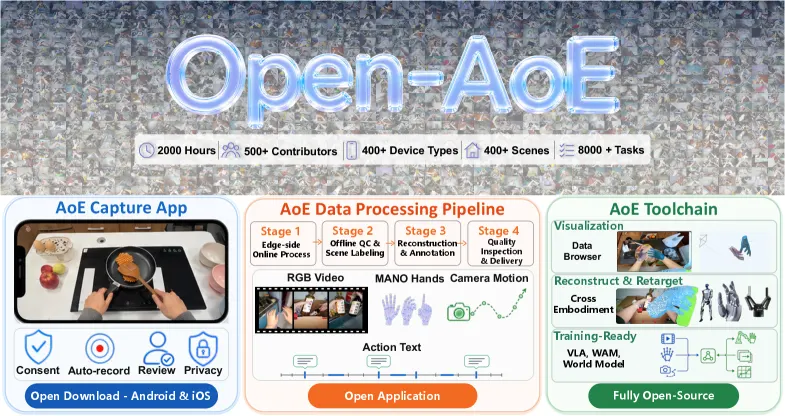
Egocentric videos of human manipulation provide scalable supervision for embodied intelligence, yet existing resources rarely combine low-cost continuous capture, manipulation-level structured annotations, and reusable tools for robot learning. We present Open-AoE, an open, community-oriented egocentric manipulation dataset and toolchain spanning the full pipeline from smartphone capture to model training. Its first release contains approximately 2,000 hours of manipulation video collected in natural environments by 500+ contributors using 400+ smartphones. The dataset provides text annotations, MANO-based hand poses, camera trajectories, and temporally localized atomic actions. Open-AoE further includes a data processing pipeline that transforms raw recordings into structured samples through temporal action segmentation, semantic annotation, hand reconstruction, and camera trajectory reconstruction. Meanwhile, we provide a separate downstream toolchain supports visualization, cross-embodiment retargeting, model-specific data conversion, and training recipes for VLA policies, WAMs, and World Models. By integrating scalable capture, structured processing, and downstream adaptation, Open-AoE reduces the barriers to both data contribution and reuse, providing practical open infrastructure for embodied model training, human-to-robot transfer, and world modeling.

Zishuo Li, Bowen Yang, Changtao MiaoJul 15, 2026
First-personEmbodied LearningDatasetsJul 15, 2026