ReST-RL: Reinforcing LLM Reasoning through Unified Self-Training and Value-Guided Search
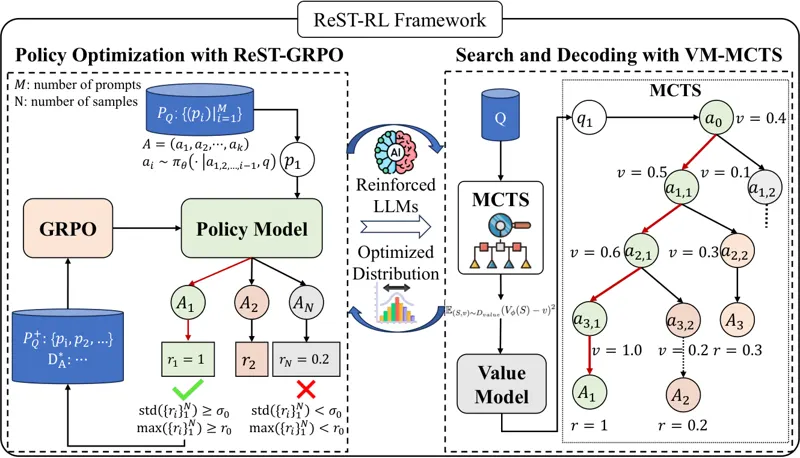
GRPO is the representative RL method for improving LLM reasoning, yet it only ever sees one sparse reward at the end of a whole trajectory: when the rewards inside a sampled group land close together, the group-relative advantage collapses into noise and the policy learns almost nothing. ReST-RL reconnects policy optimization and value-guided search into a single self-training pipeline. Stage one, ReST-GRPO, first filters out low-information prompts by reward standard deviation, then draws prefixes from each prompt's highest-reward trajectory under a discrete exponential distribution and uses them as fresh online-GRPO starting contexts. A selected prefix is context only; its suffix is re-sampled and optimized rather than imitated. Stage two, VM-MCTS, runs MCTS under the now-static policy to self-collect value targets and trains a value model that predicts expected terminal reward. At inference the same model both allocates the tree search through UCT and ranks completed candidates in a Best-of-N fashion, so search and verification share one state-value scale. On coding benchmarks including APPS, BigCodeBench and HumanEval, Qwen3-8B moves from 0.503 to 0.689 average. In matched policy-value controls, ReST-GRPO + VM-MCTS reaches 0.642 on APPS-500 while GRPO + VM-MCTS reaches only 0.538, so the stage-one distributional shift survives value learning. End-to-end accounting puts ReST-GRPO at 1,752 GPU-hours against 2,080 for GRPO, hitting a 9% gain in 71 hours instead of 207. A value model trained only on code trajectories also transfers to MATH, Omni-MATH and GPQA-Diamond without target-domain tuning.