Skip to content
Tags

#Motion priors (5)

X-Morph: Human Motion Priors for Scalable Robot Learning Across Morphologies

X-Morph: Human Motion Priors for Scalable Robot Learning Across Morphologies

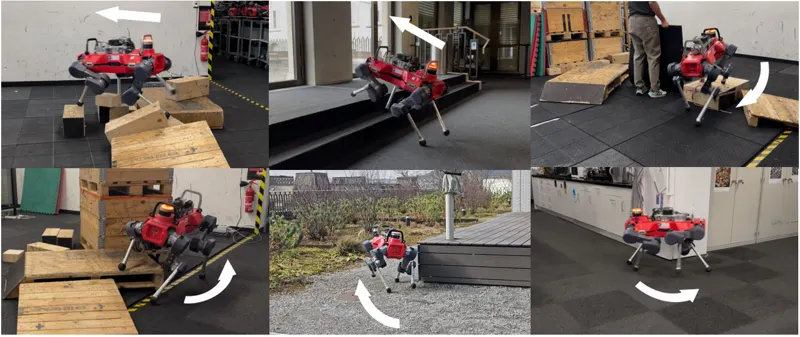
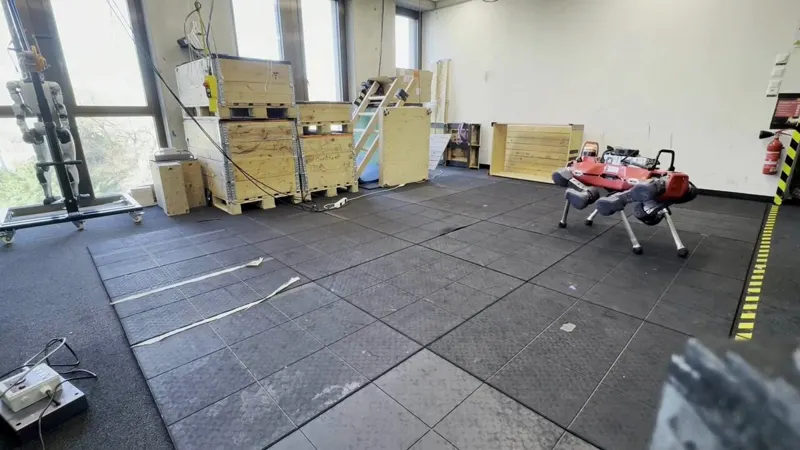
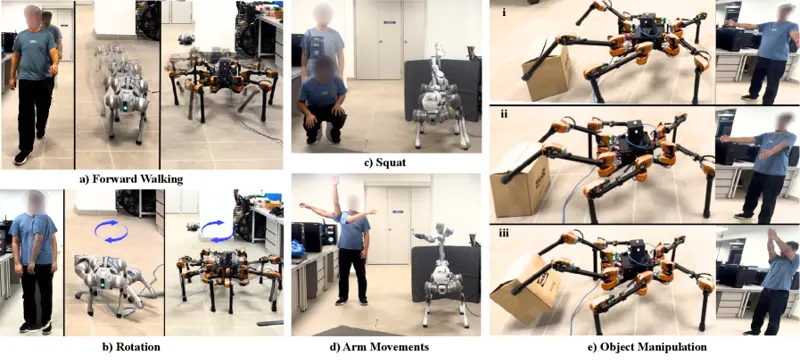
Recent progress in humanoid behavior models has been driven in large part by abundant human motion data, but comparable motion data is scarce for non-humanoid legged robots such as quadrupeds, hexapods, and quadruped manipulators. A promising alternative is to repurpose human motion across embodiments; however, direct retargeting often produces motions that are visually plausible yet physically inconsistent or difficult to track under robot dynamics. We present X-Morph, a human-motion-to-robot-behavior pipeline that converts human motion into deployable locomotion and loco-manipulation policies for diverse non-humanoid legged morphologies. A cross-morphology retargeting stage converts human motions into kinematically plausible, intent-preserving robot references, which are then tracked by a privileged RL policy and distilled into a causal student policy. We evaluate X-Morph on three morphologically distinct platforms: a quadruped, a hexapod, and a quadruped equipped with a manipulator. The resulting policies track diverse retargeted motions, generalize to unseen human motions, and support downstream use cases including video-based teleoperation, behavior-prior control, and text-conditioned motion generation. These results suggest that large-scale human motion can serve as a substrate for learning broad, reusable behavior priors beyond humanoid robots. Project page: https://maker-rat.github.io/morph/

Ritwik Sharma, Shivam Sood, Arhaan JainJun 29, 2026
RetargetingLegged robotsGait optimizationJun 29, 2026
Learning Reusable Hybrid Motion Priors for Humanoid Locomotion from Motion Imitation

Learning Reusable Hybrid Motion Priors for Humanoid Locomotion from Motion Imitation

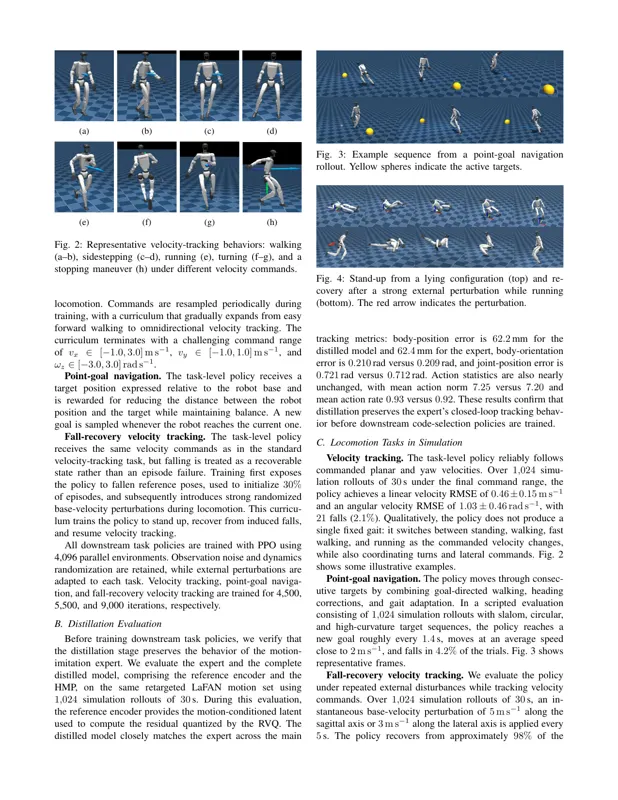
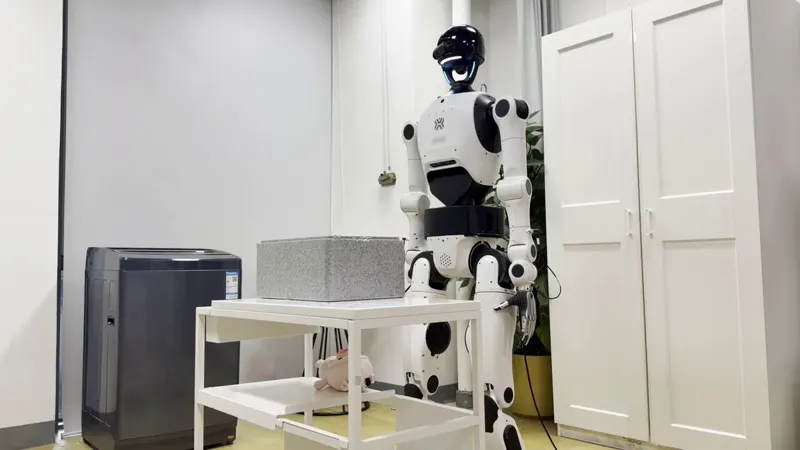
Reinforcement learning can produce robust humanoid controllers, but each new task is typically trained as a separate policy with its own reward design and training process. Motion imitation provides an alternative source of motor competence by training policies to track retargeted human motions, yet the resulting controllers remain reference trackers and are not directly usable as task policies. We propose a three-stage pipeline that turns motion-imitation skills into a reusable hybrid motion prior (HMP) for humanoid locomotion. First, an expert policy is trained to imitate retargeted human motion-capture clips. Second, the expert is distilled into a frozen architecture composed of a proprioceptive encoder, a residual vector-quantized (RVQ) codebook, and an action decoder. Third, task-level policies are trained to solve locomotion tasks by selecting discrete codebook entries while the HMP remains frozen. We evaluate the method on velocity tracking, point-goal navigation, and fall-recovery velocity tracking in simulation, and deploy the velocity-tracking policy on a real Unitree G1 robot. The distillation process preserves the tracking behavior of the expert, while the resulting HMP can be reused without retraining as the action interface for different downstream locomotion policies. The learned HMP reveals an interpretable codebook structure in which the number of active RVQ stages modulates the available gait patterns. We further show that training the codebook with the rotation trick improves latent organization and reduces downstream falls compared with a standard straight-through estimator.

Valerio Belli, Valerio Modugno, Enrico Mingo HoffmanJul 27, 2026
Motion ImitationHumanoidGait optimizationJul 27, 2026