Skip to content
Tags

#NVIDIA GR00T (5)

PhyAI: Real-Time Physical AI at the Edge, Scalable Rollouts in the Cloud

PhyAI: Real-Time Physical AI at the Edge, Scalable Rollouts in the Cloud

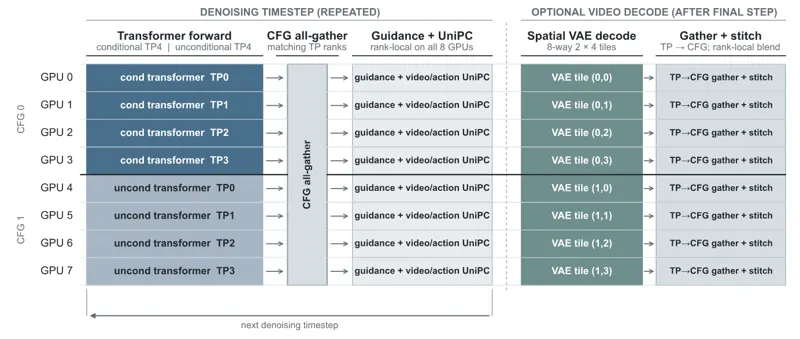
Physical AI policies require inference throughout their lifecycle, including model evaluation, cloud reinforcement learning rollout, edge GPU serving, and onboard deployment. Although these settings share the same checkpoint and action semantics, they often rely on separate inference programs. To unify them, we build PhyAI, a Physical AI inference engine with a single runtime that keeps architecture-specific conditioning, solver, cache, and output logic in model adapters while sharing graph execution, kernels, memory management, and parallel services. The same codebase runs vision-language-action (VLA) models and world-action models (WAMs) on single or multiple GPUs across onboard, edge, and cloud deployments. We used the adapter interface to add MiniCPM-Robot on the day of its release. PhyAI achieves 1.40x-4.65x speedups over the official implementations of pi0, pi0.5, GR00T N1.7, and MiniCPM-Robot. On Cosmos3-Nano-Policy-DROID it reduces latency from 2.46 to 1.18 s on eight H20 GPUs (CFG=2, TP=4), a 2.08x speedup. Specialized runtimes remain faster in several configurations, so our goal is one runtime with competitive latency rather than the fastest result in every case. Detailed profiles reveal why different models need different execution policies: on a Hopper-series GPU at batch size one, the pi0.5 action expert accounts for 8.8% of FLOPs but 57.2% of latency; at batch size 32 its share drops to 13.5% and throughput reaches about 100 samples/s. Cosmos3 remains generation-dominated and gains only 14.3% throughput as batch size increases from 1 to 16. We further introduce the control-time Roofline, which distinguishes inference-bound from environment-bound control; the measured pi0.5 points on four LIBERO suites are environment-bound while Cosmos3 stays inference-bound. Code and benchmarks: https://github.com/mingti-org/phyai.
Chenghua Wang, Daliang Xu, Dongqi CaiAug 4, 2026
Physical AIVLAPhyAIAug 4, 2026
πR²: Reactive Real-time Flow Policies

πR²: Reactive Real-time Flow Policies

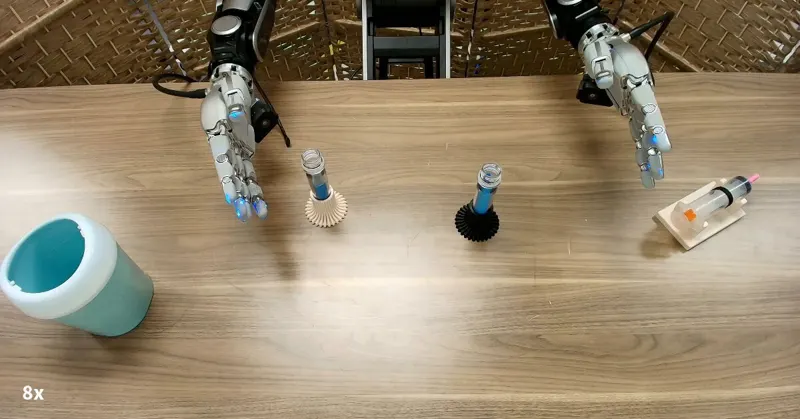
Generalist manipulation policies increasingly take the form of action-chunking flow policies built on large pretrained backbones. Such chunks run open-loop, so the policy cannot react to sensory input arriving mid-execution, sacrificing reactivity. Replanning more often would restore it, but the perception-to-action pipeline (a large backbone plus multiple denoising steps) is too slow: this latency forbids frequent replanning and leaves committed actions stale, making such policies ill-suited for dynamic, closed-loop control. We present πR², which makes these policies reactive and real-time while retaining large backbones, expressive multi-modal policies, and multi-action prediction. Built on the per-position noise schedule of diffusion forcing, πR² contributes two ideas. First, it splits conditioning into a fast channel (proprioception, fresh every tick) and an asynchronously updated slow channel (vision-language features), so the policy reacts to proprioception within a chunk while tolerating stale vision. Second, a latency-adaptive flow schedule treats in-flight actions as inpainting conditioning and emits actions in one denoising step per call, letting one trained model adapt to varying hardware latency. Requiring minimal modification to existing architectures, πR² can be finetuned from a pretrained policy: applied to GR00T-N1.7 on a real xArm6+XHand platform, it replans closed-loop roughly 4× faster than the base policy (~$25$Hz on an A5000 GPU), acting on a fresh observation every $40$ms. Across simulation and real-world manipulation tasks, πR² improves the success rate by up to 23% in simulation and 30% in the real world over the strongest baseline. Project page: https://pi-r2-flow.github.io/

Sungjae Park, Shubham TulsianiJul 28, 2026
VLAreactivediffusionJul 28, 2026
Closing the Loop in Humanoid VLA: Persistent 3D Object Tokens for Verifiable Loco-Manipulation

Closing the Loop in Humanoid VLA: Persistent 3D Object Tokens for Verifiable Loco-Manipulation

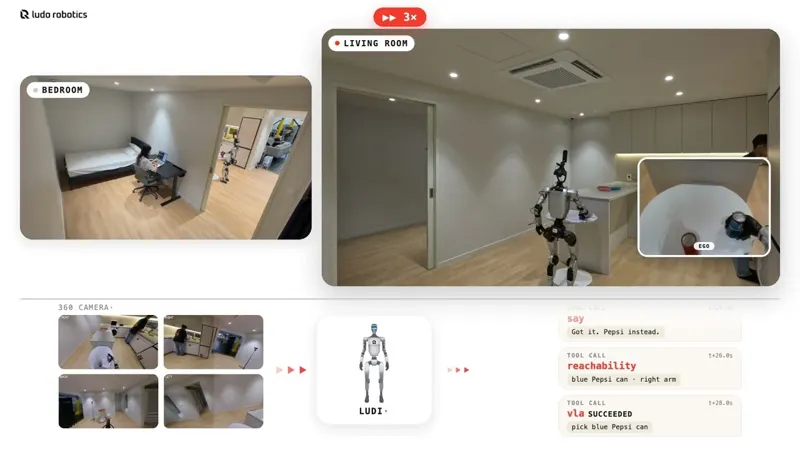
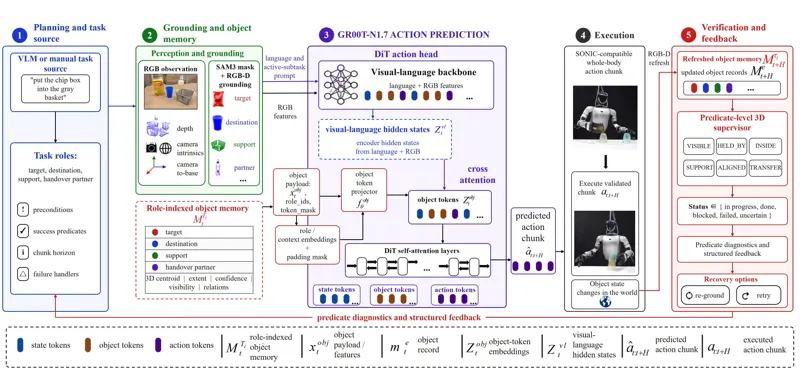
Vision-language-action policies are a promising foundation for general robot control, but long-horizon humanoid loco-manipulation requires the robot to treat task objects as persistent physical entities across movement, contact, occlusion, and recovery. We study this problem as object-state divergence: the object state used to condition a whole-body action can differ from the state used to decide whether the action achieved the intended physical relation. We propose Persistent Object Tokenization (POT), which maintains role-indexed 3D object records from RGB-D observations and converts them into object tokens for a whole-body action expert. Instantiated as POT-VLA, the same object records condition action generation and support geometric predicate checks, yielding a closed-loop execution system in which object state is both actionable and verifiable. On a Unitree G1, POT-VLA improves a matched direct GR00T-N1.7 baseline from 39/80 to 71/80 successes over eight real-world task families. In an external Being-0-aligned reference, POT-VLA achieves 44/50 successes on aligned service tasks, compared with the 37/50 success reported by the Being-0 paper. The largest gains occur on tasks requiring maintained 3D relations, suggesting that persistent object-centered state is a useful abstraction for verifiable humanoid VLA execution.

Peng Ren, Haoyang Ge, Jiang ZhaoJul 20, 2026
VLARGB-DUnitree G1Jul 20, 2026