Skip to content
← Tags

#Robot Agent (6)

Envisioning Agentic Robotics: A New Era of Robotic Systems

Envisioning Agentic Robotics: A New Era of Robotic Systems

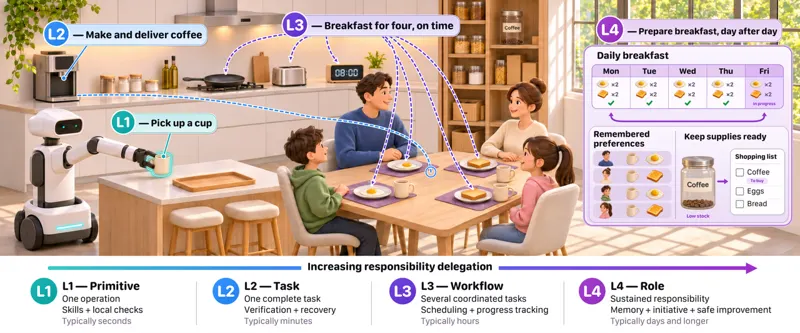
The release of GPT-6 Astra marks the emergence of a new paradigm in robotics: agentic robotics. Within weeks, frontier models with agentic harnesses matched or exceeded task-specific policies on many embodied benchmarks. Instead of training a dedicated policy for each family of tasks, an agentic robotic system applies a foundation model to open-world embodied tasks. It operates in a closed loop: observing the environment, interpreting user intent, reasoning about the task, invoking skills and tools, verifying outcomes, and adapting its strategy. Despite these advances, the community has yet to converge on a shared definition, a reliable evaluation framework, or a research roadmap. We argue that Embodied System 2, realized by a foundation model together with an embodied harness, forms the decision-making core of agentic robotics. Its central challenge is to translate general-purpose reasoning into effective and verifiable actions under physical constraints such as limited reaction time, mechanical limits, unpredictable environment changes, and irreversible consequences. Motivated by this perspective, we propose an evaluation framework that measures both model capabilities and closed-loop system performance. Furthermore, we identify the principles that carry over from digital to physical agents and the challenges that must be addressed to achieve reliable physical autonomy. On top of the Embodied System 2 and the evaluation framework, we envision a research roadmap toward sustained autonomy: the ability to perform work safely and reliably with progressively broader responsibility, from executing individual primitives to fulfilling standing roles.
Grid Robotics, Qingfeng Lan, Duo Li · 98 views · Nov 13, 2026
Agentic RoboticsAI
Nov 13, 2026
ABot-AgentOS: A General Robotic Agent OS with Lifelong Multi-modal Memory

ABot-AgentOS: A General Robotic Agent OS with Lifelong Multi-modal Memory

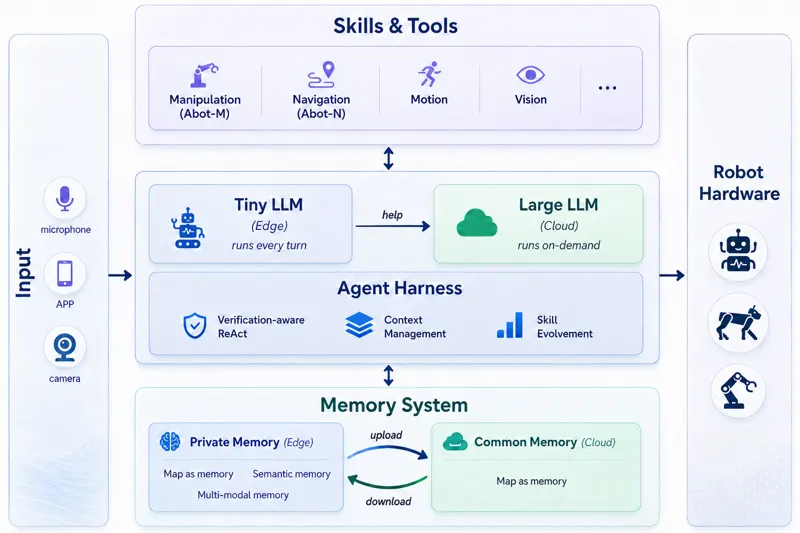
Recent VLM and VLA systems have improved robotic perception and action prediction, yet long-horizon embodied agents still require a general runtime layer for reasoning, memory, tool use, verification, and cross-embodiment execution. We present ABot-AgentOS, a general robotic Agent Operating System that sits above low-level controllers and provides a deliberative agent layer for scene-conditioned planning, context-isolated skill execution, multi-stage verification, multi-modal memory, and edge-cloud collaboration. To evaluate such systems, we introduce EmbodiedWorldBench, an executable benchmark with 16 indoor, outdoor, and hybrid scenes, four difficulty levels, and over 200 tasks involving navigation, object search, NPC dialogue, dynamic events, and trace-grounded scoring. ABot-AgentOS further introduces Universal Multi-modal Graph Memory, a persistent source-grounded substrate that converts dialogue, visual observations, spatial context, temporal relations, and task traces into typed nodes and edges. A failure-driven self-evolution loop converts diagnosed memory failures into gated runtime evo-assets that are promoted only to later evaluation splits, preventing current-split ground-truth leakage while enabling continual improvement. On an initial EmbodiedWorldBench subset, ABot-AgentOS improves over a single-controller baseline in both task success and goal completion. Across memory benchmarks, ABot-AgentOS Static achieves 87.5 on LoCoMo, 59.9 on OpenEQA EM-EQA, 88.6 on Mem-Gallery, and 76.5 Acc@All on NExT-QA; self-evolution further improves LoCoMo to 88.7, OpenEQA to 60.4, and Mem-Gallery to 89.0. These results suggest that a general Agent OS layer can improve long-horizon embodied execution while providing persistent, auditable memory for continual interaction.

Jiayi Tian, Shiao Liu, Yuting Xu · 830 views · Jul 11, 2026
AgentOSEmbodiedWorldBench
Jul 11, 2026

As an Amazon Associate, we earn from qualifying purchases.