Skip to content
← Tags

#Robot navigation (10)

OpenBelief-Nav: Evidence-Preserving Object Memory for Open-Vocabulary Language-Guided Navigation

OpenBelief-Nav: Evidence-Preserving Object Memory for Open-Vocabulary Language-Guided Navigation

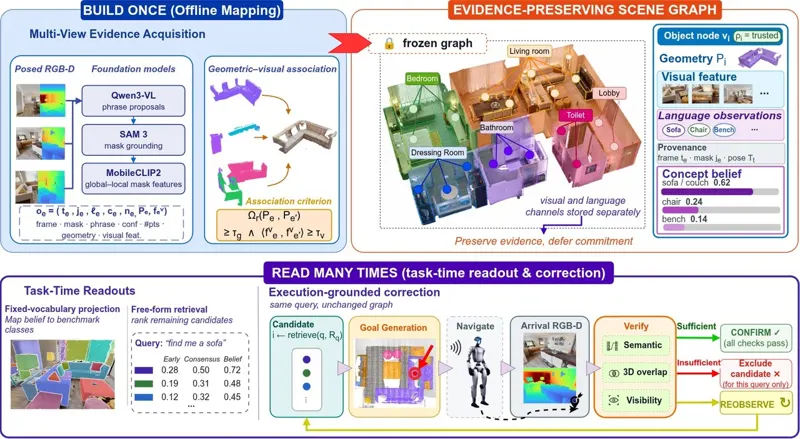
Open-vocabulary 3D scene graphs provide compact semantic memory for language-guided navigation, but mapped objects are often exposed through a single fused feature or committed semantic label. Such commitment can remove minority yet task-relevant hypotheses from the task-time interface. We present OpenBelief-Nav, an evidence-preserving object memory that retains observation-level phrases, reliability cues, and frame-mask provenance while maintaining separate aggregate geometric and visual representations. Semantically related phrases are consolidated into a vocabulary-independent object belief from which task-specific readouts perform fixed-vocabulary projection or free-form retrieval. On five ScanNet200 and eight Replica scenes, full-belief projection achieves mIoU scores of 0.2742 and 0.2912, compared with 0.2393 and 0.2701 for a matched early-commit readout. Across 78 HM3D-YCB navigation trials, consensus and early-commit retrieval each achieve 60/78 successes, compared with 58/78 for belief-weighted retrieval and 55/78 for DualMap. Across 20 Unitree G1 runs organized as 10 matched evaluation cases, a correction policy permitting at most two verified candidate attempts improves target-confirmation success from 6/10 to 8/10 relative to top-1-only execution. Code will be released upon acceptance at https://openbelief-nav.github.io/.
Dinh Tuan Nguyen, Anh Dao, Phuong Nam Dang · 35 views · Aug 14, 2026
Open-Vocabulary Navigation3D scene graphs
Aug 14, 2026
StageVLN: Spatial and Trajectory Auxiliary Guidance for Efficient Vision-Language Navigation

StageVLN: Spatial and Trajectory Auxiliary Guidance for Efficient Vision-Language Navigation

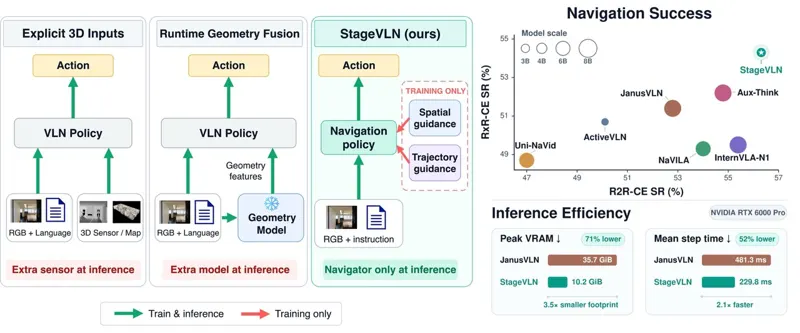
Vision-and-Language Navigation (VLN) policies increasingly benefit from strong semantic priors provided by large vision-language models (VLMs). However, standard action supervision does not explicitly encourage intermediate representations to preserve scene geometry, relative orientation, or global episode progress. Incorporating depth estimators, explicit maps, point clouds, or geometry foundation models at inference can provide such structure but introduces additional computation, memory overhead, and architectural dependence during deployment. We introduce StageVLN, a training framework that shapes navigation representations through privileged spatial and trajectory guidance while preserving the original inference pathway. A frozen geometry foundation model provides multi-level spatial guidance to hierarchical navigator states, while relative-heading and expert-route progress objectives provide complementary trajectory-state supervision. All auxiliary components are used only during training and removed at deployment. On R2R-CE validation-unseen, StageVLN achieves 56.3% SR and 51.4% SPL with a 4B-parameter backbone, without an additional geometry encoder at inference. On RxR-CE, it achieves 54.3% SR without additional navigation training data or a geometry encoder at inference.

Anh Dao, Quan-Dung Pham, Le Danh Vinh · 98 views · Oct 5, 2026
Vision-language navigationEmbodied AI
Oct 5, 2026
Long Range Navigator (LRN): Extending robot planning horizons beyond metric maps

Long Range Navigator (LRN): Extending robot planning horizons beyond metric maps

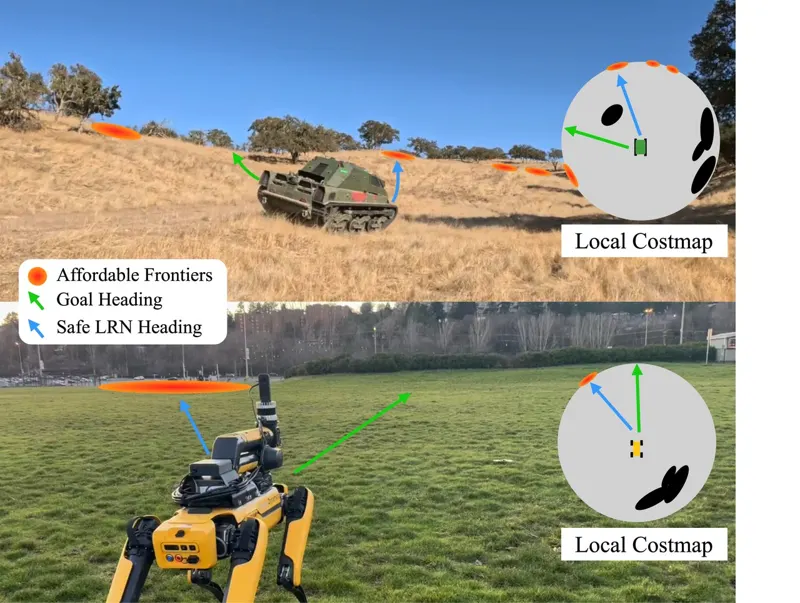
A robot navigating an outdoor environment with no prior knowledge of the space must rely on its local sensing to perceive its surroundings and plan. This can come in the form of a local metric map or local policy with some fixed horizon. Beyond that, there is a fog of unknown space marked with some fixed cost. A limited planning horizon can often result in myopic decisions leading the robot off course or worse, into very difficult terrain. Ideally, we would like the robot to have full knowledge that can be orders of magnitude larger than a local cost map. In practice, this is intractable due to sparse sensing information and often computationally expensive. In this work, we make a key observation that long-range navigation only necessitates identifying good frontier directions for planning instead of full map knowledge. To this end, we propose the Long Range Navigator (LRN), that learns an intermediate affordance representation mapping high-dimensional camera images to affordable frontiers for planning, and then optimizing for maximum alignment with the desired goal. LRN notably is trained entirely on unlabeled ego-centric videos making it easy to scale and adapt to new platforms. Through extensive off-road experiments on Spot and a Big Vehicle, we find that augmenting existing navigation stacks with LRN reduces human interventions at test-time and leads to faster decision making indicating the relevance of LRN.

Matt Schmittle, Rohan Baijal, Nathan Hatch · 54 views · Apr 17, 2025
Long-Range NavigationOff-Road Navigation
Apr 17, 2025
Navigating the Crowd: Non-linear MPC with Social Forces Dynamics for Human-Aware Robot Navigation

Navigating the Crowd: Non-linear MPC with Social Forces Dynamics for Human-Aware Robot Navigation

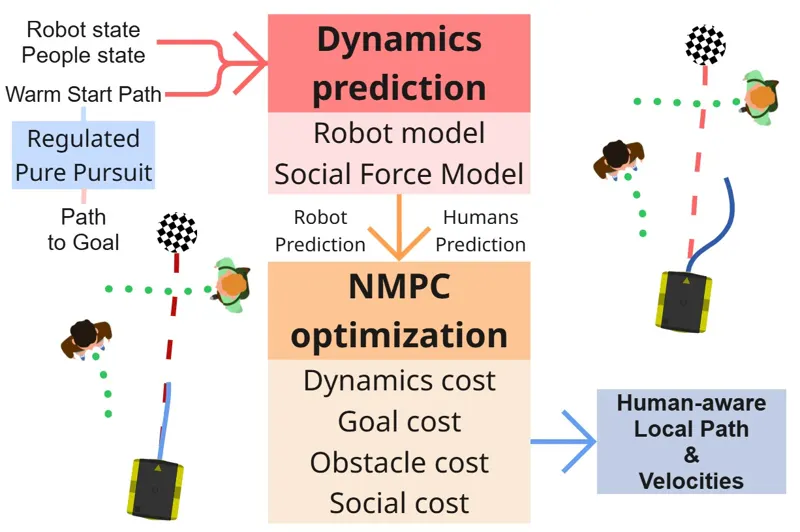
Safe and socially compliant navigation remains a fundamental challenge for autonomous robots operating in human-populated environments. Beyond collision avoidance, robots must anticipate human motion and respect personal space to ensure human comfort. Model Predictive Control (MPC) offers a robust alternative to classical and data-driven methods, although its effectiveness strongly depends on accurate human motion prediction and efficient computation. This paper introduces SFM-NMPC, a Social Force Model-based Non-linear Model Predictive Control framework that embeds human motion prediction directly within the optimization loop. By incorporating the Social Force Model into the dynamic model of surrounding agents, the controller jointly predicts the trajectories of humans and robots over the prediction horizon, thereby enabling socially-aware planning. A tailored set of social cost functions guides the optimization toward human-compliant behaviors. Despite the increased model complexity, the proposed formulation runs in real time at 20 Hz. Extensive simulated testing in crowded environments demonstrates that SFM-NMPC outperforms state-of-the-art baselines in social compliance metrics while maintaining efficient and smooth navigation. Visual trajectory analysis and an ablation study further highlight the contribution of the embedded SFM dynamics and social cost terms, confirming the effectiveness of the proposed approach for real-world social navigation.

Stefano Trepella, Andrea Ostuni, Mauro Martini · 543 views · Jul 11, 2026
Robot navigationSocial Navigation
Jul 11, 2026

As an Amazon Associate, we earn from qualifying purchases.