Skip to content
Tags

#Visual-tactile (6)

ViTacWorld: Scaling Visuo-Tactile World Models for Contact-Rich Robot Manipulation

ViTacWorld: Scaling Visuo-Tactile World Models for Contact-Rich Robot Manipulation

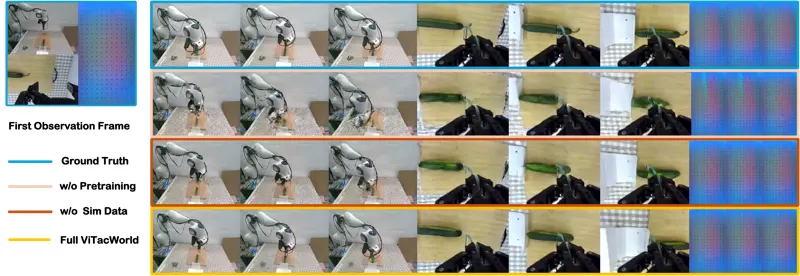
Contact-rich robot manipulation requires physical interaction cues that are often invisible to cameras, making tactile sensing essential for robust control. However, scaling visuo-tactile robot learning remains difficult because real tactile interaction data are expensive to collect, hardware-dependent, and limited in task and scene diversity. We present ViTacWorld, an action-conditioned visuo-tactile world model for scalable contact-rich robot manipulation. ViTacWorld leverages public real tactile datasets and a constructed simulation environment to scale visuo-tactile-action data, exploiting the fact that tactile signals are directly grounded in physical contact and can exhibit a smaller simulation-to-real gap than purely visual observations. The model is first pretrained with large-scale real and simulated visuo-tactile trajectories, and then finetuned with real-world policy rollouts to better match downstream manipulation behaviors. Given robot actions, ViTacWorld predicts temporally aligned visual observations and tactile feedback, enabling visuo-tactile-action rollout generation. To the best of our knowledge, ViTacWorld is the first framework that uses a world model for robot visuo-tactile-action trajectory generation and policy evaluation. It serves two roles: synthesizing rollouts to improve downstream tactile policies, and evaluating policies by predicting action-conditioned visuo-tactile outcomes under controlled action sequences. Experiments on contact-rich manipulation tasks show that ViTacWorld generates physically meaningful rollouts, improves policy performance through scalable data augmentation, and enables action-conditioned policy evaluation. Project page: https://vitacworld.github.io/

Yunao Huang, Shiyu Sang, Haotao LuJul 24, 2026
World ModelsVisuo-TactileRobot ManipulationJul 24, 2026
FELT: Generating Tactile Signals from Vision for Visuo-Tactile Manipulation

FELT: Generating Tactile Signals from Vision for Visuo-Tactile Manipulation

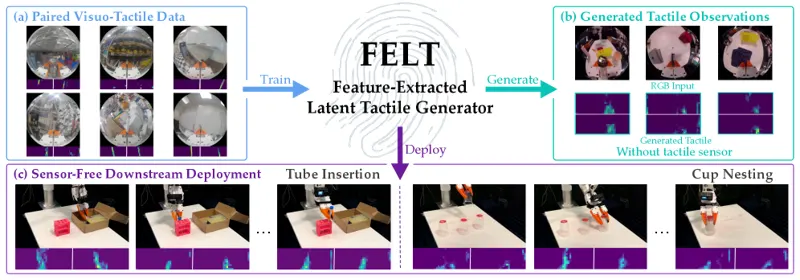
The sense of touch is central to manipulation, especially when vision is occluded or ambiguous. Although combining vision and touch improves manipulation, learning robust visuo-tactile policies requires substantial tactile data. Such data remains scarcer than visual data, because tactile sensors are fragile, specialized, and hard to standardize. To address this, we present Feature-Extracted Latent Tactile (FELT), a learning-based framework that synthesizes per-finger pressure tactile images from RGB observations, reducing the need for tactile-equipped data collection. FELT uses a large frozen visual encoder and a lightweight query decoder to predict tactile signals in a single feed-forward pass. To respect the physical topology of dual-finger tactile sensors, FELT decodes the left and right tactile sensor panels through separate branches, capturing the asymmetric contact patterns during interactions such as wiping, insertion, and in-hand rotation. At inference time, FELT only requires RGB data, allowing us to augment existing vision-only data with tactile observations, either as generated tactile images or as latent tactile features. Experiments on four contact-rich manipulation tasks demonstrate that both generated tactile images and latent tactile features improve policy success over vision-only baselines, with latent feature requiring no real tactile sensor during policy training or deployment. Supplementary material is available on our anonymous website: https://felt-tactile.github.io/.

Zinan Li, Yiyang Ling, Yuming GuJul 22, 2026
Tactile GenerationVisual-tactileCross-ModalityJul 22, 2026