PAPER DEEP DIVE
WorldDiT:面向世界与动作建模的统一扩散架构
提出WorldDiT,统一扩散架构同时建模世界与动作,在世界模型与动作生成上取得平衡,服务于具身智能。
1. 论文概览:无需大 VLM 骨干的统一扩散世界-动作模型
WorldDiT 由 Sen Wang、R. Gnana Praveen、Bidhan Roy、Marcos Villagra 于 2026 年 7 月提出,是一个统一扩散 Transformer 架构,将动作生成与视觉世界建模耦合,在无需大型预训练视觉-语言模型(VLM)作为动作骨干的情况下取得强性能。训练时,单一扩散 Transformer 生成连续动作 chunk 并从未来相机帧预测归一化 RGB patch 目标。在 LIBERO 四个仿真套件上,WorldDiT 在报告所有四套件方法中,位于"总参数量 vs 平均成功率"的 Pareto 前沿,为未来缩放研究提供了一个强力的亚十亿参数基线。系统总参数 399.084M(含推理所需冻结模块),可训练参数 135.107M。
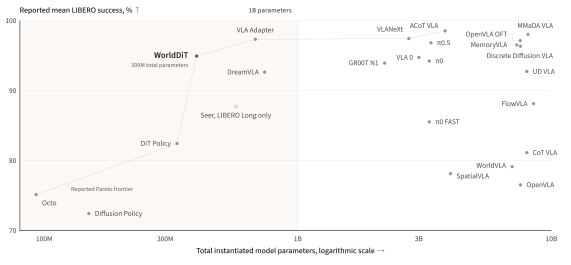
图 1 绘制了 24 种方法在 LIBERO 上的报告成功率与总参数量。连线为报告均值的前沿方法;WorldDiT(399M 总参数、94.9% 均值)位于前沿上——在所有报告四套件均值的方法中,性能更高者均使用更多参数,参数更少者成功率均更低。
2. 核心问题:规模与架构贡献的分离
论文开篇点出一个结构性问题:许多机器人策略遵循语言建模的熟悉模式——将动作生成挂载到大型预训练模型上。这带来广泛的感知与语言理解,但也使规模与架构的贡献难以分离。当策略包含数十亿参数时,强控制可能来自动作设计、预训练骨干,或二者结合。WorldDiT 因此追问:一个统一扩散 Transformer 架构能否将连续动作生成与辅助未来视觉预测目标结合,在不使用大型预训练 VLM 作动作骨干的情况下保持强控制性能?
3. 方法:统一 DiT 骨干
3.1 概览与问题形式化
设 $N$ 步轨迹段从索引 $u$ 起为:
$$\mathcal{W}_u = \left\{(\mathbf{o}_i, \mathbf{s}_i, \mathbf{a}_i)\right\}_{i=u}^{u+N-1} \tag{1}$$其中 $\mathbf{o}_i = (I_i^p, I_i^w)$(公式 2)含主相机图像 $I_i^p$ 与腕部相机图像 $I_i^w$,$\mathbf{s}_i$ 为机器人状态,$\mathbf{a}_i \in \mathbb{R}^{d_a}$ 为动作,$\ell$ 为跨段的共享语言指令。前 $C$ 步构成观测上下文。当前控制步为 $i=u+C-1$,可用历史为:
$$\mathcal{H}_i = \left(\ell, \left\{(\mathbf{o}_j, \mathbf{s}_j)\right\}_{j=u}^{i}\right) \tag{3}$$动作目标为 $H$ 步动作 chunk。WorldDiT 使用冻结的视觉与语言编码器,以及可训练的机器人状态编码器,将观测上下文条件化到共享 DiT 骨干。训练时骨干接收动作令牌与从未来主/腕相机帧选取的归一化 RGB patch 令牌(均被高斯噪声腐蚀),预测其流速度。未来 RGB patch 预测提供训练期辅助监督。部署时直接走动作路径,RGB patch 令牌与 RGB 预测头不进入推理图。
3.2 训练:流匹配目标
采用流匹配训练。骨干接收干净上下文令牌、被高斯噪声腐蚀的动作令牌与归一化 RGB patch 令牌、其时间步嵌入与可学习寄存器令牌,预测对应速度。目标为回归从高斯噪声到干净目标的直线路径速度。对动作或未来 RGB patch 目标,设 $\boldsymbol{\epsilon} \sim \mathcal{N}(\mathbf{0}, \mathbf{I})$,$\mathbf{y}$ 为干净目标,采样 $\tau \sim \mathcal{U}[0,1]$,定义:
$$\mathbf{x}_\tau = (1-\tau)\boldsymbol{\epsilon} + \tau \mathbf{y}$$流匹配目标为:
$$\mathcal{L}_{\text{flow}} = \mathbb{E}_{\boldsymbol{\epsilon}, \mathbf{y}, \tau}\left[\left\| v_\theta(\mathbf{x}_\tau, \tau, c) - (\mathbf{y} - \boldsymbol{\epsilon}) \right\|_2^2 \right] \tag{4}$$其中 $c$ 为当前步上下文,$\mathbf{y} - \boldsymbol{\epsilon}$ 为目标速度。WorldDiT 为每个目标预测一个速度。总损失为动作速度损失与 RGB patch 速度损失的加权和:
$$\mathcal{L}_{\text{total}} = w_{\text{action}} \mathcal{L}_{\text{flow}}^{\text{action}} + w_{\text{rgb}} \mathcal{L}_{\text{flow}}^{\text{rgb}} \tag{5}$$WorldDiT 用 $C$ 个观测步作条件,预测一个 $H$ 步动作 chunk 和一个由来自 $i+H$ 时刻主/腕相机帧归一化 RGB patch 组成的未来世界目标。仅最终时间槽贡献损失。
3.3 推理:动作生成与滚动视野控制
部署时骨干接收以当前控制步 $t$ 结尾的 $C$ 步历史:
$$\mathcal{H}_t = \left(\ell, \left\{(\mathbf{o}_j, \mathbf{s}_j)\right\}_{j=t-C+1}^{t}\right) \tag{6}$$多模态编码路径将其映射为条件表示 $\mathbf{G}_t$。动作生成从高斯噪声开始:
$$\mathbf{x}_{t,0}^{\text{act}} \sim \mathcal{N}(\mathbf{0}, \mathbf{I}) \tag{7}$$学到的动作速度场被数值积分:
$$\frac{d\mathbf{x}_{t,\tau}^{\text{act}}}{d\tau} = v_\theta^{\text{act}}\left(\mathbf{x}_{t,\tau}^{\text{act}}, \tau, \mathbf{G}_t\right), \qquad \tau \in [0,1] \tag{8}$$经 $T_{\text{samp}}$ 步积分后,最终流态定义预测动作 chunk:
$$\widehat{\mathbf{A}}_t = \mathbf{x}_{t,1}^{\text{act}} \in \mathbb{R}^{H \times d_a} \tag{9}$$执行 $\widehat{\mathbf{A}}_t$ 的前缀(前 3 步),更新历史并重规划——即滚动视野(receding-horizon)控制。
4. 实验:LIBERO 四套件
4.1 数据与模型配置
在 LIBERO 操作基准上评估,使用四个下游套件 libero_spatial、libero_object、libero_goal、libero_10(报告为 LIBERO Long),以及仅用于预训练的大多任务 libero_90 划分。将原始演示转换为含多视角与机器人状态的定长窗口。WorldDiT 总参数 399.084M(含推理所需冻结模块),可训练参数 135.107M。
4.2 主要结果
在四套件各 500 个仿真回合上评估。WorldDiT 取得:Spatial 98.0%、Object 97.0%、Goal 92.8%、Long 91.8%,均值成功率 94.9%。Long 仍是最难的套件,与其任务所需的扩展多阶段行为一致。
| 方法(无大 VLM 骨干) | Spatial | Object | Goal | Long | 均值 |
|---|---|---|---|---|---|
| WorldDiT(本文) | 98.0 | 97.0 | 92.8 | 91.8 | 94.9 |
| DreamVLA | 97.5 | 94.0 | 89.5 | 89.5 | 92.6 |
| FlowVLA | 93.2 | 95.0 | 91.6 | 72.6 | 88.1 |
| DiT Policy | 84.2 | 96.3 | 85.4 | 63.8 | 82.4 |
| Octo | 78.9 | 85.7 | 84.6 | 51.1 | 75.1 |
| Diffusion Policy | 78.3 | 92.5 | 68.3 | 50.5 | 72.4 |
| 方法(有大 VLM 骨干) | 均值 | 对比 |
|---|---|---|
| ACoT VLA | 98.5 | +3.6 |
| MMaDA VLA | 98.0 | +3.1 |
| VLANeXt | 97.4 | +2.5 |
| VLA Adapter | 97.3 | +2.4 |
| OpenVLA OFT | 97.1 | +2.2 |
| $\pi_{0.5}$ | 96.9 | +2.0 |
| $\pi_0$ | 94.2 | -0.7 |
| GR00T N1 | 93.9 | -1.0 |
| OpenVLA | 76.5 | -18.4 |
对比表中,WorldDiT 在无大预训练 VLM 骨干的方法中全面领先,且均值 94.9% 超越了许多使用大 VLM 骨干的方法(如 $\pi_0$ 94.2%、GR00T N1 93.9%、VLA 0 94.7%)。在与有 VLM 骨干的前沿方法对比中,仅 ACoT VLA(98.5%)、MMaDA VLA(98.0%)、VLANeXt(97.4%)等使用更多参数的方法性能更高。
5. 讨论
WorldDiT 表明单一扩散 Transformer 可耦合连续动作生成与未来视觉预测,同时保留仅动作的部署路径。其 LIBERO 表现使 399M 参数系统位于参数-成功率 Pareto 前沿,表明强力基准性能无需将大预训练 VLM 置于动作骨干即可获得。这支持统一世界-动作建模作为跨模型容量、数据多样性与部署设置的紧凑基础。未来工作可刻画归一化未来 RGB 目标如何塑造控制,以及相同权衡是否在更大规模持续。因动作与视觉目标共享流匹配形式,WorldDiT 可支持分解为独立训练的专家。
6. 局限性
- 绝对性能仍不及最强 VLA:94.9% 均值低于使用大 VLM 骨干的前沿方法(如 ACoT VLA 98.5%),表明无 VLM 骨干存在性能上限。
- Long 套件最难:91.8% 低于其他三套件,扩展多阶段行为仍具挑战。
- RGB 目标的作用机理未充分刻画:归一化未来 RGB 目标如何塑造控制尚待未来研究。
- 规模扩展性未验证:相同参数-性能权衡是否在更大规模持续尚未确认。
- 仅仿真评估:结果限于 LIBERO 仿真基准,真实机器人迁移能力未验证。
7. 总结
WorldDiT 是一个统一扩散 Transformer 架构,将连续动作生成与未来 RGB patch 预测耦合于单一骨干,训练时共享流匹配目标,推理时仅走动作路径。以 399M 总参数、135M 可训练参数,在 LIBERO 四套件上取得 94.9% 均值成功率,位于参数-成功率 Pareto 前沿,证明了强力基准性能无需将大型预训练 VLM 置于动作骨干。这一结果支持统一世界-动作建模作为紧凑的缩放基础,为未来跨模型容量、数据多样性与部署设置的研究提供了亚十亿参数的强力基线。
flowchart LR
    A["C 步观测上下文
o_j, s_j, 语言 l"] --> B["冻结视觉/语言编码器
+ 可训练状态编码器"]
    B --> C["条件表示 G_t"]
    C --> D["共享 DiT 骨干"]
    E["高斯噪声 x_0"] --> D
    D -->|"流匹配积分 T_samp 步"| F["预测动作 chunk A_t"]
    F --> G["执行前 3 步"]
    G --> H["更新历史/重规划"]
    H --> A
    D -.->|"仅训练: RGB patch 预测
(推理时关闭)"| I["归一化 RGB patch 目标"]