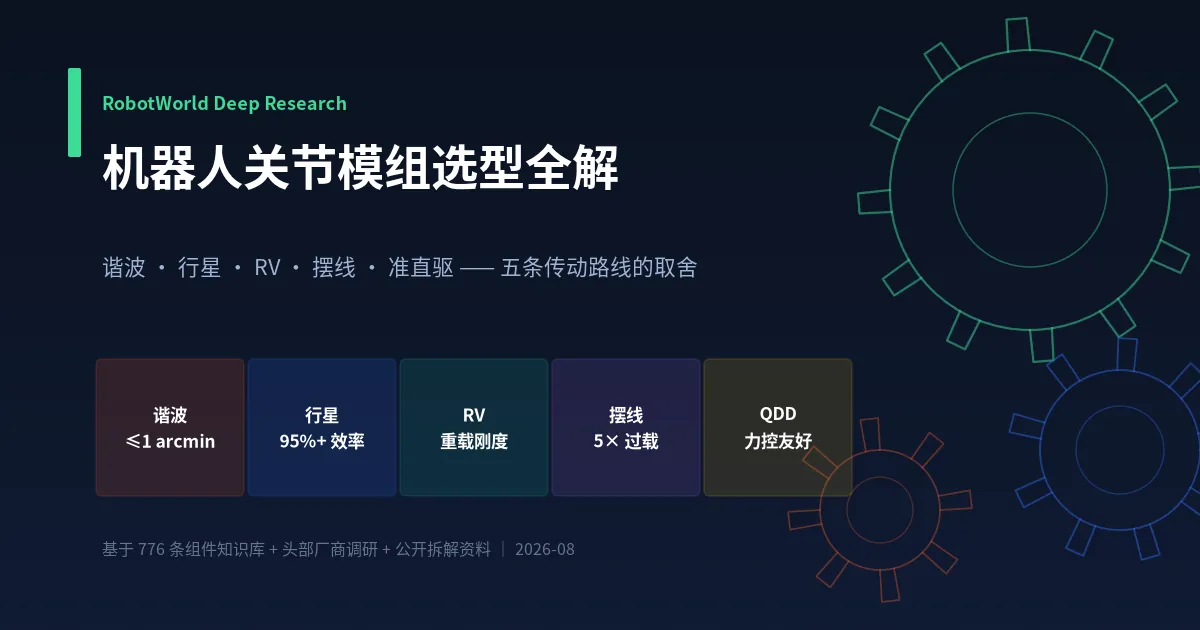
The Complete Robot Joint Module Selection Guide: Harmonic, Planetary, RV, Cycloidal & Quasi-Direct Drive — Vendor Research and Configurations by Robot Weight Class
How should robot joint modules actually be selected? Drawing on 200+ joint-module/reducer entries in the RobotWorld knowledge base, product research on leading vendors (Harmonic Drive, Nabtesco, Leaderdrive, Laifual, Leadshine, EYOBOT, ZeroErr, JIECANG, CubeMars, ENCOS), and item-by-item verification of the supply chains behind Tesla, Unitree, UBTECH, AgiBot and Fourier, this guide systematically compares harmonic, planetary, RV, cycloidal and quasi-direct-drive (QDD) transmission routes on performance and cost, provides a torque-tier product cheat-sheet (0.5-200 N·m) and full configuration recipes by robot weight class (small <=25kg / mid 30-55kg / large 60-100kg), plus a practical pitfall-avoidance playbook.
Introduction: The Joint Module — a Robot's Muscle-Tendon System
If the motor is a robot's "muscle", the reducer is its "tendon" — it converts the motor's high speed into low-speed, high-torque output, and determines whether each joint can execute every motion precisely and stably. Pick the wrong transmission route and the entire robot loses, from the source, the ability to execute commands accurately.
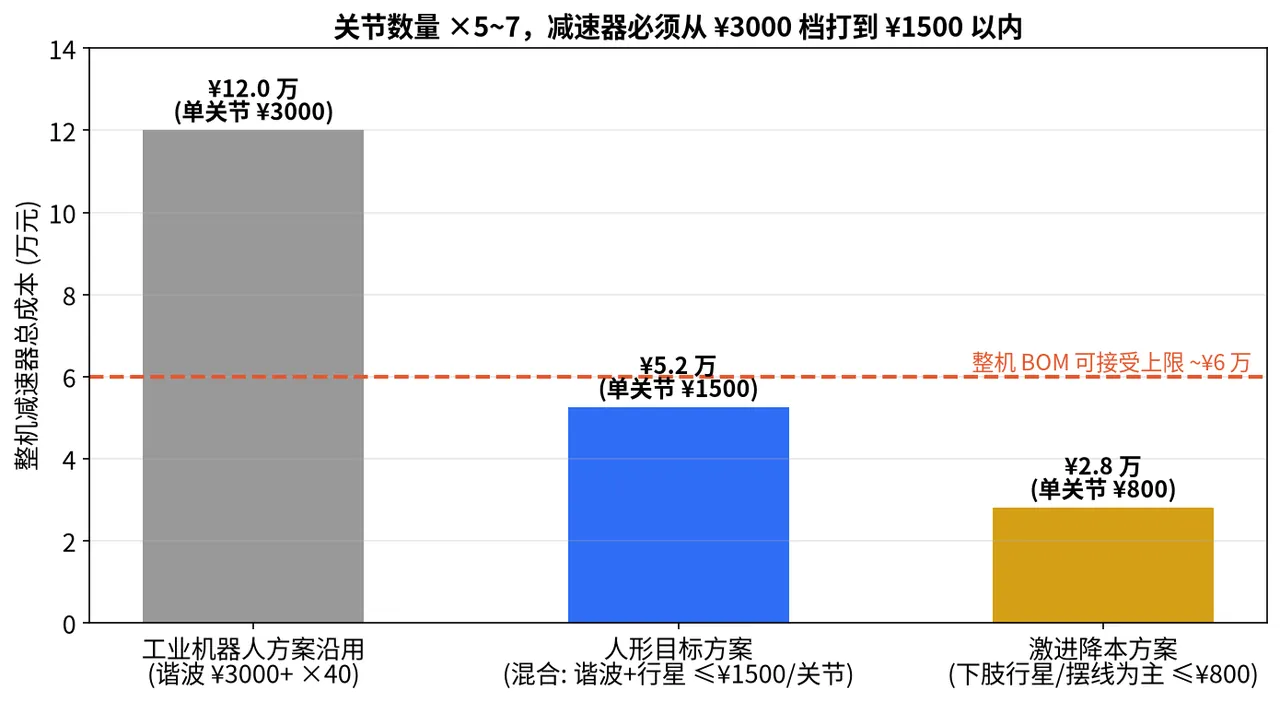
In industrial robot cost structures, reducers account for roughly 30% — the single largest core component cost. Humanoid robots need far more reducers than traditional industrial robots (which use 2-6 units each): a humanoid with 28-42 rotary joints needs nearly as many reducers as motors. This makes joint-module selection both a performance problem and a cost problem — if per-joint transmission cost cannot be pushed below ¥1,500, total transmission cost exceeds ¥60,000-80,000, i.e. 30%-40% of BOM.
This article draws on 200+ joint-module/reducer entries in the RobotWorld knowledge base, product research on leading joint-module and reducer vendors (Harmonic Drive, Nabtesco, Leaderdrive, Laifual, Leadshine, EYOBOT, Juxie Drive, ZeroErr, JIECANG, CubeMars, ENCOS, DaMiao and more), item-by-item verification of the supply chains behind Tesla, Unitree, UBTECH, AgiBot and Fourier, plus industry research and public sources (Xueqiu/Eastmoney supply-chain teardowns, GGII, CSDN teardowns) to answer one question systematically: how should robot joint modules actually be selected? Where do harmonic, planetary, RV and cycloidal each belong — and how should different-sized robots be configured?
The Four Transmission Routes at a Glance
There are four mainstream transmission routes for robot joints today, plus a rapidly rising quasi-direct-drive (QDD) approach. Overview table first:
| Route | Single-stage ratio | Backlash | Efficiency | Life | Cost tier | Typical placement |
|---|---|---|---|---|---|---|
| Harmonic (strain-wave) | 50-320 | ≤1 arcmin (precision 10-20 arcsec) | 70%-90% | 6k-10k h | High | Wrist, forearm, hand, ankle |
| Planetary | 3-10 (multi-stage to 100) | 3-8 arcmin (precision ≤3) | 95%-97% | >20k h | Lowest (single stage: a few hundred CNY) | Hip/knee low-ratio QDD joints |
| RV reducer | 30-260 | ≤1 arcmin | 85%-92% | 20k-30k h | Highest | Base, upper arm, shoulder heavy loads |
| Cycloidal (pure) | 11-87 | 1-3 arcmin | 90%-94% | High | Mid-high (domestic ~50% of Japanese price) | High-torque compact joints, base |
| Quasi-direct drive (QDD) | 4-10 | Encoder-dependent | >95% | High | Low | Ankle, hip, knee force-control joints |
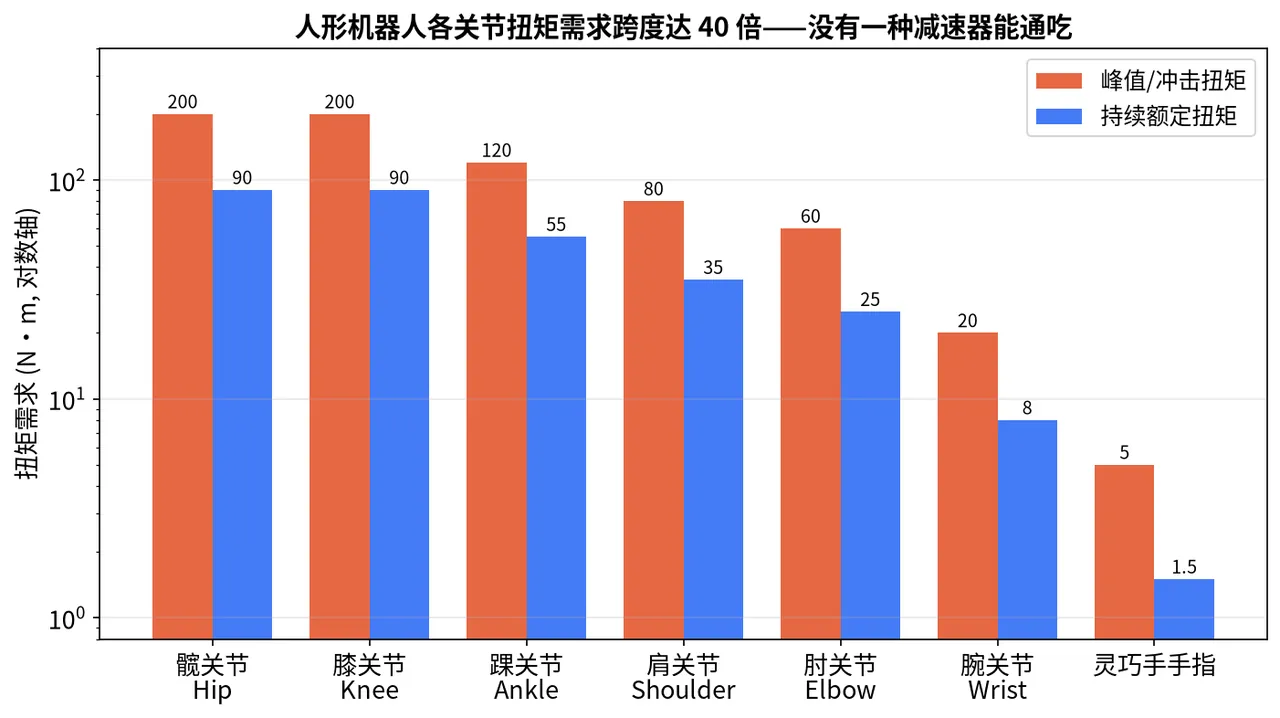
The industry rule of thumb: harmonic for precision light loads, planetary for mid-load dynamic duty, RV for heavy loads. But a humanoid's joint torque demand spans from 0.5 N·m in dexterous-hand fingers to ~200 N·m impact at the hip — a 40x range. No single reducer can cover it all; real designs must mix routes joint by joint.
Cross-Route Performance Comparison
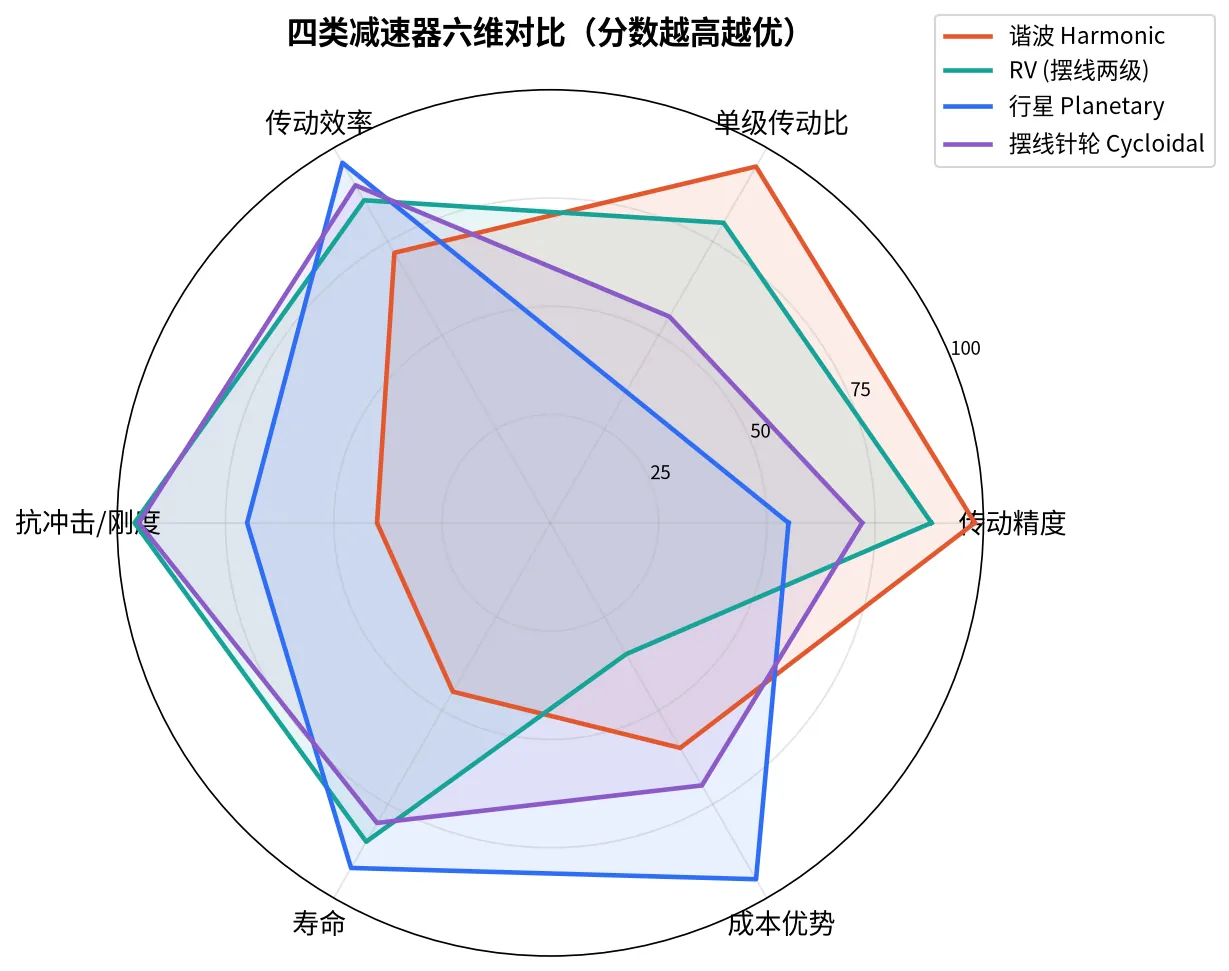
Putting the four routes on one radar chart makes each one's strengths and weaknesses immediately visible:
| Dimension | Harmonic | Planetary | RV | Note |
|---|---|---|---|---|
| Backlash | <1 arcmin | 3-5 arcmin | 1-2 arcmin | Harmonic's zero backlash is principled (multi-tooth meshing of flexspline) |
| Typical ratio | 50-160 | 3-10/stage | 30-200 | Harmonic reaches 100+ single-stage; planetary needs multi-stage trains |
| Torsional stiffness | ~1e4 N·m/rad | ~3e4 | ~5e4 | RV's dual-supported structure is stiffest |
| Precision life | 8k-10k h | 15k-20k h | 20k-30k h | Flexspline fatigue causes harmonic precision to decay over time |
| Cost index | 1.5 | 1.0 | 2.0 | Single-stage planetary = baseline 1.0 |
Data sources: GB/T 30819-2014 (harmonic gear reducers for robots), GB/T 37718-2019 (precision cycloidal-pin reducers for robots), GB/T 41400-2022 (precision planetary gear reducers for robots) plus public industry comparison tests. The three national standards cover exactly the harmonic, cycloidal/RV and planetary routes — cite the corresponding standard as your acceptance-test basis.
Special Constraints of Humanoid Robots
Industrial-robot selection only weighs the torque-precision-life triangle. Humanoids add four harsher constraints:
1. Joint count x5-7, cost must halve
A six-axis industrial robot has 6 joints and uses 2-6 reducers; a humanoid has 28-42 rotary joints. Reusing industrial-grade harmonic drives (¥3,000+ each) would push total transmission cost past ¥100,000. The industry target is ≤¥1,500 per joint; aggressive designs (planetary/cycloidal-dominant legs) push below ¥800:
2. Every gram counts
Mainstream humanoids weigh 55-80 kg. Per MIIT Fifth Electronics Research Institute estimates, every 1 kg of weight saved yields roughly 3%-5% more runtime. Joint modules are the most widely distributed mass on a robot — saving 100 g at each of 40 joints buys 4 kg of runtime dividend. This is also why hollow-shaft designs (cables routed through the axis) are popular: no external cable trays, indirectly saving structural mass.
3. Impact loads and force control
During walking, running and landing, hip/knee joints absorb ~200 N·m-class transient impacts; the ankle additionally needs good back-drivability for force-controlled landing cushioning. Harmonic flexsplines age dramatically faster under repeated impact — the core reason leg joints avoid going all-harmonic.
4. Precision requirements can actually relax
A counterintuitive conclusion: if assembly and compensation algorithms guarantee ±1 mm end-effector accuracy, per-joint backlash can relax from industrial-grade <1 arcmin to ~3 arcmin. Humanoids therefore need not pay the industrial precision premium at every joint — this is what makes planetary's "good-enough" precision viable.
The Four Routes in Depth
Harmonic: the dexterous hand of precision light loads
A harmonic reducer has three core parts — wave generator, flexspline and circular spline — transmitting motion through elastic deformation of the flexspline. Single-stage ratios of 50-320, backlash within 10 arcseconds, small, light, zero-backlash: these traits make it the de-facto standard for precision light-load joints.
Fatal weakness: the flexspline flexes continuously and fatigues; life shortens sharply under sustained heavy or impact loads, and motion precision decays with hours of use. Efficiency also drops at high input speeds (into the low 70s %), with concentrated heat.
Best fit: forearms, wrists, hands and ankles — joints demanding precision and agility under light loads. Market: Japan's Harmonic Drive holds roughly 50%-60% of global share (some estimates run higher); domestically Leaderdrive leads — 2025 harmonic sales of 425,000 units, +72.5% YoY (~246k in 2024), holding 12%-15% global share — followed by Laifual and Han's. Leaderdrive's LCS/LCSG cup series covers 4-969 N·m rated torque at ratios 30-160 with ≤10 arcsec backlash; Laifual's FH hollow-shaft harmonic targets humanoid cable-routing scenarios.
Planetary: the pragmatic choice for mid-load dynamics
A planetary gearbox (sun, planets, ring) delivers 3-10:1 per stage (multi-stage trains reach 100:1), 95%+ efficiency, compact structure, strong load capacity — and the best cost of all routes, with single-stage units priced in the hundreds of CNY.
Limitations: small per-stage ratio, standard backlash 3-8 arcmin, precision degrades under impact. But precision-grade planetary (ground gears + preload backlash elimination) reaches ≤3 arcmin at 2-3x the price.
Best fit: cost-sensitive, moderate-precision mid-load oscillating positions. Humanoid legs are adopting planetary at scale — the hip/knee joints of Unitree and AgiBot platforms, and mainstream modules like the CubeMars AK series and ENCOS EC-A series, lean heavily on 9:1-48:1 planetary. Germany's Neugart (PLE economy / PSNpro precision) remains the international benchmark.
RV: the load-bearing powerhouse
The RV reducer (planetary front stage + cycloidal-pin rear stage) delivers 85%-90% efficiency and the highest fatigue strength, stiffness and life of the four routes, with precision that — unlike harmonic — does not decay significantly over time.
Weaknesses: heavy, bulky, complex, and the most expensive (cost index ~2.0). The classic six-axis industrial configuration is "2 RV + 4 harmonic" — RV on base and upper arm, harmonic on forearm and wrist. Market: Nabtesco holds ~52%-60% global share; its China share fell from 52.3% (2024) to 42.7% (2025), while Shuanghuan — China's #1 domestic RV maker at ~12.5%-15% — plus Qinchuan, Huandong and Zhongda Leader price RV at 60%-70% of Japanese levels and are substituting fast. RV is still rare in humanoids, but lightweight micro-RV programs are underway.
Cycloidal: the underrated torque-density champion
Pure cycloidal-pin reducers share DNA with RV (RV's rear stage is cycloidal-pin) as single-stage standalone products: ratios 11-87, backlash 1-3 arcmin, efficiency 90%-94%. Their core strengths are extreme torque density and overload capability — simultaneous multi-tooth meshing tolerates 5x+ transient overload; Sumitomo's Fine Cyclo A series spans 785-24,000 N·m rated torque, the ceiling for heavy loads.
Slovakia's SPINEA (Timken) integrates cycloidal gearing with crossed-roller bearings in the TwinSpin T series: 37-2,940 N·m rated, ratios 33-191, emergency-stop torque up to 5x rated; its DriveSpin DSH hollow-shaft cycloidal actuators (18-420 N·m rated, 8-40 mm bore) directly target large humanoid joints. Domestically, Zhongda Leader and Jiangsu Tailong price cycloidal at ~50% of Japanese levels. Cycloidal's drawbacks: precision below harmonic and high manufacturing barriers — it is a route "ramping up" in humanoids today.
Quasi-Direct Drive: the Paradigm Shift Humanoids Brought
QDD is the most important transmission trend in humanoid robots: low-ratio (4-10:1) planetary/cycloidal plus a high-torque-density motor, trading some torque multiplication for three dividends:
- Back-drivability: external force reflects to the motor side attenuated only by 1/i, while reflected friction scales with i² — dropping the ratio from 100 to 10 cuts reflected friction ~100x, making the joint "transparent" and naturally suited to force control (ankle cushioning, human-robot interaction compliance);
- Impact tolerance: no elastic weak part like a flexspline; impacts are absorbed directly by gears and rotor inertia;
- Low cost, high efficiency: single-stage planetary costs hundreds of CNY at 95%+ efficiency.
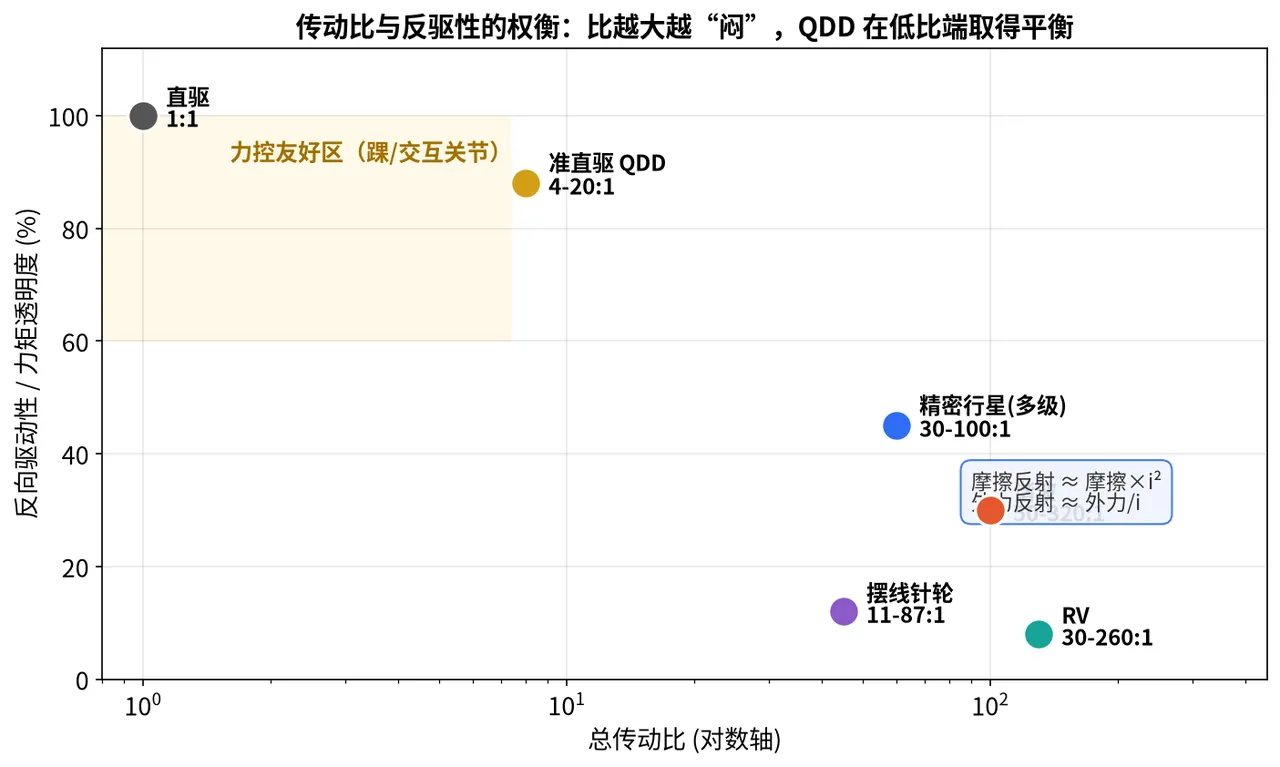
QDD's costs: continuous motor torque is limited to ~30%-40% of peak (thermal limit), and friction compensation / disturbance observers are required to cancel residual friction. Xiaomi CyberOne, Unitree, the MIT Cheetah lineage and RobStride all use this route for legs. RobStride pushes QDD module cost-performance to the extreme: RobStride 04 (9:1, 120 N·m peak, 1.42 kg) at ¥1,199 and RobStride 05 (7.75:1, 191 g) at just ¥499.
Vendor Landscape
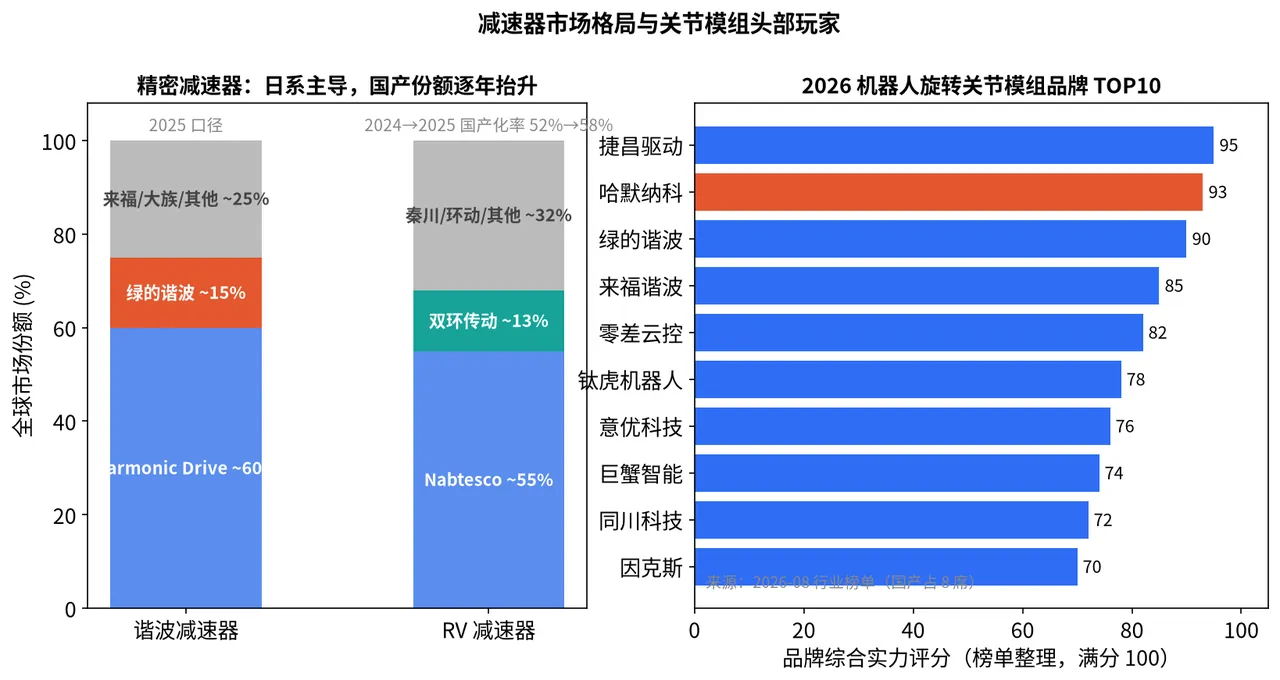
By entry count in the RobotWorld knowledge base (a proxy for product-line breadth and documentation completeness), domestic module vendors are already more active than Japanese ones:
| Vendor | Entries | Main route | Representative products / notes |
|---|---|---|---|
| Harmonic Drive | 19 | Harmonic components | CSF/CSG/FB component sets, global harmonic leader |
| Kaiserdrive (Kaixuan) | 16 | Harmonic modules | Full KGU-08~40 line, 12-762 N·m peak, zero backlash |
| Juxie Drive / EYOBOT | 15 / 15 | Harmonic + planetary | EYOBOT covers both PHA/PHU harmonic and RP planetary lines |
| DaMiao Technology | 14 | Harmonic + planetary modules | DM-JH harmonic 10.5-24 N·m; J6248P 97 N·m peak |
| Leadshine / ENCOS | 14 / 10 | Dual harmonic + planetary | Leadshine HJ2 harmonic 11-194 N·m; ENCOS EC-A full spectrum |
| CubeMars (Sanrui) | 9 | Planetary QDD | AK series 22-222 N·m; AKH70-48 hollow-shaft ¥4,888 |
| RobStride / HCFA | 9 / 9 | QDD / harmonic + planetary | RobStride ¥499-1,199; HCFA Hu-MRS harmonic at 10 arcsec |
| Leaderdrive (Lüdi) | 8 | Harmonic reducers | LCS/LCSG/LHD; China's #1 harmonic, 425k units sold in 2025 (+72.5%) |
| ESTUN Codroid / Windouble / Tongchuan | 6 / 5 / 5 | Harmonic modules | Codroid SA series with integrated torque sensor; Windouble KSG up to 1,600 N·m |
| SPINEA / Laifual / Newgear | 5 / 3 / 3 | Cycloidal / harmonic | SPINEA TwinSpin cycloidal benchmark; Laifual hollow-shaft harmonic + dual-voltage modules |
Also catalogued: Shuanghuan and Qinchuan (RV), Zhongda Leader (harmonic/planetary/cycloidal in parallel — ZD-JM01/02/03), Nabtesco (RV-E/RV-C), Sumitomo (Fine Cyclo), Neugart (planetary), HIWIN (DATORKER harmonic), INNFOS (SCA smart joints), RealMan (WHG modules), MagicLab (H70 harmonic, 96 N·m / 900 g). The sector shows a clear division of labor: Japanese vendors defend reducers, Chinese vendors attack integrated modules.
Integrated joint-module vendors: who can you actually trust
Buying a standalone reducer is only half the story — humanoid mass production runs on integrated modules (motor + transmission + dual encoders + driver). A 2026 rotary-module brand ranking (Daishi Caijing / industry media) is a useful reference, combined with our supply-chain verification:
| Vendor | Route | Representative products | Mass-production track record (verified) |
|---|---|---|---|
| Leadshine | Frameless motors + harmonic/planetary modules | HJ2 harmonic modules 11-194 N·m; FM frameless torque motors | AgiBot (70%+ frameless-motor share, 2026 "Outstanding Supplier", 10k+/month module deliveries), Unitree (50k+ frameless delivered in 2024), UBTECH (15 force-control joints on Walker X, 20k/month orders), Fourier/Galaxea/Dreame; Optimus frameless second-source (via Sanhua/Tuopu) |
| EYOBOT (Yiyou) | Integrated harmonic joints + planetary | PHA/PHU harmonic, RP planetary, high-torque-density integrated joints | AgiBot A2 series mass-production designated supplier; Huashu, Kailda |
| Juxie Drive | Self-developed harmonic modules | Humanoid full joint-module kits | Knowledge-base entry count in the top tier; active in humanoid integrated solutions |
| ZeroErr | eRob rotary joint modules | Inline-I / angle-T types, full torque spectrum | Major supplier to collaborative and multi-joint robots (Shenzhen) |
| Taihu Robotics | Professional joint modules | Humanoid-oriented joint modules | Ranked into the 2026 rotary-module TOP10 |
| JIECANG | Harmonic / planetary / cycloidal, three series | JCRM50-70 (peak 30-180 N·m), JCPM52-124 (rated 4-100 N·m), dual-steel-wheel harmonic; 15 N·m/kg torque density, ±0.01° accuracy | Batch shipments to humanoid joints already running; listed company, 100% self-developed core parts, cycloidal -35% weight / -50% cost |
| Tongchuan Technology | Harmonic / integrated joints | Harmocore lightweight harmonic joints, TRM series 46-672 N·m | Full-spectrum integrated joints, KB-catalogued |
| ENCOS (Yinkesi) | Joint actuators/modules | EC-A full spectrum (including hollow-shaft variants) | KB-catalogued; popular in research and education platforms |
| Leaderdrive (Lüdi) | Harmonic reducer → rotary actuators | LCS/LCSG/LHD reducers, PHT integrated joints, rotary-executor JV with Sanhua | 2025 harmonic sales 425k units (+72.5%), 12%-15% global share; Tesla Optimus rotary-joint harmonic supplier, UBTECH Walker S2 primary harmonic supplier (Nantong base, 1.2M-set capacity) |
| Laifual | Harmonic + modules | FH hollow-shaft harmonic, L52I-L170I modules | Core transmission supplier to multiple module makers; extending downstream into modules |
| Harmonic Drive | Harmonic components + FHA-C actuators | CSF/CSG components, FHA-C rotary actuators | ~50-60% global harmonic share; the premium benchmark |
Module-selection advice: prefer vendors with both self-developed core components and mass-production wins at head robot companies — the former determines cost and delivery stability, the latter is the hardest reliability endorsement. Leadshine and EYOBOT already hold mass-production designations at AgiBot and UBTECH; JIECANG is the listed player covering all three routes (harmonic/planetary/cycloidal); Leaderdrive is the only reducer giant combining harmonic scale with module extension. For pure procurement, qualify 2-3 module vendors and test them in parallel.
What the head robot companies actually use
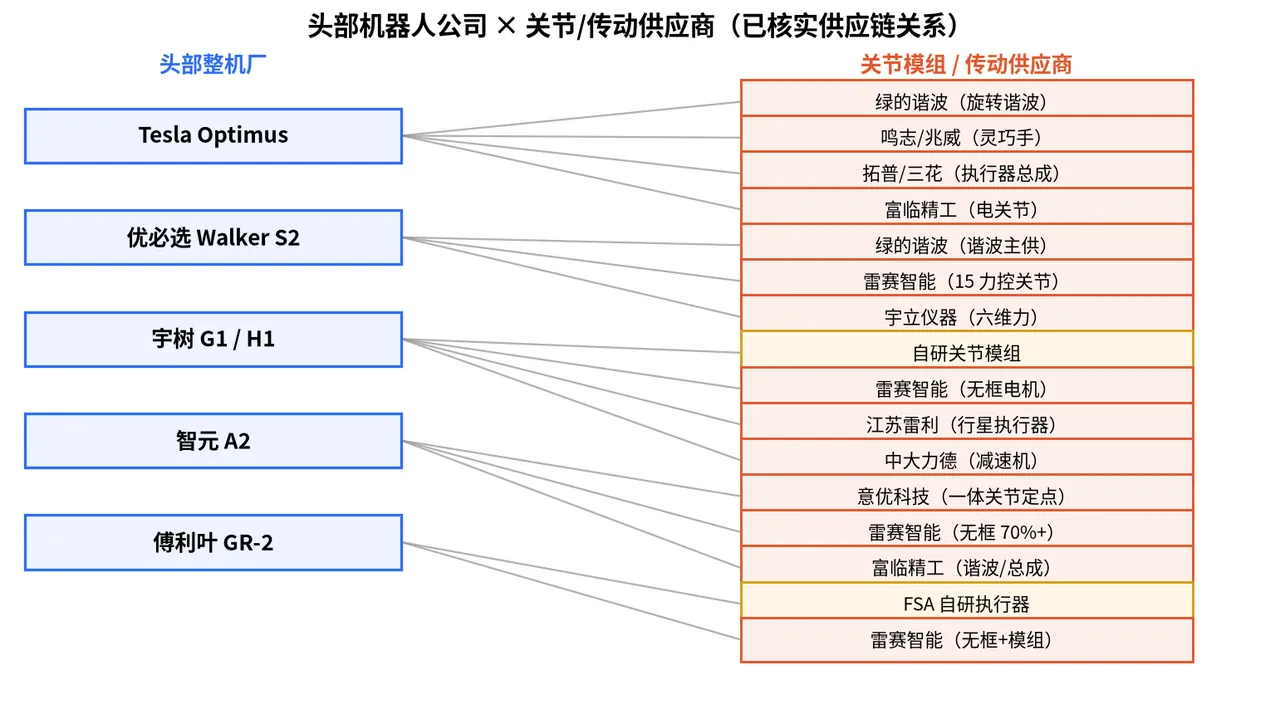
Whose joints do the leaders really buy? A supply-chain map after item-by-item verification (sources: Xueqiu/Eastmoney supply-chain teardowns, company disclosures and third-party reports):
| Robot company | Joint architecture | Verified supply chain |
|---|---|---|
| Tesla Optimus | 28 body joints = 14 rotary (frameless torque motor + harmonic reducer + output encoder/torque sensor, in 20/110/180 N·m tiers) + 14 linear (frameless motor + planetary roller screw), converged to 6 actuator types (3 rotary + 3 linear) | Leaderdrive (rotary-joint harmonics), Moons' / Zhaowei (dexterous-hand micro drives), Tuopu / Sanhua (actuator Tier-1 integrators), Fulin Precision (electric-joint co-development) |
| UBTECH Walker S2 | Servo drivers 100% self-developed (170+ patents, core parts >90% localized); Walker's 36 servo joints mostly harmonic, Walker X/S's 41 joints with self-developed harmonic/planetary integrated drivers | Leaderdrive (main harmonic supplier, Nantong base), ULI (6-axis force sensors), Keli Sensing (torque sensors); 2025 delivered 1,079 units, avg ¥760k, 54.6% gross margin — proof that in-house joints pay |
| Unitree | Fully self-developed joints: motors, reducers, encoders, drivers ("upstream of joint motors there are only copper-wire suppliers"); G1 dual-encoder two-stage planetary modules (total ratio ~20.6), 140 N·m peak instant torque | Leadshine (servo/frameless, 50k+ frameless in 2024), Moons' (control motor modules), Jiangsu Leili ("brushless motor + gearbox" planetary actuators), Zhongda Leader (precision reducers) |
| AgiBot | PowerFlow self-developed joint motors + integrated harmonic joints + high-transparency planetary (ratio <10); A2 with 49 DoF total | EYOBOT (A2 mass-production designated integrated joints), Leadshine (70%+ frameless share, 10k+/month modules), Fulin Precision (harmonic/joint-assembly co-development) |
| Fourier | GR-1: 32 fully self-developed FSA integrated actuators — harmonic upper body, planetary hips | Full actuator stack in-house; among the earliest Chinese vendors to open-source the platform (Fourier N1, 23 DoF) |
Three observations: ① head OEMs universally self-develop or deeply co-develop their joints — pure off-the-shelf buying is now rare in mass-production humanoids, so module vendors enter as "designated suppliers / co-development partners"; ② harmonic remains dominant in rotary joints (all 14 Optimus rotary joints use harmonic), while planetary / roller screws take linear and high-impact joints; ③ a "head-customer designation" is the most credible endorsement a module vendor can hold — Leadshine, EYOBOT and Fulin Precision already ship at volume into AgiBot/UBTECH/Unitree, so shortlist them first.
Joint Module Quick Reference: by Torque Tier
Sorting fully-specified modules from the knowledge base by peak torque shows domestic modules already span the full spectrum from dexterous hands to large joints:
({
  "_height": "420px",
  "backgroundColor": "transparent",
  "grid": { "left": 170, "right": 90, "top": 30, "bottom": 45 },
  "tooltip": {
    "trigger": "axis",
    "axisPointer": { "type": "shadow" },
    "backgroundColor": "rgba(15,23,42,0.95)",
    "borderColor": "#3ddc97",
    "borderWidth": 1,
    "textStyle": { "color": "#e2e8f0" },
    "formatter": function(params) {
      var p = params[0];
      var info = [
        "Harmonic 101:1 · 207 g",
        "Planetary 7.75:1 · 191 g · ¥499",
        "Harmonic 101:1 · 345 g",
        "Planetary 7.75:1 · 405 g · ¥699",
        "Harmonic 51:1 · 985 g",
        "Planetary 9:1 · 540 g",
        "Planetary 9:1 · 940 g",
        "Harmonic 101:1 · 900 g",
        "Planetary 39:1 · 750 g",
        "Harmonic · 900 g",
        "Planetary 9:1 · 1.42 kg · ¥1199",
        "Harmonic 101:1 · 2.0 kg · 10 arcsec",
        "Planetary 48:1 hollow-shaft · 1.4 kg · ¥4888",
        "Harmonic 120:1 · 5.5 kg",
        "Harmonic 121:1 · 7.9 kg",
        "Harmonic 160:1 · 22 kg"
      ];
      return p.name + "
Peak torque: " + p.value + " N·m
" + info[p.dataIndex];
    }
  },
  "xAxis": {
    "type": "log",
    "min": 1,
    "max": 3000,
    "name": "Peak torque (N·m, log axis)",
    "nameTextStyle": { "color": "#64748b" },
    "axisLabel": { "color": "#64748b" },
    "splitLine": { "lineStyle": { "color": "rgba(148,163,184,0.12)" } }
  },
  "yAxis": {
    "type": "category",
    "data": [
      "EYOBOT PHA08L-101",
      "RobStride 05",
      "DaMiao DM-JH11-101",
      "RobStride 02",
      "DaMiao DM-JH17-51",
      "CubeMars AK70-9",
      "CubeMars AK10-9",
      "EYOBOT PHA17H-101",
      "CubeMars AK60-39",
      "MagicLab H70",
      "RobStride 04",
      "HCFA Hu-MRS220N",
      "CubeMars AKH70-48",
      "Windouble KSG-20-120",
      "Kaiserdrive KGU-40D",
      "Windouble KSG-32-160"
    ],
    "axisLabel": { "color": "#334155", "fontSize": 12 },
    "axisTick": { "show": false }
  },
  "series": [
    {
      "type": "bar",
      "barWidth": 13,
      "data": [
        { "value": 3.3, "itemStyle": { "color": "#e4572e" } },
        { "value": 5.5, "itemStyle": { "color": "#2f6df6" } },
        { "value": 10.5, "itemStyle": { "color": "#e4572e" } },
        { "value": 17, "itemStyle": { "color": "#2f6df6" } },
        { "value": 24, "itemStyle": { "color": "#e4572e" } },
        { "value": 29.2, "itemStyle": { "color": "#2f6df6" } },
        { "value": 53, "itemStyle": { "color": "#2f6df6" } },
        { "value": 66, "itemStyle": { "color": "#e4572e" } },
        { "value": 72, "itemStyle": { "color": "#2f6df6" } },
        { "value": 96, "itemStyle": { "color": "#e4572e" } },
        { "value": 120, "itemStyle": { "color": "#2f6df6" } },
        { "value": 220, "itemStyle": { "color": "#e4572e" } },
        { "value": 222, "itemStyle": { "color": "#2f6df6" } },
        { "value": 360, "itemStyle": { "color": "#e4572e" } },
        { "value": 762, "itemStyle": { "color": "#e4572e" } },
        { "value": 1600, "itemStyle": { "color": "#e4572e" } }
      ],
      "label": { "show": true, "position": "right", "color": "#334155", "fontSize": 11, "formatter": "{c} N·m" }
    }
  ]
})
A few anchor products worth noting:
| Module | Transmission | Rated / peak torque | Weight | Highlight |
|---|---|---|---|---|
| CubeMars AKH70-48 | Planetary 48:1 | 74 / 222 N·m | 1,396 g | 159 N·m/kg torque density, 7 mm hollow bore, ¥4,888 |
| ENCOS EC-A9025-P2 | Two-stage planetary 23.6:1 | 100 / 320 N·m (est.) | 1,690 g | Hollow cable routing, built for high-load hips |
| ESTUN Codroid SA20 | Harmonic 101:1 | 52 N·m (rated) | — | Integrated torque sensor, force-control friendly |
| HCFA Hu-MRS220N | Harmonic 101:1 | 120 / 220 N·m | 2.0 kg | 10 arcsec backlash, high-torque harmonic |
| Windouble KSG-32-160 | Harmonic 160:1 | 800 / 1,600 N·m | 22 kg | Domestic high-torque harmonic ceiling |
| Tongchuan TRM series | Harmonic modules | 46-672 N·m | 1.6-8.2 kg | Full integrated-joint spectrum |
| Laifual L52I-L170I | Harmonic 51-161:1 | 11.5-1,530 N·m | 0.55-9.48 kg | DC low-voltage joint module line; one of the top harmonic shippers in China by 2025 shipment volume |
Sizing by Robot Weight Class
Different robot sizes face entirely different torque demands, weight budgets and cost sensitivities. Three weight classes, three configurations:
| Class | Hip / knee | Ankle | Shoulder / elbow | Wrist / hand | Reference platforms |
|---|---|---|---|---|---|
| Small ≤25 kg (education, research, light service) | Single-stage planetary QDD 9:1 (RobStride 02/03, AK70-9; ¥500-1,000 each) | Same as hip/knee or harmonic size 14 | Harmonic size 14/17 (EC-A3814 434 g, PHA08L 207 g) | Micro harmonic 11/14 or micro planetary | RobStride education kits, Unitree Go derivatives |
| Medium 30-55 kg (general-purpose humanoid mainstream) | Planetary 9-48:1 (AK60-39, AKH70-48, EC-A6416) or harmonic size 20/25 | Harmonic size 20/25 (EC-A6013 130 N·m) | Harmonic size 17/20 (EC-A5013 90 N·m, DM-JH17) | Harmonic size 14 + dexterous-hand micro modules (0.5-5 N·m) | Unitree G1 (23-43 DoF, from ~$16k) |
| Large 60-100 kg (high-performance humanoids, heavy duty) | Two-stage planetary 23-25:1 (EC-A9025 320 N·m) or large harmonic/micro RV (KSG-20 360 N·m, TRM 672 N·m) | Harmonic size 25/32 (KSG-17 180 N·m) or cycloidal DSH | Harmonic size 25/32 (KGU-25 198 N·m, Hu-MRS220N) | Harmonic size 17/20 | Unitree H1, industrial-grade humanoids |
Three rules of thumb:
- The heavier the robot, the more its legs should avoid pure harmonic: hips/knees of 60 kg+ humanoids see impacts near 200 N·m and flexspline fatigue risk spikes — planetary/cycloidal/large harmonic is the safer choice;
- The lighter the robot, the more it can go all-harmonic: under 25 kg, impact loads are small, harmonic's precision and lightness shine, and cost stays acceptable;
- Upper limbs always lean harmonic: regardless of size, shoulder/elbow/wrist loads sit inside harmonic's comfort zone; only heavy-duty industrial arms need RV or large cycloidal at shoulder/base.
Industry Practice: How the Leaders Configure
Six-axis industrial robots: 2 RV + 4 harmonic
The classic recipe persists: RV on base and upper-arm axes (heavy load, high stiffness), harmonic on the three forearm/wrist axes (light, small, precise). The logic: stiffness for heavy loads, precision for light loads.
Tesla Optimus: rotary harmonic + linear roller screws
Teardowns converge on a clear architecture: 28 body joints = 14 rotary (frameless torque motor + harmonic reducer + output encoder/torque sensor, in 20/110/180 N·m tiers) + 14 linear (frameless motor + planetary roller screw) — the elbow/knee/ankle flexion positions use linear roller-screw actuators rather than planetary gear reducers — converged to 6 actuator types (3 rotary + 3 linear). Harmonic on the rotary side, roller screws on the linear side, frameless motors and structure self-supplied: the textbook case of "designing transmission for mass production."
Unitree: fully in-house, planetary-dominant
Unitree is the most thorough self-developer: joint motors, reducers, encoders and drivers are all built in-house (official line: "upstream of joint motors there are only raw materials like copper wire"). G1 uses dual-encoder two-stage planetary joint modules (total ratio ~20.6) with 140 N·m peak instant torque — harmonic upper limbs, planetary-dominant legs — holding the starting price at ~$16k through a simplified actuator architecture; H1, the performance platform, emphasizes joint torque density and positional accuracy. External supply concentrates at the component level: Leadshine (servo/frameless motors, 50k+ frameless delivered in 2024), Moons' (control motor modules), Jiangsu Leili ("brushless motor + gearbox" planetary actuators), Zhongda Leader (precision reducers).
The emerging "hybrid template"
Across teardowns, humanoid transmission is converging on a template: harmonic upper limbs, small RV or large harmonic at shoulder/elbow, planetary or cycloidal at hip/knee, harmonic at the ankle (small/medium robots) or planetary QDD (large robots).
Per-Joint Selection Decision Tree
flowchart TD
    A["Three questions per joint:
How much torque? Force control needed? What budget?"] --> B{"Peak torque > 150 N·m?"}
    B -->|"Yes"| C{"Heavy impact (walking/jumping)?"}
    C -->|"Yes"| D["Two-stage planetary 20-50:1
or cycloidal / micro RV"]
    C -->|"No"| E["Large harmonic size 25-40
(KSG/TRM class)"]
    B -->|"No"| F{"Force control / back-drivability needed?"}
    F -->|"Yes"| G["QDD: single-stage planetary 4-12:1
+ friction compensation"]
    F -->|"No"| H{"Torque > 40 N·m?"}
    H -->|"Yes"| I["Harmonic size 20/25
or planetary 30-50:1"]
    H -->|"No"| J{"Precision < 1 arcmin required?"}
    J -->|"Yes"| K["Harmonic size 11-17"]
    J -->|"No"| L["Precision planetary vs harmonic,
decide by cost"]
Selection Pitfalls: A Practical Guide
From public cases and vendor interviews, the six most common traps:
- Pitfall 1: Matching on motor power alone, ignoring load inertia and peak torque.Under fast start-stop, inertia mismatch causes oscillation and overcurrent. Compute peak torque = load torque + inertial acceleration torque, then keep 1.5-2x margin.
- Pitfall 2: Confusing rated with peak, and peak with continuous.Peak torque typically holds for only hundreds of milliseconds to seconds; continuous torque is ~30%-40% of peak (especially for QDD modules). Always verify thermal behavior against the continuous duty cycle.
- Pitfall 3: Blindly choosing harmonic for impact duty.Flexspline fatigue life is extremely impact-sensitive; for hip/knee/ankle either switch routes or oversize the harmonic by 2+ size classes.
- Pitfall 4: Ignoring backlash propagation.Backlash in serial joints accumulates and amplifies at the end effector — but if ±1 mm end accuracy suffices, relaxing to ~3 arcmin and choosing precision planetary saves 40%+ cost.
- Pitfall 5: Comparing reducer unit prices, ignoring integration cost.Discrete builds (motor + reducer + encoder + driver bought separately) look cheaper, but assembly, calibration and cabling engineering can exceed the module premium. For humanoid mass production, integrated joint modules (motor + transmission + dual encoders + FOC drive + CAN) are virtually inevitable.
- Pitfall 6: Forgetting cable routing.Cable management across dozens of joints is a hidden nightmare; hollow shafts (harmonic hollow-bore versions, AKH70, EC-A*H, DriveSpin DSH) are worth paying a premium for.
Final Conclusions and Implementation Path
Compressing the article into an actionable selection path:
| Step | Action | Output |
|---|---|---|
| 1. Define the spectrum | List every joint's peak/continuous torque, speed and impact class | Joint torque spectrum (cf. Fig. 1) |
| 2. Assign routes | Decision-tree per joint: harmonic upper limbs, planetary/cycloidal legs, QDD for force-control joints | Route assignment table |
| 3. Match modules | Pick candidates by torque tier from the knowledge base (quick-ref table above); prefer integrated + hollow-shaft | Candidate module list |
| 4. Verify | Continuous-torque thermals, inertia ratio (<3:1 force control, <10:1 position control), backlash accumulation, life (harmonic 6k-10k h) | Verification report |
| 5. Negotiate | Target ≤¥1,500/joint for humanoid mass production; ≤¥3,000 for industrial reuse lines | BOM cost model |
| 6. Dual-source | Qualify ≥2 harmonic vendors (e.g., Leaderdrive + Laifual/HD); domestic planetary supply is mature and multi-source | Supply-chain resilience plan |
One-sentence summary: there is no best reducer — only the right reducer in the right place. Give upper limbs to harmonic, legs to planetary and cycloidal, force-control joints to low-ratio QDD, and cost to domestic integrated modules.
Uncertainties and Information Gaps
Honest limitations:
- Joint torque figures are engineering estimates for 55-80 kg humanoids; specific machines can vary ±30%. Final selection must rest on whole-body dynamics simulation.
- Market-share numbers (HD ~50-60%, Nabtesco ~52-60%, Leaderdrive 425k units in 2025) come from company reports and industry research; measurement bases (units vs revenue, domestic vs global) are not fully consistent.
- Domestic module "rated/peak" labeling is not standardized (some values are vendor estimates, e.g., certain ENCOS models); cross-vendor comparisons need caution — trust measurements.
- Tesla Optimus transmission details come from third-party teardowns and reports, not official sources; Xiaomi and Figure have not published complete transmission BOMs.
- Head-company supply-chain relationships (Leadshine×AgiBot/UBTECH, EYOBOT×AgiBot, Leaderdrive×UBTECH/Tesla, etc.) come from Xueqiu/Eastmoney supply-chain teardowns and media reports — partly industry-channel research, not company filings.
- Cycloidal adoption in humanoids is still early; SPINEA/Sumitomo humanoid deployments are limited. This article's cycloidal outlook is mildly optimistic — keep tracking.
- Knowledge-base entry counts reflect catalog richness, not market share.
Source:RobotWorldhttps://robot.agientry.com/zh/articles/robot-joint-module-selection