Skip to content
← Tags

#Humanoid robots (27)

ASENA: Self-evolving Agents for Embodied Navigation

ASENA: Self-evolving Agents for Embodied Navigation

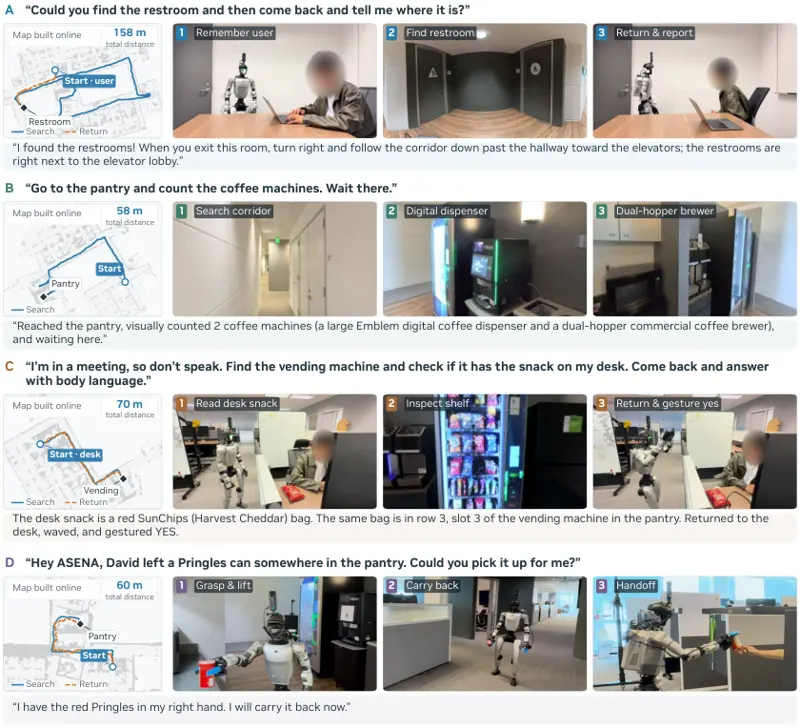
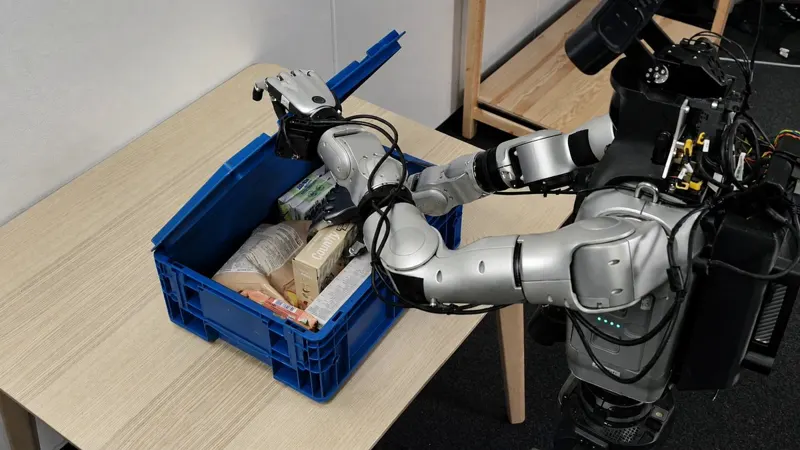
We present ASENA, an embodied agent system that enables general-purpose coding agents to program humanoid navigation, manipulation, and interaction. Through a unified robot harness, agents read sensor data, write and execute programs, inspect recorded outcomes, repair failures, and reuse notes and executable skills while keeping their model weights fixed. We also introduce ASENA-VLN, a 4B monocular navigation policy that serves as an optional tool within this programmable system. ASENA-VLN predicts body-frame trajectories for both extended routes and short-horizon behaviors. Its shared vision-language decoder is trained on route instructions, visual question answering, and a newly curated dataset of geometry-derived atomic navigation tasks. As a standalone policy, ASENA-VLN achieves state-of-the-art success rates of 68.7% on R2R and 70.2% on RxR. When integrated with a coding agent, learned navigation improves ASENA's success rate by 11 percentage points on both agentic benchmarks and reduces execution time. Persistent workspace evolution uses simulator feedback to improve success over ten passes through recurring 100-task subsets. Success increases from 72% to 98% on R2R and from 65% to 89% on RxR. On embodied question answering, ASENA achieves state-of-the-art accuracy with fewer interaction steps. On a Unitree G1, we demonstrate search, visual inspection, spatial reasoning, synthesized gestures, and mobile manipulation combining object pickup, carrying, and handoff without a pre-built map. These demonstrations illustrate how online programming extends robot behavior beyond route following and predefined skills.

An-Chieh Cheng, Isabella Liu, Edmund Bu · 296 views · Sep 30, 2026
Vision-language navigationEmbodied AI
Sep 30, 2026
EATR-Stereo: Embodiment-Aware Token Routing of Paired Stereo Evidence for Humanoid Vision-Language-Action Control

EATR-Stereo: Embodiment-Aware Token Routing of Paired Stereo Evidence for Humanoid Vision-Language-Action Control

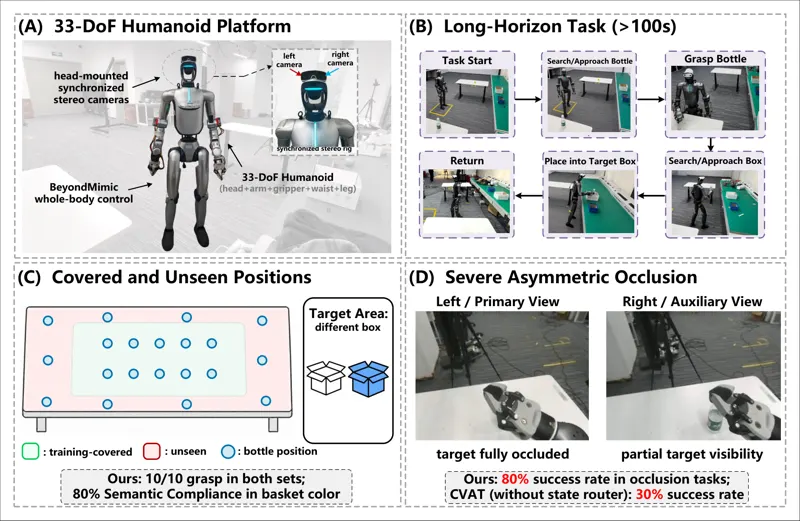
Long-horizon humanoid vision–language–action (VLA) control with head-mounted stereo cameras requires visual interfaces that can exploit complementary views while maintaining compatibility with pretrained representations. Existing interfaces often discard complementary stereo evidence or fuse additional observations without preserving the native primary-view pathway and adapting auxiliary information to robot embodiment. We present EATR-Stereo, an embodiment-aware token-routing framework that retains primary-view tokens and constructs primary-aligned Cross-View Auxiliary Tokens (CVATs) by querying the synchronized auxiliary-view token sequence. A body-segmented proprioceptive encoder further conditions token-wise auxiliary usage on robot configuration history, enabling selective incorporation of stereo evidence during action generation. The routed auxiliary stream augments the language and primary-visual context of a pretrained VLA while keeping its vision–language model frozen. On a 33-DoF physical humanoid with a 37-D proprioceptive state, we evaluate nine configurations in over-100-s search–approach–grasp–place–return tasks. EATR-Stereo achieves 60.0% full-task success, 100.0% grasp success, and 80.0% stage success. Under severe asymmetric occlusion, it improves recovery to 80% compared with 30% for CVAT alone. Ablation studies further show the importance of preserving primary tokens and combining cross-view auxiliary features with structured proprioceptive routing. These results demonstrate that selectively routed paired stereo evidence improves spatial grounding for reliable long-horizon humanoid VLA control.

Songwei Wu, Rui Zhao, Fan Yang · 447 views · Aug 18, 2026
VLAStereo vision
Aug 18, 2026

As an Amazon Associate, we earn from qualifying purchases.