PAPER DEEP DIVE
Global-Local Attention Decomposition for Terrain Encoding in Humanoid Perceptive Locomotion
Although reinforcement learning has significantly advanced humanoid locomotion, perceptive policies still struggle on sparse-foothold terrain and constrained environments. Success in these scenarios requires both broad terrain awareness and precise foothold selection, two perceptual roles that conventional encoders often entangle. To address this challenge, we propose Global-Local Attention Decomposition (GLAD) for terrain encoding in humanoid locomotion. Realized by a coarse-to-fine encoder over a robot-centric elevation map, GLAD explicitly separates these objectives: a global attention branch utilizes attention pooling to summarize the surrounding terrain context, while a state-conditioned local attention branch sparsifies and encodes precise foothold-relevant geometry. This explicit attention decomposition prevents the dilution of fine-grained spatial cues while reducing training overhead. Experiments demonstrate that GLAD enables reliable locomotion over challenging gaps, stepping stones, and stairs. Furthermore, the learned policy exhibits emergent terrain-responsive behaviors, autonomously following narrow paths and avoiding obstacles under simple velocity commands without explicit navigation planners. In real-world deployment on a Unitree G1 humanoid robot using onboard LiDAR, the proposed method achieves robust zero-shot sim-to-real transfer across diverse sparse-foothold and obstacle-rich domains.
Global-Local Attention Decomposition for Terrain Encoding in Humanoid Perceptive Locomotion
Authors: Shengcheng Fu, Yang Zhang, Zhanxiang Cao, Liyun Yan, Yizhi Chen, Yunpeng Yin, Yue Gao
Affiliations: Tongji University · Shanghai Innovation Institute · SJTU · Humanoid Robot (Shanghai) Co.
Paper: https://arxiv.org/abs/2606.00637
One-sentence Summary
GLAD uses a coarse-to-fine encoder to explicitly separate global attention (summarizing surrounding terrain context) from local attention (sparsifying and encoding precise foothold geometry) over a robot-centric elevation map, enabling robust locomotion on sparse footholds, gaps, and stairs with zero-shot sim-to-real on Unitree G1.
Background and Motivation
RL has advanced humanoid locomotion, but perceptive policies still struggle on sparse-foothold terrain and constrained environments. Success requires both broad terrain awareness and precise foothold selection — two perceptual roles that conventional encoders entangle. On sparse-foothold terrain, success depends on identifying feasible support regions and placing feet precisely.
Raw exteroceptive observations (elevation maps, depth images) are high-dimensional and noisy, reducing robustness and complicating training. Conventional terrain encoders treat perception as isolated geometric compression, ignoring the robot's immediate kinematic state. This state-unaware encoding dilutes fine-grained geometric cues, weakens the spatial correspondence between features and reachable footholds, and limits foothold precision. Attention mechanisms offer a principled way to fuse proprioception with exteroception, but existing methods (AME, AME-2) entangle multiple perceptual objectives within a single attention mechanism, failing to explicitly separate broad context from precise foothold geometry. GLAD addresses this by explicit decomposition.
Core Contributions
- Global attention branch: Attention pooling aggregates all local features into a compact surrounding-terrain context vector $c \in \mathbb{R}^D$.
- State-conditioned local attention branch: Fuses the context with a proprioceptive embedding to generate a query, scores and sparsifies local features (top-K), then applies MHA for fine-grained foothold-relevant encoding.
- Explicit attention decomposition: Avoids entangling global context and local foothold geometry in a single MHA, preventing dilution of fine-grained cues while reducing training overhead.
Method Details
Problem Formulation
Humanoid perceptive locomotion is a POMDP $\mathcal{M}=(\mathcal{S}, \mathcal{A}, \mathcal{O}, p, r, \gamma)$, partially observable due to limited sensor FoV and noise. The policy $\pi_\theta$ receives proprioception and exteroceptive terrain perception (elevation map), outputs actions. Objective: $J(\pi_\theta) = \mathbb{E}_{\pi_\theta}[\sum_{t=0}^{\infty} \gamma^t r(s_t, a_t)]$. $$ J(\pi_\theta)=\mathbb{E}_{\pi_\theta}\left[\sum_{t=0}^{\infty}\gamma^{t}\,r(s_t,a_t)\right] $$
The policy is parameterized as $a_t \sim \pi_\theta(\cdot \mid o_t)$, with system dynamics $p(s_{t+1} \mid s_t, a_t)$ and discount factor $\gamma \in (0,1)$.
Observation and Action Space
Actor observes base angular velocity $\omega_t^b$, gravity $g_t^b$, joint positions $q_t$, velocities $\dot{q}_t$, previous action $a_{t-1}$, and elevation map $m_t \in \mathbb{R}^{L \times W \times 3}$ (3D coordinates per cell in base frame). Critic additionally receives noise-free base linear velocity $v_t^b$. Action is 29-dim (29 actuated joints), interpreted as offset from nominal standing: $\theta_{\text{target}} = \theta_{\text{stand}} + a_t$. $$ \theta_{\mathrm{target}}=\theta_{\mathrm{stand}}+a_t $$
The elevation map is defined as $m_t \in \mathbb{R}^{L \times W \times 3}$, where $L$ and $W$ are the map length and width, and each grid cell stores 3D coordinates in the robot base frame.
Spatially Aligned Local Feature Extraction
The elevation map is processed by a two-layer CNN with zero padding throughout. Unlike AME (convolving only height then concatenating 3D coordinates), GLAD directly convolves 3D coordinates so positional cues are embedded from the start. The first layer performs strided downsampling (stride $s=2$), decoupling sensing resolution from encoded feature resolution; the second projects to embedding dimension $D=64$. With $L=33$, $W=21$, $s=2$: output $17 \times 11 = 187$ local features. Zero padding preserves spatial alignment with the terrain map, critical for grounding attention to physical locations.
Global-Local Attention Decomposition
Three steps. First, global attention pooling: logits and weights: $$ u_i = v^\top k_i + b_u, \qquad \alpha_i = \frac{\exp(u_i)}{\sum_{j=1}^{N}\exp(u_j)} $$ Context vector:
$$c = \sum_{i=1}^N \alpha_i k_i$$
Second, state-conditioned sparsification: concatenate $c$ with proprioceptive embedding, project to query $q \in \mathbb{R}^D$; score each feature: $$ s_i = w^\top [q; k_i] + b_s, \quad i=1,\ldots,N $$ Retain top-$K$ ($K=32$).
Third, MHA (16 heads) over retained sparse features with query $q$ produces foothold-relevant feature $f \in \mathbb{R}^D$. The final terrain encoding concatenates $c$ and $f$ with proprioception for the policy.
Two-Stage Training
Stage 1: basic terrains (stairs, random grid, rough, slopes, stepping-stone-everywhere, gaps) with perfect perception, initializing the terrain module and fundamental skills. Stage 2: retains stairs and gaps, replaces easy stepping stones with sparse-foothold courses (parallel-row, single-row, alternating stepping stones, rails, random cylindrical obstacles). Ten-level progressive curriculum within each stage; 4096 robots parallel; 10000 iterations per stage. Only standard locomotion rewards — no handcrafted foothold rewards or terrain-specific shaping — to isolate the contribution of terrain representation quality.
Method Overview
flowchart TD
    A[Elevation map m_t 33x21x3] --> B[Two-layer CNN zero-pad stride s=2]
    B --> C[Local features 17x11x64 = 187]
    C --> D[Global attention pooling]
    D --> E[Context vector c 64-dim]
    E --> F[Concat proprioceptive embedding]
    F --> G[State-conditioned query q 64-dim]
    C --> H[Relevance scoring top-K=32 sparsify]
    G --> H
    H --> I[MHA 16 heads]
    G --> I
    I --> J[Foothold feature f 64-dim]
    E --> K[Concat c + f]
    J --> K
    K --> L[Policy network MLP]
    M[Proprioception] --> L
    L --> N[29-dim joint actions]
Experimental Results
Training Efficiency
GLAD completes two-stage training in 1.00 days on a single H200, vs 1.36 for AME and 1.50 for AME w/ global context. The coarse-to-fine design avoids applying MHA to the full feature set.
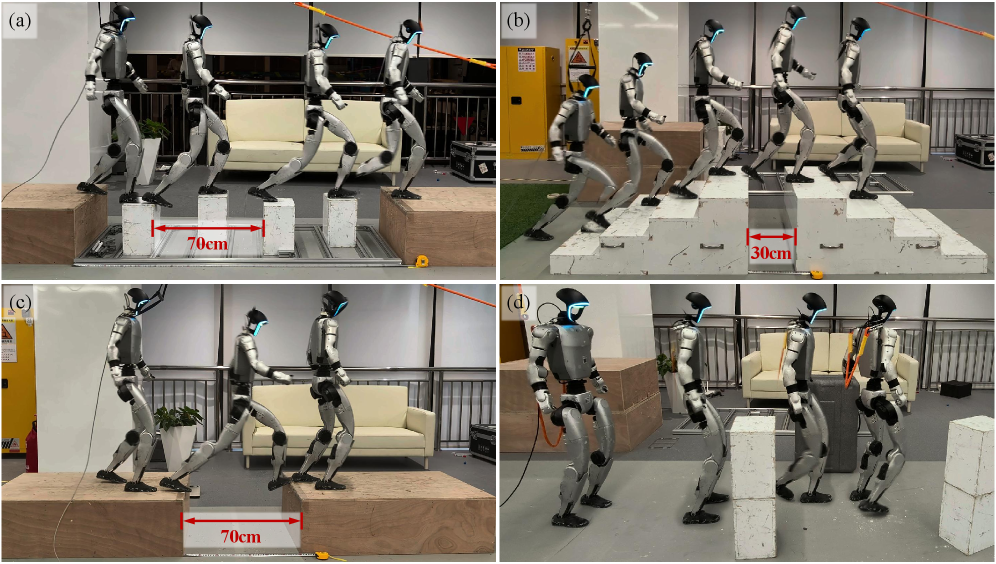
Figure 1: Unitree G1 real-world locomotion — sparse stepping stones, stair-gap composite, 70 cm gaps, dense obstacles.
Unseen Terrain Performance
| Method | (a) Composite | (b) Single-row | (c) Pentagonal | (d) Sinusoidal |
|---|---|---|---|---|
| AME | 94.92 | 93.75 | 83.59 | 25.00 |
| AME w/ global | 96.68 | 91.99 | 74.61 | 42.58 |
| GLAD w/o global | 80.08 | 85.94 | 86.91 | 23.98 |
| GLAD w/o local | 92.97 | 93.55 | 73.44 | 18.95 |
| GLAD | 95.51 | 96.88 | 91.21 | 95.90 |
On stepping stones all methods do reasonably well, but GLAD w/o global falls below 90%, confirming broad context is needed. On terrain (c) (dense but ambiguous supports), full GLAD combines foothold precision with context for >90%, while AME w/ global drops to 74.61% due to entangled attention dilution. On terrain (d) (sinusoidal narrow path, requiring anticipatory direction adjustment), GLAD achieves 95.90% vs at most 42.58% for baselines — the global branch sees the path ahead while the local branch locks each foothold.
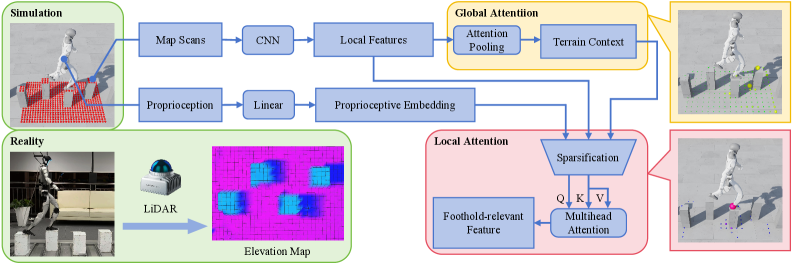
Figure 6: Global and local attention weight visualization — yellow (global) and red (local) markers.
Attention-Foothold Alignment
| Method | Terrain | $D_{\text{attn}}$ ↓ | $D_{\text{peak}}$ ↓ | $A_{\text{peak}}$ ↑ |
|---|---|---|---|---|
| GLAD | Continuous | 0.137±0.006 | 0.103±0.006 | 0.257±0.029 |
| GLAD | Discrete | 0.133±0.006 | 0.113±0.006 | 0.447±0.035 |
| AME | Continuous | 0.400±0.000 | 0.107±0.012 | 0.073±0.006 |
| AME-GC | Continuous | 0.530±0.010 | 0.140±0.030 | 0.023±0.006 |
GLAD's attention-weighted distance to the foothold is only 0.137 m (AME 0.400, AME-GC 0.530), and attention concentration $A_{\text{peak}}$ reaches 0.447 on discrete terrain (AME only 0.077). State-conditioned sparsification concentrates ~45% of attention on the single most relevant feature, vs 7.7% for AME — directly explaining GLAD's superior foothold precision.
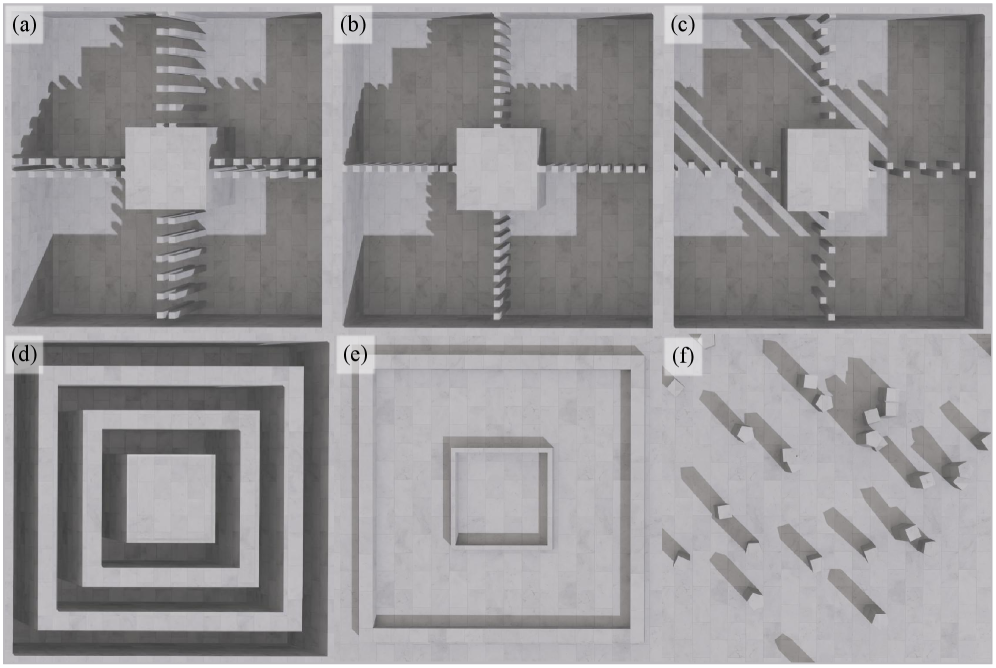
Figure 3: Stage-2 training terrains at highest curriculum difficulty — sparse stepping stones, rails, gaps, random cylindrical obstacles.
Real-World Deployment
GLAD achieves zero-shot sim-to-real on Unitree G1 with onboard LiDAR across diverse sparse-foothold and obstacle-rich domains. The policy exhibits emergent terrain-responsive behavior — autonomously following narrow paths and avoiding obstacles under simple velocity commands without explicit navigation planners.
Limitations
- Limited perception range: The elevation map covers only 1.6 m × 1.0 m; long-range path planning may be insufficient. The sinusoidal path's anticipatory adjustment is bounded by the sensing window.
- Fixed top-K threshold: K=32 is fixed; for varying terrain complexity an adaptive K or score-based threshold could improve performance.
- Elevation-map quality dependency: Assumes reliable elevation maps; real LiDAR noise, occlusion, and drift may affect encoding. Domain randomization mitigates but extreme perception failures are not fully validated.
Conclusion and Outlook
GLAD proposes global-local attention decomposition for terrain encoding in humanoid perceptive locomotion. By explicitly separating global attention (surrounding context) from local attention (precise foothold geometry) via a coarse-to-fine encoder, GLAD avoids perceptual-objective entanglement in a single attention mechanism. Experiments demonstrate robust locomotion on gaps, stepping stones, and stairs, significantly outperforming AME and AME-2 on unseen terrains, with emergent terrain-responsive behavior and zero-shot sim-to-real on Unitree G1.
The core insight is that broad terrain awareness and precise foothold selection are fundamentally different perceptual roles; entangling them in a single attention mechanism causes mutual dilution. Global attention pools to capture "what's around"; local attention sparsifies to focus "where to step." State-conditioned sparsification is the key innovation: the current motion state guides the query vector, automatically focusing attention on reachable and geometrically suitable foothold candidates. The interpretable attention alignment — local attention highly concentrated on actual footholds — is both a performance driver and a debugging asset.
Golden Quote
When "seeing the surroundings" and "seeing exactly where to step" are no longer handled by the same pair of eyes but delegated to two kinds of attention, the robot finally neither loses its way nor misses a foothold on sparse terrain.
SOURCE LINKS