PAPER DEEP DIVE
FastDSAC: Enhancing Policy Plasticity via Constrained Exploration for Scalable Humanoid Locomotion
Scalable reinforcement learning has popularized high-throughput sampling architectures, which significantly compresses the training time for off-policy methods in robotic locomotion. However, the rapid increase of data volume and update frequency undermines the stability of value-based methods and diminishes the plasticity of policy networks. To address these challenges, this work presents FastDSAC, a fast and high-performance variant of the Distributional Actor-Critic algorithm designed for parallel sampling scenarios. Specifically, we introduce a truncated Gaussian distribution to approximate the learned policy, which effectively excludes out-of-distribution actions that strain target value estimation while keeping necessary stochasticity for exploration. The proposed action constraint functions as an implicit regularization, which counteracts the plasticity loss typically caused by aggressive gradient updates. This preservation of network adaptability enhances sample efficiency, particularly in scenarios with a high update-to-data ratio, and accelerates the early training process. In contrast to prior fast reinforcement learning approaches that rely on discrete value distributions, our method utilizes a continuous Gaussian representation equipped with adaptive variance regulation, which improves value estimation accuracy by sampling confident and informative transitions. Extensive experiments on MuJoCo Playground and HumanoidBench demonstrate that FastDSAC not only stabilizes the overall training process but also achieves superior asymptotic performance and faster convergence compared to state-of-the-art baselines.
FastDSAC: Enhancing Policy Plasticity via Constrained Exploration for Scalable Humanoid Locomotion
Paper: FastDSAC: Enhancing Policy Plasticity via Constrained Exploration for Scalable Humanoid Locomotion
Authors: Chongqing University / Tsinghua University / USTB team
Link: arXiv:2606.31691 | Code: github.com/luge66/FastDSAC | Benchmarks: MuJoCo Playground + HumanoidBench
One-line summary: To address instability of off-policy value-based methods under high-throughput parallel sampling, a mean-centered truncated Gaussian constrains target actions, filtering extreme actions to reduce TD target variance while preserving exploration stochasticity, achieving faster convergence and higher asymptotic performance on humanoid locomotion tasks.
Background and Motivation
Scalable reinforcement learning has popularized high-throughput sampling architectures that significantly compress training time for off-policy methods in robotic locomotion. However, the rapid increase of data volume and update frequency undermines the stability of value-based methods and diminishes the plasticity of policy networks. Massively parallel simulation on a single workstation makes wall-clock efficiency and rapid iteration first-class objectives. PPO, SAC, and TD3 are increasingly evaluated under high-throughput training regimes.
The core problem stems from inaccurate target Q-value estimates. In off-policy actor-critic methods, target Q-values are estimated using target Q-networks. During high-throughput training, large mini-batches increase the number of target actions sampled from the target policy, making extreme low-probability actions more likely, yielding higher-variance target Q-value estimates and TD errors. This destabilizes critic learning and slows policy improvement. Additionally, aggressive gradient updates cause plasticity loss — the network loses the ability to adapt to new data.
Existing methods like Parallel Q-Learning study distributional critic scaling but rely on asynchronous parallelism. FastSAC starts fast but becomes unstable later. FastDSAC's core idea: decouple exploration from target Q-value estimation, imposing regularization only on the target action when the target Q-network forms the TD error — using mean-centered truncated Gaussian to filter extreme target actions while preserving mild exploration stochasticity.
Method Details
1. Gaussian Policy Parameterization
The policy network outputs diagonal Gaussian mean $\mu_{\phi}(s)$ and standard deviation $\sigma_{\phi}(s)$, i.e., $\pi_{\phi}(a|s)\sim\mathcal{N}(\mu_{\phi}(s),\sigma_{\phi}^{2}(s))$. The reparameterization trick enables gradient backpropagation:
$$a=\mu_{\phi}(s)+\sigma_{\phi}(s)\odot\epsilon,\quad\epsilon\sim\mathcal{N}(0,I)$$
Compared to the commonly used tanh-squashed parameterization, this design avoids vanishing gradients when actions approach bounds and avoids the log-likelihood correction numerical issues from tanh squashing. The policy mean $\mu_{\phi}(s)$ is bounded within $[m_{\min},m_{\max}]$ and standard deviation $\sigma_{\phi}(s)$ within $[\ell_{\min},\ell_{\max}]$ for stability.
2. Mean-Centered Truncation for Target Actions
Given next state $s'$, first sample a pre-truncation action:
$$u^{\prime}=\mu_{\phi}(s^{\prime})+\sigma_{\phi}(s^{\prime})\odot\epsilon,\quad\epsilon\sim\mathcal{N}(0,I)$$
Then obtain the target action via mean-centered truncation mapping:
$$a^{\prime}=\mu_{\phi}(s^{\prime})+c\,\tanh\!\big(u^{\prime}-\mu_{\phi}(s^{\prime})\big)$$
The elementwise $\tanh(\cdot)$ smoothly squashes the offset, bounding each component of $a'-\mu_{\phi}(s')$ strictly within $[-c,c]$. Compared to hard clipping, this mapping is continuous, avoids boundary discontinuities, and yields smoother target evaluation. This mapping is applied only when evaluating the target Q-value $Q_{\theta'}(s',a')$ at the next state.

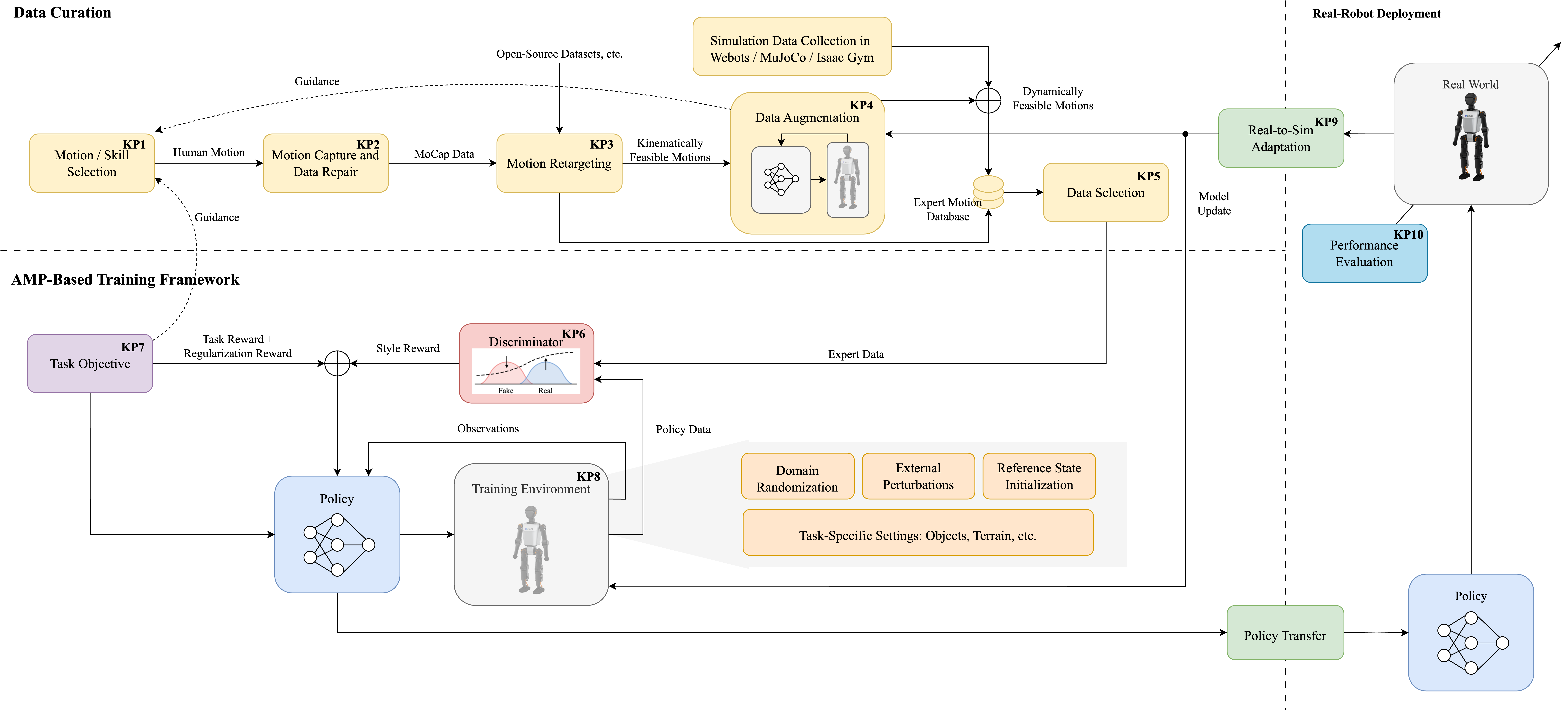
Figure 1: FastDSAC framework. Mean-centered truncation constrains target actions only during target Q-value evaluation; exploration actions are unaffected.
3. Induced Distribution Log-Probability
Since target Q-values are evaluated at the truncated action $a'$, the entropy term must use the log-probability of the corresponding induced action distribution. Via change-of-variables:
$$\log\pi_{\phi}(a^{\prime}|s^{\prime})=\log\pi_{\phi}(u^{\prime}|s^{\prime})-\log\!\left|\det\!\left(\frac{\partial a^{\prime}}{\partial u^{\prime}}\right)\right|$$
The Jacobian determinant is the product of truncation mapping derivatives, ensuring the entropy term is consistent with the constrained target action.
4. Critic and Actor Updates
The target return uses the minimum Q-value:
$$y=r+\gamma\big(Q_{\theta^{\prime}}^{\min}(s^{\prime},a^{\prime})-\alpha\log\pi_{\phi}(a^{\prime}|s^{\prime})\big)$$
The critic loss maximizes the likelihood of $y_z$ under the Gaussian parameterization:
$$J_{Z}(\theta)=\mathbb{E}\!\left[\frac{(y_{z}-Q_{\theta}(s,a))^{2}}{2\sigma_{\theta}^{2}(s,a)}+\log\sigma_{\theta}(s,a)\right]$$
The actor is learned by maximizing the critic mean objective:
$$J_{\pi}(\phi)=\mathbb{E}\!\left[Q_{\theta}(s,a)-\alpha\log\pi_{\phi}(a|s)\right]$$
Entropy temperature $\alpha$ adapts to match target entropy $\mathcal{H}^{\text{target}}$:
$$\alpha\leftarrow\alpha-\nabla_{\alpha}\frac{1}{|B|}\sum\big(\mathcal{H}^{\text{target}}-\mathcal{H}(s)\big)\cdot\alpha$$
5. Continuous Gaussian Distributional Critic
Unlike FastTD3 and FastSAC which use discrete value distributions with fixed intervals, FastDSAC employs a continuous Gaussian distributional critic with adaptively learned variance $\sigma_{\theta}(s,a)$. This improves value estimation accuracy and reduces overconfident updates in epistemically uncertain regions, retaining more high-reward transitions during interaction. Transition reward analysis shows FastDSAC achieves higher and more stable transition rewards than all baselines, indicating exploration is guided more consistently toward high-reward behaviors.
graph TD
  A[Sample exploration action a ~ N(μ,σ²)] --> B[Environment interaction + store in replay buffer]
  B --> C[Sample mini-batch from buffer]
  C --> D[Target action: a' = μ + c·tanh(u'-μ)]
  D --> E[Target Q: y = r + γ(Q'min - α·logπ')]
  E --> F[Update Critic: minimize TD error]
  F --> G[Update Actor: maximize Q-α·logπ]
  G --> H[Update entropy temperature α]
  H --> I[Soft update target networks]
  style D fill:#f5a623,stroke:#b97316,color:#fff
  style E fill:#4a90d9,stroke:#2c5f8a,color:#fff
  style F fill:#7ed321,stroke:#4a8a14,color:#fff
Experimental Results
Sample Efficiency and Time Efficiency
On four MuJoCo Playground locomotion tasks, PPO as an on-policy baseline improves slowly and plateaus at markedly lower returns. FastSAC rises quickly but becomes unstable later, showing plasticity loss signs leading to lower final returns. FastTD3 and DSAC-T have stable curves but more gradual improvement. FastDSAC combines fast early gains with stable late-stage learning, achieving the highest final return on all four tasks. On the more challenging G1JoystickRoughTerrain, FastDSAC matches FastSAC's early progress while continuing to improve without late-stage regressions.
| Method | Early Convergence | Late Stability | Final Return | Wall-clock Efficiency |
|---|---|---|---|---|
| PPO | Slow | Low plateau | Lowest | Slowest |
| FastSAC | Fastest | Unstable/regression | Lower | Fast but high latency |
| FastTD3 | Gradual | Stable | Medium | Comparable to FastDSAC |
| DSAC-T | Gradual | Stable | Medium-low | Comparable to FastDSAC |
| FastDSAC | Fast | Stable, no regression | Highest | Best trade-off |
Cross-Suite Generalization and Robustness
On six HumanoidBench locomotion tasks, FastSAC shows weaker and less consistent outcomes. FastDSAC remains competitive, exhibiting more stable learning and better preserving plasticity. FastDSAC is on par with or better than FastTD3, both substantially outperforming DSAC-T. Dynamics perturbation tests modifying mass parameters and ground friction show the robot maintains a stable, natural walking gait without posture degradation, providing preliminary qualitative evidence of policy robustness.
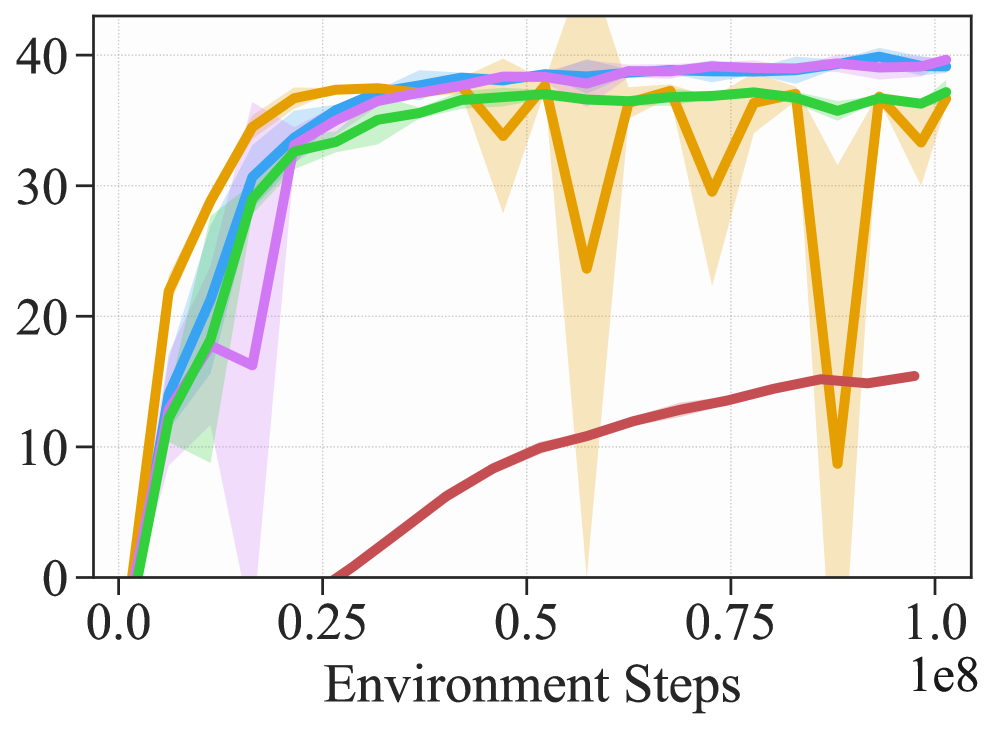
Figure 2: Environment-step learning curves on four MuJoCo Playground tasks. FastDSAC combines fast early gains with stable late-stage learning.
Ablation: Truncation Radius c
Truncation radius $c\in\{10^{-2},10^{-3},10^{-4}\}$ mainly affects early learning speed while final returns remain relatively close. Larger $c$ preserves more target action variability, speeding early learning; smaller $c$ yields more conservative targets. $c=10^{-3}$ works well in simpler environments; $c=10^{-2}$ is better in complex environments. $c=10^{-3}$ is the robust default.
Ablation: Target Action Choice
| Target Action Choice | Early Convergence | Complex Terrain | Final Return |
|---|---|---|---|
| Mean-centered truncated a' | Fast | Best | Highest |
| Raw Gaussian sample u' | Competitive | Slower early | Medium |
| Deterministic mean μ(s') | Slowest | Worst | Lowest |
This shows retaining some stochasticity benefits target evaluation — fully deterministic mean loses diversity and exploration coverage, while unconstrained Gaussian increases variance. Mean-centered truncation balances both: preserving mild stochasticity while limiting extremes.

Figure 3: Sensitivity to truncation radius c. Only moderate sensitivity within practical range, mainly affecting early learning speed.
Limitations
Author-stated: Results suggest improved robustness under aggressive optimization but provide only indirect behavioral evidence of preserved network plasticity. Future work will incorporate plasticity-specific diagnostics, representation-level analyses, qualitative behavior evaluation, and sim-to-real experiments.
Analysis: Mean-centered truncation effectively reduces target Q-value variance, but the truncation radius $c$ still requires manual tuning or logarithmic sweep without an adaptive mechanism. The method constrains actions only during target Q-value evaluation, not addressing potential issues in the exploration policy itself. The Gaussian distributional critic, while more accurate than discrete distributions, has unverified variance estimation reliability in high-dimensional action spaces. Experiments are simulation-only; sim-to-real transfer is unverified. Plasticity loss mechanism analysis is insufficient — how truncation constraints specifically affect network gradient and representation dynamics needs deeper study. Systematic comparison with the latest large-scale training methods is limited.
Conclusion and Outlook
FastDSAC is a lightweight method for stabilizing entropy-regularized off-policy reinforcement learning under massively parallel sampling and large-batch updates. It applies mean-centered truncation exclusively to the target action in Bellman backups and computes the entropy term using the log-probability induced by the transformed distribution. By limiting extreme target actions, FastDSAC improves training stability with negligible computational overhead. Experiments demonstrate faster and more reliable learning, fewer late-stage regressions, and effectiveness at high update-to-data ratios. From a methodological perspective, the core idea of decoupling exploration from target evaluation — full stochasticity during exploration, constraints during target evaluation — provides a new paradigm for the stability-plasticity trade-off in high-throughput off-policy learning.
Explore boldly, but evaluate conservatively — leave aggressiveness to environment interaction, inject restraint into TD targets. This is FastDSAC's key insight for balancing stability and plasticity in high-throughput training.