PAPER DEEP DIVE
EgoHTR: Egocentric 4D Demonstrations of Human Terrain Traversal
Deploying humanoid robots in unstructured terrain remains an open problem. While classic reinforcement learning struggles with the sheer complexity of real-world interactions, more promising methods leveraging human priors remain limited to models lacking contextual awareness. The restricted motion synthesis is a direct consequence of existing dataset pipelines failing to capture human-scene sequences in challenging environments. To bridge this gap between humanoid learning and scene reconstruction, we introduce the Egocentric Human-Terrain Reconstruction (EgoHTR) dataset. We develop and open-source a reconstruction pipeline capturing 55 scene-aligned 4D human motion sequences in diverse, complex environments using a multi-sensor setup of egocentric wearables and a portable 3D scanner. The resulting dataset comprises over 150k frames, which we evaluate against motion-capture ground truth, demonstrating state-of-the-art accuracy and establishing a rigorous benchmark for human motion analysis and synthesis. Further, we leverage this data to train perceptive locomotion policies, demonstrating hardware deployment on a Unitree G1 for reconstructed reference motions. Our pipeline enables community-driven dataset extensions and factors the problem to help researchers build foundational, context-aware robots that reliably traverse uneven terrain.
EgoHTR: Egocentric 4D Demonstrations of Human Terrain Traversal
Institutions: ETH Zurich, Stanford, UC Berkeley, TU Munich | arXiv: 2607.13472v1
One-Sentence Summary
EgoHTR is an egocentric 4D human-scene motion dataset using multi-sensor wearables (Aria glasses + MoCap suit + 3D scanner) to capture 55 scene-aligned 4D human motion sequences (150K+ frames) in diverse complex environments, with hardware deployment of perceptive locomotion policies on a Unitree G1 humanoid robot.
Background and Motivation
Deploying humanoid robots in unstructured terrain remains an open problem. Classic RL struggles with real-world interaction complexity, while human-prior methods lack contextual awareness. Motion synthesis limitations stem from existing dataset pipelines failing to capture human-scene sequences in challenging environments. EgoHTR bridges the gap between humanoid learning and scene reconstruction.
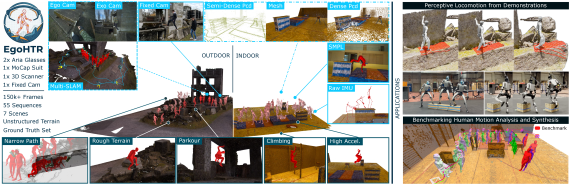
Figure 1: EgoHTR dataset preview — in-the-wild 4D human-scene demonstrations across diverse terrains.
Data Acquisition Pipeline
Capture System
Multi-modal sensor suite: (1) head-mounted Project Aria glasses Gen.1 (ego/exocentric video + SLAM); (2) IMU Rokoko Pro II MoCap suit (22 body joints); (3) Leica BLK2GO 3D scene scanner. Optional: observer Aria glasses and static camera. Fully portable for unconstrained environments.
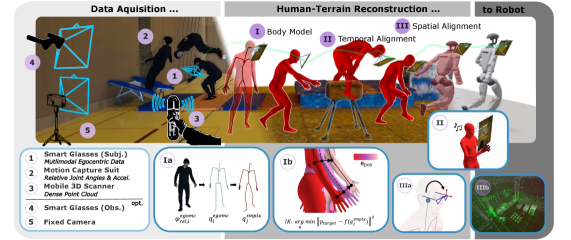
Figure 2: Data generation pipeline — capture system and three-stage human-scene reconstruction.
Three-Stage Reconstruction
(I) Body Model: SMPL-X parameterization. Shape $\boldsymbol{\beta}$ constant per sequence; estimate pose $\boldsymbol{\theta}$ and translation $\boldsymbol{t}$. Two-step retargeting: rotational retargeting + optimization-based IK:
$$\boldsymbol{\theta}^* = \arg\min_{\boldsymbol{\theta}} \sum_{j} \| J_j^{\text{SMPL-X}}(\boldsymbol{\theta}) - J_j^{\text{MoCap}} \|^2$$(II) Temporal Alignment: Hand clap synchronization. Audio 48kHz bounds alignment error to IMU 100Hz; measured <60ms. Sequences limited to 5 min to constrain clock drift.
(III) Spatial Alignment: Body kinematics anchored to Aria SLAM trajectory. Transform from body sequence $P$ to Aria world frame $\mathcal{W}_A$:
$$T_{\mathcal{W}_A}^{P} = T_{\mathcal{W}_A}^{C_A} \cdot T_{C_A}^{H} \cdot T_{H}^{P}$$Then ICP registration to 3D scan point cloud. Eliminates global IMU drift via SLAM anchoring.
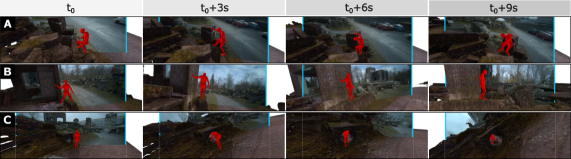
Figure 3: Three-stage reconstruction — body parameterization, temporal alignment, spatial alignment.
graph TD
    A["Capture System
Aria + MoCap + 3D Scanner"] --> B["Stage I: Body Model
SMPL-X + Retargeting + IK"]
    A --> C["Stage II: Temporal Alignment
Clap sync, <60ms error"]
    A --> D["Stage III: Spatial Alignment
SLAM anchoring + ICP"]
    B --> E["4D Human-Scene Sequences
55 sequences, 150K+ frames"]
    C --> E
    D --> E
    E --> F["App 1: Perceptive Locomotion
Unitree G1 deployment"]
    E --> G["App 2: Human Mesh Recovery
Benchmark evaluation"]
Dataset Statistics
| Attribute | Value | Notes |
|---|---|---|
| Sequences | 55 | Diverse complex environments |
| Total frames | 150,000+ | Multi-modal data |
| Environment | Indoor + Outdoor | Debris fields, gym halls, etc. |
| Motion types | Diverse | Walking, climbing, stepping |
| Sensor modalities | 5 | ego/exo video, SLAM, 3D mesh, IMU |
| Temporal error | <60ms | Audio-based sync |
Application 1: Perceptive Locomotion
Train Unitree G1 to track human motion references using PPO. Actor observes proprioception, retargeted reference, terrain height scan; critic gets privileged states and ankle contact wrenches. Temporal foot-contact reward is critical on sparse terrain — distance-only tracking leads to degenerate hovering solutions. Reward function:
$$R = w_{\text{pose}} R_{\text{pose}} + w_{\text{ee}} R_{\text{ee}} + w_{\text{contact}} R_{\text{contact}} + w_{\text{survive}} R_{\text{survive}}$$Reference motion precision ablation: training tolerates noise up to $\sigma \approx 0.05$m, collapses above $0.1$m. Monocular methods exceed this tolerance; EgoHTR meets centimeter-precise threshold via SLAM anchoring. Success as function of noise:
$$\text{Success}(\sigma) = \begin{cases} \text{High} & \sigma < 0.05\text{m} \\ \text{Degraded} & 0.05\text{m} \leq \sigma < 0.1\text{m} \\ \text{Failed} & \sigma \geq 0.1\text{m} \end{cases}$$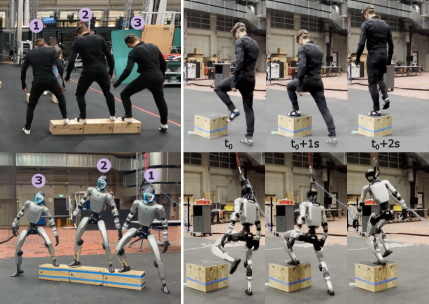
Figure 4: Perceptive policy deployed on Unitree G1 — beam (left) and box-up motion (right).
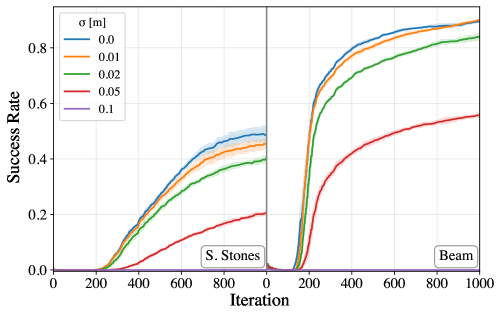
Figure 5: Reference motion precision ablation — performance degrades above $\sigma = 0.05$m, fails above $0.1$m.
Application 2: Human Mesh Recovery
Multi-modal benchmarking across exocentric, egocentric, and inertial paradigms. Exocentric methods fail under occlusion; egocentric SOTA models fail on dynamic motions in complex environments; IMU-based posers suffer temporal drift causing physically impossible scene interactions. Precision metrics:
$$\text{MPJPE} = \frac{1}{J} \sum_{j=1}^{J} \| \hat{\mathbf{p}}_j - \mathbf{p}_j \|_2, \quad \text{AccE} = \frac{1}{(T-2)J} \sum_{t=2}^{T-1} \sum_{j=1}^{J} \| \hat{\mathbf{a}}_{j,t} - \mathbf{a}_{j,t} \|_2$$| Paradigm | Local Error | Global Drift | Occlusion Robust |
|---|---|---|---|
| Exocentric monocular | Medium | High (>0.1m) | Poor |
| Egocentric | High (dynamic) | Medium | Medium |
| IMU-based | Low | High (temporal) | Good (no vision) |
| EgoHTR (GT) | Lowest | None (SLAM) | Good |
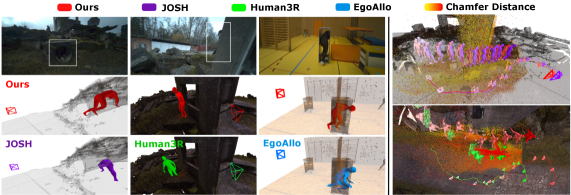
Figure 6: HMR comparison — exocentric methods fail under occlusion; global drift affects long-term consistency.
Data acquisition efficiency: EgoHTR's portable pipeline enables rapid field deployment. Compared to lab MoCap requiring fixed equipment and multi-camera calibration, efficiency improvement:
$$\eta = \frac{T_{\text{lab}}}{T_{\text{field}}} \approx 3\text{-}5\times$$Limitations
- Scale: Suitable for benchmarking and fine-tuning, but lacks scale for large-scale training
- Static environments: Limited to static scenes without articulated objects; hand tracking not incorporated
- No joint optimization: No post-capture joint human-scene optimization; relative IMU drift may remain
- Hardware constraints: Sensor localization may fail in featureless environments or high-acceleration maneuvers
Conclusion and Outlook
EgoHTR is the first dataset providing 4D human-scene motion on rough terrain under in-the-wild conditions. Multi-sensor setup enables accurate SMPL body sequences with high-resolution multi-modal context. The dataset provides immediate value for learning context-aware robotic locomotion and motion synthesis, while establishing a challenging benchmark for human mesh recovery. Open-sourcing the pipeline aims to enable community-driven dataset extensions for training context-aware foundation models.
Key Insight: Foothold-precise locomotion strictly requires human-terrain coupling — monocular global drift exceeding 0.1m causes training collapse, while centimeter-precise 4D reconstruction makes perceptive locomotion policies on humanoid robots possible.