PAPER DEEP DIVE
Athena-Brain Technical Report: An Efficient Robot Brain for General Intelligence and Embodied Interactio
Large language models (LLMs) have demonstrated remarkable capabilities in language understanding, reasoning, and world knowledge. As embodied agents become increasingly capable, there is a growing demand for compact models that can serve as an on-device brain, preserving the broad general intelligence of LLMs while enabling effective high-level interaction with embodied environments. Existing approaches, however, often prioritize either general-purpose intelligence or specialized embodied capabilities, making it challenging to satisfy both requirements within a single model. We present \textbf{Athena-Brain-8B}, an 8B LLM designed to serve as an on-device brain for embodied intelligence for embodied intelligence. Through a multi-stage post-training pipeline consisting of General Supervised Fine-Tuning, General Reinforcement Learning, Embodied Expert training, and Model Merge, Athena-Brain-8B maintains strong general capabilities while acquiring strong high-level embodied interaction capabilities and generating concise responses for efficient embodied interaction. Experimental results demonstrate the effectiveness of Athena across both general and embodied evaluations. Compared with the corresponding Qwen3-8B thinking model, Athena-Brain-8B achieves comparable performance on general language and reasoning benchmarks while generating substantially shorter responses. On in-domain embodied benchmarks, Athena-Brain-8B consistently outperforms models of similar scale and surpasses several substantially larger frontier models evaluated zero-shot, demonstrating that compact language models can effectively integrate strong general intelligence with embodied capabilities.
1. Background and Motivation
Large language models (LLMs) have demonstrated remarkable capabilities in language understanding, reasoning, and world knowledge. As embodied agents become increasingly capable, there is a growing demand for compact models that can serve as an on-device brain, preserving the broad general intelligence of LLMs while enabling effective high-level interaction with embodied environments. Existing approaches, however, often prioritize either general-purpose intelligence or specialized embodied capabilities, making it challenging to satisfy both requirements within a single model.
Frontier LLMs, while achieving remarkable progress in language reasoning, dialogue, and computer-use agents, are not explicitly optimized for embodied interaction. Their reasoning-oriented inference often generates unnecessarily verbose responses, increasing interaction latency, and they lack post-training tailored for embodied decision making. Meanwhile, recent embodied foundation models, while effective for embodied benchmarks, are primarily optimized for learning embodied behaviors within specific environments, with less emphasis on the high-level reasoning and planning capabilities required of a general robot brain. Robots deployed in open-world settings must continually interpret instructions, decompose long-horizon tasks, actively explore partially observable environments, and interact with users or external tools—capabilities that rely heavily on the general intelligence of modern LLMs.
Athena-Brain-8B is designed to resolve this tension: an 8B-parameter compact language model that preserves strong general capabilities while acquiring robust embodied interaction capabilities and generating concise responses for efficient embodied interaction.

Figure 1: Overall comparison of Athena-Brain-8B with representative open-source models across general capabilities, embodied capabilities, and generation efficiency.
2. Athena-Brain-8B at a Glance
Built upon Qwen3-8B-Base, Athena-Brain-8B achieves balance across general capabilities, embodied capabilities, and interaction efficiency through a four-stage post-training pipeline. Compared with the Qwen3-8B thinking model, Athena-Brain-8B achieves comparable or better performance on general language and reasoning benchmarks while generating substantially shorter responses. On in-domain embodied benchmarks, it consistently outperforms similar-scale embodied models and even surpasses several substantially larger frontier models on certain tasks.
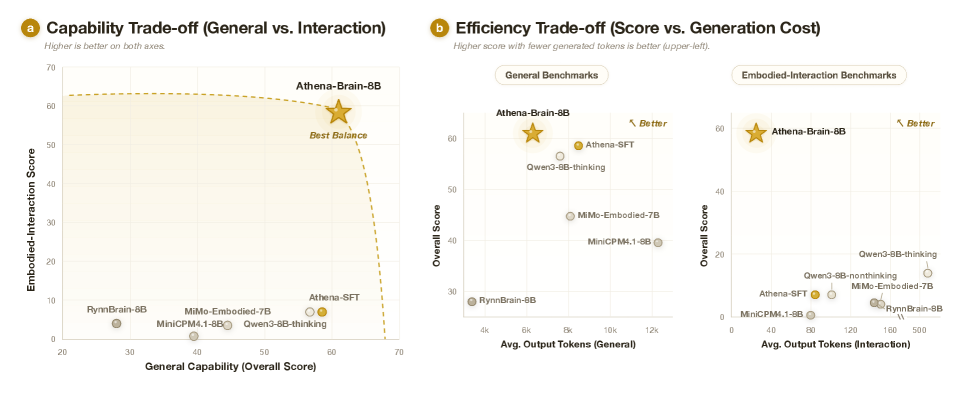
Figure 2: Representative performance on selected general language and embodied interaction benchmarks.
3. Four-Stage Post-Training Pipeline
The pipeline decomposes capability building into four sequential stages, each focusing on a specific aspect while serving as the foundation for the next. This progressive strategy enables Athena to preserve strong general language intelligence, acquire robust embodied expertise, and ultimately integrate both capabilities into a unified model.
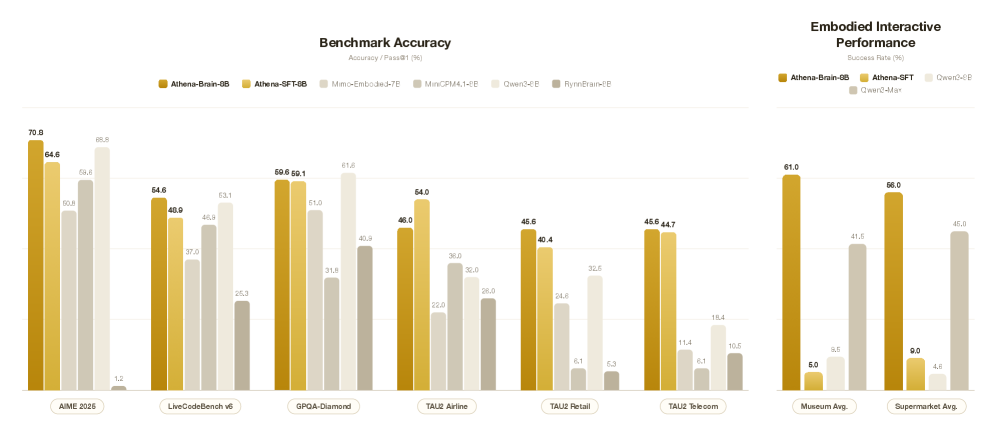
Figure 3: Post-training pipeline overview. Starting from an open-weight base model, building general-capability foundation, training specialized and embodied experts, and merging into a single compact robot-brain model.
4. Stage 1: General Supervised Fine-Tuning
Starting from pretrained Qwen3-8B-Base, a progressive two-stage SFT strategy is adopted. Stage 1 performs large-scale training on diverse instruction corpora with the following data distribution:
| Data Type | Weighted Examples | Sampling Share |
|---|---|---|
| Code | 1,013,476 | 18.16% |
| General | 1,169,718 | 20.97% |
| Math | 2,653,858 | 47.57% |
| Science | 293,848 | 5.27% |
| Tool use | 314,481 | 5.64% |
| Chinese QA | 133,938 | 2.40% |
Stage 2 uses a carefully curated high-quality smaller corpus for refinement, placing greater emphasis on response quality, reasoning consistency, and instruction-following behaviors.
5. Stage 2: General Reinforcement Learning
Supervised learning alone is insufficient for fully optimizing reasoning quality and efficiency. For practical robotic deployment, the model must not only produce correct decisions but also reach them through concise reasoning under strict latency constraints. General RL optimizes using a combination of task-specific correctness rewards and a token-budget reward.
Correctness rewards are automatically computed for tasks with verifiable answers (mathematical reasoning, scientific reasoning, code generation). The token-budget reward explicitly encourages concise reasoning by rewarding solutions reaching correct answers with fewer generated tokens. The model is optimized using GRPO (Group Relative Policy Optimization), enabling large-scale RL without human preference annotations. The GRPO objective is:
$$J_{\text{GRPO}}(\theta) = \mathbb{E}_{q \sim \mathcal{D}, \{o_i\}_{i=1}^{G} \sim \pi_{\theta_{\text{old}}}(o|q)} \left[\frac{1}{G}\sum_{i=1}^{G} \frac{\pi_\theta(o_i|q)}{\pi_{\theta_{\text{old}}}(o_i|q)} \hat{A}_{i}\right]$$where $G$ is the group size, $\hat{A}_i$ is the group-relative advantage estimate, and $\pi_\theta$ is the current policy. The total reward $R$ combines correctness reward $R_{\text{correct}}$ and token-budget reward $R_{\text{budget}}$:
$$R = R_{\text{correct}} + \lambda \cdot R_{\text{budget}}$$where $\lambda$ is the budget reward weight. Training constrains maximum generation to 16K tokens, balancing reasoning capability and inference efficiency.
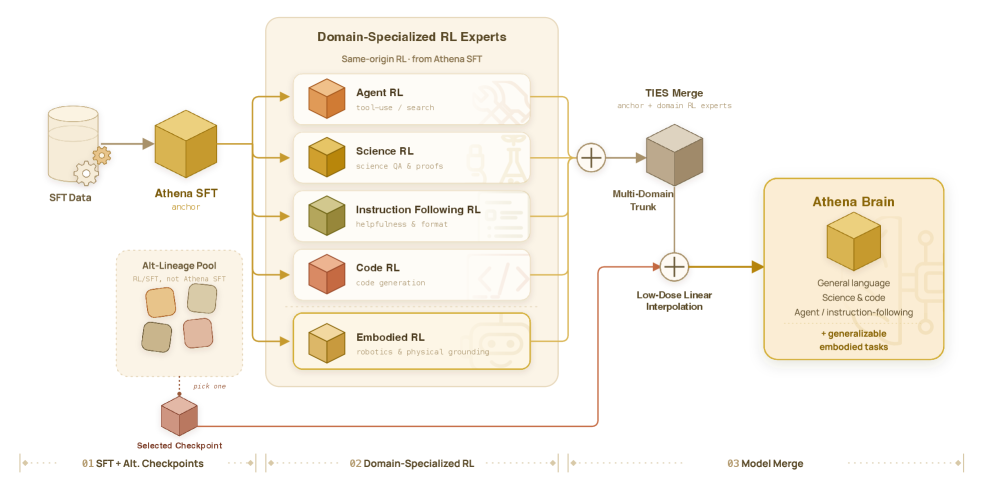
Figure 4: General RL training dynamics. The first three subfigures show reward improvement on representative reasoning tasks; the bottom-right shows average generated token consumption decreasing over training.
6. Stage 3: Embodied Expert Training
General RL equips Athena with strong general reasoning, but the model still lacks embodied knowledge for real-world robotic interaction. The embodied expert training stage specializes Athena through continuous interaction with executable interactive environments. Unlike general language tasks, embodied tasks require continuous interaction with an external environment rather than producing a single response from a fixed input. At each step, the model receives updated observations, reasons about the current state, executes actions, and adapts based on environmental feedback.
Training environments include Museum and Supermarket scenarios, capturing complementary service robotics domains. Tasks are organized into progressive embodiment levels:
| Level | Capability | Representative Tasks |
|---|---|---|
| E0 | High-level topology | Task planning, tool use, target search over rooms/zones |
| E1 | Local topology and orientation | Position maintenance under limited observations, exploratory actions |
| E2 | Continuous position, coarse observations | Distance estimation, approaching objects, local reachability reasoning |
| E3 | Continuous heading, view-cone observations | Egocentric localization, turning, decision making under visibility constraints |
Training begins with a 4K-step supervised warm-up on collected interaction trajectories, followed by GRPO-based RL to optimize embodied interaction policies. Rewards accumulate from executable environment scores: Museum rewards target-visit progress and completion; Supermarket rewards cart correctness and checkout success.

Figure 7: Embodied expert training dynamics. Both average interaction reward and rollout completion rate steadily increase.
7. Stage 4: Model Merging
The first three stages produce multiple specialized checkpoints with complementary strengths. Model merging uses a lineage-aware, two-stage parameter-space merge rather than selecting a single checkpoint.
Stage 1: Consolidates domain-specialized RL experts sharing the same Athena-SFT initialization. For a same-origin RL expert with parameters $\theta_i$, the task vector relative to Athena-SFT is:
$$\tau_i = \theta_i - \theta_{\text{AthenaSFT}}$$Since all experts share the same initialization, coordinate-wise sign agreement reflects agreement among post-training updates. TIES is applied to $\{\tau_i\}_{i=1}^{N}$, obtaining merged update $\tau_{\text{TIES}}$, with the stage-1 model:
$$\theta_{\text{stage1}} = \theta_{\text{AthenaSFT}} + \tau_{\text{TIES}}$$TIES removes low-magnitude entries, elects an aggregate sign at each coordinate, and merges only entries aligned with that sign, preserving salient sign-consistent updates while suppressing weak changes and cross-expert interference.
Stage 2: Introduces a complementary SFT checkpoint from a different training lineage through conservative low-weight linear interpolation:
$$\theta_{\text{final}} = (1 - \alpha) \cdot \theta_{\text{stage1}} + \alpha \cdot \theta_{\text{diff\_lineage}}$$where $\alpha$ is a conservative low-weight coefficient. This checkpoint is excluded from the TIES voting pool because its displacement relative to the Athena-SFT anchor conflates lineage-level and task-specific differences.
8. General Capability Evaluation
Evaluated on diverse benchmarks spanning mathematical reasoning, coding, scientific reasoning, general language understanding, and function calling. All evaluations use thinking mode, max 40960 tokens, temperature 0.6, top-p 0.95, top-k 20.
| Dataset | Athena-Brain-8B | Athena-SFT | Qwen3-8B | RynnBrain-8B |
|---|---|---|---|---|
| AIME 2024 | 76.67 | 73.75 | 75.83 | 2.92 |
| AIME 2025 | 70.83 | 64.58 | 68.75 | 1.25 |
| LiveCodeBench v6 | 54.63 | 48.90 | 53.08 | 25.33 |
| GPQA-Diamond | 59.60 | 59.09 | 61.62 | 40.91 |
| IFEval | 86.32 | 78.19 | 85.40 | 73.01 |
| MMLU-Redux | 86.47 | 85.86 | 86.74 | 74.25 |
| BFCL v1 | 81.51 | 82.66 | 84.46 | 82.01 |
| Overall Average | 60.85 | 58.56 | 56.70 | 27.99 |
Athena-Brain-8B achieves 60.85 overall, outperforming Qwen3-8B (56.70) and Athena-SFT (58.56), confirming that RL enhances reasoning without sacrificing broad language capabilities.

Figure 8: Average generated tokens across benchmark categories. Athena-Brain consistently generates shorter responses while maintaining stronger capability.
9. Embodied Interaction Capability
Evaluated on in-domain (Museum Tour, Supermarket Shopping) and out-of-domain (ALFWorld zero-shot) text-based interactive environments. In-domain tests cover E0-E3 embodiment levels, with 100 Museum and 120 Supermarket instances, max 100 steps per episode.
| Model | Museum Avg. | Supermarket Avg. | Overall |
|---|---|---|---|
| GPT-5.5 | 80.00 | 79.17 | 79.58 |
| Gemini-3.1-Pro | 67.75 | 74.15 | 70.95 |
| Qwen3-Max | 41.50 | 45.00 | 43.25 |
| Qwen3-8B-Thinking | 19.25 | 8.75 | 14.00 |
| Athena-SFT | 5.00 | 8.96 | 6.98 |
| Athena-Brain-8B | 61.00 | 56.04 | 58.52 |
Athena-Brain-8B leads 7B/8B models at 58.52% overall success rate, a massive improvement over Athena-SFT's 6.98%. While frontier API models remain higher, Athena-Brain-8B substantially narrows the gap while maintaining a compact 8B scale.
For reasoning efficiency, Token Cost is defined as average generated tokens divided by overall score:
$$\text{Token Cost} = \frac{\text{Avg. Generated Tokens}}{\text{Overall Score}}$$Athena-Brain-8B achieves a Token Cost of only 0.41, far superior to Qwen3-8B-Thinking's 36.81, demonstrating that improving reasoning efficiency is more beneficial than simply producing longer reasoning traces.
10. Out-of-Domain Generalization and Intermediate Probes
On the unseen ALFWorld split, Athena-Brain-8B improves success rate from Athena-SFT's 11.94% to 36.57% zero-shot, proving that embodied post-training capabilities transfer beyond training domains.
To understand the effects of embodied expert training, two intermediate interactive probes are designed: State-Goal (evaluating short-horizon goal completion) and State-Return (evaluating return to previously visited locations under partial observability). State-Goal success rate improves dramatically from Athena-SFT's 6.0% to 59.3%, demonstrating that embodied training significantly strengthens near-future goal execution.

Figure 9: Two intermediate interactive probes. State-Goal evaluates near-future goal completion; State-Return evaluates return to a previously visited location under partial observability.
11. Merge Analysis
Analysis shows that same-origin RL expert task vectors maintain local neighborhood structure around Athena-SFT, inducing limited drift in the leading singular spectrum and limited subspace rotation—consistent with observations that RLVR tends to update off-principal, low-curvature, spectrum-preserving directions. The different-lineage SFT checkpoint exhibits qualitatively different geometry, with substantially larger displacement.
| Benchmark | Athena-SFT | Best Expert | Athena-Brain-8B | Delta |
|---|---|---|---|---|
| AIME 2025 | 64.58 | 70.00 (RL) | 70.83 | +0.83 |
| LiveCodeBench v6 | 48.90 | 49.78 (RL) | 54.63 | +4.85 |
| In-Domain Embodied | 6.98 | 60.11 (embodied RL) | 58.52 | -1.59 |
| ALFWorld OOD | 16/134 | 47/134 (embodied RL) | 49/134 | +2 |
The merged model matches or surpasses corresponding domain experts on most general benchmarks, retains nearly all in-domain embodied performance, and even exceeds the embodied RL expert on ALFWorld OOD, proving effective capability combination.
12. Embodied RL Ablation
Ablation varies three axes: truncation rule, reward design, and map sampling. The best configuration is partial maps + mild reward + format-only-stop truncation, achieving 0.6000 overall.
| Maps | Reward | Truncation | Museum | Supermarket | Overall |
|---|---|---|---|---|---|
| Full | Punitive | Format-only | 0.5675 | 0.5375 | 0.5511 |
| Full | Mild | Format-only | 0.5800 | 0.5333 | 0.5545 |
| Partial | Mild | Format-only | 0.6125 | 0.5896 | 0.6000 |
| Partial | Mild | All-error | 0.5600 | 0.5625 | 0.5614 |
Key findings: mild reward outperforms punitive, as overly large tool and truncation penalties cause RL to over-optimize protocol avoidance; format-only-stop preserves recovery trajectories from recoverable errors, benefiting policy generalization; partial-map training outperforms full-map, indicating the training curriculum should maintain moderate difficulty.
13. Method Pipeline
Broad coverage + quality refinement"] B --> C["Athena-SFT"] C --> D["Stage 2: General RL
Correctness + Token-budget rewards"] D --> E["General RL Expert"] C --> F["Stage 3: Embodied Expert Training
Supervised warm-up + GRPO RL"] F --> G["Embodied RL Expert"] E --> H["Stage 4: Model Merge"] G --> H C --> H H --> I["Athena-Brain-8B
General + Embodied + Efficient"]
14. Limitations and Future Directions
The authors acknowledge that current embodied environments, while capturing key properties of robot interaction (partial observability, tool-mediated actions, long-horizon decision making), remain limited in scale and diversity. Future work will expand to more tasks, richer object interactions, and different robot embodiments, bridging the gap to real-world systems through simulation-based training and visual-language perception.
Additionally, the current step-based discrete interaction does not reflect the continuous evolution of real-world environments. The team plans to explore the Engagement Process framework, modeling interaction as continuous engagement rather than discrete observation-action loops. The ultimate vision is a unified interactive intelligence model spanning both physical and software environments, where executable code itself becomes a powerful action interface for robot brains.
15. Conclusion
Athena-Brain-8B is a compact 8B robot-brain model integrating strong general language capability, efficient reasoning, and robust embodied interaction through a unified post-training pipeline. The four-stage progressive training (General SFT, General RL, Embodied Expert, Model Merge) enables the model to acquire powerful embodied capabilities without sacrificing general intelligence, while the token-budget reward achieves concise responses. Experiments demonstrate that compact language models can serve as practical robot brains, substantially outperforming similar-scale models on embodied interaction and narrowing the gap with frontier large models.
SOURCE LINKS