PAPER DEEP DIVE
Pose-Aware Modeling to Mitigate Pose-Related Artifacts in Tactile Gloves
Tactile gloves digitize contact and force during hand-object interactions, enabling robotics applications in dexterous manipulation, teleoperation, and learning from demonstration. To preserve hand dexterity and capture the nuances of natural interactions, these gloves and the integrated tactile sensors are designed to be soft, flexible, and comfortable. However, such flexible sensors are sensitive not only to contact forces but also unavoidably to hand pose changes, resulting in pose-related artifacts (PRAs). PRAs are especially problematic in the low-force range, resulting in misdetections or late-onset detections of contact, which raises the minimum detectable force (MDF) of the glove. In this work, we characterize the PRAs in relation to pose and force. Building on these insights, we introduce a glove-agnostic algorithmic framework that leverages hand pose information, which is increasingly available, to mitigate PRAs without glove modifications. Our pose-aware force estimation model augments tactile-to-force pipelines with a residual prediction branch that explicitly accounts for pose-induced sensor deformations. We validate our approach across 3 glove designs and 15 users, reducing MDF by 10.4%, 12.2%, and 18.3%, with consistent improvements across all evaluated metrics. This method provides a practical path to improving the usability of tactile gloves in data collection and diverse robotic applications.
One-Sentence Summary
This paper defines and characterizes Pose-Related Artifacts (PRAs) in tactile gloves — finger bending alone produces tactile signal changes comparable to light touch — and proposes a pose-aware force estimation model with a residual prediction branch using hand pose information, reducing minimum detectable force (MDF) by 10.4%-18.3% across 3 glove designs and 15 users.
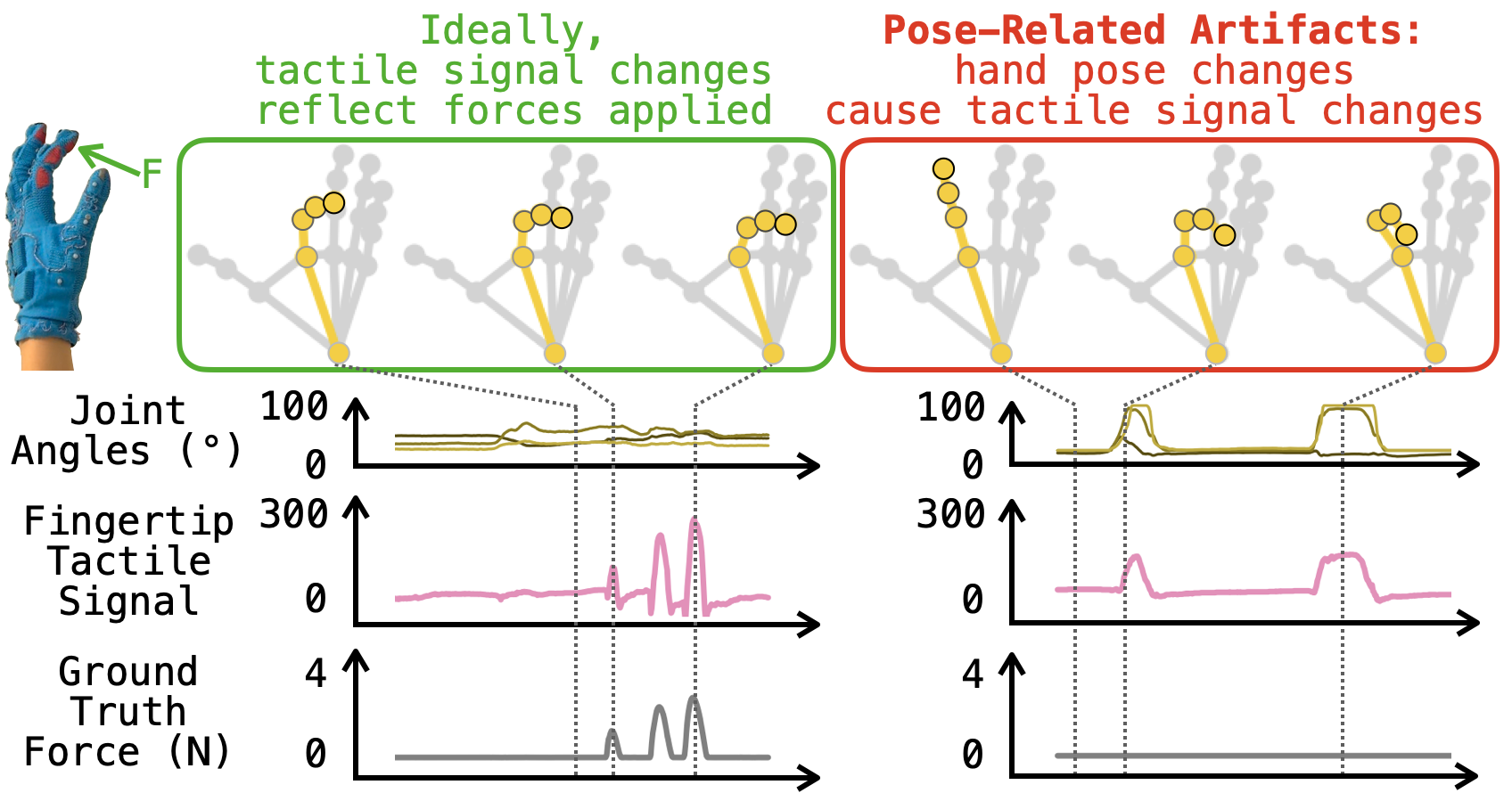
Figure 1 — Finger bending produces tactile signal changes without external contact (PRA), comparable to a 1.1N tap.
1. Background and Motivation
Tactile gloves digitize contact and force during hand-object interactions, supporting dexterous manipulation, teleoperation, and learning from demonstration. To preserve hand dexterity, gloves and sensors must be soft, flexible, and comfortable. But flexible sensors are sensitive not only to contact forces but also unavoidably to hand pose changes, producing Pose-Related Artifacts (PRAs).
PRAs are especially harmful in the low-force range: causing misdetections or delayed contact detection, raising the Minimum Detectable Force (MDF). Bending a finger in air produces tactile signal changes comparable to a 1.1N (112.2gF) tap. Existing solutions require hardware modifications or frequent calibration, impractical for natural interactions.
2. Core Method
2.1 PRA Characterization
Systematically characterizes PRAs in relation to pose and force. Key finding: PRAs are consistent across sensor and glove designs, indicating they arise from inherent force-strain coupling rather than specific hardware implementations.
2.2 Pose-Aware Force Estimation Model
Proposes a glove-agnostic algorithmic framework leveraging increasingly available hand pose information to mitigate PRAs, without glove hardware modifications. The model adds a residual prediction branch to the tactile-to-force estimation pipeline, explicitly modeling pose-induced sensor deformations.
Force estimation formula:
$$\hat{F} = f_{base}(s_{tactile}) + \Delta f(s_{tactile}, \mathbf{p}_{pose})$$
where $f_{base}$ is the baseline tactile-to-force mapping, $\Delta f$ is the pose-aware residual term, $s_{tactile}$ is the tactile signal, and $\mathbf{p}_{pose}$ is the hand pose.
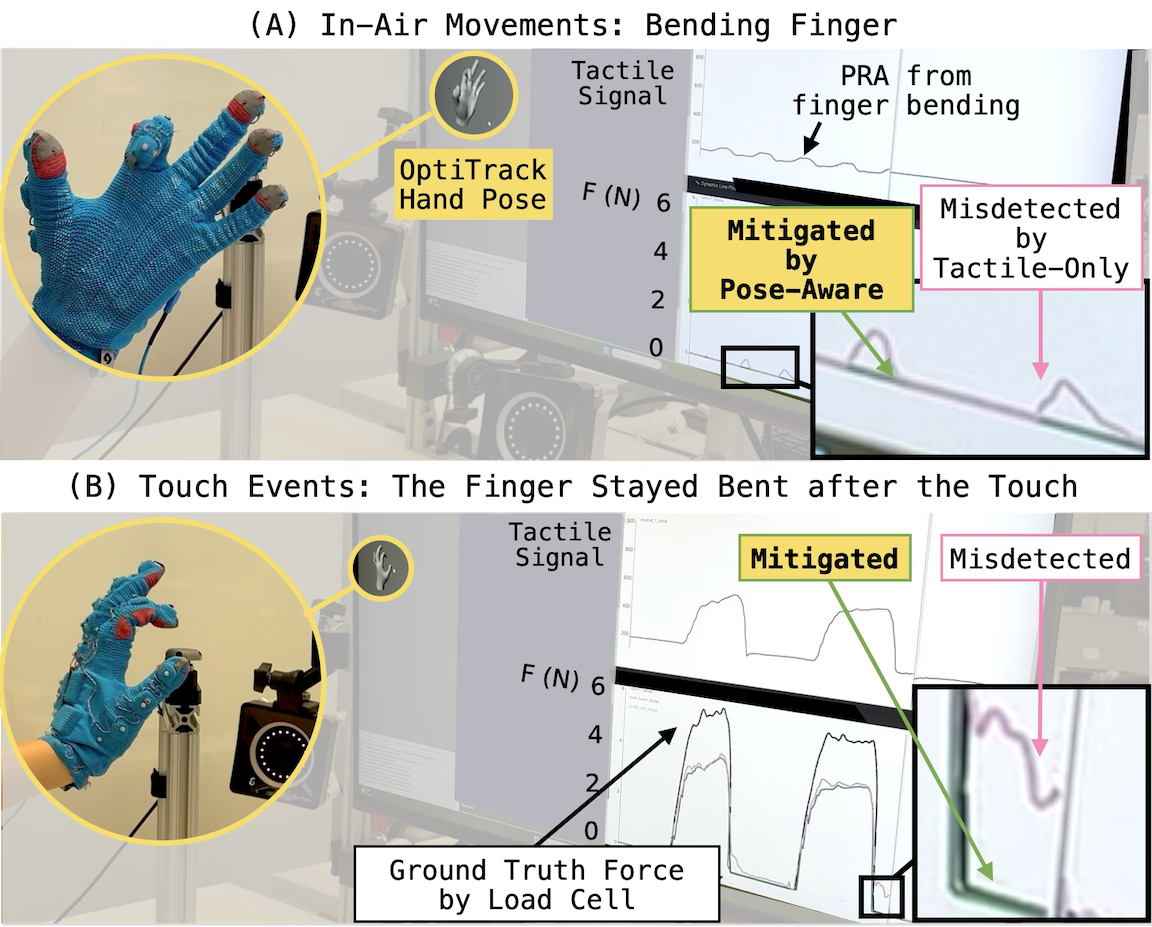
Figure 2 — Real-time PRA mitigation: (A) in-air movements and (B) touch events.
flowchart LR
    A["Tactile Signal
s_tactile"] --> B["Base Force Estimator
f_base"]
    A --> C["Residual Branch
Δf(s, p)"]
    D["Hand Pose
p_pose"] --> C
    B --> E["Σ"]
    C --> E
    E --> F["Corrected Force
F̂ = f_base + Δf"]
    style C fill:#e0e7ff,stroke:#2563eb
    style F fill:#dcfce7,stroke:#16a34a
3. Experimental Results
Validated on 3 different tactile glove designs and 15 users.
| Glove | Baseline MDF (N) | Pose-Aware MDF (N) | MDF Reduction |
|---|---|---|---|
| Glove 1 | 0.77 | 0.69 | 10.4% |
| Glove 2 | 0.82 | 0.72 | 12.2% |
| Glove 3 | 0.71 | 0.58 | 18.3% |
All evaluation metrics show consistent improvements. Method retrofittable to existing tactile gloves without hardware modifications.
4. Main Contributions
- PRA characterization: Systematically characterizes PRAs in tactile gloves, providing insights for modeling force estimation and hand-object interaction.
- Pose-aware force estimation model: Multimodal model fusing hand pose modality via residual learning to correct PRAs.
- Multi-glove validation: 3 gloves, 15 users, MDF reduced by 10.4%-18.3%, consistent improvements across all metrics.
5.
Force prediction
$$ \hat{\mathbf{F}}_{t}=\hat{\mathbf{F}}_{t}^{\text{base}}(\mathbf{T}_{t})-\hat{\mathbf{F}}_{t}^{\text{residual}}(\mathbf{T}_{t},\mathbf{P}_{t}) $$
Positional encoding
$$ \mathbf{P}_{t}^{\text{enc}}=[\sin(\mathbf{P}_{t}),\cos(\mathbf{P}_{t})] $$
Fused features
$$ \mathbf{Z}_{t}=\left[\mathbf{T}_{t}^{\text{feat}},\mathbf{P}_{t}^{\text{feat}},\mathbf{T}_{t}^{\text{feat}}\odot\mathbf{P}_{t}^{\text{feat}}\right] $$
Force loss
$$ \mathcal{L}_{\text{final\_force}}=\text{MAPE}(\hat{\mathbf{F}},\mathbf{F})=\frac{1}{N}\sum_{i=1}^{N}\frac{|\hat{F}_{i}-F_{i}|}{1+F_{i}} $$
| Parameter | Value | Description |
|---|---|---|
| Learning rate | 1e-4 | Adam optimizer |
| Batch size | 256 | Training batch |
| Discount $\gamma$ | 0.99 | Reward discount |
| Epochs | 5000 | Training iterations |
Figure 2: Additional results from the paper.
Limitations and Future WorkLimitations:
- Only analyzes index fingertip tactile signals; other fingers and locations not covered.
- Pose information depends on external sources (mocap/vision/wearable sensors), introducing additional latency.
- PRA patterns may vary with glove aging and wear differences.
Future work: Extend to full-hand multi-finger tactile signals, with online adaptive calibration for glove changes.
6. Conclusion
The core contribution is defining and characterizing Pose-Related Artifacts (PRAs) in tactile gloves, and proposing a pose-aware force estimation model to mitigate them. By adding a residual prediction branch to the tactile-to-force estimation pipeline, using increasingly available hand pose information to explicitly correct pose-induced sensor deformations, without glove hardware modifications. On 3 gloves and 15 users, MDF is reduced by 10.4%-18.3% with consistent improvements across all metrics, providing a practical improvement path for tactile glove usability in data collection and robotic applications.
SOURCE LINKS